Paper I — Q6
(a) A regular tetrahedron, formed of six light rods, each of length l, rests on a smooth horizontal plane. A ring of weight W and…
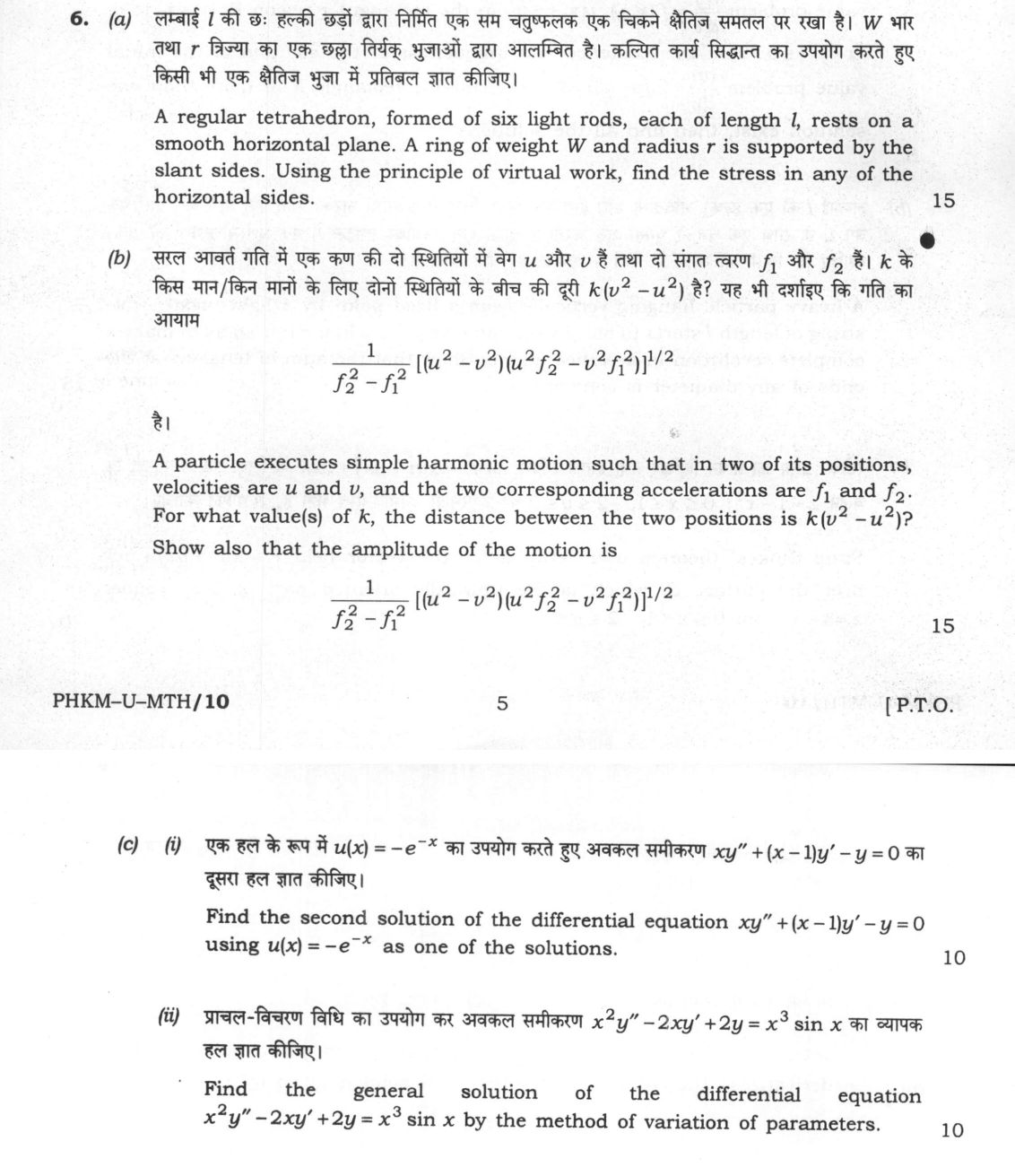
A regular tetrahedron, formed of six light rods, each of length l, rests on a smooth horizontal plane. A ring of weight W and radius r is supported by the slant sides. Using the principle of virtual work, find the stress in any of the horizontal sides. 15 marks
A particle executes simple harmonic motion such that in two of its positions, velocities are u and v, and the two corresponding accelerations are f₁ and f₂. For what value(s) of k, the distance between the two positions is k(v² - u²)? Show also that the amplitude of the motion is 1/(f₂² - f₁²) [(u² - v²)(u²f₂² - v²f₁²)]^(1/2) 15 marks
Find the second solution of the differential equation xy'' + (x-1)y' - y = 0 using u(x) = -e^-x as one of the solutions. 10 marks
Find the general solution of the differential equation x²y'' - 2xy' + 2y = x³ sin x by the method of variation of parameters. 10 marks
हिंदी में प्रश्न पढ़ें
लंबाई l की छः हल्की छड़ों द्वारा निर्मित एक सम चतुष्फलक एक चिकने क्षैतिज समतल पर रखा है। W भार तथा r त्रिज्या का एक छल्ला तिर्यक भुजाओं द्वारा आलंबित है। कल्पित कार्य सिद्धांत का उपयोग करते हुए किसी भी एक क्षैतिज भुजा में प्रतिबल ज्ञात कीजिए। (15 अंक)
सरल आवर्त गति में एक कण की दो स्थितियों में वेग u और v हैं तथा दो संगत त्वरण f₁ और f₂ हैं। k के किस मान/किन मानों के लिए दोनों स्थितियों के बीच की दूरी k(v² - u²) है? यह भी दर्शाइए कि गति का आयाम 1/(f₂² - f₁²) [(u² - v²)(u²f₂² - v²f₁²)]^(1/2) है। (15 अंक)
एक हल के रूप में u(x) = -e^-x का उपयोग करते हुए अवकल समीकरण xy'' + (x-1)y' - y = 0 का दूसरा हल ज्ञात कीजिए। (10 अंक)
प्राचल-विचरण विधि का उपयोग कर अवकल समीकरण x²y'' - 2xy' + 2y = x³ sin x का व्यापक हल ज्ञात कीजिए। (10 अंक)
What "Solve" is asking you to do
Choose the method, then carry it through to a final answer. Identifying what kind of problem this is and why that method applies is the first thing marked; a correct figure arrived at invisibly earns almost nothing.
Structure that answers it
Given data and what is required → method chosen, with the reason it applies → set-up (equation, circuit, free body, trial balance) → working, step by step → answer with units and any condition of validity
Where marks are lost
Doing the middle steps mentally and writing only the result. In mathematics papers, a further loss comes from giving a decimal where the exact value in surds or fractions was wanted, or from skipping the justification a part explicitly asks for.
How this answer will be evaluated
Approach
(a) calculate: given > formula > substitution > result with units > interpretation | (b) derive: given > assumptions > stepwise derivation > result > check | (c(i)) calculate: given > formula > substitution > result with units > interpretation | (c(ii)) calculate: given > formula > substitution > result with units > interpretation Full marks: Complete derivations with all steps, correct results, and verification.
Key points expected
- Define geometry and virtual displacement
- Apply principle of virtual work
- Relate ring weight to rod stress
- State final stress in terms of W, l, r
- Use SHM equations for v and a
- Derive distance formula with k
- Derive amplitude formula
- Verify consistency of results
Evaluation rubric
Each sub-part is marked on its own, against the marks and word limit printed on the paper.
- (a) Stress in horizontal sides of a regular tetrahedron supporting a ring. 15 marks
calculate— given → formula → substitution → result with units → interpretation
Must cover
- Define geometry and virtual displacement
- Apply principle of virtual work
- Relate ring weight to rod stress
- State final stress in terms of W, l, r
Loses marks
- Missing virtual work principle
- Incorrect geometric relations
Earns more
- Neat diagram of tetrahedron and ring
- Explicit calculation of height change
Extra mark
- Alternative method noted briefly
- (b) Value of k for distance and amplitude of SHM. 15 marks
derive— given → assumptions → stepwise derivation → result → check
Must cover
- Use SHM equations for v and a
- Derive distance formula with k
- Derive amplitude formula
- Verify consistency of results
Loses marks
- Skipping intermediate algebra steps
- Incorrect SHM relations
Earns more
- Clear step-by-step algebra
- Explicit definition of variables
Extra mark
- Alternative derivation method
- (c(i)) Second solution of the given differential equation. 10 marks
calculate— given → formula → substitution → result with units → interpretation
Must cover
- Use reduction of order method
- Substitute u(x) = -e^-x
- Solve for second solution
- Verify solution satisfies ODE
Loses marks
- Incorrect substitution
- Missing verification step
Earns more
- Clear integration steps
- Explicit formula for second solution
Extra mark
- Alternative method noted
- (c(ii)) General solution using variation of parameters. 10 marks
calculate— given → formula → substitution → result with units → interpretation
Must cover
- Find complementary solution
- Apply variation of parameters
- Solve for particular solution
- State general solution
Loses marks
- Incorrect Wronskian
- Missing particular solution
Earns more
- Clear Wronskian calculation
- Explicit integration steps
Extra mark
- Alternative method noted
Model answer coming soon
Every evaluation on this site is marked against a verified model answer. This question's answer is still being written; evaluation opens the moment it lands.
More from Mathematics 2024 Paper I
- Q3 (a) Let V = M₂ₓ₂(ℝ) denote a vector space over the field of real numbers. Find the matrix…
- Q4 (a) Let A = 3 & 2 & 4 2 & 0 & 2 4 & 2 & 3 be a 3×3 matrix. Find the eigenvalues and the c…
- Q5 (a) Find the orthogonal trajectories of the family of curves r = c(sec θ + tan θ), where…
- Q6 (a) A regular tetrahedron, formed of six light rods, each of length l, rests on a smooth…
- Q7 (a) State uniqueness theorem for the existence of unique solution of the initial value pr…
- Q8 (a) Using Laplace transform, solve the initial value problem y'' + 2y' + 5y = δ(t-2), y(0…