Paper I — Q4
(a) Let A = 3 & 2 & 4 2 & 0 & 2 4 & 2 & 3 be a 3×3 matrix. Find the eigenvalues and the corresponding eigenvectors of A. Hence…
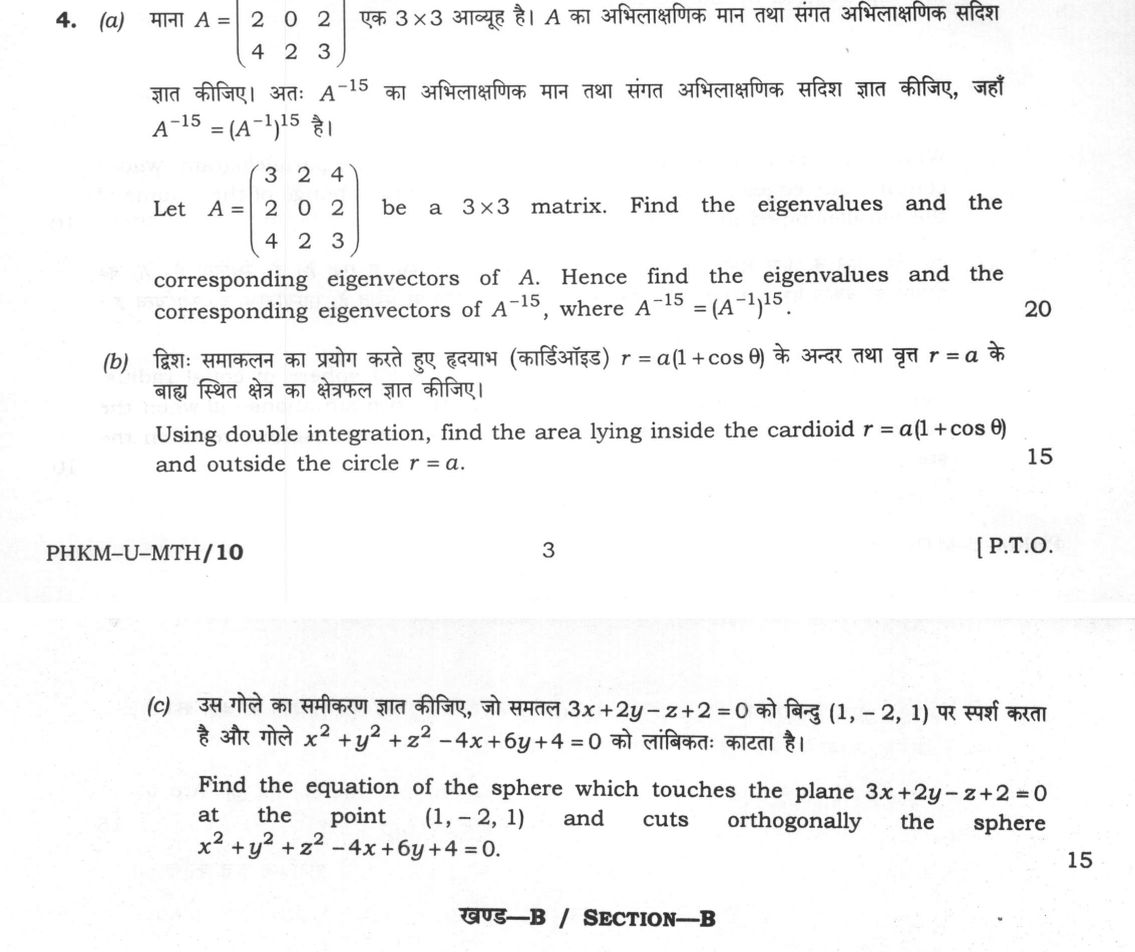
Let A = 3 & 2 & 4 2 & 0 & 2 4 & 2 & 3 be a 3×3 matrix. Find the eigenvalues and the corresponding eigenvectors of A. Hence find the eigenvalues and the corresponding eigenvectors of A⁻¹⁵, where A⁻¹⁵ = (A⁻¹)¹⁵. 20 marks
Using double integration, find the area lying inside the cardioid r = a(1+cos θ) and outside the circle r = a. 15 marks
Find the equation of the sphere which touches the plane 3x+2y-z+2=0 at the point (1, -2, 1) and cuts orthogonally the sphere x²+y²+z²-4x+6y+4=0. 15 marks
हिंदी में प्रश्न पढ़ें
माना A = 3 & 2 & 4 2 & 0 & 2 4 & 2 & 3 एक 3×3 आव्यूह है। A का अभिलक्षणिक मान तथा संगत अभिलक्षणिक सदिश ज्ञात कीजिए। अतः A⁻¹⁵ का अभिलक्षणिक मान तथा संगत अभिलक्षणिक सदिश ज्ञात कीजिए, जहाँ A⁻¹⁵ = (A⁻¹)¹⁵ है। (20 अंक)
दिशा: समाकलन का प्रयोग करते हुए हृदयाक्ष (कार्डिओइड) r = a(1+cos θ) के अंदर तथा वृत्त r = a के बाह्य स्थित क्षेत्र का क्षेत्रफल ज्ञात कीजिए। (15 अंक)
उस गोले का समीकरण ज्ञात कीजिए, जो समतल 3x+2y-z+2=0 को बिंदु (1, -2, 1) पर स्पर्श करता है और गोले x²+y²+z²-4x+6y+4=0 को लंबिकतः काटता है। (15 अंक)
Model answer
Written by UPSC Answer Check against this question's marking rubric, to the expected length. UPSC does not publish answers for Mains — this is one way to score well, not an official key.
(a) Let A = ((3,2,4),(2,0,2),(4,2,3)).
The characteristic equation is det(A − λI) = 0. Expanding,
det(A − λI) = −λ³ + 6λ² + 15λ + 8 = −(λ + 1)²(λ − 8).
Hence the eigenvalues are λ = −1, −1, 8.
For λ = 8, solve (A − 8I)X = 0:
−5x + 2y + 4z = 0, 2x − 8y + 2z = 0, 4x + 2y − 5z = 0.
From the second equation, x = 4y − z. Substituting in the first gives z = 2y, so x = 2y. Thus an eigenvector is v₃ = (2, 1, 2).
For λ = −1, solve (A + I)X = 0:
4x + 2y + 4z = 0, so 2x + y + 2z = 0.
Two independent eigenvectors are v₁ = (1, −2, 0), v₂ = (1, 0, −1).
Any nonzero linear combination of v₁ and v₂ is also an eigenvector for λ = −1.
Since A is symmetric, it is diagonalizable. Hence A⁻¹⁵ has the same eigenvectors, and its eigenvalues are λ⁻¹⁵. Therefore:
- For λ = −1, the eigenvalue of A⁻¹⁵ is (−1)⁻¹⁵ = −1, occurring twice. Corresponding eigenvectors: (1, −2, 0) and (1, 0, −1).
- For λ = 8, the eigenvalue of A⁻¹⁵ is 8⁻¹⁵ = 1/8¹⁵ = 1/35184372088832. Corresponding eigenvector: (2, 1, 2).
Final eigenvalues of A⁻¹⁵: −1, −1, 1/35184372088832.
(b) Let S be the required area. The region is inside the cardioid r = a(1 + cos θ) and outside the circle r = a. Thus
a ≤ r ≤ a(1 + cos θ).
For this interval to be nonempty, a(1 + cos θ) ≥ a, so cos θ ≥ 0. Hence θ ranges from −π/2 to π/2. By symmetry about the x-axis,
S = 2 ∫₀^π/2 ∫_a^a(1+cos θ) r dr dθ.
First integrate with respect to r:
∫_a^a(1+cos θ) r dr = (1/2)[r²]_a^a(1+cos θ) = (a²/2)[(1 + cos θ)² − 1] = (a²/2)(2cos θ + cos²θ) = a²(cos θ + (1/2)cos²θ).
Therefore,
S = 2a² ∫₀^π/2 (cos θ + (1/2)cos²θ) dθ = a² ∫₀^π/2 (2cos θ + cos²θ) dθ.
Now,
∫₀^π/2 2cos θ dθ = 2,
∫₀^π/2 cos²θ dθ = π/4.
Hence
S = a²(2 + π/4).
Final area: a²(2 + π/4) square units, with a > 0.
(c) Let the required sphere have centre C = (α, β, γ) and radius R. The given plane is 3x + 2y − z + 2 = 0, whose normal is n = (3, 2, −1). It touches the sphere at P = (1, −2, 1). Therefore CP is perpendicular to the plane, so C lies on the normal line through P:
C = P + t n = (1 + 3t, −2 + 2t, 1 − t).
Thus
R = |t|√(3² + 2² + (−1)²) = |t|√14.
The given sphere is
x² + y² + z² − 4x + 6y + 4 = 0.
Completing squares:
(x − 2)² + (y + 3)² + z² = 9.
So its centre is O = (2, −3, 0) and radius r = 3.
For two spheres cutting orthogonally, the distance d between their centres satisfies
d² = R² + r².
Now
OC² = (1 + 3t − 2)² + (−2 + 2t + 3)² + (1 − t − 0)² = (3t − 1)² + (2t + 1)² + (1 − t)² = 14t² − 4t + 3.
Also R² = 14t² and r² = 9. Hence
14t² − 4t + 3 = 14t² + 9,
so −4t = 6, giving t = −3/2.
Therefore
C = (1 + 3(−3/2), −2 + 2(−3/2), 1 − (−3/2)) = (−7/2, −5, 5/2).
Also
R² = 14(9/4) = 63/2.
Thus the required sphere is
(x + 7/2)² + (y + 5)² + (z − 5/2)² = 63/2.
Equivalently,
x² + y² + z² + 7x + 10y − 5z + 12 = 0.
What "Solve" is asking you to do
Choose the method, then carry it through to a final answer. Identifying what kind of problem this is and why that method applies is the first thing marked; a correct figure arrived at invisibly earns almost nothing.
Structure that answers it
Given data and what is required → method chosen, with the reason it applies → set-up (equation, circuit, free body, trial balance) → working, step by step → answer with units and any condition of validity
Where marks are lost
Doing the middle steps mentally and writing only the result. In mathematics papers, a further loss comes from giving a decimal where the exact value in surds or fractions was wanted, or from skipping the justification a part explicitly asks for.
How this answer will be evaluated
Approach
(a) calculate: given > formula > substitution > result with units > interpretation | (b) calculate: given > formula > substitution > result with units > interpretation | (c) calculate: given > formula > substitution > result with units > interpretation Full marks: Complete derivations, correct final answers, clear notation
Key points expected
- Characteristic equation det(A-λI)=0
- Solve for eigenvalues of A
- Eigenvectors for each eigenvalue
- Eigenvalues of A⁻¹⁵ as λ⁻¹⁵
- Intersection points θ = ±π/3
- Double integral setup in polar
- Limits: θ from 0 to π/3
- r from a to a(1+cosθ)
Evaluation rubric
Each sub-part is marked on its own, against the marks and word limit printed on the paper.
- (a) Eigenvalues/vectors of A and A⁻¹⁵ 20 marks
calculate— given → formula → substitution → result with units → interpretation
Must cover
- Characteristic equation det(A-λI)=0
- Solve for eigenvalues of A
- Eigenvectors for each eigenvalue
- Eigenvalues of A⁻¹⁵ as λ⁻¹⁵
Loses marks
- Incorrect characteristic polynomial
- Missing eigenvectors for A
Earns more
- Eigenvectors of A⁻¹⁵ noted as same as A
- Verification of eigenvalues
Extra mark
- Alternative method for eigenvectors
- (b) Area inside cardioid, outside circle 15 marks
calculate— given → formula → substitution → result with units → interpretation
Must cover
- Intersection points θ = ±π/3
- Double integral setup in polar
- Limits: θ from 0 to π/3
- r from a to a(1+cosθ)
Loses marks
- Incorrect intersection points
- Missing symmetry factor
Earns more
- Symmetry factor of 2 applied
- Correct integration of cos²θ
Extra mark
- Neat sketch of region
- (c) Equation of specific sphere 15 marks
calculate— given → formula → substitution → result with units → interpretation
Must cover
- Center on normal line from (1,-2,1)
- Radius equals distance to plane
- Orthogonality condition 2g₁g₂+2f₁f₂+2h₁h₂ = g₂²+f₂²
- Solve for center coordinates
Loses marks
- Incorrect normal vector
- Wrong orthogonality formula
Earns more
- Correct center (1, -2, 1) + t(3,2,-1)
- Final equation in standard form
Extra mark
- Verification of orthogonality
Practice this exact question
Write your answer and it is marked point by point against the model answer above — what you covered, what you missed, what you got wrong.
Evaluate my answer →More from Mathematics 2024 Paper I
- Q1 (a) Let H be a subspace of R⁴ spanned by the vectors v₁ = (1, –2, 5, –3), v₂ = (2, 3, 1,…
- Q2 (a) Consider a linear operator T on R³ over R defined by T(x, y, z) = (2x, 4x – y, 2x + 3…
- Q3 (a) Let V = M₂ₓ₂(ℝ) denote a vector space over the field of real numbers. Find the matrix…
- Q4 (a) Let A = 3 & 2 & 4 2 & 0 & 2 4 & 2 & 3 be a 3×3 matrix. Find the eigenvalues and the c…
- Q5 (a) Find the orthogonal trajectories of the family of curves r = c(sec θ + tan θ), where…
- Q6 (a) A regular tetrahedron, formed of six light rods, each of length l, rests on a smooth…
- Q7 (a) State uniqueness theorem for the existence of unique solution of the initial value pr…