Paper I — Q5
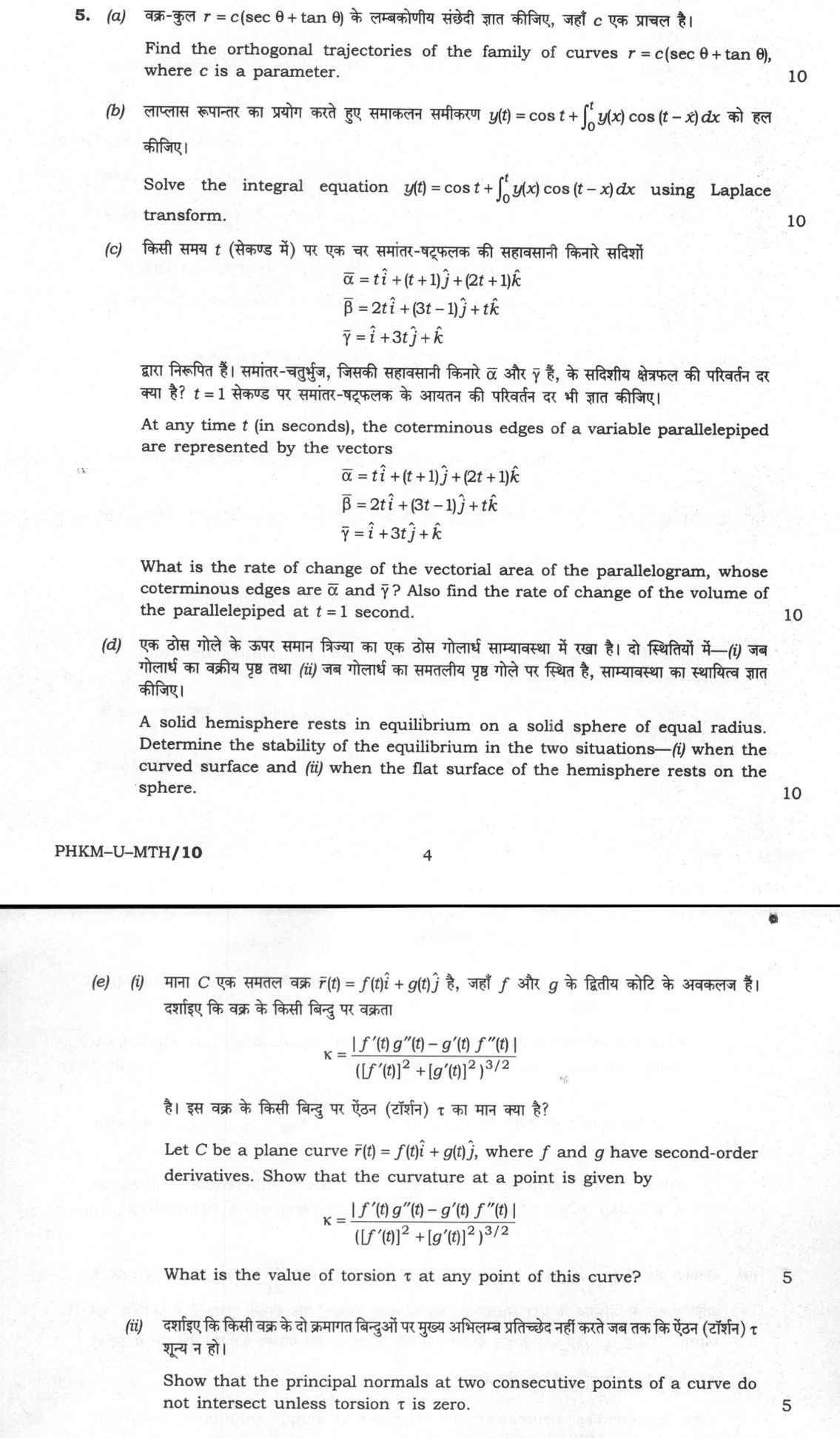
(a) Find the orthogonal trajectories of the family of curves r = c(sec θ + tan θ), where c is a parameter. (10 marks) (b) Solve…
Find the orthogonal trajectories of the family of curves r = c(sec θ + tan θ), where c is a parameter. 10 marks
Solve the integral equation y(t) = cos t + ∫₀ᵗ y(x) cos(t-x)dx using Laplace transform. 10 marks
At any time t (in seconds), the coterminous edges of a variable parallelepiped are represented by the vectors ᾱ = tî + (t+1)ĵ + (2t+1)k̂ β̄ = 2tî + (3t-1)ĵ + tk̂ γ̄ = î + 3tĵ + k̂ What is the rate of change of the vectorial area of the parallelogram, whose coterminous edges are ᾱ and γ̄? Also find the rate of change of the volume of the parallelepiped at t = 1 second. 10 marks
A solid hemisphere rests in equilibrium on a solid sphere of equal radius. Determine the stability of the equilibrium in the two situations—(i) when the curved surface and (ii) when the flat surface of the hemisphere rests on the sphere. 10 marks
Let C be a plane curve r̄(t) = f(t)î + g(t)ĵ, where f and g have second-order derivatives. Show that the curvature at a point is given by κ = |f'(t)g''(t) - g'(t)f''(t)| / ([f'(t)]² + [g'(t)]²)^(3/2) What is the value of torsion τ at any point of this curve? 5 marks
Show that the principal normals at two consecutive points of a curve do not intersect unless torsion τ is zero. 5 marks
हिंदी में प्रश्न पढ़ें
वक्र-कुल r = c(sec θ + tan θ) के लंबकोणीय संवेधी ज्ञात कीजिए, जहाँ c एक प्राचल है। (10 अंक)
लाप्लास रूपांतर का प्रयोग करते हुए समाकल समीकरण y(t) = cos t + ∫₀ᵗ y(x) cos(t-x)dx को हल कीजिए। (10 अंक)
किसी समय t (सेकंड में) पर एक चर समांतर-षट्फलक की सहावसानी किनारे सदिशों ᾱ = tî + (t+1)ĵ + (2t+1)k̂ β̄ = 2tî + (3t-1)ĵ + tk̂ γ̄ = î + 3tĵ + k̂ द्वारा निरूपित हैं। समांतर-चतुर्भुज, जिसकी सहावसानी किनारे ᾱ और γ̄ हैं, के सदिशीय क्षेत्रफल की परिवर्तन दर क्या है? t = 1 सेकंड पर समांतर-षट्फलक के आयतन की परिवर्तन दर भी ज्ञात कीजिए। (10 अंक)
एक ठोस गोले के ऊपर समान त्रिज्या का एक ठोस गोलार्ध साम्यावस्था में रखा है। दो स्थितियों में—(i) जब गोलार्ध का वक्रीय पृष्ठ तथा (ii) जब गोलार्ध का समतलीय पृष्ठ गोले पर स्थित है, साम्यावस्था का स्थायित्व ज्ञात कीजिए। (10 अंक)
माना C एक समतल वक्र r̄(t) = f(t)î + g(t)ĵ है, जहाँ f और g के द्वितीय कोटि के अवकलज हैं। दर्शाइए कि वक्र के किसी बिंदु पर वक्रता κ = |f'(t)g''(t) - g'(t)f''(t)| / ([f'(t)]² + [g'(t)]²)^(3/2) है। इस वक्र के किसी बिंदु पर ऐंठन (टॉर्शन) τ का मान क्या है? (5 अंक)
दर्शाइए कि किसी वक्र के दो क्रमागत बिंदुओं पर मुख्य अभिलंब प्रतिच्छेद नहीं करते जब तक कि ऐंठन (टॉर्शन) τ शून्य न हो। (5 अंक)
Model answer
Written by UPSC Answer Check against this question's marking rubric, to the expected length. UPSC does not publish answers for Mains — this is one way to score well, not an official key.
(a) Let S = sec θ + tan θ. Then
dS/dθ = sec θ tan θ + sec² θ = sec θ(sec θ + tan θ) = sec θ S.
Given r = cS, differentiating with respect to θ gives
dr/dθ = c sec θ S = r sec θ.
For a polar curve r = r(θ), the differential equation of its orthogonal trajectories R = R(θ) is
dR/dθ = -R²/(dr/dθ),
where dr/dθ is evaluated at the intersection point. Hence
dR/dθ = -R²/(R sec θ) = -R cos θ.
Separating variables,
dR/R = -cos θ dθ.
Integrating,
ln R = -sin θ + ln C.
Therefore the orthogonal trajectories are
R = C e^(-sin θ), equivalently r e^(sin θ) = C.
(b) Let Y(s) = L{y(t)}. By the convolution theorem,
L{∫₀ᵗ y(x) cos(t-x) dx} = Y(s) · s/(s²+1).
Also L{cos t} = s/(s²+1). Thus
Y(s) = s/(s²+1) + Y(s) · s/(s²+1).
So
Y(s)[1 - s/(s²+1)] = s/(s²+1).
Since 1 - s/(s²+1) = (s² - s + 1)/(s²+1),
Y(s) = s/(s² - s + 1).
Complete the square:
s² - s + 1 = (s - 1/2)² + 3/4.
Write s = (s - 1/2) + 1/2. Then
Y(s) = (s - 1/2)/[(s - 1/2)² + (√3/2)²] + (1/2)/[(s - 1/2)² + (√3/2)²].
Taking inverse Laplace transforms,
y(t) = e^(t/2) cos(√3 t/2) + (1/√3)e^(t/2) sin(√3 t/2).
Hence
y(t) = e^(t/2)[cos(√3 t/2) + (1/√3) sin(√3 t/2)] = (2/√3)e^(t/2) sin(√3 t/2 + π/3).
(c) Write α = (t, t+1, 2t+1), β = (2t, 3t-1, t), γ = (1, 3t, 1). The vector area of the parallelogram with edges α and γ is A = α × γ:
A = [ (t+1)(1) - (2t+1)(3t) ]î - [ t(1) - (2t+1)(1) ]ĵ + [ t(3t) - (t+1)(1) ]k̂
= (-6t² - 2t + 1)î + (t+1)ĵ + (3t² - t - 1)k̂.
Therefore
dA/dt = (-12t - 2)î + ĵ + (6t - 1)k̂.
At t = 1,
dA/dt = -14î + ĵ + 5k̂, and |dA/dt| = √222 units²/s.
For volume V = α · (β × γ). First,
β × γ = (-3t² + 3t - 1)î - tĵ + (6t² - 3t + 1)k̂.
Thus
V = t(-3t² + 3t - 1) + (t+1)(-t) + (2t+1)(6t² - 3t + 1)
= 9t³ + 2t² - 3t + 1.
Hence
dV/dt = 27t² + 4t - 3.
At t = 1,
dV/dt = 27 + 4 - 3 = 28 units³/s.
(d) Let R be the radius and a = 3R/8 the distance of the centre of mass of the solid hemisphere from its base centre. Assume rolling without slipping. Stability is decided by the potential energy V = Mg z_G.
(i) Curved surface rests on the sphere. At equilibrium the line joining the centre O of the fixed sphere to the centre C of curvature of the hemisphere is vertical, with OC = 2R. For a small turn φ of OC, rolling without slipping between two equal spherical surfaces makes the hemisphere rotate through 2φ. The height of C is 2R cos φ, and the centre of mass G is at distance a below C along the symmetry axis. Thus
z_G = 2R cos φ - a cos 2φ.
So
V(φ) - V(0) = Mg[2R cos φ - a cos 2φ - (2R - a)].
Using a = 3R/8, expansion gives
V(φ) - V(0) ≈ Mg(-R/4)φ².
This is negative for small φ, so V is maximum at equilibrium.
Hence the equilibrium is unstable.
(ii) Flat surface rests on the sphere. Let e be the unit normal from O to the contact point, making a small angle φ with the vertical. The flat face is tangent to the sphere. Let C be the centre of the flat face. Rolling without slipping gives the tangential shift s = -Rφ. Hence
z_C = R cos φ + Rφ sin φ.
Since the centre of mass is at distance a above C along e,
z_G = (R + a)cos φ + Rφ sin φ.
Therefore
V(φ) - V(0) = Mg[(R + a)cos φ + Rφ sin φ - (R + a)]
≈ Mg[(R - a)/2]φ².
With a = 3R/8,
V(φ) - V(0) ≈ Mg(5R/16)φ² > 0.
Thus V is minimum at equilibrium.
Hence the equilibrium is stable.
(e)(i) Let r(t) = f(t)î + g(t)ĵ. Then
r' = f'î + g'ĵ, r'' = f''î + g''ĵ.
The speed is
|r'| = ([f']² + [g']²)^(1/2).
The curvature is given by
κ = |r' × r''| / |r'|³.
In the plane,
r' × r'' = (f'g'' - g'f'')k̂,
so |r' × r''| = |f'g'' - g'f''|. Hence
κ = |f'(t)g''(t) - g'(t)f''(t)| / ([f'(t)]² + [g'(t)]²)^(3/2).
For a plane curve the binormal is constant, so dB/ds = 0. By the Frenet formula dB/ds = -τN, hence
τ = 0 at every point of the plane curve.
(e)(ii) Let s be arc length, and let P(s) be a point on the curve. The principal normal at P(s) is the line P(s) + λN(s). At the consecutive point s + ds, the principal normal is
P(s) + ds T + μ[N(s) + N'(s)ds].
If these two lines intersect, then to first order
λN = ds T + μN + μN' ds.
Using the Frenet formula N' = -κT + τB, this becomes
λN = ds T + μN + μ(-κT + τB)ds.
Comparing coefficients of T, N, B:
- From T: 0 = ds - μκ ds, so μ = 1/κ.
- From N: λ = μ.
- From B: 0 = μτ ds, so τ = 0.
Thus if τ ≠ 0, the consecutive principal normals are skew and do not intersect. They can intersect only when
τ = 0.
What "Solve" is asking you to do
Choose the method, then carry it through to a final answer. Identifying what kind of problem this is and why that method applies is the first thing marked; a correct figure arrived at invisibly earns almost nothing.
Structure that answers it
Given data and what is required → method chosen, with the reason it applies → set-up (equation, circuit, free body, trial balance) → working, step by step → answer with units and any condition of validity
Where marks are lost
Doing the middle steps mentally and writing only the result. In mathematics papers, a further loss comes from giving a decimal where the exact value in surds or fractions was wanted, or from skipping the justification a part explicitly asks for.
How this answer will be evaluated
Approach
Framework: null. (a) derive: given > assumptions > stepwise derivation > result > check | (b) calculate: given > formula > substitution > result with units > interpretation | (c) calculate: given > formula > substitution > result with units > interpretation | (d) discuss: intro > 3-4 dimensions > example > balanced close | (e(i)) derive: given > assumptions > stepwise derivation > result > check | (e(ii)) justify: claim > 3-4 reasons > evidence > conclusion Full marks: All parts answered with complete working, correct results, and clear justifications.
Key points expected
- Differentiate r = c(sec θ + tan θ) to eliminate c
- Formulate the differential equation of the family
- Replace dr/dθ with -r dθ/dr for orthogonal trajectories
- Solve the resulting differential equation
- Apply Laplace transform to both sides of the equation
- Use the convolution theorem for the integral term
- Solve the resulting algebraic equation for Y(s)
- Apply inverse Laplace transform to find y(t)
Evaluation rubric
Each sub-part is marked on its own, against the marks and word limit printed on the paper.
- (a) Find the orthogonal trajectories of the given family of curves. 10 marks
derive— given → assumptions → stepwise derivation → result → check
Must cover
- Differentiate r = c(sec θ + tan θ) to eliminate c
- Formulate the differential equation of the family
- Replace dr/dθ with -r dθ/dr for orthogonal trajectories
- Solve the resulting differential equation
Loses marks
- Incorrect differentiation of the original equation
- Failure to apply the orthogonality condition correctly
Earns more
- Simplification of the differential equation
- Verification of the result
Extra mark
- Alternative method noted briefly
- (b) Solve the integral equation using Laplace transform. 10 marks
calculate— given → formula → substitution → result with units → interpretation
Must cover
- Apply Laplace transform to both sides of the equation
- Use the convolution theorem for the integral term
- Solve the resulting algebraic equation for Y(s)
- Apply inverse Laplace transform to find y(t)
Loses marks
- Incorrect application of Laplace transform
- Failure to use the convolution theorem
Earns more
- Correct application of convolution theorem
- Verification of the solution
Extra mark
- Alternative method noted briefly
- (c) Find the rate of change of vectorial area and volume. 10 marks
calculate— given → formula → substitution → result with units → interpretation
Must cover
- Calculate the vectorial area of the parallelogram
- Differentiate the vectorial area with respect to t
- Calculate the volume of the parallelepiped
- Differentiate the volume with respect to t and evaluate at t=1
Loses marks
- Incorrect calculation of vectorial area
- Incorrect calculation of volume
Earns more
- Correct calculation of vectorial area
- Correct calculation of volume
Extra mark
- Alternative method noted briefly
- (d) Determine the stability of the equilibrium in two situations. 10 marks
discuss— intro → 3-4 dimensions → example → balanced close
Must cover
- Define the conditions for stability
- Analyze the stability when the curved surface rests on the sphere
- Analyze the stability when the flat surface rests on the sphere
- Provide a balanced conclusion
Loses marks
- Failure to define stability conditions
- Incomplete analysis of one or both situations
Earns more
- Clear definition of stability conditions
- Detailed analysis of both situations
Extra mark
- Neat figure illustrating the two situations
- (e(i)) Show the formula for curvature and find the torsion. 5 marks
derive— given → assumptions → stepwise derivation → result → check
Must cover
- Derive the formula for curvature
- State the value of torsion for a plane curve
- Justify the value of torsion
Loses marks
- Incorrect derivation of the curvature formula
- Failure to state the value of torsion
Earns more
- Clear derivation of the curvature formula
- Correct statement of torsion value
Extra mark
- Alternative method noted briefly
- (e(ii)) Show that principal normals do not intersect unless torsion is zero. 5 marks
justify— claim → 3-4 reasons → evidence → conclusion
Must cover
- State the condition for intersection of principal normals
- Relate the condition to torsion
- Justify the conclusion
Loses marks
- Failure to state the intersection condition
- Incorrect relation to torsion
Earns more
- Clear statement of the intersection condition
- Correct relation to torsion
Extra mark
- Alternative method noted briefly
Practice this exact question
Write your answer and it is marked point by point against the model answer above — what you covered, what you missed, what you got wrong.
Evaluate my answer →More from Mathematics 2024 Paper I
- Q2 (a) Consider a linear operator T on R³ over R defined by T(x, y, z) = (2x, 4x – y, 2x + 3…
- Q3 (a) Let V = M₂ₓ₂(ℝ) denote a vector space over the field of real numbers. Find the matrix…
- Q4 (a) Let A = 3 & 2 & 4 2 & 0 & 2 4 & 2 & 3 be a 3×3 matrix. Find the eigenvalues and the c…
- Q5 (a) Find the orthogonal trajectories of the family of curves r = c(sec θ + tan θ), where…
- Q6 (a) A regular tetrahedron, formed of six light rods, each of length l, rests on a smooth…
- Q7 (a) State uniqueness theorem for the existence of unique solution of the initial value pr…
- Q8 (a) Using Laplace transform, solve the initial value problem y'' + 2y' + 5y = δ(t-2), y(0…