Paper I — Q7
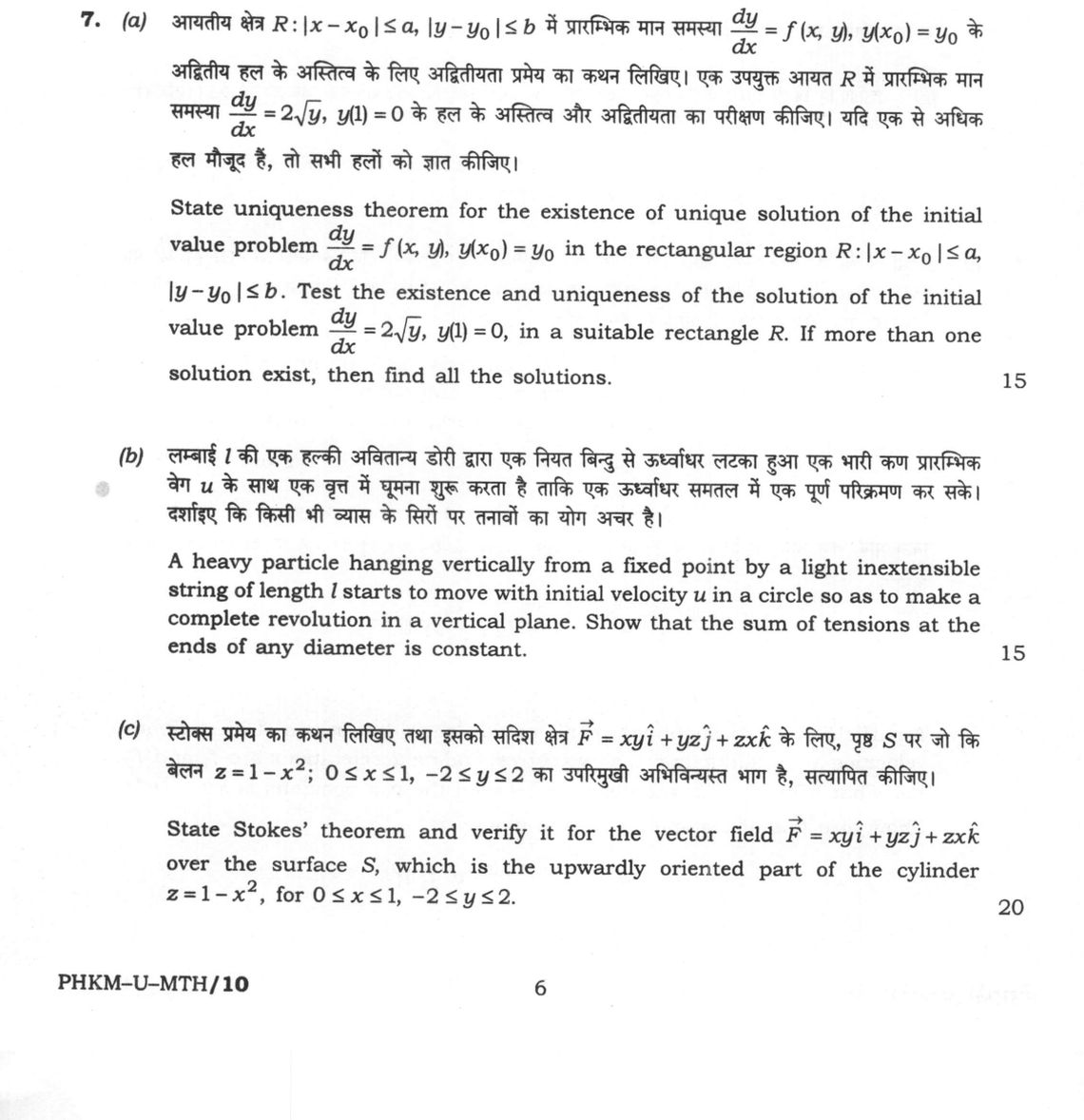
(a) State uniqueness theorem for the existence of unique solution of the initial value problem dy/dx = f(x, y), y(x₀) = y₀ in the…
State uniqueness theorem for the existence of unique solution of the initial value problem dy/dx = f(x, y), y(x₀) = y₀ in the rectangular region R: |x - x₀| ≤ a, |y - y₀| ≤ b. Test the existence and uniqueness of the solution of the initial value problem dy/dx = 2√y, y(1) = 0, in a suitable rectangle R. If more than one solution exist, then find all the solutions. 15 marks
A heavy particle hanging vertically from a fixed point by a light inextensible string of length l starts to move with initial velocity u in a circle so as to make a complete revolution in a vertical plane. Show that the sum of tensions at the ends of any diameter is constant. 15 marks
State Stokes' theorem and verify it for the vector field F⃗ = xyî + yzĵ + zxk̂ over the surface S, which is the upwardly oriented part of the cylinder z = 1 - x², for 0 ≤ x ≤ 1, -2 ≤ y ≤ 2. 20 marks
हिंदी में प्रश्न पढ़ें
आयतीय क्षेत्र R: |x - x₀| ≤ a, |y - y₀| ≤ b में प्रारंभिक मान समस्या dy/dx = f(x, y), y(x₀) = y₀ के अद्वितीय हल के अस्तित्व के लिए अद्वितीयता प्रमेय का कथन लिखिए। एक उपयुक्त आयत R में प्रारंभिक मान समस्या dy/dx = 2√y, y(1) = 0 के हल के अस्तित्व और अद्वितीयता का परीक्षण कीजिए। यदि एक से अधिक हल मौजूद हैं, तो सभी हलों को ज्ञात कीजिए। (15 अंक)
लंबाई l की एक हल्की अवितान्य डोरी द्वारा एक नियत बिंदु से उर्ध्वाधर लटका हुआ एक भारी कण प्रारंभिक वेग u के साथ एक वृत्त में घूमना शुरू करता है ताकि एक उर्ध्वाधर समतल में एक पूर्ण परिक्रमण कर सके। दर्शाइए कि किसी भी व्यास के सिरों पर तनावों का योग अचर है। (15 अंक)
स्टोक्स प्रमेय का कथन लिखिए तथा इसको सदिश क्षेत्र F⃗ = xyî + yzĵ + zxk̂ के लिए, पृष्ठ S पर जो कि बेलन z = 1 - x²; 0 ≤ x ≤ 1, -2 ≤ y ≤ 2 का उपरिमुखी अभिविन्यस्त भाग है, सत्यापित कीजिए। (20 अंक)
Model answer
Written by UPSC Answer Check against this question's marking rubric, to the expected length. UPSC does not publish answers for Mains — this is one way to score well, not an official key.
(a) Picard–Lindelöf theorem: Let f(x,y) be continuous in the rectangle R: |x−x₀|≤a, |y−y₀|≤b, and satisfy the Lipschitz condition in y: |f(x,y₁)−f(x,y₂)| ≤ K|y₁−y₂| for all (x,y₁),(x,y₂)∈R. Let M=max|f| on R and h=min(a,b/M). Then the initial value problem dy/dx=f(x,y), y(x₀)=y₀ has a unique solution for |x−x₀|≤h.
For dy/dx=2√y, y(1)=0. Since the right side is real only for y≥0, take R: |x−1|≤a, 0≤y≤b. Here f=2√y is continuous on R, so existence is assured by the Cauchy–Peano theorem. But uniqueness fails because f is not Lipschitz at y=0: |2√y−0|/|y−0| = 2/√y → ∞ as y→0⁺. Hence no Lipschitz constant K exists on any rectangle reaching y=0.
To find all solutions, for y>0 write z=√y. Then dz/dx = (dy/dx)/(2√y)=1, so z=x−c, giving y=(x−c)². At y=0 the solution may remain zero. Therefore all solutions on an interval containing x=1 are:
- y(x)=0 for all x;
- for each c≥1, y(x)=0 for x≤c and y(x)=(x−c)² for x≥c. Thus y(1)=0 is satisfied, but the solution is not unique.
(b) Let θ be the angle of the string from the downward vertical. The radial equation is T − mg cosθ = m v²/l. Energy from the lowest point, where the speed is u, gives v² = u² − 2gl(1−cosθ). Hence T(θ)=mg cosθ + (m/l)[u² −2gl(1−cosθ)] = (m u²/l) −2mg +3mg cosθ. For the opposite end of the same diameter, the angle is θ+π. Therefore T(θ+π)= (m u²/l) −2mg +3mg cos(θ+π) = (m u²/l) −2mg −3mg cosθ. Adding, T(θ)+T(θ+π)= 2m u²/l −4mg, which is independent of θ. Thus the sum of tensions at the ends of any diameter is constant.
For a complete revolution, the string remains taut if T(π)≥0, i.e. (m u²/l)−5mg≥0, so u²≥5gl.
(c) Stokes’ theorem: If S is an oriented surface bounded by a closed curve C, with orientation induced positively on C, then ∮_C F·dr = ∬_S (∇×F)·n dS.
Here F = xy î + yz ĵ + zx k̂. Thus ∇×F = (∂(zx)/∂y − ∂(yz)/∂z) î + (∂(xy)/∂z − ∂(zx)/∂x) ĵ + (∂(yz)/∂x − ∂(xy)/∂y) k̂ = (−y) î + (−z) ĵ + (−x) k̂.
The surface is r(x,y)= x î + y ĵ + (1−x²) k̂, 0≤x≤1, −2≤y≤2. Then r_x × r_y = (1,0,−2x) × (0,1,0) = (2x,0,1), which points upward. Hence n dS = (2x,0,1) dx dy. On S, z=1−x², so (∇×F)·(r_x×r_y) = (−y)(2x)+(−z)(0)+(−x)(1) = −2xy−x. Therefore ∬_S (∇×F)·n dS = ∫_x=0^1 ∫_y=−2^2 (−2xy−x) dy dx = ∫_0^1 (−4x) dx = −2.
Now compute the line integral around the boundary. With upward orientation, C is traversed counterclockwise in the xy-domain.
C₁: y=−2, x from 0 to 1, z=1−x². F·dr = −2x dx +(1−x²)x(−2x dx) = (−2x−2x²+2x⁴) dx. So ∫_C₁ F·dr = −19/15.
C₂: x=1, z=0, y from −2 to 2. F·dr=0, so integral =0.
C₃: y=2, x from 1 to 0, z=1−x². F·dr = 2x dx +(1−x²)x(−2x dx) = (2x−2x²+2x⁴) dx. So ∫_C₃ F·dr = −11/15.
C₄: x=0, z=1, y from 2 to −2. F·dr = y dy, and ∫_2^−2 y dy=0.
Thus ∮_C F·dr = −19/15 + 0 −11/15 + 0 = −2. Both sides equal −2, so Stokes’ theorem is verified.
What "Solve" is asking you to do
Choose the method, then carry it through to a final answer. Identifying what kind of problem this is and why that method applies is the first thing marked; a correct figure arrived at invisibly earns almost nothing.
Structure that answers it
Given data and what is required → method chosen, with the reason it applies → set-up (equation, circuit, free body, trial balance) → working, step by step → answer with units and any condition of validity
Where marks are lost
Doing the middle steps mentally and writing only the result. In mathematics papers, a further loss comes from giving a decimal where the exact value in surds or fractions was wanted, or from skipping the justification a part explicitly asks for.
How this answer will be evaluated
Approach
(a) explain: definition/context > points in order > small example > short close | (b) justify: claim > 3-4 reasons > evidence > conclusion | (c) explain: definition/context > points in order > small example > short close Full marks: Rigorous derivations, all steps shown, correct final results, clear notation.
Key points expected
- State Picard-Lindelöf theorem conditions
- Check continuity of f(x,y) = 2√y
- Check continuity of ∂f/∂y at y=0
- Find all solutions including y=0
- Apply Newton's second law radially
- Use conservation of energy for velocity
- Derive tension T(θ) as function of angle
- Show T(θ) + T(θ+π) is constant
Evaluation rubric
Each sub-part is marked on its own, against the marks and word limit printed on the paper.
- (a) State Picard-Lindelöf theorem and analyze the specific IVP for existence and uniqueness. 15 marks
explain— definition/context → points in order → small example → short close
Must cover
- State Picard-Lindelöf theorem conditions
- Check continuity of f(x,y) = 2√y
- Check continuity of ∂f/∂y at y=0
- Find all solutions including y=0
Loses marks
- Claiming uniqueness without checking partial derivative
- Missing the trivial solution y=0
Earns more
- Define the rectangle R explicitly
- Show non-uniqueness via counter-example
- Derive the non-trivial solution y=(x-1)²
Extra mark
- Sketch the solution curves
- (b) Prove that the sum of tensions at opposite ends of a diameter is constant. 15 marks
justify— claim → 3-4 reasons → evidence → conclusion
Must cover
- Apply Newton's second law radially
- Use conservation of energy for velocity
- Derive tension T(θ) as function of angle
- Show T(θ) + T(θ+π) is constant
Loses marks
- Confusing tension with weight components
- Failing to use energy conservation for v²
Earns more
- Define angle θ clearly from vertical
- State the condition for complete revolution
- Identify the constant as 3mg + mu²/l
Extra mark
- Neat free-body diagram
- (c) State Stokes' theorem and verify it for the given vector field and surface. 20 marks
explain— definition/context → points in order → small example → short close
Must cover
- State Stokes' theorem formula
- Compute surface integral of curl F
- Compute line integral over boundary C
- Show both integrals are equal
Loses marks
- Incorrect orientation of the normal vector
- Calculation errors in the integrals
Earns more
- Correctly parameterize the surface S
- Correctly parameterize the boundary curve C
- Show detailed integration steps
Extra mark
- Sketch of the surface and boundary
Practice this exact question
Write your answer and it is marked point by point against the model answer above — what you covered, what you missed, what you got wrong.
Evaluate my answer →More from Mathematics 2024 Paper I
- Q4 (a) Let A = 3 & 2 & 4 2 & 0 & 2 4 & 2 & 3 be a 3×3 matrix. Find the eigenvalues and the c…
- Q5 (a) Find the orthogonal trajectories of the family of curves r = c(sec θ + tan θ), where…
- Q6 (a) A regular tetrahedron, formed of six light rods, each of length l, rests on a smooth…
- Q7 (a) State uniqueness theorem for the existence of unique solution of the initial value pr…
- Q8 (a) Using Laplace transform, solve the initial value problem y'' + 2y' + 5y = δ(t-2), y(0…