Paper I — Q3
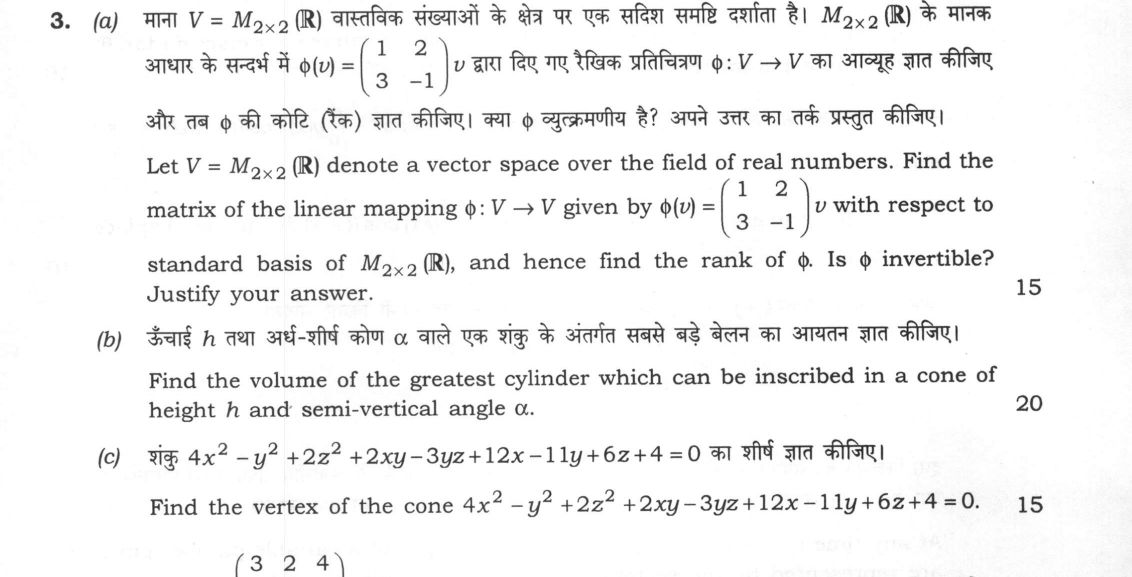
(a) Let V = M₂ₓ₂(ℝ) denote a vector space over the field of real numbers. Find the matrix of the linear mapping φ: V → V given by…
Let V = M₂ₓ₂(ℝ) denote a vector space over the field of real numbers. Find the matrix of the linear mapping φ: V → V given by φ(v) = 1 & 2 3 & -1 v with respect to standard basis of M₂ₓ₂(ℝ), and hence find the rank of φ. Is φ invertible? Justify your answer. 15 marks
Find the volume of the greatest cylinder which can be inscribed in a cone of height h and semi-vertical angle α. 20 marks
Find the vertex of the cone 4x² - y² + 2z² + 2xy - 3yz + 12x - 11y + 6z + 4 = 0. 15 marks
हिंदी में प्रश्न पढ़ें
माना V = M₂ₓ₂(ℝ) वास्तविक संख्याओं के क्षेत्र पर एक सदिश समष्टि दर्शाता है। M₂ₓ₂(ℝ) के मानक आधार के सन्दर्भ में φ(v) = 1 & 2 3 & -1 v द्वारा दिए गए रैखिक प्रतिचित्रण φ: V → V का आव्यूह ज्ञात कीजिए और तब φ की कोटि (रैंक) ज्ञात कीजिए। क्या φ व्युत्क्रमणीय है? अपने उत्तर का तर्क प्रस्तुत कीजिए। (15 अंक)
ऊँचाई h तथा अर्ध-शीर्ष कोण α वाले एक शंकु के अंतर्गत सबसे बड़े बेलन का आयतन ज्ञात कीजिए। (20 अंक)
शंकु 4x² - y² + 2z² + 2xy - 3yz + 12x - 11y + 6z + 4 = 0 का शीर्ष ज्ञात कीजिए। (15 अंक)
Model answer
Written by UPSC Answer Check against this question's marking rubric, to the expected length. UPSC does not publish answers for Mains — this is one way to score well, not an official key.
(a) Let A = (1 2; 3 −1). For v = (x₁₁ x₁₂; x₂₁ x₂₂),
φ(v) = A v = (x₁₁+2x₂₁, x₁₂+2x₂₂; 3x₁₁−x₂₁, 3x₁₂−x₂₂).
Take the standard ordered basis E₁₁, E₁₂, E₂₁, E₂₂ of M₂ₓ₂(ℝ). Then
φ(E₁₁) = E₁₁ + 3E₂₁, φ(E₁₂) = E₁₂ + 3E₂₂, φ(E₂₁) = 2E₁₁ − E₂₁, φ(E₂₂) = 2E₁₂ − E₂₂.
Hence the matrix of φ is
M = (1 0 2 0; 0 1 0 2; 3 0 −1 0; 0 3 0 −1).
Now det A = 1(−1) − 2·3 = −1 − 6 = −7 ≠ 0. Reordering the basis as E₁₁, E₂₁, E₁₂, E₂₂, the matrix M becomes block diagonal with two copies of A, so det M = (−7)² = 49 ≠ 0.
Therefore rank φ = 4. Since V has dimension 4 and rank φ = 4, φ is bijective. Thus φ is invertible. Its inverse is left multiplication by
A⁻¹ = (1/7 2/7; 3/7 −1/7).
Indeed A A⁻¹ = I, so φ⁻¹(w) = A⁻¹w.
(b) Let the cone have height h and semi-vertical angle α. Its base radius is
R = h tan α.
Let the inscribed cylinder have height y and radius r. At height y above the base, the cone cross-section radius is
R(1 − y/h) = (h − y) tan α.
For maximum volume at fixed y, the cylinder radius must equal this available radius, so
r = (h − y) tan α.
Thus the cylinder volume is
V(y) = π r² y = π tan²α · y(h − y)².
Differentiate:
dV/dy = π tan²α [(h − y)² − 2y(h − y)] = π tan²α (h − y)(h − 3y).
The critical points are y = h and y = h/3. The endpoints y = 0 and y = h give zero volume, so the maximum occurs at
y = h/3.
Then
r = (h − h/3) tan α = (2h/3) tan α.
Therefore
Vmax = π r² y = π (4h²/9 tan²α)(h/3)
= 4π h³ tan²α / 27.
Condition: h > 0 and 0 < α < π/2. The maximum volume is 4πh³ tan²α/27 cubic units.
(c) Let
F(x,y,z) = 4x² − y² + 2z² + 2xy − 3yz + 12x − 11y + 6z + 4.
The vertex of a cone is its unique singular point, so solve
Fₓ = 8x + 2y + 12 = 0, F_y = 2x − 2y − 3z − 11 = 0, F_z = −3y + 4z + 6 = 0.
From the first equation,
y = −4x − 6.
From the third equation,
4z = 3y − 6 = 3(−4x − 6) − 6 = −12x − 24,
so
z = −3x − 6.
Substitute into the second equation:
2x − 2(−4x − 6) − 3(−3x − 6) − 11 = 0
⇒ 2x + 8x + 12 + 9x + 18 − 11 = 0
⇒ 19x + 19 = 0
⇒ x = −1.
Then
y = −4(−1) − 6 = −2, z = −3(−1) − 6 = −3.
Thus the vertex is
(−1, −2, −3).
Indeed, putting X = x + 1, Y = y + 2, Z = z + 3 gives
4X² − Y² + 2Z² + 2XY − 3YZ = 0,
a homogeneous quadratic equation in X, Y, Z, confirming that (−1, −2, −3) is the vertex.
What "Solve" is asking you to do
Choose the method, then carry it through to a final answer. Identifying what kind of problem this is and why that method applies is the first thing marked; a correct figure arrived at invisibly earns almost nothing.
Structure that answers it
Given data and what is required → method chosen, with the reason it applies → set-up (equation, circuit, free body, trial balance) → working, step by step → answer with units and any condition of validity
Where marks are lost
Doing the middle steps mentally and writing only the result. In mathematics papers, a further loss comes from giving a decimal where the exact value in surds or fractions was wanted, or from skipping the justification a part explicitly asks for.
How this answer will be evaluated
Approach
(a) calculate: given > formula > substitution > result with units > interpretation | (b) calculate: given > formula > substitution > result with units > interpretation | (c) calculate: given > formula > substitution > result with units > interpretation Full marks: Complete method with all steps, verification, and clear justification
Key points expected
- Define standard basis for M2x2(R)
- Compute images of basis vectors under phi
- Construct 4x4 matrix representation of phi
- Determine rank and invertibility from matrix
- Define variables for cylinder dimensions
- Establish geometric constraints from cone
- Formulate volume function to maximize
- Apply calculus to find maximum volume
Evaluation rubric
Each sub-part is marked on its own, against the marks and word limit printed on the paper.
- (a) Matrix of linear map, rank, and invertibility justification. 15 marks
calculate— given → formula → substitution → result with units → interpretation
Must cover
- Define standard basis for M2x2(R)
- Compute images of basis vectors under phi
- Construct 4x4 matrix representation of phi
- Determine rank and invertibility from matrix
Loses marks
- Incorrect basis definition
- Matrix construction errors
- Missing invertibility justification
Earns more
- Verify linearity of the mapping
- Check determinant for invertibility
Extra mark
- Alternative method for rank calculation
- (b) Volume of greatest inscribed cylinder in a cone. 20 marks
calculate— given → formula → substitution → result with units → interpretation
Must cover
- Define variables for cylinder dimensions
- Establish geometric constraints from cone
- Formulate volume function to maximize
- Apply calculus to find maximum volume
Loses marks
- Missing geometric constraints
- Incorrect optimization method
- No final volume expression
Earns more
- Neat diagram of cone and cylinder
- Verification of maximum using second derivative
Extra mark
- Alternative geometric approach
- (c) Vertex coordinates of the given quadratic cone. 15 marks
calculate— given → formula → substitution → result with units → interpretation
Must cover
- Identify quadratic form matrix
- Set up system of equations for vertex
- Solve linear system for coordinates
- Verify point satisfies cone equation
Loses marks
- Incorrect matrix setup
- Algebraic errors in solving system
- Missing verification step
Earns more
- Use of matrix notation for quadratic form
- Check by substitution into original equation
Extra mark
- Alternative method using partial derivatives
Practice this exact question
Write your answer and it is marked point by point against the model answer above — what you covered, what you missed, what you got wrong.
Evaluate my answer →More from Mathematics 2024 Paper I
- Q1 (a) Let H be a subspace of R⁴ spanned by the vectors v₁ = (1, –2, 5, –3), v₂ = (2, 3, 1,…
- Q2 (a) Consider a linear operator T on R³ over R defined by T(x, y, z) = (2x, 4x – y, 2x + 3…
- Q3 (a) Let V = M₂ₓ₂(ℝ) denote a vector space over the field of real numbers. Find the matrix…
- Q4 (a) Let A = 3 & 2 & 4 2 & 0 & 2 4 & 2 & 3 be a 3×3 matrix. Find the eigenvalues and the c…
- Q5 (a) Find the orthogonal trajectories of the family of curves r = c(sec θ + tan θ), where…
- Q6 (a) A regular tetrahedron, formed of six light rods, each of length l, rests on a smooth…