Paper II — Q1
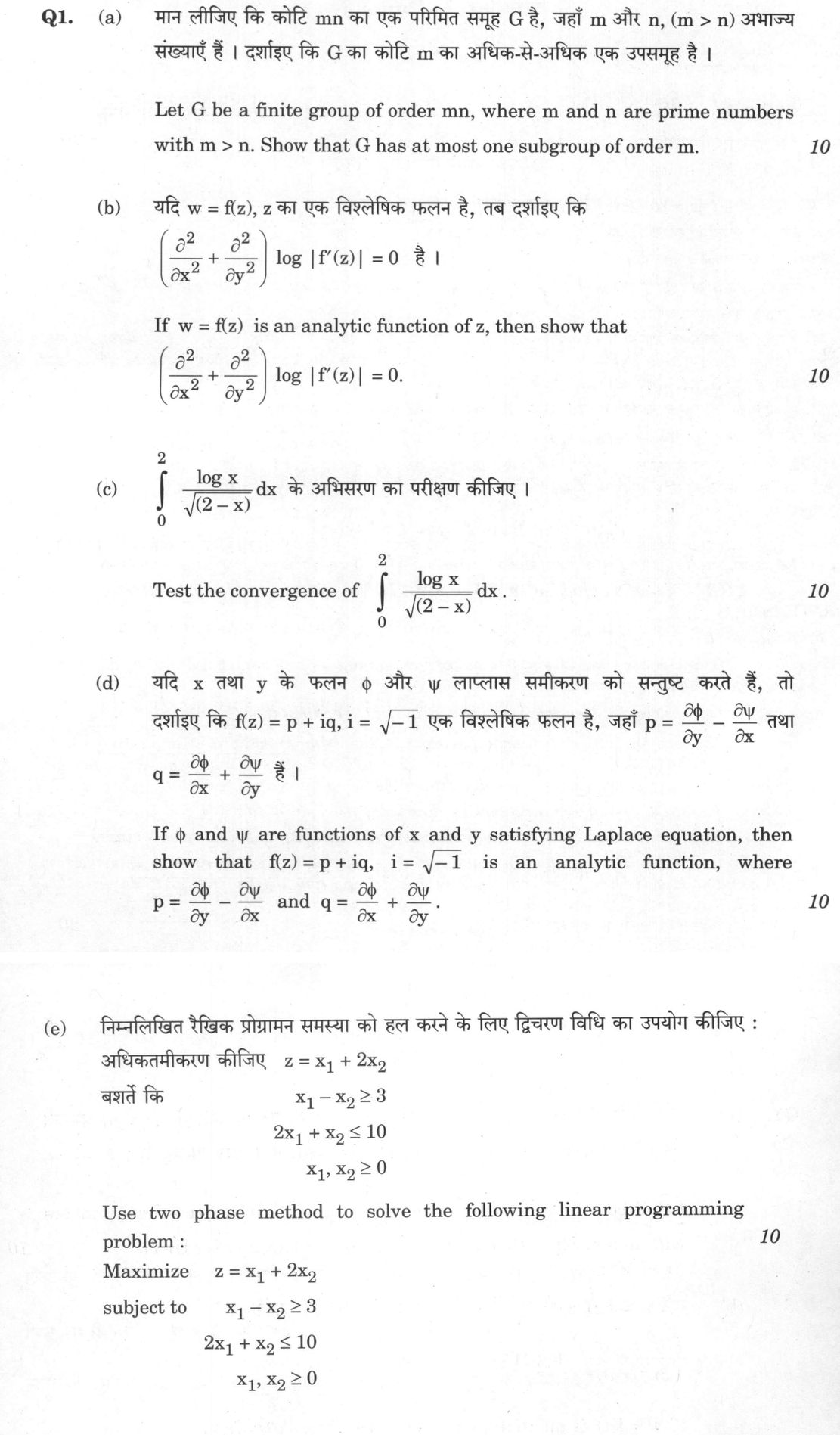
(a) Let G be a finite group of order mn, where m and n are prime numbers with m > n. Show that G has at most one subgroup of…
Let G be a finite group of order mn, where m and n are prime numbers with m > n. Show that G has at most one subgroup of order m. 10 marks
If w = f(z) is an analytic function of z, then show that
((∂²)/(∂ x²) + (∂²)/(∂ y²)) log |f'(z)| = 0. 10 marks
Test the convergence of ∫limits₀² (log x)/(√((2-x))) dx . 10 marks
If φ and ψ are functions of x and y satisfying Laplace equation, then show that f(z) = p + iq, i = √−1 is an analytic function, where p = (∂ φ)/(∂ y) - (∂ ψ)/(∂ x) and q = (∂ φ)/(∂ x) + (∂ ψ)/(∂ y) . 10 marks
Use two phase method to solve the following linear programming problem :
Maximize z = x₁ + 2x₂
subject to x₁ - x₂ ≥ 3
2x₁ + x₂ ≤ 10
x₁, x₂ ≥ 0
10 marks
हिंदी में प्रश्न पढ़ें
मान लीजिए कि कोटि mn का एक परिमित समूह G है, जहाँ m और n, (m > n) अभाज्य संख्याएँ हैं । दर्शाइए कि G का कोटि m का अधिक-से-अधिक एक उपसमूह है । 10 अंक
यदि w = f(z), z का एक विसलेषिक फलन है, तब दर्शाइए कि
((∂²)/(∂ x²) + (∂²)/(∂ y²)) log |f'(z)| = 0 है । 10 अंक
∫limits₀² (log x)/(√((2-x))) dx के अभिसरण का परीक्षण कीजिए । 10 अंक
यदि x तथा y के फलन φ और ψ लाप्लास समीकरण को सन्तुष्ट करते हैं, तो दर्शाइए कि f(z) = p + iq, i = √−1 एक विसलेषिक फलन है, जहाँ p = (∂ φ)/(∂ y) - (∂ ψ)/(∂ x) तथा q = (∂ φ)/(∂ x) + (∂ ψ)/(∂ y) हैं । 10 अंक
निम्नलिखित रैखिक प्रोग्रामन समस्या को हल करने के लिए द्विचरण विधि का उपयोग कीजिए :
अधिकतमीकरण कीजिए z = x₁ + 2x₂
बशर्ते कि x₁ - x₂ ≥ 3
2x₁ + x₂ ≤ 10
x₁, x₂ ≥ 0
10 अंक
Model answer
Written by UPSC Answer Check against this question's marking rubric, to the expected length. UPSC does not publish answers for Mains — this is one way to score well, not an official key.
(a) Use Sylow’s third theorem. Since |G| = mn, with m and n primes and m > n, any subgroup of order m is a Sylow m-subgroup. Let s be the number of Sylow m-subgroups of G. Sylow’s theorem gives s ≡ 1 (mod m), and s divides |G|/m = n. Since n is prime, the only divisors of n are 1 and n. Thus s = 1 or s = n. If s = n, then n ≡ 1 (mod m), i.e. m divides n − 1. But 1 ≤ n < m, so n − 1 < m, impossible. Hence s = 1. Therefore G has exactly one, hence at most one, subgroup of order m. Final answer: G has at most one subgroup of order m.
(b) Let F(z) = f′(z) = u(x, y) + i v(x, y). Since f is analytic, F is also analytic, so u and v satisfy the Cauchy–Riemann equations u_x = v_y, u_y = −v_x. Assume F(z) ≠ 0 where the logarithm is taken. Put L = log |f′(z)| = log |F(z)| = (1/2) log(u² + v²). Since F is analytic and non-zero, log F(z) is locally analytic. Its real part is exactly log |F(z)|. Write log F = U + i V, where U = log |F|. For an analytic function, the real and imaginary parts satisfy the Cauchy–Riemann equations: U_x = V_y, U_y = −V_x. Therefore U_xx + U_yy = ∂/∂x(V_y) + ∂/∂y(−V_x) = V_yx − V_xy = 0, because mixed partial derivatives are equal. Hence (∂²/∂x² + ∂²/∂y²) log |f′(z)| = 0. Final answer: the Laplacian of log |f′(z)| is zero wherever f′(z) ≠ 0.
(c) Let I = ∫₀² log x / √(2 − x) dx. The integrand has possible singularities only at x = 0 and x = 2 because log x → −∞ as x → 0⁺ and 1/√(2 − x) → ∞ as x → 2⁻.
Near x = 0, for 0 < x < 1, |log x| / √(2 − x) ≤ |log x|, and ∫₀¹ |log x| dx converges. Hence x = 0 causes no divergence.
Near x = 2, for 3/2 < x < 2, log x is bounded by log 2, so |log x| / √(2 − x) ≤ C / √(2 − x). But ∫₀^ε t^(−1/2) dt converges because 1/2 < 1. Hence x = 2 also causes no divergence. Thus the integral converges.
For its exact value, put x = 2t. Then dx = 2 dt and √(2 − x) = √2 √(1 − t). Hence I = √2 ∫₀¹ [log(2t)] / √(1 − t) dt = √2 [ log 2 ∫₀¹ dt/√(1 − t) + ∫₀¹ log t / √(1 − t) dt ]. Now ∫₀¹ dt/√(1 − t) = 2, and by the beta function, ∫₀¹ log t / √(1 − t) dt = 4 log 2 − 4. Therefore I = √2 [2 log 2 + 4 log 2 − 4] = √2(6 log 2 − 4). Final answer: the integral converges, and its value is 6√2 log 2 − 4√2.
(d) We are given that φ and ψ satisfy Laplace’s equation: φ_xx + φ_yy = 0, ψ_xx + ψ_yy = 0. Define p = φ_y − ψ_x, q = φ_x + ψ_y. To prove f(z) = p + i q is analytic, it is enough to verify the Cauchy–Riemann equations p_x = q_y and p_y = −q_x.
First, p_x = φ_yx − ψ_xx, q_y = φ_xy + ψ_yy. Since mixed partial derivatives commute, φ_yx = φ_xy. Also ψ_xx + ψ_yy = 0, so ψ_yy = −ψ_xx. Hence q_y = φ_xy − ψ_xx = p_x.
Next, p_y = φ_yy − ψ_xy, q_x = φ_xx + ψ_yx. Using φ_xx + φ_yy = 0, we get φ_yy = −φ_xx. Also ψ_xy = ψ_yx. Thus −q_x = −φ_xx − ψ_yx = φ_yy − ψ_xy = p_y. So p_y = −q_x.
Thus p and q satisfy the Cauchy–Riemann equations. Assuming φ and ψ are C², p and q have continuous first partial derivatives, so f(z) = p + i q is analytic. Final answer: f(z) = p + i q is analytic.
(e) Convert the problem to standard form. The constraints are x₁ − x₂ ≥ 3, 2x₁ + x₂ ≤ 10, x₁, x₂ ≥ 0. Introduce surplus s₁, artificial a₁, and slack s₂: x₁ − x₂ − s₁ + a₁ = 3, 2x₁ + x₂ + s₂ = 10, x₁, x₂, s₁, s₂, a₁ ≥ 0.
Phase I: Minimize W = a₁. Initially a₁ = 3, s₂ = 10, and x₁ = x₂ = s₁ = 0. From the first equation, W = a₁ = 3 − x₁ + x₂ + s₁. Choose x₁ to enter because increasing x₁ decreases W. The ratio test gives min(3/1, 10/2) = 3, so a₁ leaves. Pivot on x₁: x₁ − x₂ − s₁ = 3, 3x₂ + 2s₁ + s₂ = 4. Now W = 0. Since W ≥ 0 always, Phase I is complete.
Phase II: Use the original objective Maximize z = x₁ + 2x₂. The current equations are x₁ − x₂ − s₁ = 3, 3x₂ + 2s₁ + s₂ = 4. Express z in terms of nonbasic variables: x₁ = 3 + x₂ + s₁, so z = x₁ + 2x₂ = 3 + 3x₂ + s₁. Enter x₂. The ratio test gives 4/3, so s₂ leaves. Pivot on x₂: x₂ = 4/3 − (2/3)s₁ − (1/3)s₂. Then x₁ = 3 + x₂ + s₁ = 13/3 + (1/3)s₁ − (1/3)s₂. Substitute into z: z = x₁ + 2x₂ = 7 − s₁ − s₂. Since the coefficients of s₁ and s₂ in z are negative, no further increase is possible. Hence the maximum occurs at x₁ = 13/3, x₂ = 4/3. Check: x₁ − x₂ = 13/3 − 4/3 = 3, and 2x₁ + x₂ = 26/3 + 4/3 = 10. Final answer: maximum z = 7 at x₁ = 13/3 and x₂ = 4/3.
What "Prove" is asking you to do
Establish that the statement holds for every case it claims, not for one representative case. The argument must be closed: each line follows from a definition, a hypothesis, or a named theorem you are entitled to use.
Structure that answers it
Given and to prove, restated → theorem or construction to be used, named → the argument line by line → conclusion stated as proved
Where marks are lost
Testing one example, which illustrates but proves nothing. On an if and only if claim, proving one direction and stopping forfeits that half outright, and degenerate cases — zero, the empty set, the equality case — have to be disposed of rather than assumed away.
How this answer will be evaluated
Approach
(a) justify: claim > 3-4 reasons > evidence > conclusion | (b) derive: given > assumptions > stepwise derivation > result > check | (c) calculate: given > formula > substitution > result with units > interpretation | (d) justify: claim > 3-4 reasons > evidence > conclusion | (e) calculate: given > formula > substitution > result with units > interpretation Full marks: All parts solved with clear, step-by-step derivations and correct application of theorems.
Key points expected
- State Sylow's Theorem for subgroups of order m
- Apply Sylow's Theorem to find number of subgroups
- Use m > n to constrain the number of subgroups
- Conclude that there is at most one subgroup
- State the Cauchy-Riemann equations for f(z)
- Differentiate the Cauchy-Riemann equations
- Show that f'(z) is analytic
- Apply the Laplacian to log |f'(z)|
Evaluation rubric
Each sub-part is marked on its own, against the marks and word limit printed on the paper.
- (a) Prove uniqueness of the subgroup of order m in G. 10 marks
justify— claim → 3-4 reasons → evidence → conclusion
Must cover
- State Sylow's Theorem for subgroups of order m
- Apply Sylow's Theorem to find number of subgroups
- Use m > n to constrain the number of subgroups
- Conclude that there is at most one subgroup
Loses marks
- Failing to state Sylow's Theorem
- Incorrect application of Sylow's Theorem
- Failing to use the condition m > n
Earns more
- Explicitly state the conditions for Sylow's Theorem
- Show the divisibility condition for the number of subgroups
- Mention the congruence condition for the number of subgroups
- Provide a clear logical flow from assumptions to conclusion
Extra mark
- Mention the specific case where m = 2
- Provide an example of a group satisfying the conditions
- (b) Show that the Laplacian of log |f'(z)| is zero. 10 marks
derive— given → assumptions → stepwise derivation → result → check
Must cover
- State the Cauchy-Riemann equations for f(z)
- Differentiate the Cauchy-Riemann equations
- Show that f'(z) is analytic
- Apply the Laplacian to log |f'(z)|
Loses marks
- Failing to state the Cauchy-Riemann equations
- Incorrect differentiation of the Cauchy-Riemann equations
- Failing to show that f'(z) is analytic
Earns more
- Clearly define the notation for partial derivatives
- Show the intermediate steps in the differentiation
- Verify the result for a simple function
- Mention the conditions for the validity of the result
Extra mark
- Provide an alternative method using complex analysis
- Mention the physical interpretation of the result
- (c) Test the convergence of the given integral. 10 marks
calculate— given → formula → substitution → result with units → interpretation
Must cover
- Identify the type of improper integral
- Apply the appropriate convergence test
- Show the steps in the convergence test
- State the final result of the convergence test
Loses marks
- Failing to identify the type of improper integral
- Incorrect application of the convergence test
- Failing to show the steps in the convergence test
Earns more
- Clearly define the notation for the integral
- Show the intermediate steps in the convergence test
- Verify the result using a different method
- Mention the conditions for the validity of the result
Extra mark
- Provide an alternative method for testing convergence
- Mention the physical interpretation of the result
- (d) Show that f(z) = p + iq is an analytic function. 10 marks
justify— claim → 3-4 reasons → evidence → conclusion
Must cover
- State the Cauchy-Riemann equations for f(z)
- Show that p and q satisfy the Cauchy-Riemann equations
- Verify the continuity of the partial derivatives
- Conclude that f(z) is analytic
Loses marks
- Failing to state the Cauchy-Riemann equations
- Incorrect verification of the Cauchy-Riemann equations
- Failing to verify the continuity of the partial derivatives
Earns more
- Clearly define the notation for partial derivatives
- Show the intermediate steps in the verification
- Verify the result for a simple function
- Mention the conditions for the validity of the result
Extra mark
- Provide an alternative method using complex analysis
- Mention the physical interpretation of the result
- (e) Solve the linear programming problem using the two-phase method. 10 marks
calculate— given → formula → substitution → result with units → interpretation
Must cover
- Formulate the linear programming problem in standard form
- Apply the two-phase method to solve the problem
- Show the steps in the two-phase method
- State the final solution of the linear programming problem
Loses marks
- Failing to formulate the linear programming problem in standard form
- Incorrect application of the two-phase method
- Failing to show the steps in the two-phase method
Earns more
- Clearly define the notation for the linear programming problem
- Show the intermediate steps in the two-phase method
- Verify the result using a different method
- Mention the conditions for the validity of the result
Extra mark
- Provide an alternative method for solving the linear programming problem
- Mention the physical interpretation of the result
Practice this exact question
Write your answer and it is marked point by point against the model answer above — what you covered, what you missed, what you got wrong.
Evaluate my answer →More from Mathematics 2024 Paper II
- Q1 (a) Let G be a finite group of order mn, where m and n are prime numbers with m > n. Show…
- Q2 (a) Using Cauchy's general principle of convergence, examine the convergence of the seque…
- Q3 (a) Locate the poles and their order for the function f(z) = 1/[z(sin πz)(z + 1/2)]. Also…
- Q4 (a) Consider the polynomial ring Z[x] over the ring Z of integers. Let S be an ideal of Z…