Paper II — Q5
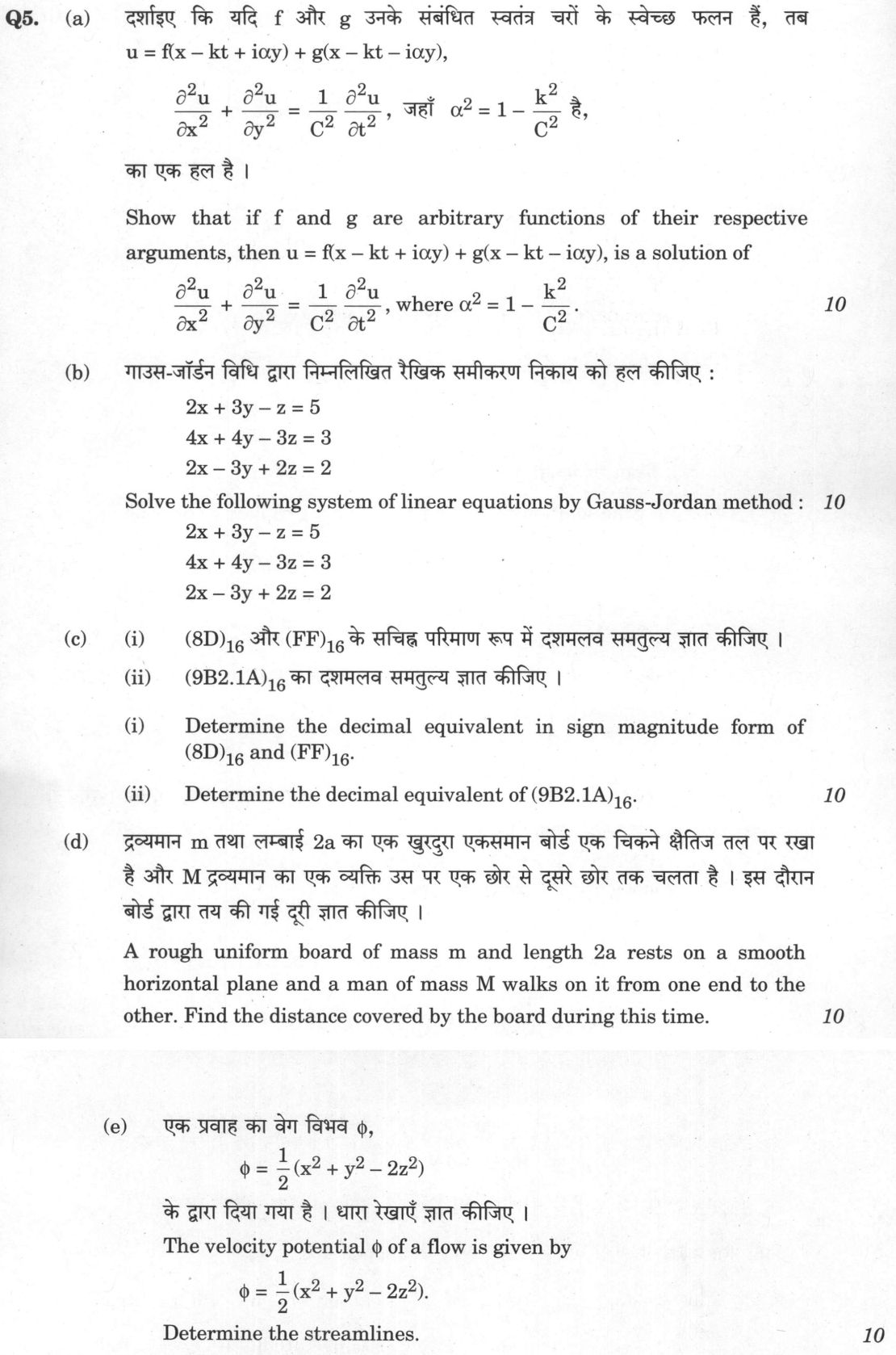
(a) Show that if f and g are arbitrary functions of their respective arguments, then u = f(x - kt + iαy) + g(x - kt - iαy), is a…
Show that if f and g are arbitrary functions of their respective arguments, then u = f(x - kt + iαy) + g(x - kt - iαy), is a solution of ∂²u/∂x² + ∂²u/∂y² = (1/C²)∂²u/∂t², where α² = 1 - k²/C². 10 marks
Solve the following system of linear equations by Gauss-Jordan method: (10 marks) 2x + 3y - z = 5 4x + 4y - 3z = 3 2x - 3y + 2z = 2
Determine the decimal equivalent in sign magnitude form of (8D)₁₆ and (FF)₁₆.
Determine the decimal equivalent of (9B2.1A)₁₆. 10 marks
A rough uniform board of mass m and length 2a rests on a smooth horizontal plane and a man of mass M walks on it from one end to the other. Find the distance covered by the board during this time. 10 marks
The velocity potential φ of a flow is given by φ = (1/2)(x² + y² - 2z²). Determine the streamlines. 10 marks
हिंदी में प्रश्न पढ़ें
दर्शाइए कि यदि f और g उनके संबंधित स्वतंत्र चरों के स्वेच्छ फलन हैं, तब u = f(x - kt + iαy) + g(x - kt - iαy), ∂²u/∂x² + ∂²u/∂y² = (1/C²)∂²u/∂t² का एक हल है, जहाँ α² = 1 - k²/C² है। (10 अंक)
गॉस-जॉर्डन विधि द्वारा निम्नलिखित रैखिक समीकरण निकाय को हल कीजिए: (10 अंक) 2x + 3y - z = 5 4x + 4y - 3z = 3 2x - 3y + 2z = 2
(8D)₁₆ और (FF)₁₆ के संचिह्न परिमाण रूप में दशमलव समतुल्य ज्ञात कीजिए।
(9B2.1A)₁₆ का दशमलव समतुल्य ज्ञात कीजिए। (10 अंक)
द्रव्यमान m तथा लम्बाई 2a का एक खुरदुरा एकसमान बोर्ड एक चिकने क्षैतिज तल पर रखा है और M द्रव्यमान का एक व्यक्ति उस पर एक छोर से दूसरे छोर तक चलता है। इस दौरान बोर्ड द्वारा तय की गई दूरी ज्ञात कीजिए। (10 अंक)
एक प्रवाह का वेग विभव φ, φ = (1/2)(x² + y² - 2z²) के द्वारा दिया गया है। धारा रेखाएँ ज्ञात कीजिए। (10 अंक)
Model answer
Written by UPSC Answer Check against this question's marking rubric, to the expected length. UPSC does not publish answers for Mains — this is one way to score well, not an official key.
(a) Let ξ = x - kt + iαy, η = x - kt - iαy, u = f(ξ) + g(η), where f and g are twice differentiable arbitrary functions.
Differentiate u with respect to x: u_x = f′(ξ) + g′(η) u_xx = f″(ξ) + g″(η).
Differentiate u with respect to y. Since ξ_y = iα and η_y = -iα, u_y = iα f′(ξ) - iα g′(η) u_yy = (iα)² f″(ξ) + (-iα)² g″(η) = -α² f″(ξ) - α² g″(η).
Therefore ∂²u/∂x² + ∂²u/∂y² = (1 - α²)[f″(ξ) + g″(η)].
Now differentiate with respect to t. Since ξ_t = -k and η_t = -k, u_t = -k f′(ξ) - k g′(η) u_tt = k² f″(ξ) + k² g″(η) = k²[f″(ξ) + g″(η)].
Using α² = 1 - k²/C², we get 1 - α² = k²/C². Hence ∂²u/∂x² + ∂²u/∂y² = (k²/C²)[f″(ξ) + g″(η)].
But (1/C²)∂²u/∂t² = (1/C²)k²[f″(ξ) + g″(η)] = (k²/C²)[f″(ξ) + g″(η)].
Thus ∂²u/∂x² + ∂²u/∂y² = (1/C²)∂²u/∂t². So u is a solution.
(b) The given system is 2x + 3y - z = 5 4x + 4y - 3z = 3 2x - 3y + 2z = 2.
Write the augmented matrix: [2 3 -1 | 5] [4 4 -3 | 3] [2 -3 2 | 2]
Apply Gauss-Jordan elimination.
R2 → R2 - 2R1, R3 → R3 - R1: [2 3 -1 | 5] [0 -2 -1 | -7] [0 -6 3 | -3]
R3 → R3 - 3R2: [2 3 -1 | 5] [0 -2 -1 | -7] [0 0 6 | 18]
R3 → R3/6: [2 3 -1 | 5] [0 -2 -1 | -7] [0 0 1 | 3]
Eliminate z from R1 and R2: R1 → R1 + R3, R2 → R2 + R3: [2 3 0 | 8] [0 -2 0 | -4] [0 0 1 | 3]
R2 → R2/(-2): [2 3 0 | 8] [0 1 0 | 2] [0 0 1 | 3]
R1 → R1 - 3R2: [2 0 0 | 2] [0 1 0 | 2] [0 0 1 | 3]
R1 → R1/2: [1 0 0 | 1] [0 1 0 | 2] [0 0 1 | 3]
Hence x = 1, y = 2, z = 3.
(c)(i) In sign-magnitude representation, the most significant bit is the sign bit: 0 means positive and 1 means negative. The remaining bits give the magnitude.
For (8D)₁₆: (8D)₁₆ = 1000 1101₂. The sign bit is 1, so the number is negative. The magnitude is 000 1101₂ = 13₁₀. Therefore (8D)₁₆ ≡ -13.
For (FF)₁₆: (FF)₁₆ = 1111 1111₂. The sign bit is 1, so the number is negative. The magnitude is 111 1111₂ = 127₁₀. Therefore (FF)₁₆ ≡ -127.
(c)(ii) Expand (9B2.1A)₁₆ in powers of 16: (9B2.1A)₁₆ = 9×16² + 11×16¹ + 2×16⁰ + 1×16⁻¹ + 10×16⁻².
Now 9×16² = 9×256 = 2304, 11×16 = 176, 2×16⁰ = 2, 1×16⁻¹ = 1/16, 10×16⁻² = 10/256.
Thus (9B2.1A)₁₆ = 2304 + 176 + 2 + 1/16 + 10/256 = 2482 + 1/16 + 5/128 = 2482 + (8 + 5)/128 = 2482 + 13/128 = 317709/128 = 2482.1015625.
Therefore (9B2.1A)₁₆ = 2482.1015625₁₀.
(d) Let the board move a distance s in the direction in which the man walks. The board is uniform, so its centre of mass is at its midpoint.
Initially, take the centre of the board at x = 0. The man is at one end, so his initial coordinate is x = -a.
Finally, the man reaches the other end of the board. Since the board has shifted by s, the man’s final coordinate is x = s + a, while the board’s centre has coordinate x = s.
The horizontal plane is smooth. Hence there is no external horizontal force on the system consisting of the man and the board. The system is initially at rest, so its centre of mass remains fixed horizontally.
Using conservation of the centre of mass: M(-a) + m(0) = M(s + a) + ms.
That is, -Ma = Ms + Ma + ms -Ma - Ma = (M + m)s -2Ma = (M + m)s.
Therefore s = -2Ma/(M + m).
The negative sign shows that the board moves opposite to the direction in which the man walks. The distance covered by the board is 2Ma/(M + m).
(e) For a velocity potential φ, the velocity components are u = ∂φ/∂x, v = ∂φ/∂y, w = ∂φ/∂z.
Given φ = (1/2)(x² + y² - 2z²), we get u = ∂φ/∂x = x, v = ∂φ/∂y = y, w = ∂φ/∂z = -2z.
The differential equations of streamlines are dx/u = dy/v = dz/w, so dx/x = dy/y = dz/(-2z).
From dx/x = dy/y, integrating gives ln|x| = ln|y| + constant, hence x/y = c₁, where c₁ is a constant.
From dx/x = dz/(-2z), we have 2 dx/x = -dz/z. Integrating, 2 ln|x| = -ln|z| + constant, so x²z = c₂, where c₂ is a constant.
Thus the streamlines are given by the pair of equations x/y = c₁, x²z = c₂. Equivalently, one may also write y²z = c₃, since this follows from the same set of relations.
What "Solve" is asking you to do
Choose the method, then carry it through to a final answer. Identifying what kind of problem this is and why that method applies is the first thing marked; a correct figure arrived at invisibly earns almost nothing.
Structure that answers it
Given data and what is required → method chosen, with the reason it applies → set-up (equation, circuit, free body, trial balance) → working, step by step → answer with units and any condition of validity
Where marks are lost
Doing the middle steps mentally and writing only the result. In mathematics papers, a further loss comes from giving a decimal where the exact value in surds or fractions was wanted, or from skipping the justification a part explicitly asks for.
How this answer will be evaluated
Approach
(a) derive: given > assumptions > stepwise derivation > result > check | (b) calculate: given > formula > substitution > result with units > interpretation | (c(i)) calculate: given > formula > substitution > result with units > interpretation | (c(ii)) calculate: given > formula > substitution > result with units > interpretation | (d) calculate: given > formula > substitution > result with units > interpretation | (e) derive: given > assumptions > stepwise derivation > result > check Full marks: Complete stepwise derivations with all intermediate steps shown and verified
Key points expected
- Define arguments ξ = x - kt + iαy
- Define argument η = x - kt - iαy
- Compute ∂²u/∂x², ∂²u/∂y², ∂²u/∂t²
- Substitute α² = 1 - k²/C² to verify
- Form augmented matrix
- Perform row operations to RREF
- State final solution for x, y, z
- Verify solution in original equations
Evaluation rubric
Each sub-part is marked on its own, against the marks and word limit printed on the paper.
- (a) Verify u satisfies the PDE by substitution. 10 marks
derive— given → assumptions → stepwise derivation → result → check
Must cover
- Define arguments ξ = x - kt + iαy
- Define argument η = x - kt - iαy
- Compute ∂²u/∂x², ∂²u/∂y², ∂²u/∂t²
- Substitute α² = 1 - k²/C² to verify
Loses marks
- Skipping intermediate derivative steps
- Answer without working
Earns more
- Explicit chain rule steps
- Verification of final identity
Extra mark
- Alternative method noted
- (b) Solve the system using Gauss-Jordan method. 10 marks
calculate— given → formula → substitution → result with units → interpretation
Must cover
- Form augmented matrix
- Perform row operations to RREF
- State final solution for x, y, z
- Verify solution in original equations
Loses marks
- Skipping intermediate matrix steps
- Incorrect row operations
Earns more
- Clear row operation notation
- Step-by-step matrix transformation
Extra mark
- Alternative method noted
- (c(i)) Convert (8D)₁₆ and (FF)₁₆ to decimal sign-magnitude.
calculate— given → formula → substitution → result with units → interpretation
Must cover
- Convert (8D)₁₆ to decimal
- Convert (FF)₁₆ to decimal
- Express in sign-magnitude form
- Show binary conversion steps
Loses marks
- Incorrect base conversion
- Missing sign-magnitude format
Earns more
- Clear place value notation
- Sign bit identification
Extra mark
- Alternative conversion method
- (c(ii)) Convert (9B2.1A)₁₆ to decimal equivalent.
calculate— given → formula → substitution → result with units → interpretation
Must cover
- Convert integer part 9B2₁₆
- Convert fractional part .1A₁₆
- Combine to final decimal
- Show place value calculations
Loses marks
- Incorrect fractional conversion
- Missing place value steps
Earns more
- Separate integer/fractional steps
- Clear power notation
Extra mark
- Alternative conversion method
- (d) Find distance covered by board as man walks. 10 marks
calculate— given → formula → substitution → result with units → interpretation
Must cover
- Apply conservation of center of mass
- Set up initial/final COM equations
- Solve for board displacement
- State final distance with units
Loses marks
- Missing COM conservation principle
- Incorrect displacement calculation
Earns more
- Clear coordinate system definition
- Free body diagram
Extra mark
- Alternative method noted
- (e) Determine streamlines from given velocity potential. 10 marks
derive— given → assumptions → stepwise derivation → result → check
Must cover
- Compute velocity components from φ
- Set up streamline differential equations
- Integrate to find streamline equations
- State final streamline relations
Loses marks
- Incorrect velocity component calculation
- Missing integration steps
Earns more
- Clear velocity component derivation
- Integration steps shown
Extra mark
- Alternative method noted
Practice this exact question
Write your answer and it is marked point by point against the model answer above — what you covered, what you missed, what you got wrong.
Evaluate my answer →More from Mathematics 2024 Paper II
- Q2 (a) Using Cauchy's general principle of convergence, examine the convergence of the seque…
- Q3 (a) Locate the poles and their order for the function f(z) = 1/[z(sin πz)(z + 1/2)]. Also…
- Q4 (a) Consider the polynomial ring Z[x] over the ring Z of integers. Let S be an ideal of Z…
- Q5 (a) Show that if f and g are arbitrary functions of their respective arguments, then u =…
- Q6 (a) Show that the solution of the two-dimensional Laplace's equation ∂²φ(x,y)/∂x² + ∂²φ(x…
- Q7 (a) Find the integral surface of the following quasi-linear equation (y - φ) (∂ φ)/(∂ x)…
- Q8 (a) Solve the partial differential equation (∂)/(∂ y)((∂ φ)/(∂ x) + φ) + 2x^2y((∂ φ)/(∂ x…