Paper II — Q3
(a) Locate the poles and their order for the function f(z) = 1/[z(sin πz)(z + 1/2)]. Also, find the residue of f(z) at these…
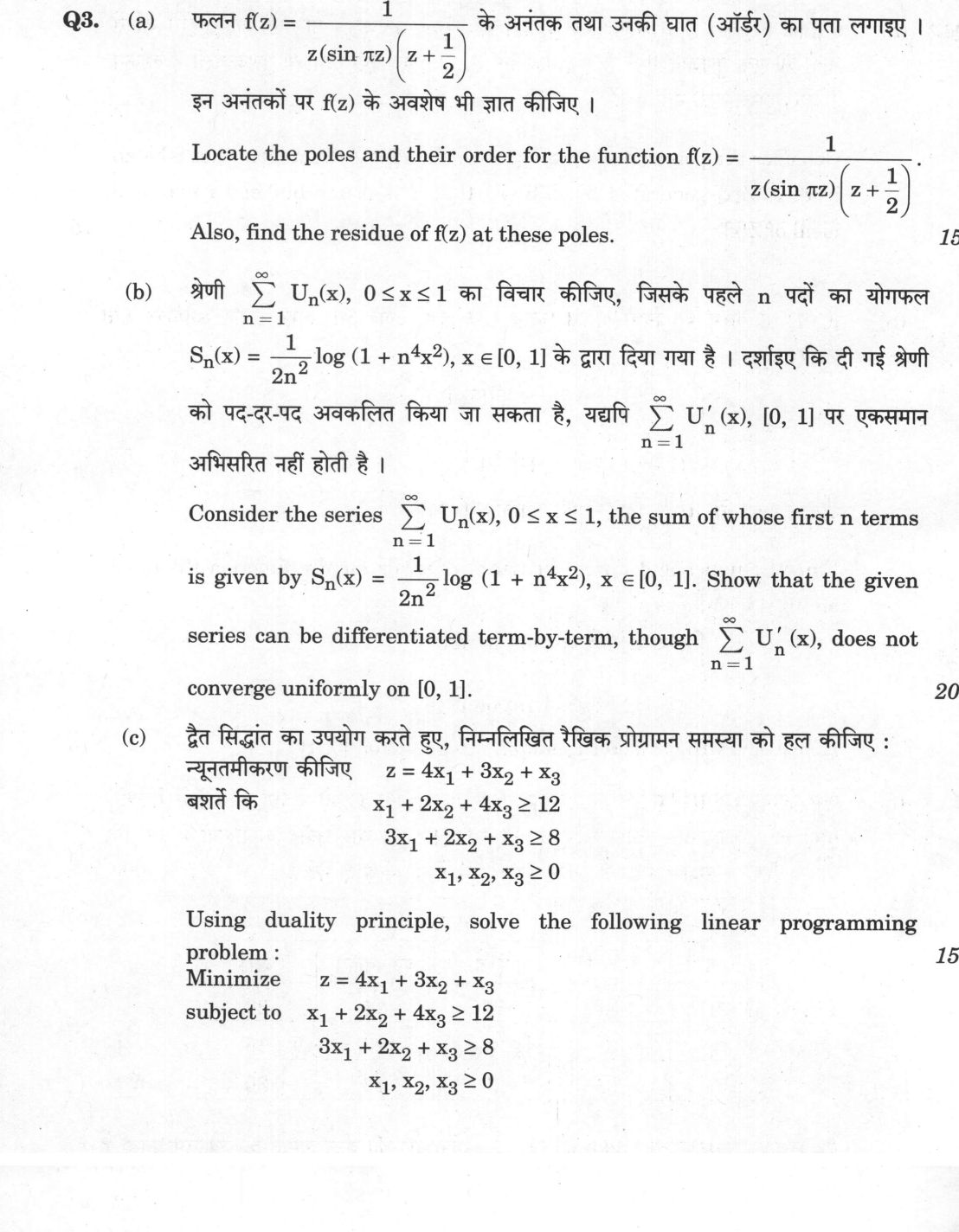
Locate the poles and their order for the function f(z) = 1/[z(sin πz)(z + 1/2)]. Also, find the residue of f(z) at these poles. 15 marks
Consider the series Σ(n=1 to ∞) U_n(x), 0 ≤ x ≤ 1, the sum of whose first n terms is given by S_n(x) = (1/2n²)log(1 + n⁴x²), x ∈ [0,1]. Show that the given series can be differentiated term-by-term, though Σ(n=1 to ∞) U'_n(x), does not converge uniformly on [0,1]. 20 marks
Using duality principle, solve the following linear programming problem: Minimize z = 4x₁ + 3x₂ + x₃ subject to x₁ + 2x₂ + 4x₃ ≥ 12, 3x₁ + 2x₂ + x₃ ≥ 8, x₁, x₂, x₃ ≥ 0. 15 marks
हिंदी में प्रश्न पढ़ें
फलन f(z) = 1/[z(sin πz)(z + 1/2)] के अनंतक तथा उनकी घात (ऑर्डर) का पता लगाइए। इन अनंतकों पर f(z) के अवशेष भी ज्ञात कीजिए। (15 अंक)
श्रेणी Σ(n=1 to ∞) U_n(x), 0 ≤ x ≤ 1 का विचार कीजिए, जिसके पहले n पदों का योगफल S_n(x) = (1/2n²)log(1 + n⁴x²), x ∈ [0,1] के द्वारा दिया गया है। दर्शाइए कि दी गई श्रेणी को पद-दर-पद अवकलित किया जा सकता है, यद्यपि Σ(n=1 to ∞) U'_n(x), [0,1] पर एकसमान अभिसरित नहीं होती है। (20 अंक)
द्वैत सिद्धांत का उपयोग करते हुए, निम्नलिखित रैखिक प्रोग्रामन समस्या को हल कीजिए: न्यूनतमीकरण कीजिए z = 4x₁ + 3x₂ + x₃ बशर्ते कि x₁ + 2x₂ + 4x₃ ≥ 12, 3x₁ + 2x₂ + x₃ ≥ 8, x₁, x₂, x₃ ≥ 0। (15 अंक)
Model answer
Written by UPSC Answer Check against this question's marking rubric, to the expected length. UPSC does not publish answers for Mains — this is one way to score well, not an official key.
(a) The poles are zeros of the denominator z(sin πz)(z + 1/2).
- At z = 0: z has a simple zero and sin πz has a simple zero, while z + 1/2 ≠ 0. Hence the denominator has a zero of order 2, so f has a pole of order 2 at z = 0.
- At z = n, where n is an integer and n ≠ 0: sin πz has a simple zero, while n ≠ 0 and n + 1/2 ≠ 0. Hence f has a simple pole at each z = n, n ∈ ℤ, n ≠ 0.
- At z = −1/2: z + 1/2 has a simple zero, while z = −1/2 ≠ 0 and sin(−π/2) = −1 ≠ 0. Hence f has a simple pole at z = −1/2.
Residues:
For a simple pole at z = n, n ∈ ℤ, n ≠ 0, Res(f, n) = lim(z→n) (z − n) f(z) = 1/[n(n + 1/2)] · lim(z→n) (z − n)/sin πz. Since sin πz ≈ (−1)ⁿ π(z − n) near z = n, lim(z→n) (z − n)/sin πz = (−1)ⁿ/π. Thus Res(f, n) = (−1)ⁿ/[π n(n + 1/2)] = 2(−1)ⁿ/[π n(2n + 1)], n ∈ ℤ, n ≠ 0.
At z = −1/2, Res(f, −1/2) = lim(z→−1/2) (z + 1/2) f(z) = 1/[z sin πz] at z = −1/2 = 1/[(-1/2)(−1)] = 2.
At z = 0, let h(z) = (z + 1/2) sin πz. Near z = 0, sin πz = πz − π³z³/6 + …, so h(z) = (z + 1/2)(πz − π³z³/6 + …) = (π/2)z + πz² + … . Therefore 1/h(z) = 2/(πz) − 4/π + …, and f(z) = 1/[z h(z)] = 2/(π z²) − 4/(π z) + … . Hence Res(f, 0) = −4/π.
(b) Let Sₙ(x) = 1/(2n²) log(1 + n⁴x²), x ∈ [0, 1]. Then U₁ = S₁ and for n ≥ 2, Uₙ = Sₙ − Sₙ₋₁, with S₀ = 0.
First find the sum of the given series. For fixed x, if x = 0, Sₙ(x) = 0. If x > 0, Sₙ(x) = 1/(2n²) log(1 + n⁴x²) = 1/(2n²)[4 log n + 2 log x + o(1)] → 0. Also for 0 ≤ x ≤ 1, 0 ≤ Sₙ(x) ≤ log(1 + n⁴)/(2n²) → 0. Thus the series converges uniformly to f(x) = 0 on [0, 1].
Now differentiate Sₙ: Sₙ′(x) = 1/(2n²) · (2n⁴x)/(1 + n⁴x²) = n²x/(1 + n⁴x²).
Therefore U₁′(x) = S₁′(x) = x/(1 + x²), and for n ≥ 2, Uₙ′(x) = Sₙ′(x) − Sₙ₋₁′(x).
The partial sum of the derivative series is Σ(k=1 to N) Uₖ′(x) = S_N′(x) = N²x/(1 + N⁴x²).
For fixed x ≥ 0, if x = 0, S_N′(0) = 0; if x > 0, S_N′(x) ∼ 1/(N²x) → 0. Hence Σ(n=1 to ∞) Uₙ′(x) = 0 = f′(x). So the given series can be differentiated term-by-term on [0, 1].
However, the convergence of Σ Uₙ′(x) is not uniform. Its N-th remainder is 0 − S_N′(x) = − N²x/(1 + N⁴x²). The maximum of N²x/(1 + N⁴x²) on [0, 1] occurs at x = 1/N², and equals (N² · 1/N²)/(1 + 1) = 1/2. Thus sup(0 ≤ x ≤ 1) |remainder| = 1/2, which does not tend to 0 as N → ∞. Therefore Σ Uₙ′(x) does not converge uniformly on [0, 1], although term-by-term differentiation still holds here.
(c) Primal problem: Minimize z = 4x₁ + 3x₂ + x₃ subject to x₁ + 2x₂ + 4x₃ ≥ 12, 3x₁ + 2x₂ + x₃ ≥ 8, x₁, x₂, x₃ ≥ 0.
Using duality, the dual is: Maximize w = 12y₁ + 8y₂ subject to y₁ + 3y₂ ≤ 4, 2y₁ + 2y₂ ≤ 3, 4y₁ + y₂ ≤ 1, y₁, y₂ ≥ 0.
From 4y₁ + y₂ ≤ 1 and y₁ ≥ 0, w = 12y₁ + 8y₂ = 8(4y₁ + y₂) − 20y₁ ≤ 8 · 1 − 0 = 8. Equality holds when y₁ = 0 and 4y₁ + y₂ = 1, so y₂ = 1. This point satisfies all dual constraints. Hence the dual optimum is **w* = 8 at (y₁, y₂) = (0, 1)**.
By the duality principle, the primal optimum is also **z* = 8**.
Use complementary slackness. Since y₂ = 1 > 0, the second primal constraint is tight: 3x₁ + 2x₂ + x₃ = 8. At (y₁, y₂) = (0, 1), the dual constraints for x₁ and x₂ are y₁ + 3y₂ = 3 < 4, 2y₁ + 2y₂ = 2 < 3. Hence x₁ = 0 and x₂ = 0. Then from the tight second constraint, x₃ = 8. The first primal constraint gives 4x₃ = 32 ≥ 12, so it is satisfied.
Therefore the optimal primal solution is (x₁, x₂, x₃) = (0, 0, 8), and the minimum value is z_min = 8.
What "Solve" is asking you to do
Choose the method, then carry it through to a final answer. Identifying what kind of problem this is and why that method applies is the first thing marked; a correct figure arrived at invisibly earns almost nothing.
Structure that answers it
Given data and what is required → method chosen, with the reason it applies → set-up (equation, circuit, free body, trial balance) → working, step by step → answer with units and any condition of validity
Where marks are lost
Doing the middle steps mentally and writing only the result. In mathematics papers, a further loss comes from giving a decimal where the exact value in surds or fractions was wanted, or from skipping the justification a part explicitly asks for.
How this answer will be evaluated
Approach
(a) calculate: given > formula > substitution > result with units > interpretation | (b) justify: claim > 3-4 reasons > evidence > conclusion | (c) calculate: given > formula > substitution > result with units > interpretation Full marks: Complete derivations, correct theorems cited, all parts solved with verification.
Key points expected
- Identify poles at z=0, z=n (integers), z=-1/2
- Determine order of each pole (simple)
- Calculate residue at z=0
- Calculate residue at z=-1/2
- Derive U_n(x) from S_n(x) - S_{n-1}(x)
- Show S_n(x) converges uniformly on [0,1]
- Show U_n'(x) converges pointwise
- Prove sum of U_n'(x) is not uniformly convergent
Evaluation rubric
Each sub-part is marked on its own, against the marks and word limit printed on the paper.
- (a) Identify poles, their orders, and calculate residues for f(z). 15 marks
calculate— given → formula → substitution → result with units → interpretation
Must cover
- Identify poles at z=0, z=n (integers), z=-1/2
- Determine order of each pole (simple)
- Calculate residue at z=0
- Calculate residue at z=-1/2
Loses marks
- Missing any pole location
- Incorrect order of poles
- Calculation error in residue formula
Earns more
- Calculate residue at general integer pole z=n
- Use limit definition for residues
- Verify residue sum is zero (if applicable)
Extra mark
- Mention Riemann sphere pole at infinity
- (b) Prove term-by-term differentiability and non-uniform convergence of derivative series. 20 marks
justify— claim → 3-4 reasons → evidence → conclusion
Must cover
- Derive U_n(x) from S_n(x) - S_{n-1}(x)
- Show S_n(x) converges uniformly on [0,1]
- Show U_n'(x) converges pointwise
- Prove sum of U_n'(x) is not uniformly convergent
Loses marks
- Failing to derive U_n(x) explicitly
- Assuming uniform convergence without proof
- Incorrect differentiation of log term
Earns more
- State Weierstrass M-test or relevant theorem
- Explicitly calculate limit of U_n'(x)
- Show sup norm of remainder does not vanish
Extra mark
- Provide a specific counter-example for non-uniformity
- (c) Solve the minimization LPP using the duality principle. 15 marks
calculate— given → formula → substitution → result with units → interpretation
Must cover
- Formulate the dual maximization problem
- Solve the dual problem (e.g., via simplex)
- Identify optimal values of dual variables
- State the minimum value of z
Loses marks
- Incorrect formulation of the dual
- Solving the primal directly instead of dual
- Arithmetic errors in simplex iterations
Earns more
- Show the simplex table for the dual
- Verify complementary slackness conditions
- State the optimal values of x1, x2, x3
Extra mark
- Graphical verification of the solution
Practice this exact question
Write your answer and it is marked point by point against the model answer above — what you covered, what you missed, what you got wrong.
Evaluate my answer →More from Mathematics 2024 Paper II
- Q1 (a) Let G be a finite group of order mn, where m and n are prime numbers with m > n. Show…
- Q2 (a) Using Cauchy's general principle of convergence, examine the convergence of the seque…
- Q3 (a) Locate the poles and their order for the function f(z) = 1/[z(sin πz)(z + 1/2)]. Also…
- Q4 (a) Consider the polynomial ring Z[x] over the ring Z of integers. Let S be an ideal of Z…
- Q5 (a) Show that if f and g are arbitrary functions of their respective arguments, then u =…
- Q6 (a) Show that the solution of the two-dimensional Laplace's equation ∂²φ(x,y)/∂x² + ∂²φ(x…