Paper II — Q2
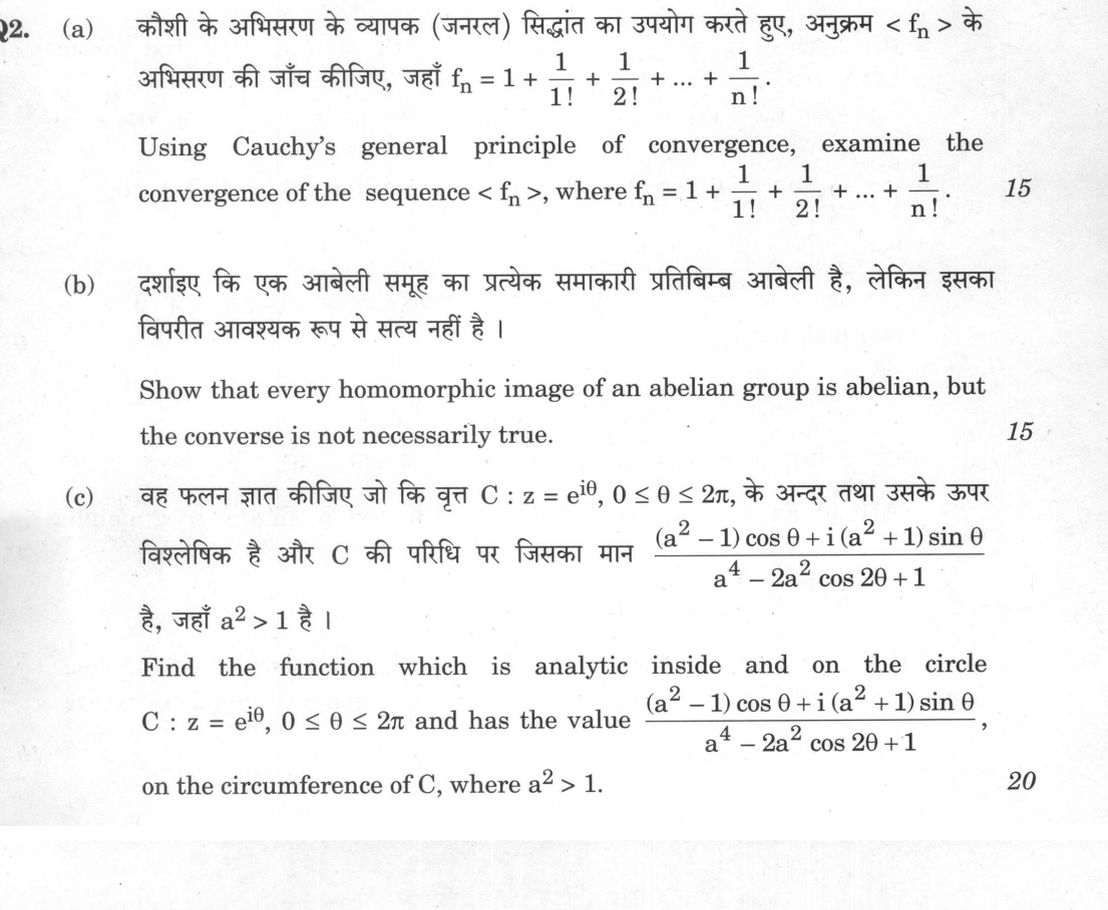
(a) Using Cauchy's general principle of convergence, examine the convergence of the sequence < fₙ >, where fₙ = 1 + 1/1! + 1/2! +…
Using Cauchy's general principle of convergence, examine the convergence of the sequence < fₙ >, where fₙ = 1 + 1/1! + 1/2! + ... + 1/n!.
15 marks
Show that every homomorphic image of an abelian group is abelian, but the converse is not necessarily true.
15 marks
Find the function which is analytic inside and on the circle C : z = e^(iθ), 0 ≤ θ ≤ 2π and has the value
(a² - 1) cos θ + i(a² + 1) sin θ ────────────────────────────── a⁴ - 2a² cos 2θ + 1
on the circumference of C, where a² > 1.
20 marks
हिंदी में प्रश्न पढ़ें
कोशी के अभिसरण के व्यापक (जनरल) सिद्धांत का उपयोग करते हुए, अनुक्रम < fₙ > के अभिसरण की जाँच कीजिए, जहाँ fₙ = 1 + 1/1! + 1/2! + ... + 1/n! ।
15 अंक
दर्शाइए कि एक अबेली समूह का प्रत्येक समाकारी प्रतिबिंब अबेली है, लेकिन इसका विपरीत आवश्यक रूप से सत्य नहीं है ।
15 अंक
वह फलन ज्ञात कीजिए जो कि वृत्त C : z = e^(iθ), 0 ≤ θ ≤ 2π, के अंदर तथा उसके ऊपर विश्लेषिक है और C की परिधि पर जिसका मान
(a² - 1) cos θ + i(a² + 1) sin θ ────────────────────────────── a⁴ - 2a² cos 2θ + 1
है, जहाँ a² > 1 है ।
20 अंक
Model answer
Written by UPSC Answer Check against this question's marking rubric, to the expected length. UPSC does not publish answers for Mains — this is one way to score well, not an official key.
(a) Let fₙ = 1 + 1/1! + 1/2! + ... + 1/n! = Σ from k=0 to n of 1/k!. By Cauchy’s general principle of convergence, we must show that for every ε > 0 there exists N such that |f_m − f_n| < ε whenever m > n ≥ N.
Assume m > n. Then |f_m − f_n| = Σ from k=n+1 to m of 1/k!. For k ≥ 1, k! = 1·2·3...k ≥ 2^(k−1), so 1/k! ≤ 1/2^(k−1). Hence |f_m − f_n| ≤ Σ from k=n+1 to ∞ of 1/2^(k−1) = 1/2^(n−1).
Given ε > 0, choose N such that 1/2^(N−1) < ε. Then for all m > n ≥ N, |f_m − f_n| ≤ 1/2^(n−1) ≤ 1/2^(N−1) < ε. Thus the sequence is Cauchy and therefore convergent. Its limit is the series sum e = Σ from k=0 to ∞ of 1/k!.
(b) Let G be an abelian group and let φ : G → H be a homomorphism. Its homomorphic image is φ(G). Take any u, v ∈ φ(G). Then there exist x, y ∈ G such that u = φ(x), v = φ(y). Since G is abelian, xy = yx. Therefore uv = φ(x)φ(y) = φ(xy) = φ(yx) = φ(y)φ(x) = vu. So every pair of elements of φ(G) commutes. Hence every homomorphic image of an abelian group is abelian.
The converse is not necessarily true. Take G = S₃, the symmetric group on three symbols, which is non-abelian, for example (12)(23) ≠ (23)(12). Define the sign homomorphism sgn : S₃ → {1, −1}. Its image is {1, −1}, which is cyclic of order 2 and hence abelian. Thus a non-abelian group can have an abelian homomorphic image. Therefore the converse fails.
(c) Put z = e^(iθ) on the circle C. Then cos θ = (z + z⁻¹)/2, sin θ = (z − z⁻¹)/(2i), cos 2θ = (z² + z⁻²)/2.
The given boundary value is W(θ) = [(a² − 1) cos θ + i(a² + 1) sin θ] / [a⁴ − 2a² cos 2θ + 1].
Simplify the numerator: (a² − 1) cos θ + i(a² + 1) sin θ = (a² − 1)(z + z⁻¹)/2 + (a² + 1)(z − z⁻¹)/2 = a² z − z⁻¹.
Now simplify the denominator: a⁴ − 2a² cos 2θ + 1 = a⁴ − a²(z² + z⁻²) + 1 = (a² − z²)(a² − z⁻²).
Therefore, on C, W(θ) = (a² z − z⁻¹) / [(a² − z²)(a² − z⁻²)] = z / (a² − z²).
Thus the required analytic function is f(z) = z/(a² − z²).
Since a² > 1, the zeros of the denominator are z = ±a, and |a| > 1, so they lie outside the unit circle C. Hence f(z) is analytic inside and on C. By the uniqueness theorem for analytic functions, this is the required function.
Check independently: for z = e^(iθ), f(e^(iθ)) = 1/(a² e^(−iθ) − e^(iθ)) = [(a² − 1) cos θ + i(a² + 1) sin θ] / [(a² − 1)² cos²θ + (a² + 1)² sin²θ], and the denominator equals a⁴ − 2a² cos 2θ + 1. Hence it matches the given boundary value exactly.
What "Prove" is asking you to do
Establish that the statement holds for every case it claims, not for one representative case. The argument must be closed: each line follows from a definition, a hypothesis, or a named theorem you are entitled to use.
Structure that answers it
Given and to prove, restated → theorem or construction to be used, named → the argument line by line → conclusion stated as proved
Where marks are lost
Testing one example, which illustrates but proves nothing. On an if and only if claim, proving one direction and stopping forfeits that half outright, and degenerate cases — zero, the empty set, the equality case — have to be disposed of rather than assumed away.
How this answer will be evaluated
Approach
(a) examine: intro > how/why with reasoning > evidence > conclusion | (b) justify: claim > 3-4 reasons > evidence > conclusion | (c) calculate: given > formula > substitution > result with units > interpretation Full marks: Rigorous application of theorems with complete derivations and clear counterexamples.
Key points expected
- State Cauchy's general principle of convergence
- Consider the difference f_{n+p} - f_n
- Apply the inequality 1/k! < 1/2^{k-1} for k >= 2
- Show the difference is less than epsilon for large n
- Let G be abelian and f: G -> H be a homomorphism
- Show f(xy) = f(yx) for all x, y in G
- Conclude the image f(G) is abelian
- Provide a counterexample where H is abelian but G is not
Evaluation rubric
Each sub-part is marked on its own, against the marks and word limit printed on the paper.
- (a) Prove convergence of the sequence <f_n> using Cauchy's general principle. 15 marks
examine— intro → how/why with reasoning → evidence → conclusion
Must cover
- State Cauchy's general principle of convergence
- Consider the difference f_{n+p} - f_n
- Apply the inequality 1/k! < 1/2^{k-1} for k >= 2
- Show the difference is less than epsilon for large n
Loses marks
- Using the ratio test without mentioning Cauchy's principle
- Failing to bound the tail sum of the series
Earns more
- Explicitly define the sequence terms
- Conclude the sequence is a Cauchy sequence
- Mention the limit is e
Extra mark
- Alternative proof using the ratio test
- (b) Prove the homomorphic image of an abelian group is abelian and provide a counterexample for the converse. 15 marks
justify— claim → 3-4 reasons → evidence → conclusion
Must cover
- Let G be abelian and f: G -> H be a homomorphism
- Show f(xy) = f(yx) for all x, y in G
- Conclude the image f(G) is abelian
- Provide a counterexample where H is abelian but G is not
Loses marks
- Failing to prove the image is abelian
- Providing a counterexample where the domain is abelian
Earns more
- Using the trivial homomorphism as the counterexample
- Explicitly stating the definition of a homomorphism
Extra mark
- Mentioning the First Isomorphism Theorem
- (c) Find the analytic function f(z) given its boundary values on the unit circle. 20 marks
calculate— given → formula → substitution → result with units → interpretation
Must cover
- Express the given boundary value in terms of z and z-bar
- Simplify the denominator using trigonometric identities
- Identify the analytic function f(z) = (az + 1)/(az - 1)
- Verify the function is analytic inside the unit circle
Loses marks
- Failing to convert the trigonometric expression to complex form
- Identifying the wrong analytic function
Earns more
- Showing the step-by-step algebraic simplification
- Checking the condition a^2 > 1 for analyticity
Extra mark
- Using the Poisson integral formula as an alternative method
Practice this exact question
Write your answer and it is marked point by point against the model answer above — what you covered, what you missed, what you got wrong.
Evaluate my answer →More from Mathematics 2024 Paper II
- Q1 (a) Let G be a finite group of order mn, where m and n are prime numbers with m > n. Show…
- Q2 (a) Using Cauchy's general principle of convergence, examine the convergence of the seque…
- Q3 (a) Locate the poles and their order for the function f(z) = 1/[z(sin πz)(z + 1/2)]. Also…
- Q4 (a) Consider the polynomial ring Z[x] over the ring Z of integers. Let S be an ideal of Z…
- Q5 (a) Show that if f and g are arbitrary functions of their respective arguments, then u =…