Paper II — Q4
(a) Consider the polynomial ring Z[x] over the ring Z of integers. Let S be an ideal of Z[x] generated by x. Show that S is prime…
Consider the polynomial ring Z[x] over the ring Z of integers. Let S be an ideal of Z[x] generated by x. Show that S is prime but not a maximal ideal of Z[x]. 15 marks
Find the upper and lower Riemann integrals for the function f defined on [0, 1] as follows: f(x) = (1-x²)^½, if x is rational; f(x) = (1-x), if x is irrational. Hence, show that f is not Riemann integrable on [0, 1]. 15 marks
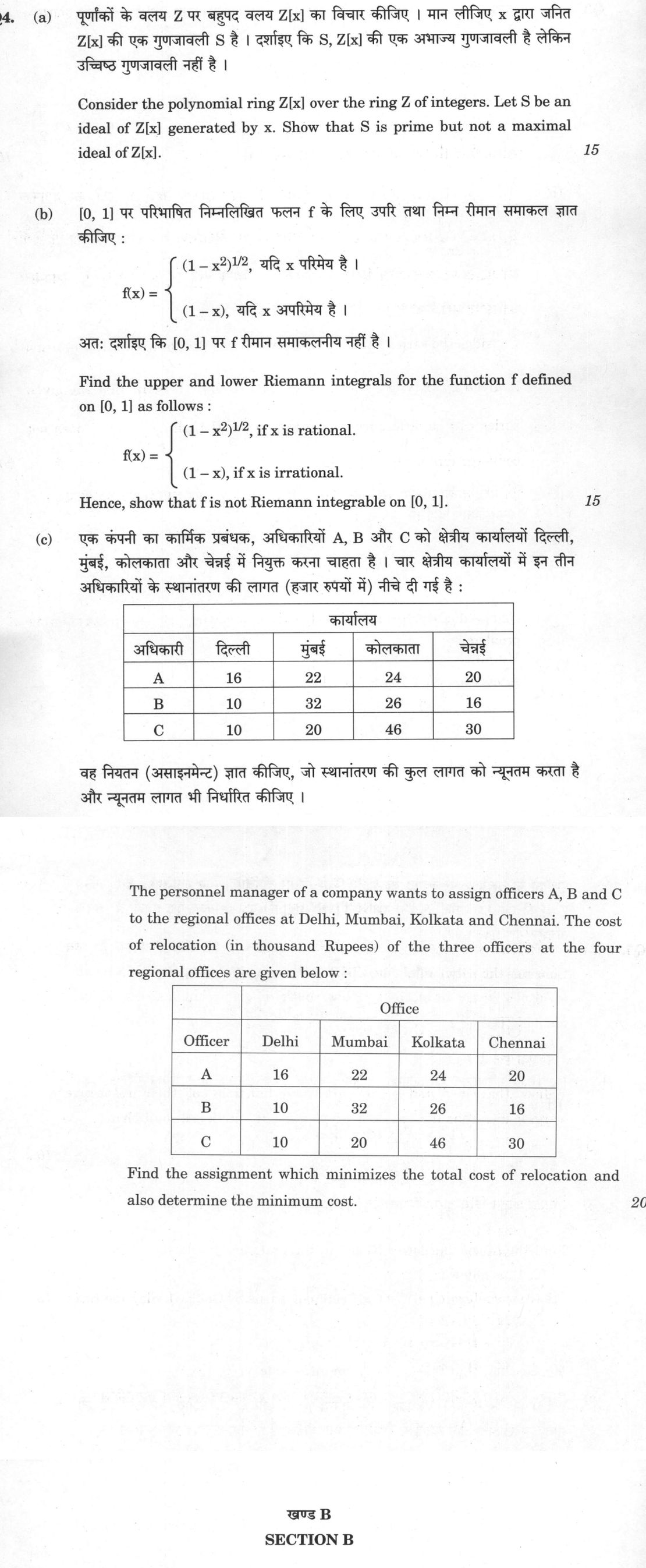
The personnel manager of a company wants to assign officers A, B and C to the regional offices at Delhi, Mumbai, Kolkata and Chennai. The cost of relocation (in thousand Rupees) of the three officers at the four regional offices are given below:
| Officer | Delhi | Mumbai | Kolkata | Chennai |
|---|---|---|---|---|
| A | 16 | 22 | 24 | 20 |
| B | 10 | 32 | 26 | 16 |
| C | 10 | 20 | 46 | 30 |
Find the assignment which minimizes the total cost of relocation and also determine the minimum cost. 20 marks
हिंदी में प्रश्न पढ़ें
पूर्णांकों के वलय Z पर बहुपद वलय Z[x] का विचार कीजिए। मान लीजिए x द्वारा जनित Z[x] की एक गुणजावली S है। दर्शाइए कि S, Z[x] की एक अभाज्य गुणजावली है लेकिन उच्चिष्ट गुणजावली नहीं है। (15 अंक)
[0, 1] पर परिभाषित निम्नलिखित फलन f के लिए ऊपर तथा निम्न रीमान समाकल ज्ञात कीजिए: f(x) = (1-x²)^½, यदि x परिमेय है; f(x) = (1-x), यदि x अपरिमेय है। अतः दर्शाइए कि [0, 1] पर f रीमान समाकलनीय नहीं है। (15 अंक)
एक कंपनी का कर्मिक प्रबंधक, अधिकारियों A, B और C को क्षेत्रीय कार्यालयों दिल्ली, मुंबई, कोलकाता और चेन्नई में नियुक्त करना चाहता है। चार क्षेत्रीय कार्यालयों में इन तीन अधिकारियों के स्थानांतरण की लागत (हजार रुपयों में) नीचे दी गई है: [तालिका दी गई है] वह नियतन (असाइनमेंट) ज्ञात कीजिए, जो स्थानांतरण की कुल लागत को न्यूनतम करता है और न्यूनतम लागत भी निर्धारित कीजिए। (20 अंक)
The figure this question refers to, in words
The question paper is a scan and the diagram did not survive as text. This is the figure as read from the original page — every component, value and label — so the question can be worked from the text below.
(c) A table with 4 rows and 5 columns giving relocation costs (in thousand Rupees) of three officers at four regional offices: Header row 1: Blank in column 1, 'Office' spanning columns 2 to 5 Header row 2: 'Officer', 'Delhi', 'Mumbai', 'Kolkata', 'Chennai' Row 1: 'A', '16', '22', '24', '20' Row 2: 'B', '10', '32', '26', '16' Row 3: 'C', '10', '20', '46', '30'
Model answer
Written by UPSC Answer Check against this question's marking rubric, to the expected length. UPSC does not publish answers for Mains — this is one way to score well, not an official key.
(a) Let S = (x) in Z[x]. Define φ: Z[x] → Z by φ(p(x)) = p(0). This is a surjective ring homomorphism. Its kernel is exactly the set of polynomials with constant term 0, which is S. Hence Z[x]/S ≅ Z. Since Z is an integral domain, S is prime.
To see that S is not maximal, consider T = (2, x). Every element of T has even constant term, so 1 ∉ T; hence T is a proper ideal of Z[x]. Also S ⊊ T, because 2 ∈ T but 2 ∉ S. Thus S is contained properly in a proper ideal, so S is not maximal. Final: S is prime but not maximal.
(b) Let P = {0 = x₀ < x₁ < ... < xₙ = 1} be any partition, and let Iᵢ = [xᵢ₋₁, xᵢ]. Since rationals and irrationals are both dense in R, on each Iᵢ the rational values of f are √(1-x²) and the irrational values are 1-x. Both functions are decreasing on [0, 1].
For 0 ≤ t ≤ 1, √(1-t²) ≥ 1-t, because 1-t² - (1-t)² = 2t(1-t) ≥ 0. Therefore, on Iᵢ, Mᵢ = sup f = √(1-xᵢ₋₁²), mᵢ = inf f = 1-xᵢ. Hence the upper and lower Darboux sums are U(P,f) = Σ Δxᵢ √(1-xᵢ₋₁²), L(P,f) = Σ Δxᵢ (1-xᵢ), where Δxᵢ = xᵢ - xᵢ₋₁.
The upper Riemann integral is inf_P U(P,f) = ∫₀¹ √(1-x²) dx = π/4, the area of a quarter unit circle. The lower Riemann integral is sup_P L(P,f) = ∫₀¹ (1-x) dx = 1/2.
Since π/4 ≠ 1/2, the upper and lower integrals are unequal. Therefore f is not Riemann integrable on [0, 1]. Final: upper integral = π/4, lower integral = 1/2; f is not Riemann integrable.
(c) This is an assignment problem. Since there are 3 officers and 4 offices, add a dummy officer D with zero cost to every office to make a 4×4 matrix. The cost matrix in thousand Rupees is: A: 16 22 24 20 B: 10 32 26 16 C: 10 20 46 30 D: 0 0 0 0
Use the Hungarian method. Row reduction gives: A: 0 6 8 4 B: 0 22 16 6 C: 0 10 36 20 D: 0 0 0 0 Column minima are all 0, so the matrix is unchanged.
Cover zeros with the Delhi column and the dummy row D. The minimum uncovered entry is 4. Subtract it from uncovered entries and add it at intersections. This gives: A: 0 2 4 0 B: 0 18 12 2 C: 0 6 32 16 D: 4 0 0 0
Next cover zeros with the Delhi column, the Chennai column, and the dummy row D. The minimum uncovered entry is 2. Subtract and add appropriately: A: 0 0 2 0 B: 0 16 10 2 C: 0 4 30 16 D: 6 0 0 2
Next cover zeros with the Delhi column and rows A and D. The minimum uncovered entry is 2. Subtract and add appropriately: A: 2 0 2 0 B: 0 14 8 0 C: 0 2 28 14 D: 8 0 0 2
Now an optimal zero assignment is: A → Mumbai, B → Chennai, C → Delhi, D → Kolkata.
Thus the real assignment is A to Mumbai, B to Chennai, C to Delhi, leaving Kolkata vacant. The minimum total cost is 22 + 16 + 10 = 48 thousand Rupees = ₹48,000.
Final: A → Mumbai, B → Chennai, C → Delhi; minimum relocation cost = ₹48,000.
What "Prove" is asking you to do
Establish that the statement holds for every case it claims, not for one representative case. The argument must be closed: each line follows from a definition, a hypothesis, or a named theorem you are entitled to use.
Structure that answers it
Given and to prove, restated → theorem or construction to be used, named → the argument line by line → conclusion stated as proved
Where marks are lost
Testing one example, which illustrates but proves nothing. On an if and only if claim, proving one direction and stopping forfeits that half outright, and degenerate cases — zero, the empty set, the equality case — have to be disposed of rather than assumed away.
How this answer will be evaluated
Approach
(a) justify: claim > 3-4 reasons > evidence > conclusion | (b) calculate: given > formula > substitution > result with units > interpretation | (c) calculate: given > formula > substitution > result with units > interpretation Full marks: Rigorous proofs with named theorems; complete Hungarian method steps.
Key points expected
- Define S = (x) as ideal generated by x
- Show Z[x]/S is isomorphic to Z
- Prove Z is an integral domain
- Show S is not maximal (e.g., (x,2) exists)
- Identify sup/inf of f on any subinterval
- Calculate upper Riemann integral value
- Calculate lower Riemann integral value
- Show upper integral is not equal to lower
Evaluation rubric
Each sub-part is marked on its own, against the marks and word limit printed on the paper.
- (a) Prove S is prime but not maximal in Z[x]. 15 marks
justify— claim → 3-4 reasons → evidence → conclusion
Must cover
- Define S = (x) as ideal generated by x
- Show Z[x]/S is isomorphic to Z
- Prove Z is an integral domain
- Show S is not maximal (e.g., (x,2) exists)
Loses marks
- Confusing prime with maximal ideal
- Failing to show quotient is domain
Earns more
- Explicitly state definition of prime ideal
- Explicitly state definition of maximal ideal
- Use First Isomorphism Theorem by name
Extra mark
- Mention Z[x] is not a PID
- (b) Compute upper/lower integrals and prove non-integrability. 15 marks
calculate— given → formula → substitution → result with units → interpretation
Must cover
- Identify sup/inf of f on any subinterval
- Calculate upper Riemann integral value
- Calculate lower Riemann integral value
- Show upper integral is not equal to lower
Loses marks
- Assuming continuity implies integrability
- Incorrect calculation of sup/inf
Earns more
- State Riemann integrability criterion
- Note density of rationals/irrationals
Extra mark
- Sketch graph of the two component functions
- (c) Find minimum cost assignment for 3 officers to 4 offices. 20 marks
calculate— given → formula → substitution → result with units → interpretation
Must cover
- Balance the 3x4 cost matrix (add dummy row)
- Perform row and column reductions
- Draw minimum number of lines for optimality
- Determine final assignment and total cost
Loses marks
- Skipping balancing step
- Incorrect final cost calculation
Earns more
- Show intermediate steps of Hungarian method
- Verify optimality condition
Extra mark
- Alternative method noted briefly
Practice this exact question
Write your answer and it is marked point by point against the model answer above — what you covered, what you missed, what you got wrong.
Evaluate my answer →More from Mathematics 2024 Paper II
- Q1 (a) Let G be a finite group of order mn, where m and n are prime numbers with m > n. Show…
- Q2 (a) Using Cauchy's general principle of convergence, examine the convergence of the seque…
- Q3 (a) Locate the poles and their order for the function f(z) = 1/[z(sin πz)(z + 1/2)]. Also…
- Q4 (a) Consider the polynomial ring Z[x] over the ring Z of integers. Let S be an ideal of Z…
- Q5 (a) Show that if f and g are arbitrary functions of their respective arguments, then u =…
- Q6 (a) Show that the solution of the two-dimensional Laplace's equation ∂²φ(x,y)/∂x² + ∂²φ(x…
- Q7 (a) Find the integral surface of the following quasi-linear equation (y - φ) (∂ φ)/(∂ x)…