Paper II — Q8
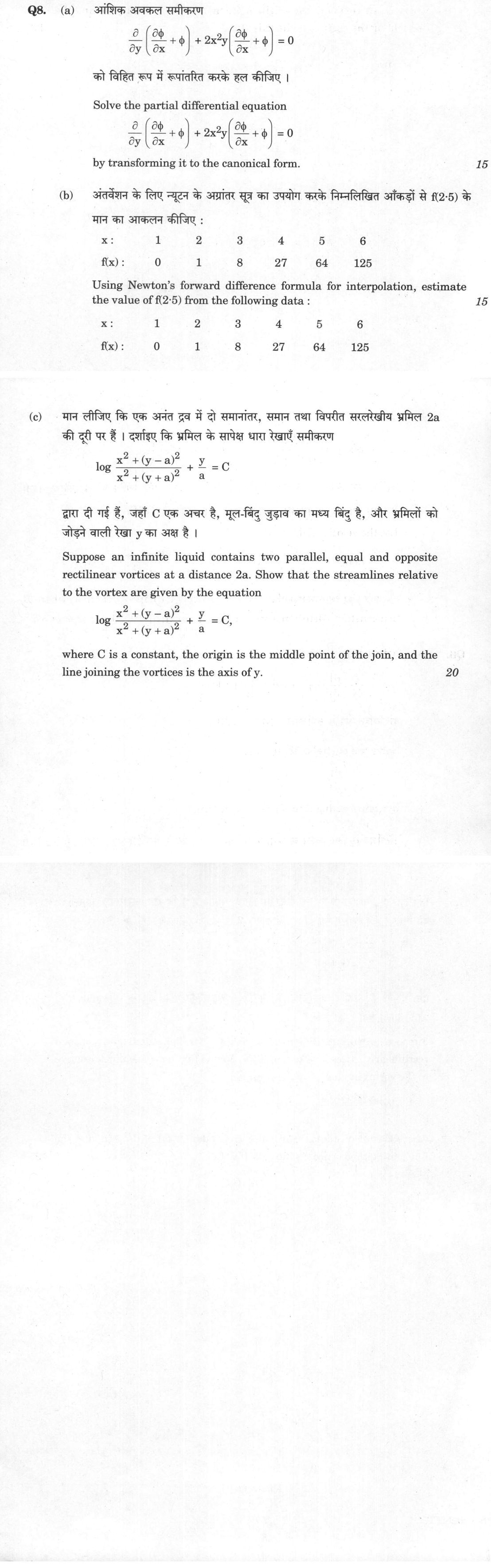
(a) Solve the partial differential equation (∂)/(∂ y)((∂ φ)/(∂ x) + φ) + 2x^2y((∂ φ)/(∂ x) + φ) = 0 by transforming it to the…
Solve the partial differential equation (∂)/(∂ y)((∂ φ)/(∂ x) + φ) + 2x^2y((∂ φ)/(∂ x) + φ) = 0 by transforming it to the canonical form. 15 marks
Using Newton's forward difference formula for interpolation, estimate the value of f(2·5) from the following data: x : 1 2 3 4 5 6, f(x) : 0 1 8 27 64 125. 15 marks
Suppose an infinite liquid contains two parallel, equal and opposite rectilinear vortices at a distance 2a. Show that the streamlines relative to the vortex are given by the equation log (x² + (y-a)²)/(x² + (y+a)²) + y/a = C, where C is a constant, the origin is the middle point of the join, and the line joining the vortices is the axis of y. 20 marks
हिंदी में प्रश्न पढ़ें
आंशिक अवकल समीकरण (∂)/(∂ y)((∂ φ)/(∂ x) + φ) + 2x^2y((∂ φ)/(∂ x) + φ) = 0 को विहित रूप में रूपांतरित करके हल कीजिए। (15 अंक)
अंतर्वेशन के लिए न्यूटन के अग्रांतर सूत्र का उपयोग करके निम्नलिखित आँकड़ों से f(2·5) के मान का आकलन कीजिए: x : 1 2 3 4 5 6, f(x) : 0 1 8 27 64 125. (15 अंक)
मान लीजिए कि एक अनंत द्रव में दो समानांतर, समान तथा विपरीत सरलरेखीय भ्रमिल 2a की दूरी पर हैं। दर्शाइए कि भ्रमिल के सापेक्ष धारा रेखाएँ समीकरण log (x² + (y-a)²)/(x² + (y+a)²) + y/a = C द्वारा दी गई हैं, जहाँ C एक अचर है, मूल-बिंदु जुड़ाव का मध्य बिंदु है, और भ्रमिलों को जोड़ने वाली रेखा y का अक्ष है। (20 अंक)
Model answer
Written by UPSC Answer Check against this question's marking rubric, to the expected length. UPSC does not publish answers for Mains — this is one way to score well, not an official key.
(a) Write the equation as φ_xy + φ_y + 2x²y φ_x + 2x²y φ = 0. For the second-order part, A = 0, B = 1, C = 0, so B² − 4AC = 1 > 0. Hence it is hyperbolic. The characteristic equation is A(dy)² − B dx dy + C(dx)² = 0, i.e. −dx dy = 0. Thus the characteristics are x = constant and y = constant, so take ξ = x, η = y. The canonical form is φ_ξη + φ_η + 2ξ²η φ_ξ + 2ξ²η φ = 0, or (φ_ξ + φ)_η + 2ξ²η(φ_ξ + φ) = 0.
Set v = φ_ξ + φ. Then v_η + 2ξ²η v = 0. The integrating factor in η is exp(∫2ξ²η dη) = exp(ξ²η²). Therefore (v exp(ξ²η²))_η = 0, so v exp(ξ²η²) = F(ξ), where F is arbitrary. Hence φ_ξ + φ = F(ξ) exp(−ξ²η²). Multiply by exp(ξ): (φ exp(ξ))_ξ = F(ξ) exp(ξ − ξ²η²). Integrating with respect to ξ, φ exp(ξ) = ∫^ξ F(s) exp(s − s²η²) ds + G(η). Thus the general solution is φ(x,y) = exp(−x)[∫^x F(s) exp(s − s²y²) ds + G(y)], where F and G are arbitrary functions. Check: φ_x + φ = F(x) exp(−x²y²), so the original equation is satisfied.
(b) Use Newton’s forward difference formula: f(x₀ + ph) = f₀ + pΔf₀ + p(p−1)/2! Δ²f₀ + p(p−1)(p−2)/3! Δ³f₀ + … Take x₀ = 2, h = 1, x = 2·5, so p = (2·5 − 2)/1 = 0·5.
At x₀ = 2: f₀ = f(2) = 1 Δf₀ = f(3) − f(2) = 8 − 1 = 7 Δ²f₀ = f(4) − 2f(3) + f(2) = 27 − 16 + 1 = 12 Δ³f₀ = f(5) − 3f(4) + 3f(3) − f(2) = 64 − 81 + 24 − 1 = 6 Δ⁴f₀ = 0.
Therefore f(2·5) = 1 + 0·5×7 + [(0·5)(−0·5)/2]×12 + [(0·5)(−0·5)(−1·5)/6]×6 = 1 + 3·5 − 1·5 + 0·375 = 3·375. So f(2·5) = 27/8 = 3·375.
(c) Let the vortices be at A(0,a) and B(0,−a). Let the circulation at A be Γ and at B be −Γ. For a rectilinear vortex of strength k, the stream function at distance r is ψ = −(k/2π) ln r. Hence the total stream function for the two vortices is ψ = −(Γ/2π) ln r₁ + (Γ/2π) ln r₂ = (Γ/2π) ln(r₂/r₁), where r₁² = x² + (y − a)², r₂² = x² + (y + a)².
The vortex at A is convected by the field of B. The speed induced at distance 2a is U = Γ/(2π·2a) = Γ/(4πa). With the chosen signs, the pair moves along the positive x-direction.
In the frame moving with the vortices, subtract the uniform stream U in the x-direction. The relative stream function is ψ_rel = ψ − Uy = (Γ/2π) ln(r₂/r₁) − (Γ/(4πa))y. For a streamline relative to the vortex, ψ_rel = constant. Thus (Γ/2π) ln(r₂/r₁) − (Γ/(4πa))y = constant. Divide by Γ/(2π): ln(r₂/r₁) − y/(2a) = constant. Multiply by −2 and absorb the constant: 2 ln(r₁/r₂) + y/a = C. Equivalently, ln(r₁²/r₂²) + y/a = C. Substituting r₁² and r₂², log([x² + (y − a)²]/[x² + (y + a)²]) + y/a = C, where C is a constant. This holds for all points except the vortex singularities r₁ = 0 and r₂ = 0.
What "Solve" is asking you to do
Choose the method, then carry it through to a final answer. Identifying what kind of problem this is and why that method applies is the first thing marked; a correct figure arrived at invisibly earns almost nothing.
Structure that answers it
Given data and what is required → method chosen, with the reason it applies → set-up (equation, circuit, free body, trial balance) → working, step by step → answer with units and any condition of validity
Where marks are lost
Doing the middle steps mentally and writing only the result. In mathematics papers, a further loss comes from giving a decimal where the exact value in surds or fractions was wanted, or from skipping the justification a part explicitly asks for.
How this answer will be evaluated
Approach
(a) derive: given > assumptions > stepwise derivation > result > check | (b) calculate: given > formula > substitution > result with units > interpretation | (c) derive: given > assumptions > stepwise derivation > result > check Full marks: Complete derivations with all steps justified and verified.
Key points expected
- Identify the PDE as linear in the term (∂φ/∂x + φ)
- Apply the substitution u = ∂φ/∂x + φ to simplify the equation
- Solve the resulting first-order PDE for u(x, y)
- Integrate the result to find the general solution for φ
- Construct the forward difference table correctly
- State Newton's forward difference formula explicitly
- Substitute the values for x=2.5 and u=0.5
- Calculate the final numerical value of f(2.5)
Evaluation rubric
Each sub-part is marked on its own, against the marks and word limit printed on the paper.
- (a) Transform the given PDE into canonical form and solve it. 15 marks
derive— given → assumptions → stepwise derivation → result → check
Must cover
- Identify the PDE as linear in the term (∂φ/∂x + φ)
- Apply the substitution u = ∂φ/∂x + φ to simplify the equation
- Solve the resulting first-order PDE for u(x, y)
- Integrate the result to find the general solution for φ
Loses marks
- Skipping the substitution step
- Incorrect integration of the simplified PDE
Earns more
- Explicitly states the transformation to canonical form
- Verifies the solution by substitution
Extra mark
- Alternative method noted briefly
- (b) Estimate f(2.5) using Newton's forward difference formula. 15 marks
calculate— given → formula → substitution → result with units → interpretation
Must cover
- Construct the forward difference table correctly
- State Newton's forward difference formula explicitly
- Substitute the values for x=2.5 and u=0.5
- Calculate the final numerical value of f(2.5)
Loses marks
- Errors in the difference table
- Incorrect substitution of u in the formula
Earns more
- Shows the calculation of the difference terms
- Checks the result against the data trend
Extra mark
- Alternative method noted briefly
- (c) Show that the streamlines are given by the specified equation. 20 marks
derive— given → assumptions → stepwise derivation → result → check
Must cover
- Define the stream function for a single rectilinear vortex
- Apply the principle of superposition for two vortices
- Set up the coordinates with vortices at (0, a) and (0, -a)
- Derive the final equation involving the logarithmic term
Loses marks
- Incorrect coordinate setup for the vortices
- Missing the superposition step
Earns more
- Neat figure showing the vortex positions
- Explicitly states the condition for opposite vortices
Extra mark
- Alternative method noted briefly
Practice this exact question
Write your answer and it is marked point by point against the model answer above — what you covered, what you missed, what you got wrong.
Evaluate my answer →More from Mathematics 2024 Paper II
- Q5 (a) Show that if f and g are arbitrary functions of their respective arguments, then u =…
- Q6 (a) Show that the solution of the two-dimensional Laplace's equation ∂²φ(x,y)/∂x² + ∂²φ(x…
- Q7 (a) Find the integral surface of the following quasi-linear equation (y - φ) (∂ φ)/(∂ x)…
- Q8 (a) Solve the partial differential equation (∂)/(∂ y)((∂ φ)/(∂ x) + φ) + 2x^2y((∂ φ)/(∂ x…