Paper II — Q6
(a) Show that the solution of the two-dimensional Laplace's equation ∂²φ(x,y)/∂x² + ∂²φ(x,y)/∂y² = 0, x ∈ (-∞, ∞), y ≥ 0 subject…
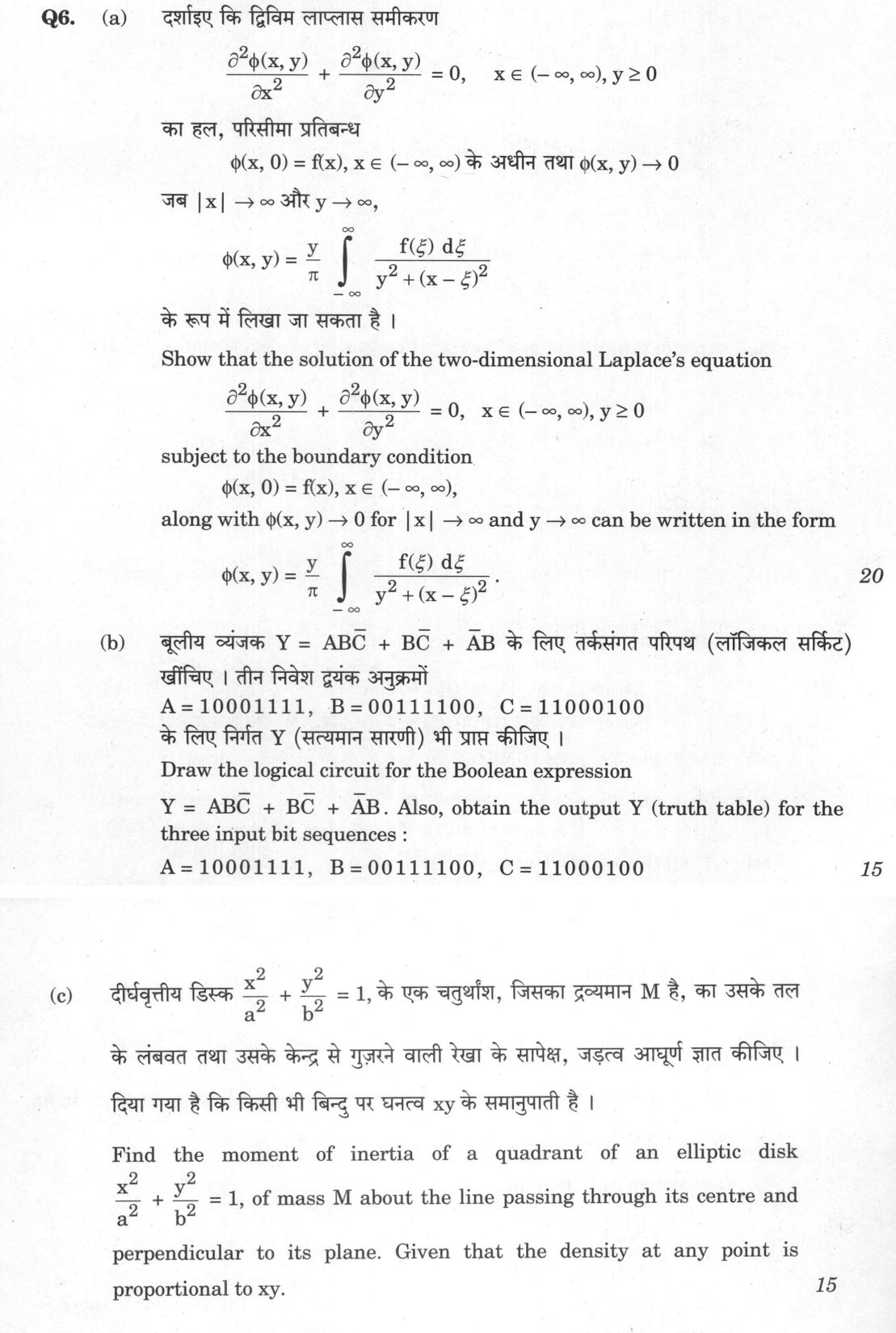
Show that the solution of the two-dimensional Laplace's equation ∂²φ(x,y)/∂x² + ∂²φ(x,y)/∂y² = 0, x ∈ (-∞, ∞), y ≥ 0 subject to the boundary condition φ(x,0) = f(x), x ∈ (-∞, ∞), along with φ(x,y) → 0 for |x| → ∞ and y → ∞ can be written in the form φ(x,y) = (y/π)∫₋∞^∞ [f(ξ)dξ]/[y² + (x-ξ)²]. 20 marks
Draw the logical circuit for the Boolean expression Y = ABC̄ + BC̄ + ĀB. Also, obtain the output Y (truth table) for the three input bit sequences: A = 10001111, B = 00111100, C = 11000100 15 marks
Find the moment of inertia of a quadrant of an elliptic disk x²/a² + y²/b² = 1, of mass M about the line passing through its centre and perpendicular to its plane. Given that the density at any point is proportional to xy. 15 marks
हिंदी में प्रश्न पढ़ें
दर्शाइए कि द्विविम लाप्लास समीकरण ∂²φ(x,y)/∂x² + ∂²φ(x,y)/∂y² = 0, x ∈ (-∞, ∞), y ≥ 0 का हल, परिसीमा प्रतिबंध φ(x,0) = f(x), x ∈ (-∞, ∞) के अधीन तथा φ(x,y) → 0 जब |x| → ∞ और y → ∞, φ(x,y) = (y/π)∫₋∞^∞ [f(ξ)dξ]/[y² + (x-ξ)²] के रूप में लिखा जा सकता है। (20 अंक)
बूलिय व्यंजक Y = ABC̄ + BC̄ + ĀB के लिए तर्कसंगत परिपथ (लॉजिकल सर्किट) खींचिए। तीन निवेश द्वयक अनुक्रमों A = 10001111, B = 00111100, C = 11000100 के लिए निर्गत Y (सत्यमान सारणी) भी प्राप्त कीजिए। (15 अंक)
दीर्घवृत्तीय डिस्क x²/a² + y²/b² = 1, के एक चतुर्थांश, जिसका द्रव्यमान M है, का उसके तल के लंबवत तथा उसके केंद्र से गुजरने वाली रेखा के सापेक्ष, जड़त्व आघूर्ण ज्ञात कीजिए। दिया गया है कि किसी भी बिंदु पर घनत्व xy के समानुपाती है। (15 अंक)
Model answer
Written by UPSC Answer Check against this question's marking rubric, to the expected length. UPSC does not publish answers for Mains — this is one way to score well, not an official key.
(a) Let Φ(k,y) = ∫ from −∞ to ∞ φ(x,y) exp(−ikx) dx, and let F(k) = ∫ from −∞ to ∞ f(x) exp(−ikx) dx. Applying the Fourier transform in x to Laplace's equation ∂²φ/∂x² + ∂²φ/∂y² = 0 gives Φ'' − k²Φ = 0, where the prime denotes the second derivative with respect to y. The solution that decays as y→∞ is Φ(k,y) = F(k) exp(−|k|y). By the inverse Fourier transform, φ(x,y) = (1/2π) ∫ from −∞ to ∞ F(k) exp(−|k|y) exp(ikx) dk = (1/2π) ∫ from −∞ to ∞ f(ξ) [ ∫ from −∞ to ∞ exp(−|k|y) exp(ik(x−ξ)) dk ] dξ. Let s = x−ξ. Since exp(−|k|y) is even, ∫ from −∞ to ∞ exp(−|k|y) exp(iks) dk = 2 ∫ from 0 to ∞ exp(−ky) cos(ks) dk = 2y/(y²+s²). Therefore, φ(x,y) = (1/2π) ∫ from −∞ to ∞ f(ξ) · 2y/(y²+(x−ξ)²) dξ = (y/π) ∫ from −∞ to ∞ f(ξ) dξ/[y²+(x−ξ)²]. As y→0⁺, the kernel y/[π(y²+(x−ξ)²)] tends to the Dirac delta δ(x−ξ), so φ(x,0⁺)=f(x). The decay condition φ→0 as |x|→∞ and y→∞ ensures uniqueness. This is the Poisson integral formula for the upper half-plane. Condition of validity: f continuous and bounded (or absolutely integrable) and vanishing at infinity as required.
(b) Simplify: Y = ABC̄ + BC̄ + ĀB = BC̄(A+1) + ĀB = BC̄ + ĀB = B(C̄+Ā) = B(AC)̄. Thus Y=1 exactly when B=1 and not(A=1 and C=1). The logical circuit is: feed A and C into a NAND gate to obtain (AC)̄; feed this output and B into an AND gate. Equivalently, invert A and C, OR the inverted outputs, then AND with B. Circuit: A ──┐ NAND ──┐ C ──┘ AND ── Y B ─────────┘ Now align the given bit sequences from left to right:
- Position 1: A=1, B=0, C=1 ⇒ Y=0
- Position 2: A=0, B=0, C=1 ⇒ Y=0
- Position 3: A=0, B=1, C=0 ⇒ Y=1
- Position 4: A=0, B=1, C=0 ⇒ Y=1
- Position 5: A=1, B=1, C=0 ⇒ Y=1
- Position 6: A=1, B=1, C=1 ⇒ Y=0
- Position 7: A=1, B=0, C=0 ⇒ Y=0
- Position 8: A=1, B=0, C=0 ⇒ Y=0 Final output: Y = 00111000.
(c) Consider the quadrant x≥0, y≥0, x²/a² + y²/b² ≤ 1. The density is ρ = kxy. Use elliptic polar coordinates: x = a r cos θ, y = b r sin θ, 0 ≤ r ≤ 1, 0 ≤ θ ≤ π/2. The Jacobian is J = ab r. The mass is M = ∫∫ ρ dx dy = ∫ from 0 to π/2 ∫ from 0 to 1 k (a r cos θ)(b r sin θ) (ab r) dr dθ = k a² b² ∫ from 0 to 1 r³ dr ∫ from 0 to π/2 sin θ cos θ dθ = k a² b² (1/4)(1/2) = k a² b² / 8. Hence k = 8M/(a² b²). The moment of inertia about the line through the centre perpendicular to the plane (the z-axis) is I = ∫∫ ρ (x²+y²) dx dy = ∫∫ kxy (x²+y²) dx dy. Substituting the elliptic polar coordinates, x²+y² = r² (a² cos² θ + b² sin² θ). Thus I = k a² b² ∫ from 0 to 1 r⁵ dr ∫ from 0 to π/2 sin θ cos θ (a² cos² θ + b² sin² θ) dθ. The r-integral is 1/6. For the θ-integral, put u = sin² θ, so du = 2 sin θ cos θ dθ. Then ∫ from 0 to π/2 sin θ cos θ (a² cos² θ + b² sin² θ) dθ = 1/2 ∫ from 0 to 1 [a²(1−u) + b²u] du = 1/2 [a² − a²/2 + b²/2] = (a² + b²)/4. Therefore I = k a² b² (1/6)(a² + b²)/4 = k a² b² (a² + b²)/24. Using k = 8M/(a² b²), I = (8M/(a² b²)) · a² b² (a² + b²)/24 = M (a² + b²)/3. Final answer: I = M(a² + b²)/3.
What "Derive" is asking you to do
Reach the stated expression from a starting relation, justifying every step. The destination is printed in the question, so only the route earns marks, and the assumptions you work under are part of that route.
Structure that answers it
Assumptions and notation defined → starting relation or governing equation → each step with its justification → the required expression → limiting case or boundary check
Where marks are lost
Writing the standard result first and fitting three lines to it, which an examiner reads at a glance. Marks also go on assumptions left unstated — lossless medium, small amplitude, errors independent with zero mean — and on symbols used before they are defined, even when the question says usual notations.
How this answer will be evaluated
Approach
(a) derive: given > assumptions > stepwise derivation > result > check | (b) describe: define > structure or process in order > labelled diagram > significance | (c) calculate: given > formula > substitution > result with units > interpretation Full marks: Complete derivations with all steps justified and verified.
Key points expected
- Apply Fourier transform to Laplace's equation
- Solve resulting ODE in y with decay condition
- Use convolution theorem for inverse transform
- Evaluate integral to obtain Poisson kernel
- Draw circuit with AND, OR, NOT gates
- Compute Y for each of the 8 bit positions
- Show intermediate terms ABC̄, BC̄, ĀB
- Set up double integral for moment of inertia
Evaluation rubric
Each sub-part is marked on its own, against the marks and word limit printed on the paper.
- (a) Derive the Poisson integral formula for the upper half-plane. 20 marks
derive— given → assumptions → stepwise derivation → result → check
Must cover
- Apply Fourier transform to Laplace's equation
- Solve resulting ODE in y with decay condition
- Use convolution theorem for inverse transform
- Evaluate integral to obtain Poisson kernel
Loses marks
- Skipping the Fourier transform step
- Failing to justify the decay condition
Earns more
- Verify boundary condition φ(x,0) = f(x)
- State decay condition for |x|→∞
Extra mark
- Alternative derivation via Green's function
- (b) Draw the logical circuit and compute the output truth table. 15 marks
describe— define → structure or process in order → labelled diagram → significance
Must cover
- Draw circuit with AND, OR, NOT gates
- Compute Y for each of the 8 bit positions
- Show intermediate terms ABC̄, BC̄, ĀB
Loses marks
- Missing any gate in the circuit diagram
- Incorrect calculation of any bit in Y
Earns more
- Label all gates and inputs clearly
- Present truth table in a structured format
Extra mark
- Simplify the Boolean expression first
- (c) Calculate the moment of inertia of the elliptic quadrant. 15 marks
calculate— given → formula → substitution → result with units → interpretation
Must cover
- Set up double integral for moment of inertia
- Use density ρ = kxy in the integrand
- Integrate over the quadrant region
- Express final result in terms of M
Loses marks
- Incorrect limits of integration
- Failing to relate k to total mass M
Earns more
- Use elliptical coordinates for integration
- Verify dimensions of the final answer
Extra mark
- Alternative method using polar coordinates
Practice this exact question
Write your answer and it is marked point by point against the model answer above — what you covered, what you missed, what you got wrong.
Evaluate my answer →More from Mathematics 2024 Paper II
- Q3 (a) Locate the poles and their order for the function f(z) = 1/[z(sin πz)(z + 1/2)]. Also…
- Q4 (a) Consider the polynomial ring Z[x] over the ring Z of integers. Let S be an ideal of Z…
- Q5 (a) Show that if f and g are arbitrary functions of their respective arguments, then u =…
- Q6 (a) Show that the solution of the two-dimensional Laplace's equation ∂²φ(x,y)/∂x² + ∂²φ(x…
- Q7 (a) Find the integral surface of the following quasi-linear equation (y - φ) (∂ φ)/(∂ x)…
- Q8 (a) Solve the partial differential equation (∂)/(∂ y)((∂ φ)/(∂ x) + φ) + 2x^2y((∂ φ)/(∂ x…