Paper II — Q7
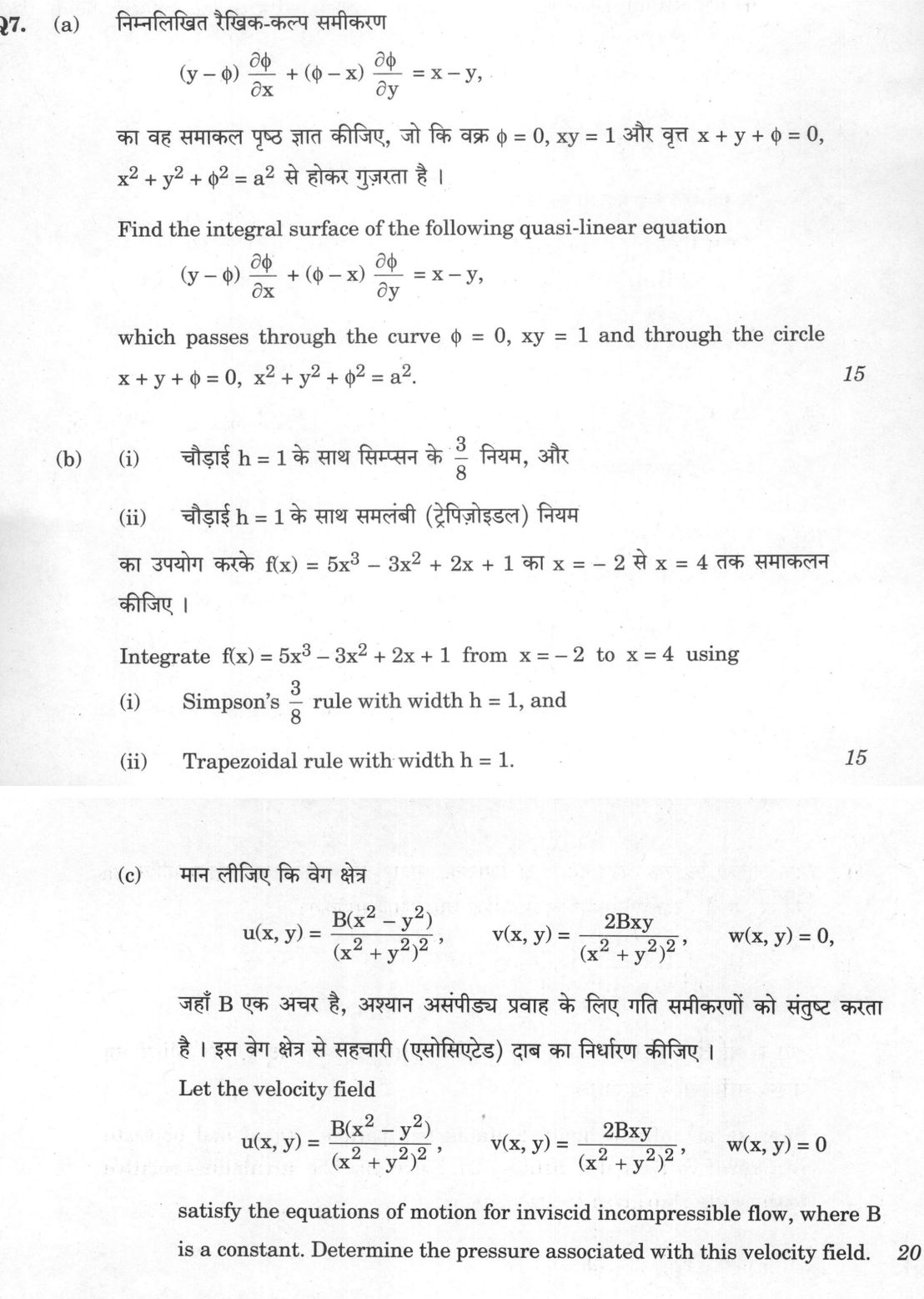
(a) Find the integral surface of the following quasi-linear equation (y - φ) (∂ φ)/(∂ x) + (φ - x) (∂ φ)/(∂ y) = x - y, which…
Find the integral surface of the following quasi-linear equation (y - φ) (∂ φ)/(∂ x) + (φ - x) (∂ φ)/(∂ y) = x - y, which passes through the curve φ = 0, xy = 1 and through the circle x + y + φ = 0, x² + y² + φ² = a². 15 marks
Integrate f(x) = 5x³ - 3x² + 2x + 1 from x = -2 to x = 4 using (i) Simpson's 3/8 rule with width h = 1, and (ii) Trapezoidal rule with width h = 1. 15 marks
Let the velocity field u(x, y) = (B(x² - y²))/((x² + y²)²), v(x, y) = 2Bxy/((x² + y²)²), w(x, y) = 0 satisfy the equations of motion for inviscid incompressible flow, where B is a constant. Determine the pressure associated with this velocity field. 20 marks
हिंदी में प्रश्न पढ़ें
निम्नलिखित रैखिक-कल्प समीकरण (y - φ) (∂ φ)/(∂ x) + (φ - x) (∂ φ)/(∂ y) = x - y, का वह समाकल पृष्ठ ज्ञात कीजिए, जो कि वक्र φ = 0, xy = 1 और वृत्त x + y + φ = 0, x² + y² + φ² = a² से होकर गुजरता है। (15 अंक)
चौड़ाई h = 1 के साथ सिम्पसन के 3/8 नियम, और (ii) चौड़ाई h = 1 के साथ समलंबी (ट्रेपिजॉइडल) नियम का उपयोग करके f(x) = 5x³ - 3x² + 2x + 1 का x = -2 से x = 4 तक समाकलन कीजिए। (15 अंक)
मान लीजिए कि वेग क्षेत्र u(x, y) = (B(x² - y²))/((x² + y²)²), v(x, y) = 2Bxy/((x² + y²)²), w(x, y) = 0, जहाँ B एक अचर है, अश्यान असंपीड्य प्रवाह के लिए गति समीकरणों को संतुष्ट करता है। इस वेग क्षेत्र से सहचारी (एसोसिएटेड) दाब का निर्धारण कीजिए। (20 अंक)
Model answer
Written by UPSC Answer Check against this question's marking rubric, to the expected length. UPSC does not publish answers for Mains — this is one way to score well, not an official key.
(a) Put z=φ, p=∂z/∂x, q=∂z/∂y. The equation is (y-z)p+(z-x)q=x-y. By Lagrange's method for Pp+Qq=R, dx/(y-z)=dy/(z-x)=dz/(x-y). Let ds be the common parameter. Then dx/ds=y-z, dy/ds=z-x, dz/ds=x-y. Adding the three differentials gives d(x+y+z)/ds=(y-z)+(z-x)+(x-y)=0, so c1=x+y+z. Multiplying the three equations by x, y, z and adding gives d(x²+y²+z²)/ds=2[x(y-z)+y(z-x)+z(x-y)]=0, so c2=x²+y²+z². The gradients of c1 and c2 are (1,1,1) and (2x,2y,2z); they are not parallel except on x=y=z, so the general integral is F(c1,c2)=0.
On φ=0, xy=1, write x=t, y=1/t, t≠0. Then c1=t+1/t=s and c2=t²+1/t²=s²-2. Also s²-4=(t-1/t)²≥0, so |s|≥2. Thus the first curve only forces F(s,s²-2)=0 on the two intervals |s|≥2; it does not force c2=c1²-2 for all c1. On the circle x+y+φ=0, x²+y²+φ²=a², we have c1=0 and c2=a².
We need a C¹ function g such that g(s)=s²-2 for |s|≥2 and g(0)=a². To make the implicit surface a graph φ(x,y) on the circle, also require g'(0)>2|a|. One explicit choice is g(s)=s²-2+((a²+2)/16)(s²-4)²(1+2s), |s|≤2, g(s)=s²-2, |s|≥2. At s=±2, (s²-4)² and its derivative vanish, so g is C¹. At s=0, g(0)=-2+((a²+2)/16)(16)=a². The derivative of (s²-4)²(1+2s) at 0 is 32, so g'(0)=((a²+2)/16)(32)=2(a²+2)>2|a|. Take F(c1,c2)=c2-g(c1). Then an integral surface is x²+y²+φ²-g(x+y+φ)=0. It contains the first curve because there c2=c1²-2 and |c1|≥2. It contains the circle because there c1=0 and c2=a².
For H=x²+y²+φ²-g(x+y+φ), H_x=2x-g', H_y=2y-g', H_z=2φ-g'. Where H_z≠0, ∂φ/∂x=-(2x-g')/(2φ-g') and ∂φ/∂y=-(2y-g')/(2φ-g'). Then (y-φ)∂φ/∂x+(φ-x)∂φ/∂y = -[(y-φ)(2x-g')+(φ-x)(2y-g')]/(2φ-g') = -[(y-x)(2φ-g')]/(2φ-g')=x-y. On the first curve, φ=0 and g'(c1)=2c1, so H_z=-2c1≠0. On the circle, |φ|≤|a|, so H_z=2φ-g'(0)≤2|a|-2(a²+2)<0. Hence the PDE is satisfied on the required curves. The surface is not unique.
(b) The nodes are x0=-2, x1=-1, x2=0, x3=1, x4=2, x5=3, x6=4. The ordinates are f0=-55, f1=-9, f2=1, f3=5, f4=33, f5=115, f6=281.
(i) Simpson's 3/8 rule is obtained by integrating the cubic interpolant through four equally spaced points. On [x0,x3], with t=(x-x0)/h, the integrals of the four Lagrange basis functions over t=0,1,2,3 are 3/8, 9/8, 9/8, 3/8, so ∫ from x0 to x3 f(x) dx ≈ (3h/8)(f0+3f1+3f2+f3). Since 6=2×3, apply this to [x0,x3] and [x3,x6] and add: (3h/8)(f0+3f1+3f2+f3)+(3h/8)(f3+3f4+3f5+f6) =(3h/8)[f0+3f1+3f2+2f3+3f4+3f5+f6]. With h=1, =(3/8)[-55+3(-9)+3(1)+2(5)+3(33)+3(115)+281]. Now f0+f6=226, f1+f2+f4+f5=-9+1+33+115=140, so 3×140=420, and 2f3=10. Hence the sum is 226+420+10=656, and (3/8)×656=246.
(ii) Trapezoidal rule uses linear interpolation on each subinterval, i.e. the sum of six trapezoids: ∫≈(h/2)[(f0+f1)+(f1+f2)+...+(f5+f6)] =(h/2)[f0+2(f1+f2+f3+f4+f5)+f6]. With h=1, f1+f2+f3+f4+f5=-9+1+5+33+115=145, so =(1/2)[-55+2(145)+281]=(1/2)(516)=258. As a check, the exact antiderivative is (5/4)x⁴-x³+x²+x. At x=4 it is 320-64+16+4=276; at x=-2 it is 20+8+4-2=30. The exact integral is 246, so Simpson's 3/8 is exact for this cubic. Simpson's 3/8: 246. Trapezoidal: 258.
(c) Let ρ be the constant density, and assume steady motion with no body forces. Continuity for incompressible flow is ∂u/∂x+∂v/∂y+∂w/∂z=0. With r²=x²+y² and w=0, use the product rule: ∂u/∂x=B[2x/r⁴-4x(x²-y²)/r⁶]=2Bx(3y²-x²)/r⁶, ∂v/∂y=2B[x/r⁴-4xy²/r⁶]=2Bx(x²-3y²)/r⁶. Thus ∂u/∂x+∂v/∂y=0. Also ∂v/∂x=2B[y/r⁴-4x²y/r⁶]=2By(y²-3x²)/r⁶, ∂u/∂y=B[-2y/r⁴-4y(x²-y²)/r⁶]=2By(y²-3x²)/r⁶, so ∂v/∂x=∂u/∂y; the flow is irrotational away from (0,0). A potential can be found by integrating u with respect to x: Φ=-Bx/r²+h(y). Then ∂Φ/∂y=2Bxy/r⁴+h'(y)=v, so h'(y)=0 and Φ=-Bx/r². The speed is q²=u²+v²=B²[(x²-y²)²+4x²y²]/r⁸=B²(x²+y²)²/r⁸=B²/r⁴. For steady inviscid incompressible irrotational flow, Bernoulli's theorem gives p+(1/2)ρq²=C. Equivalently, because (u·∇)u=∇(q²/2), Euler's x-equation gives p_x=2ρB²x/r⁶. Integrating with respect to x, put u=r², du=2x dx: p=2ρB²∫ x/r⁶ dx=-ρB²/(2r⁴)+C(y). Differentiating this with respect to y gives p_y=2ρB²y/r⁶+C'(y). The y-equation of Euler requires p_y=2ρB²y/r⁶, so C'(y)=0. The z-equation gives p_z=0, which is satisfied. Hence p(x,y)=C-(ρB²)/(2(x²+y²)²). The constant C is fixed by a reference pressure. The formula is valid for (x,y)≠(0,0); the velocity and pressure are singular at the origin. If ρ is in kg/m³ and B in m³/s, p is in Pa.
What "Solve" is asking you to do
Choose the method, then carry it through to a final answer. Identifying what kind of problem this is and why that method applies is the first thing marked; a correct figure arrived at invisibly earns almost nothing.
Structure that answers it
Given data and what is required → method chosen, with the reason it applies → set-up (equation, circuit, free body, trial balance) → working, step by step → answer with units and any condition of validity
Where marks are lost
Doing the middle steps mentally and writing only the result. In mathematics papers, a further loss comes from giving a decimal where the exact value in surds or fractions was wanted, or from skipping the justification a part explicitly asks for.
How this answer will be evaluated
Approach
(a) derive: given > assumptions > stepwise derivation > result > check | (b) calculate: given > formula > substitution > result with units > interpretation | (c) derive: given > assumptions > stepwise derivation > result > check Full marks: Complete derivations with all steps shown, correct application of theorems, verification of results, and clear presentation.
Key points expected
- Formulate Lagrange's auxiliary equations
- Derive two independent integrals (first integrals)
- Apply initial curve condition (φ=0, xy=1)
- Apply circle condition (x+y+φ=0, x²+y²+φ²=a²)
- Calculate function values f(x) for x = -2 to 4
- Apply Simpson's 3/8 rule formula correctly
- Apply Trapezoidal rule formula correctly
- Show substitution of values into formulas
Evaluation rubric
Each sub-part is marked on its own, against the marks and word limit printed on the paper.
- (a) Integral surface of the quasi-linear PDE satisfying the given initial curve and circle conditions. 15 marks
derive— given → assumptions → stepwise derivation → result → check
Must cover
- Formulate Lagrange's auxiliary equations
- Derive two independent integrals (first integrals)
- Apply initial curve condition (φ=0, xy=1)
- Apply circle condition (x+y+φ=0, x²+y²+φ²=a²)
Loses marks
- Skipping intermediate integration steps
- Incorrect setup of auxiliary equations
- Failure to apply boundary conditions
Earns more
- Correct identification of characteristic curves
- Clear algebraic manipulation of integrals
- Verification of the final surface equation
Extra mark
- Sketch of the characteristic curves
- Alternative method noted briefly
- (b) Numerical integration of f(x) from -2 to 4 using Simpson's 3/8 and Trapezoidal rules with h=1. 15 marks
calculate— given → formula → substitution → result with units → interpretation
Must cover
- Calculate function values f(x) for x = -2 to 4
- Apply Simpson's 3/8 rule formula correctly
- Apply Trapezoidal rule formula correctly
- Show substitution of values into formulas
Loses marks
- Arithmetic errors in function evaluation
- Incorrect application of rule coefficients
- Missing intermediate calculation steps
Earns more
- Tabulation of x and f(x) values
- Explicit statement of h and n
- Comparison of results with exact value
Extra mark
- Calculation of error terms
- Graphical representation of the function
- (c) Pressure field associated with the given inviscid incompressible velocity field. 20 marks
derive— given → assumptions → stepwise derivation → result → check
Must cover
- Verify continuity equation for incompressible flow
- Apply Euler's equations of motion
- Integrate pressure gradient equations
- Determine pressure function p(x,y)
Loses marks
- Skipping continuity verification
- Incorrect integration of velocity components
- Failure to state assumptions (inviscid, incompressible)
Earns more
- Explicit check of divergence-free condition
- Step-by-step integration of partial derivatives
- Verification of pressure field consistency
Extra mark
- Physical interpretation of pressure distribution
- Alternative derivation method noted
Practice this exact question
Write your answer and it is marked point by point against the model answer above — what you covered, what you missed, what you got wrong.
Evaluate my answer →More from Mathematics 2024 Paper II
- Q4 (a) Consider the polynomial ring Z[x] over the ring Z of integers. Let S be an ideal of Z…
- Q5 (a) Show that if f and g are arbitrary functions of their respective arguments, then u =…
- Q6 (a) Show that the solution of the two-dimensional Laplace's equation ∂²φ(x,y)/∂x² + ∂²φ(x…
- Q7 (a) Find the integral surface of the following quasi-linear equation (y - φ) (∂ φ)/(∂ x)…
- Q8 (a) Solve the partial differential equation (∂)/(∂ y)((∂ φ)/(∂ x) + φ) + 2x^2y((∂ φ)/(∂ x…