Paper I — Q1
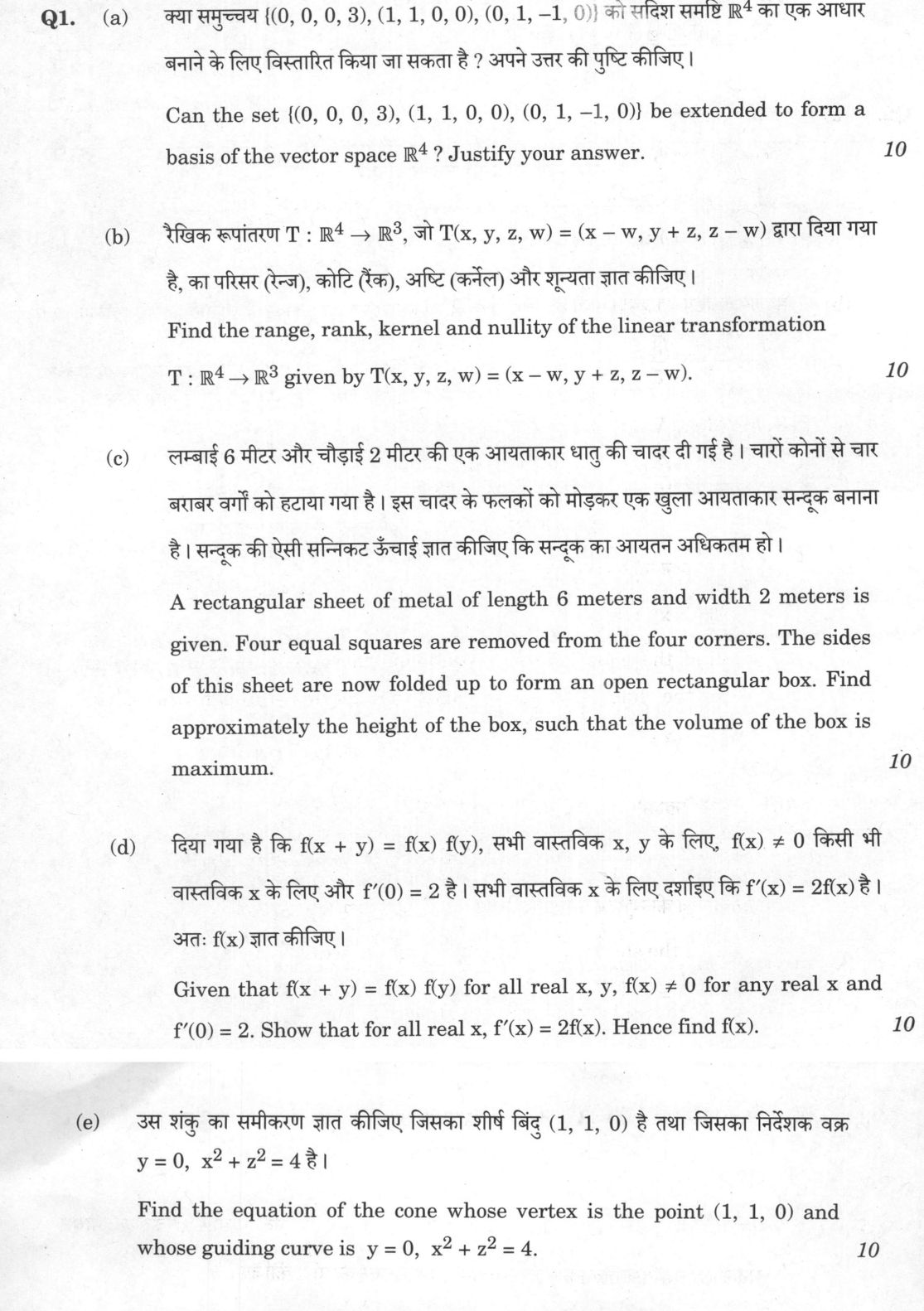
(a) Can the set {(0, 0, 0, 3), (1, 1, 0, 0), (0, 1, –1, 0)} be extended to form a basis of the vector space ℝ⁴? Justify your…
Can the set {(0, 0, 0, 3), (1, 1, 0, 0), (0, 1, –1, 0)} be extended to form a basis of the vector space ℝ⁴? Justify your answer. 10 marks
Find the range, rank, kernel and nullity of the linear transformation T : ℝ⁴ → ℝ³ given by T(x, y, z, w) = (x – w, y + z, z – w). 10 marks
A rectangular sheet of metal of length 6 meters and width 2 meters is given. Four equal squares are removed from the four corners. The sides of this sheet are now folded up to form an open rectangular box. Find approximately the height of the box, such that the volume of the box is maximum. 10 marks
Given that f(x + y) = f(x) f(y) for all real x, y, f(x) ≠ 0 for any real x and f'(0) = 2. Show that for all real x, f'(x) = 2f(x). Hence find f(x). 10 marks
Find the equation of the cone whose vertex is the point (1, 1, 0) and whose guiding curve is y = 0, x² + z² = 4. 10 marks
हिंदी में प्रश्न पढ़ें
क्या समुच्चय {(0, 0, 0, 3), (1, 1, 0, 0), (0, 1, –1, 0)} को सदिश समष्टि ℝ⁴ का एक आधार बनाने के लिए विस्तारित किया जा सकता है? अपने उत्तर की पुष्टि कीजिए। 10 अंक
रैखिक रूपांतरण T : ℝ⁴ → ℝ³, जो T(x, y, z, w) = (x – w, y + z, z – w) द्वारा दिया गया है, का परिसर (रेंज), कोटि (रैंक), अश्टि (कर्नेल) और शून्यता ज्ञात कीजिए। 10 अंक
लम्बाई 6 मीटर और चौड़ाई 2 मीटर की एक आयताकार धातु की चादर दी गई है। चारों कोनों से चार बराबर वर्गों को हटाया गया है। इस चादर के फलकों को मोड़कर एक खुला आयताकार संदूक बनाना है। संदूक की ऐसी सन्निकट ऊँचाई ज्ञात कीजिए कि संदूक का आयतन अधिकतम हो। 10 अंक
दिया गया है कि f(x + y) = f(x) f(y), सभी वास्तविक x, y के लिए, f(x) ≠ 0 किसी भी वास्तविक x के लिए और f'(0) = 2 है। सभी वास्तविक x के लिए दर्शाइए कि f'(x) = 2f(x) है। अतः f(x) ज्ञात कीजिए। 10 अंक
उस शंकु का समीकरण ज्ञात कीजिए जिसका शीर्ष बिंदु (1, 1, 0) है तथा जिसका निर्देशक वक्र y = 0, x² + z² = 4 है। 10 अंक
Model answer
Written by UPSC Answer Check against this question's marking rubric, to the expected length. UPSC does not publish answers for Mains — this is one way to score well, not an official key.
(a) Let v₁ = (0, 0, 0, 3), v₂ = (1, 1, 0, 0), v₃ = (0, 1, –1, 0).
To check linear independence, suppose α v₁ + β v₂ + γ v₃ = (0, 0, 0, 0). Comparing coordinates:
- First coordinate: β = 0.
- Second coordinate: β + γ = 0, so γ = 0.
- Third coordinate: –γ = 0, so γ = 0.
- Fourth coordinate: 3α = 0, so α = 0.
Thus α = β = γ = 0, so the three given vectors are linearly independent. Since dim ℝ⁴ = 4, any linearly independent set of 3 vectors can be extended to a basis by adding one more vector outside its span.
Take e₁ = (1, 0, 0, 0). It is not in the span of the given three vectors, because if (1, 0, 0, 0) = α v₁ + β v₂ + γ v₃, then first coordinate gives β = 1, second gives β + γ = 0, so γ = –1, but third coordinate gives –γ = 0, so γ = 0, a contradiction.
Now check the four vectors v₁, v₂, v₃, e₁ are independent. Suppose α v₁ + β v₂ + γ v₃ + δ e₁ = (0, 0, 0, 0). Then coordinates give:
- x-coordinate: β + δ = 0.
- y-coordinate: β + γ = 0.
- z-coordinate: –γ = 0, so γ = 0.
- Then β = 0 from y-coordinate, δ = 0 from x-coordinate.
- w-coordinate: 3α = 0, so α = 0.
Hence the four vectors are linearly independent in ℝ⁴, so they form a basis.
Final answer: Yes. The set can be extended; for example, {(0, 0, 0, 3), (1, 1, 0, 0), (0, 1, –1, 0), (1, 0, 0, 0)} is a basis of ℝ⁴.
(b) The linear transformation is T(x, y, z, w) = (x – w, y + z, z – w).
Its matrix with respect to the standard bases of ℝ⁴ and ℝ³ is
A = [1 0 0 –1 0 1 1 0 0 0 1 –1]
The range of T is the column space of A. The columns are c₁ = (1, 0, 0), c₂ = (0, 1, 0), c₃ = (0, 1, 1), c₄ = (–1, 0, –1).
The first three columns c₁, c₂, c₃ are linearly independent. Indeed, if α c₁ + β c₂ + γ c₃ = (0, 0, 0), then first coordinate gives α = 0, third coordinate gives γ = 0, and second coordinate gives β + γ = 0, so β = 0.
Thus rank(T) = 3. Since the codomain ℝ³ has dimension 3, the range is the whole of ℝ³.
Now find the kernel. Put T(x, y, z, w) = (0, 0, 0). Then
x – w = 0 ⇒ x = w, y + z = 0 ⇒ y = –z, z – w = 0 ⇒ z = w.
Hence w = x = z and y = –z. Let z = t, where t ∈ ℝ. Then (x, y, z, w) = (t, –t, t, t).
Therefore kernel T = {(t, –t, t, t) : t ∈ ℝ} = span{(1, –1, 1, 1)}.
So nullity(T) = 1. The rank–nullity theorem checks this: rank + nullity = 3 + 1 = 4 = dim ℝ⁴.
Final answer: Range = ℝ³, rank = 3, kernel = span{(1, –1, 1, 1)}, nullity = 1.
(c) Let the side of each removed square be h meters. After folding, the height of the open box is h. The base length becomes 6 – 2h and the base width becomes 2 – 2h. For a positive base, 0 < h < 1.
Volume of the box is
V(h) = h(6 – 2h)(2 – 2h).
Simplify:
V(h) = h · 2(3 – h) · 2(1 – h) = 4h(3 – h)(1 – h) = 4h(3 – 4h + h²) = 12h – 16h² + 4h³.
Differentiate:
dV/dh = 12 – 32h + 12h².
Set dV/dh = 0:
12 – 32h + 12h² = 0 ⇒ 3h² – 8h + 3 = 0.
Using the quadratic formula,
h = [8 ± √(64 – 36)]/6 = [8 ± √28]/6 = [8 ± 2√7]/6 = (4 ± √7)/3.
The two values are approximately
(4 + √7)/3 ≈ 2.215 m, (4 – √7)/3 ≈ 0.451 m.
Since 0 < h < 1, the valid value is h = (4 – √7)/3 m.
Check maximum. The second derivative is
d²V/dh² = –32 + 24h.
At h = (4 – √7)/3,
d²V/dh² = –32 + 8(4 – √7) = –32 + 32 – 8√7 = –8√7 < 0.
So the volume is maximum at this value.
Final answer: h = (4 – √7)/3 m ≈ 0.451 m.
(d) Given f(x + y) = f(x) f(y) for all real x, y, and f(x) ≠ 0 for every real x.
First put x = y = 0:
f(0) = f(0) f(0) = f(0)².
Since f(0) ≠ 0, divide by f(0) to get f(0) = 1.
Now compute f′(x) from the definition of derivative:
f′(x) = lim_(h→0) [f(x + h) – f(x)]/h.
Using the functional equation,
f(x + h) = f(x) f(h).
Therefore,
f′(x) = lim_(h→0) [f(x)f(h) – f(x)]/h = f(x) lim_(h→0) [f(h) – 1]/h.
But f(0) = 1, so
lim_(h→0) [f(h) – 1]/h = lim_(h→0) [f(h) – f(0)]/h = f′(0) = 2.
Hence
f′(x) = 2f(x).
This is the required differential equation. Since f(x) ≠ 0, divide by f(x):
f′(x)/f(x) = 2.
Integrating,
ln|f(x)| = 2x + C.
Put x = 0. Since f(0) = 1,
ln 1 = 0 + C ⇒ C = 0.
Thus
ln|f(x)| = 2x ⇒ |f(x)| = e^(2x).
Because f is differentiable and f(0) = 1 > 0, f is positive for all real x. Hence
f(x) = e^(2x).
Final answer: f′(x) = 2f(x), and f(x) = e^(2x).
(e) The vertex of the cone is V = (1, 1, 0). The guiding curve is the circle y = 0, x² + z² = 4 in the plane y = 0.
Let P = (x, y, z) be any point on the cone. The generator through V and P is
(1, 1, 0) + t[(x, y, z) – (1, 1, 0)] = (1 + t(x – 1), 1 + t(y – 1), t z).
For y ≠ 1, this generator meets the plane y = 0 when
1 + t(y – 1) = 0 ⇒ t = 1/(1 – y).
At that intersection point Q, the coordinates are
X = 1 + t(x – 1) = 1 + (x – 1)/(1 – y) = (x – y)/(1 – y),
Y = 0,
Z = t z = z/(1 – y).
Since Q lies on the guiding curve y = 0, x² + z² = 4, we must have
X² + Z² = 4.
Substitute X and Z:
[(x – y)/(1 – y)]² + [z/(1 – y)]² = 4.
Multiplying by (1 – y)² gives
(x – y)² + z² = 4(1 – y)².
Equivalently, expanding,
x² – 2xy + y² + z² = 4 – 8y + 4y²,
so
x² + z² – 2xy – 3y² + 8y – 4 = 0.
This equation is satisfied by the vertex (1, 1, 0), as required.
Final answer: (x – y)² + z² = 4(1 – y)², or equivalently x² + z² – 2xy – 3y² + 8y – 4 = 0.
What "Solve" is asking you to do
Choose the method, then carry it through to a final answer. Identifying what kind of problem this is and why that method applies is the first thing marked; a correct figure arrived at invisibly earns almost nothing.
Structure that answers it
Given data and what is required → method chosen, with the reason it applies → set-up (equation, circuit, free body, trial balance) → working, step by step → answer with units and any condition of validity
Where marks are lost
Doing the middle steps mentally and writing only the result. In mathematics papers, a further loss comes from giving a decimal where the exact value in surds or fractions was wanted, or from skipping the justification a part explicitly asks for.
How this answer will be evaluated
Approach
Framework: UPSC Mathematics Paper 1. (a) justify: claim > 3-4 reasons > evidence > conclusion | (b) calculate: given > formula > substitution > result with units > interpretation | (c) calculate: given > formula > substitution > result with units > interpretation | (d) derive: given > assumptions > stepwise derivation > result > check | (e) derive: given > assumptions > stepwise derivation > result > check Full marks: Rigorous step-by-step derivation with all justifications and checks.
Key points expected
- Check linear independence of the three given vectors
- State the dimension of the vector space R⁴
- Apply the basis extension theorem
- Conclude with a clear yes/no answer
- Determine the kernel by solving T(x,y,z,w) = 0
- Calculate the nullity from the kernel dimension
- Determine the range by analyzing the image vectors
- Calculate the rank using the Rank-Nullity Theorem
Evaluation rubric
Each sub-part is marked on its own, against the marks and word limit printed on the paper.
- (a) Determine if the set can be extended to a basis of R⁴. 10 marks
justify— claim → 3-4 reasons → evidence → conclusion
Must cover
- Check linear independence of the three given vectors
- State the dimension of the vector space R⁴
- Apply the basis extension theorem
- Conclude with a clear yes/no answer
Loses marks
- Assuming independence without proof
- Confusing span with basis
Earns more
- Explicitly showing the determinant or row reduction
- Defining the concept of a basis
Extra mark
- Sketching the geometric interpretation of the subspace
- (b) Find range, rank, kernel, and nullity of the transformation T. 10 marks
calculate— given → formula → substitution → result with units → interpretation
Must cover
- Determine the kernel by solving T(x,y,z,w) = 0
- Calculate the nullity from the kernel dimension
- Determine the range by analyzing the image vectors
- Calculate the rank using the Rank-Nullity Theorem
Loses marks
- Confusing the domain and codomain dimensions
- Failing to solve the homogeneous system for the kernel
Earns more
- Writing the transformation in matrix form
- Showing the row-reduction steps for the matrix
Extra mark
- Verifying the Rank-Nullity Theorem with the calculated values
- (c) Find the height of the box for maximum volume. 10 marks
calculate— given → formula → substitution → result with units → interpretation
Must cover
- Define the variable x as the side of the removed square
- Formulate the volume function V(x) = x(6-2x)(2-2x)
- Differentiate V(x) and set V'(x) = 0
- Solve for x and verify it is a maximum
Loses marks
- Setting up the volume formula incorrectly
- Ignoring the physical constraints on x
Earns more
- Checking the second derivative V''(x) < 0
- Stating the domain of x (0 < x < 1)
Extra mark
- Calculating the maximum volume value
- (d) Show f'(x) = 2f(x) and find the function f(x). 10 marks
derive— given → assumptions → stepwise derivation → result → check
Must cover
- Differentiate f(x+y) = f(x)f(y) with respect to y
- Set y = 0 to relate f'(x) and f(x)
- Use the given condition f'(0) = 2
- Solve the differential equation to find f(x)
Loses marks
- Differentiating with respect to the wrong variable
- Failing to use the initial condition f'(0) = 2
Earns more
- Showing the step f(0) = 1
- Integrating the differential equation explicitly
Extra mark
- Verifying the solution satisfies the original functional equation
- (e) Find the equation of the cone with given vertex and curve. 10 marks
derive— given → assumptions → stepwise derivation → result → check
Must cover
- Define a general point (x,y,z) on the cone
- Find the intersection of the generator line with y=0
- Substitute the intersection point into x² + z² = 4
- Simplify to obtain the final equation
Loses marks
- Incorrectly finding the intersection with the plane y=0
- Failing to substitute into the guiding curve equation
Earns more
- Using the section formula for the line intersection
- Clearly stating the parametric equation of the generator
Extra mark
- Sketching the cone and the guiding curve
Practice this exact question
Write your answer and it is marked point by point against the model answer above — what you covered, what you missed, what you got wrong.
Evaluate my answer →More from Mathematics 2025 Paper I
- Q1 (a) Can the set {(0, 0, 0, 3), (1, 1, 0, 0), (0, 1, –1, 0)} be extended to form a basis o…
- Q2 (a) Let T : ℝ³ → ℝ² be a linear transformation such that T(1, 1, -1) = (1, 0), T(4, 1, 1)…
- Q3 (a) Reduce the following matrix to echelon form: A = 2 & -2 & 2 & 1 -3 & 6 & 0 & -1 1 & -…
- Q4 (a) Show that there is no tangent plane to the sphere x² + y² + z² - 4x + 2y - 4z + 4 = 0…