Paper I — Q5
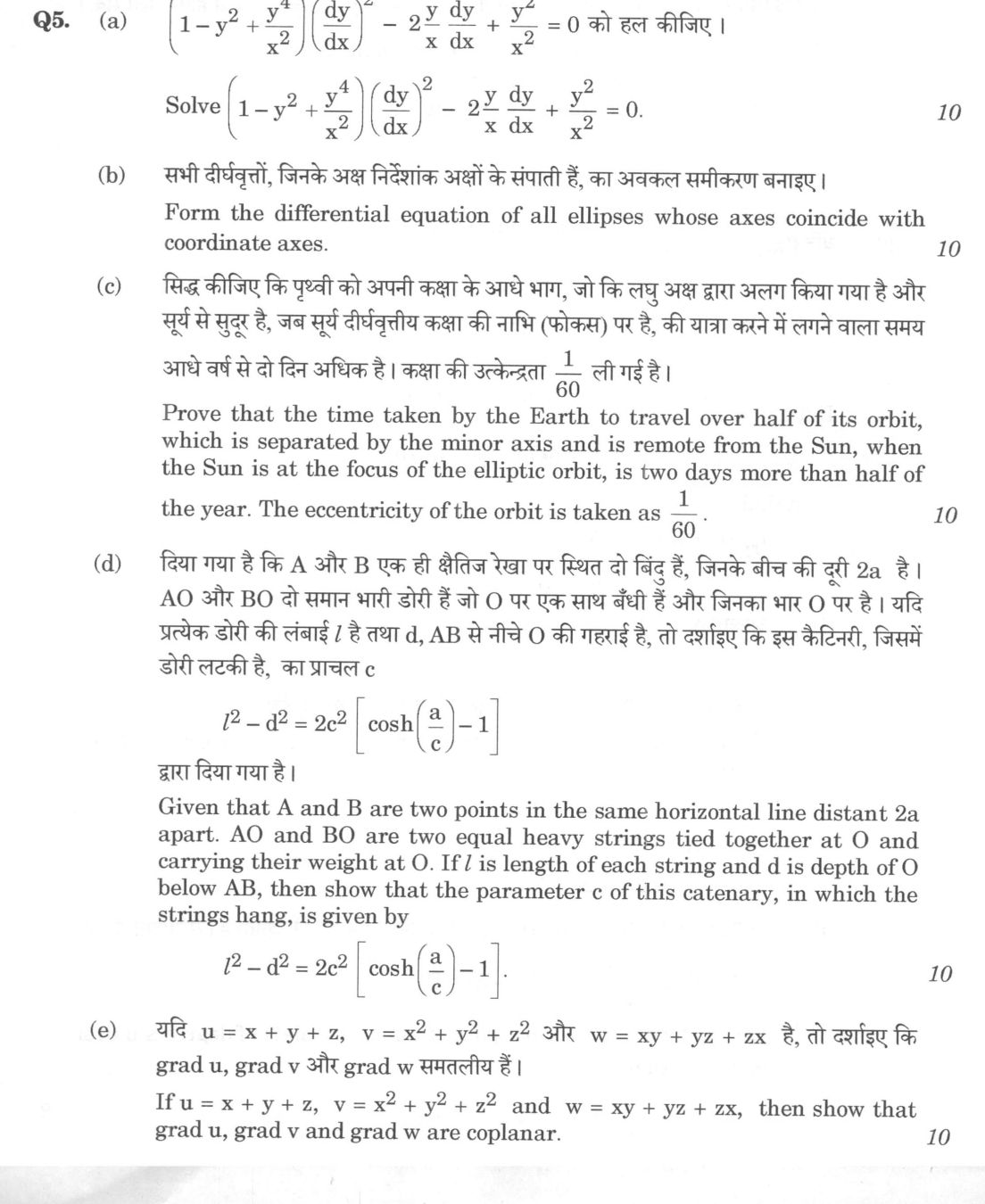
(a) Solve (1-y²+(y⁴)/(x²))(dy/dx)²-2y/xdy/dx+(y²)/(x²)=0. 10 marks (b) Form the differential equation of all ellipses whose axes…
Solve (1-y²+(y⁴)/(x²))(dy/dx)²-2y/xdy/dx+(y²)/(x²)=0. 10 marks
Form the differential equation of all ellipses whose axes coincide with coordinate axes. 10 marks
Prove that the time taken by the Earth to travel over half of its orbit, which is separated by the minor axis and is remote from the Sun, when the Sun is at the focus of the elliptic orbit, is two days more than half of the year. The eccentricity of the orbit is taken as 1/60. 10 marks
Given that A and B are two points in the same horizontal line distant 2a apart. AO and BO are two equal heavy strings tied together at O and carrying their weight at O. If l is length of each string and d is depth of O below AB, then show that the parameter c of this catenary, in which the strings hang, is given by
l²-d²=2c²[cosh(a/c)-1]. 10 marks
If u=x+y+z, v=x²+y²+z² and w=xy+yz+zx, then show that grad u, grad v and grad w are coplanar. 10 marks
हिंदी में प्रश्न पढ़ें
(1-y²+(y⁴)/(x²))(dy/dx)²-2y/xdy/dx+(y²)/(x²)=0 को हल कीजिए । 10 अंक
सभी दीर्घवृत्तों, जिनके अक्ष निर्देशांक अक्षों के संपाती हैं, का अवकल समीकरण बनाइए । 10 अंक
सिद्ध कीजिए कि पृथ्वी को अपनी कक्षा के आधे भाग, जो कि लघु अक्ष द्वारा अलग किया गया है और सूर्य से सुदूर है, जब सूर्य दीर्घवृत्तीय कक्षा की नाभि (फोकस) पर है, की यात्रा करने में लगने वाला समय आधे वर्ष से दो दिन अधिक है। कक्षा की उत्केन्द्रता 1/60 ली गई है। 10 अंक
दिया गया है कि A और B एक ही क्षैतिज रेखा पर स्थित दो बिंदु हैं, जिनके बीच की दूरी 2a है। AO और BO दो समान भारी डोरी हैं जो O पर एक साथ बंधी हैं और जिनका भार O पर है। यदि प्रत्येक डोरी की लंबाई l है तथा d, AB से नीचे O की गहराई है, तो दर्शाइए कि इस कैटनरी, जिसमें डोरी लटकी है, का प्राचल c
l²-d²=2c²[cosh(a/c)-1]
द्वारा दिया गया है। 10 अंक
यदि u=x+y+z, v=x²+y²+z² और w=xy+yz+zx है, तो दर्शाइए कि grad u, grad v और grad w समतलीय हैं। 10 अंक
Model answer
Written by UPSC Answer Check against this question's marking rubric, to the expected length. UPSC does not publish answers for Mains — this is one way to score well, not an official key.
(a) Let p = dy/dx. The equation is (1 - y² + y⁴/x²)p² - 2(y/x)p + y²/x² = 0.
Put q = dx/dy = 1/p for p ≠ 0. Substituting p = 1/q gives, after multiplying by x²q², x²(1 - y²) + y⁴ - 2xyq + y²q² = 0. Hence (yq - x)² = y²(x² - y²).
Set u = x/y, so x = uy. Then q = dx/dy = u + y du/dy, and yq - x = y² du/dy. Thus y⁴(du/dy)² = y⁴(u² - 1), so (du/dy)² = u² - 1. Therefore du/dy = ±√(u² - 1), and integration gives arcosh|u| = ±y + C. Hence u = ±cosh(y + C), so the general solution is x = ± y cosh(y + C).
The exceptional solutions y = 0, x = y and x = -y also satisfy the original equation.
(b) Let the ellipse have its axes along the coordinate axes and centre at the origin: x²/a² + y²/b² = 1, where a and b are arbitrary constants. Differentiate twice with respect to x: 2x/a² + 2y y′/b² = 0, so x/a² + y y′/b² = 0. … (1)
Differentiating again, 1/a² + (y′² + y y″)/b² = 0. … (2)
From (1), y y′/b² = -x/a². Using this in (2), 1/a² - x(y′² + y y″)/(a² y y′) = 0. Multiplying by a², 1 - x(y′² + y y″)/(y y′) = 0. Thus y y′ - x y′² - x y y″ = 0, or x y y″ + x(y′)² - y y′ = 0. This is the required differential equation.
(c) Let the semi-major axis be a, semi-minor axis b, and eccentricity e = 1/60. The distance of the focus from the centre is c = ae. The total area of the ellipse is πab, and by Kepler’s second law, area swept is proportional to time.
Let T be the length of the year. The minor axis divides the ellipse into two equal halves of area πab/2. Consider the half remote from the Sun. The area swept by the radius vector from the Sun over this remote half equals the half-ellipse area plus the triangle whose base is the minor axis, length 2b, and whose height is c = ae.
Area of that triangle = (1/2)(2b)(ae) = abe. So the area swept over the remote half is πab/2 + abe.
Hence the time t taken over this remote half is t = T × (area swept)/(total area) = T × (πab/2 + abe)/(πab) = T(1/2 + e/π).
Therefore t - T/2 = T e/π. With e = 1/60, t - T/2 = T/(60π). Taking T ≈ 365.25 days, t - T/2 ≈ 365.25/(60 × 3.14159) ≈ 1.94 days ≈ 2 days. Thus the time taken over the remote half is two days more than half the year.
(d) By symmetry, since AO = BO = l and the load is at O, O lies midway between A and B. Hence the horizontal distance from A to O is a, and the vertical depth of O below AB is d.
Take the string AO as a segment of a catenary y = c cosh((x - x₀)/c) + k. Let O correspond to parameter u and A to parameter v, so that u - v = a/c.
For a catenary, the arc length and vertical height are s = c sinh((x - x₀)/c), y - k = c cosh((x - x₀)/c). Thus for the segment AO, taking A higher than O, l = c(sinh u - sinh v), d = c(cosh v - cosh u).
Therefore l² - d² = c²[(sinh u - sinh v)² - (cosh u - cosh v)²].
Using the identities sinh u - sinh v = 2 cosh((u+v)/2) sinh((u-v)/2), cosh u - cosh v = 2 sinh((u+v)/2) sinh((u-v)/2), we get l² - d² = c²[4 sinh²((u-v)/2){cosh²((u+v)/2) - sinh²((u+v)/2)}] = 4c² sinh²((u-v)/2).
Since u - v = a/c, l² - d² = 4c² sinh²(a/(2c)). But 4 sinh²(a/(2c)) = 2[cosh(a/c) - 1]. Hence l² - d² = 2c²[cosh(a/c) - 1]. This proves the required result.
(e) Given u = x + y + z, v = x² + y² + z², w = xy + yz + zx, we compute the gradients: grad u = i + j + k, grad v = 2x i + 2y j + 2z k, grad w = (y + z)i + (z + x)j + (x + y)k.
Now observe that u² = (x + y + z)² = x² + y² + z² + 2(xy + yz + zx) = v + 2w. Hence v = u² - 2w. Taking gradients, grad v = 2u grad u - 2 grad w. Thus grad v is a linear combination of grad u and grad w. Therefore the three vectors grad u, grad v, grad w are linearly dependent, and hence they are coplanar.
Directly, their scalar triple product is det[[1, 1, 1], [2x, 2y, 2z], [y+z, z+x, x+y]] = 0, which also proves that grad u, grad v and grad w are coplanar.
What "Solve" is asking you to do
Choose the method, then carry it through to a final answer. Identifying what kind of problem this is and why that method applies is the first thing marked; a correct figure arrived at invisibly earns almost nothing.
Structure that answers it
Given data and what is required → method chosen, with the reason it applies → set-up (equation, circuit, free body, trial balance) → working, step by step → answer with units and any condition of validity
Where marks are lost
Doing the middle steps mentally and writing only the result. In mathematics papers, a further loss comes from giving a decimal where the exact value in surds or fractions was wanted, or from skipping the justification a part explicitly asks for.
How this answer will be evaluated
Approach
(a) calculate: given > formula > substitution > result with units > interpretation | (b) derive: given > assumptions > stepwise derivation > result > check | (c) justify: claim > 3-4 reasons > evidence > conclusion | (d) justify: claim > 3-4 reasons > evidence > conclusion | (e) justify: claim > 3-4 reasons > evidence > conclusion Full marks: Complete, rigorous derivations with all steps justified and verified.
Key points expected
- Identify equation as homogeneous in x, y
- Apply substitution y = vx
- Separate variables and integrate
- State final general solution
- State general equation of ellipse
- Differentiate to eliminate constants
- Form final differential equation
- Use Kepler's Second Law (equal areas)
Evaluation rubric
Each sub-part is marked on its own, against the marks and word limit printed on the paper.
- (a) General solution of the given second-order non-linear differential equation. 10 marks
calculate— given → formula → substitution → result with units → interpretation
Must cover
- Identify equation as homogeneous in x, y
- Apply substitution y = vx
- Separate variables and integrate
- State final general solution
Loses marks
- Incorrect substitution for homogeneous equation
- Algebraic errors in separation of variables
Earns more
- Correct algebraic simplification of terms
- Verification of solution by differentiation
Extra mark
- Alternative substitution method noted
- (b) Differential equation representing the family of ellipses with axes on coordinate axes. 10 marks
derive— given → assumptions → stepwise derivation → result → check
Must cover
- State general equation of ellipse
- Differentiate to eliminate constants
- Form final differential equation
Loses marks
- Failure to eliminate all constants
- Incorrect differentiation steps
Earns more
- Clear elimination of arbitrary constants
- Verification of the derived equation
Extra mark
- Mention of specific cases (circle)
- (c) Proof that time for half-orbit (remote from Sun) exceeds half-year by 2 days. 10 marks
justify— claim → 3-4 reasons → evidence → conclusion
Must cover
- Use Kepler's Second Law (equal areas)
- Calculate area of half-ellipse
- Substitute eccentricity e = 1/60
- Show time difference is 2 days
Loses marks
- Incorrect area calculation for ellipse
- Failure to relate area to time
Earns more
- Correct application of area formula
- Clear logical flow of the proof
Extra mark
- Diagram of elliptical orbit with Sun at focus
- (d) Derivation of the catenary parameter c relation for the given string setup. 10 marks
justify— claim → 3-4 reasons → evidence → conclusion
Must cover
- Set up coordinate system for catenary
- Use catenary equation y = c cosh(x/c)
- Apply boundary conditions for length l and depth d
- Derive the given formula
Loses marks
- Incorrect catenary equation
- Algebraic errors in derivation
Earns more
- Correct use of arc length formula
- Clear geometric interpretation
Extra mark
- Neat diagram of the hanging strings
- (e) Proof that the gradients of u, v, and w are coplanar. 10 marks
justify— claim → 3-4 reasons → evidence → conclusion
Must cover
- Calculate grad u, grad v, grad w
- Set up scalar triple product
- Show determinant is zero
- Conclude coplanarity
Loses marks
- Incorrect gradient calculations
- Failure to show determinant is zero
Earns more
- Correct calculation of gradients
- Clear determinant evaluation
Extra mark
- Alternative method using linear dependence
Practice this exact question
Write your answer and it is marked point by point against the model answer above — what you covered, what you missed, what you got wrong.
Evaluate my answer →More from Mathematics 2025 Paper I
- Q2 (a) Let T : ℝ³ → ℝ² be a linear transformation such that T(1, 1, -1) = (1, 0), T(4, 1, 1)…
- Q3 (a) Reduce the following matrix to echelon form: A = 2 & -2 & 2 & 1 -3 & 6 & 0 & -1 1 & -…
- Q4 (a) Show that there is no tangent plane to the sphere x² + y² + z² - 4x + 2y - 4z + 4 = 0…
- Q5 (a) Solve (1-y²+(y⁴)/(x²))(dy/dx)²-2y/xdy/dx+(y²)/(x²)=0. 10 marks (b) Form the different…
- Q6 (a) If F(s) and G(s) are Laplace transforms of f(t) and g(t) respectively, then prove tha…
- Q7 (a) A solid sphere rests inside a fixed rough and hemispherical bowl of twice its radius.…
- Q8 (a) Solve the differential equation (x + 2)(d^2y)/(dx²) - (2x + 5)dy/dx + 2y = (1 + x) e^…