Paper I — Q4
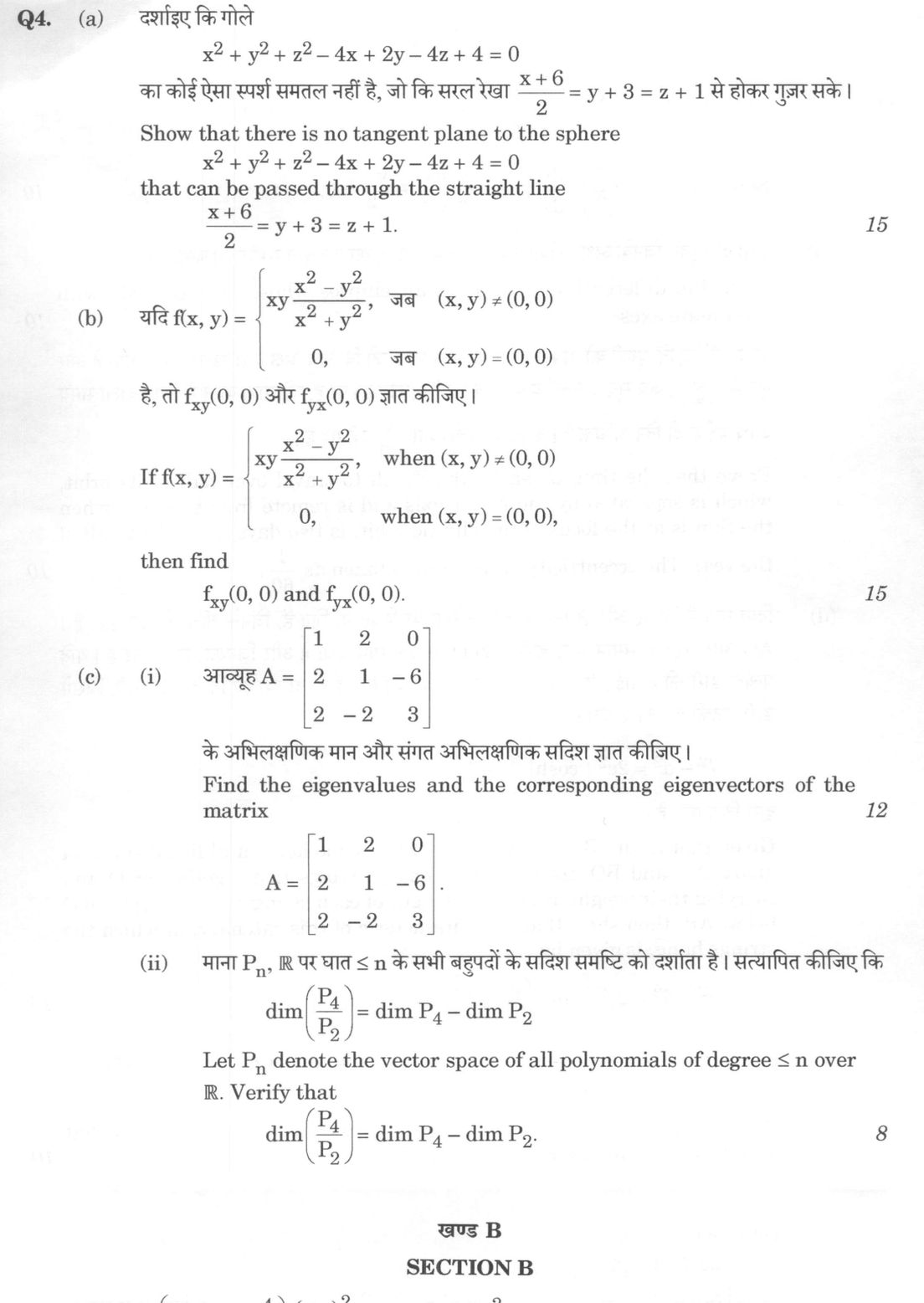
(a) Show that there is no tangent plane to the sphere x² + y² + z² - 4x + 2y - 4z + 4 = 0 that can be passed through the straight…
Show that there is no tangent plane to the sphere x² + y² + z² - 4x + 2y - 4z + 4 = 0 that can be passed through the straight line (x+6)/2 = y + 3 = z + 1. 15 marks
If f(x, y) = { xy(x²-y²)/(x²+y²), when (x,y) ≠ (0,0) { 0, when (x,y) = (0,0), then find f_xy(0,0) and f_yx(0,0). 15 marks
Find the eigenvalues and the corresponding eigenvectors of the matrix A = [1 2 0] [2 1 -6] [2 -2 3] 12 marks
Let P_n denote the vector space of all polynomials of degree ≤ n over R. Verify that dim(P_4/P_2) = dim P_4 - dim P_2. 8 marks
हिंदी में प्रश्न पढ़ें
दर्शाइए कि गोले x² + y² + z² - 4x + 2y - 4z + 4 = 0 का कोई ऐसा स्पर्श समतल नहीं है, जो कि सरल रेखा (x+6)/2 = y + 3 = z + 1 से होकर गुजर सके। (15 अंक)
यदि f(x, y) = { xy(x²-y²)/(x²+y²), जब (x,y) ≠ (0,0) { 0, जब (x,y) = (0,0) है, तो f_xy(0,0) और f_yx(0,0) ज्ञात कीजिए। (15 अंक)
आव्यूह A = [1 2 0] [2 1 -6] [2 -2 3] के अभिलक्षणिक मान और संगत अभिलक्षणिक सदिश ज्ञात कीजिए। (12 अंक)
माना P_n, R पर घात ≤ n के सभी बहुपदों के सदिश समष्टि को दर्शाता है। सत्यापित कीजिए कि dim(P_4/P_2) = dim P_4 - dim P_2। (8 अंक)
Model answer
Written by UPSC Answer Check against this question's marking rubric, to the expected length. UPSC does not publish answers for Mains — this is one way to score well, not an official key.
(a) Complete the square in the sphere equation: x² + y² + z² - 4x + 2y - 4z + 4 = 0 => (x-2)² + (y+1)² + (z-2)² = 5. So the sphere has centre C = (2,-1,2) and radius R = √5.
The given line is (x+6)/2 = y+3 = z+1 = t. Hence x = 2t - 6, y = t - 3, z = t - 1. So it passes through A = (-6,-3,-1) and has direction vector v = (2,1,1).
Suppose a tangent plane to the sphere contains this line. Then its distance from C must equal R = √5.
Any plane containing the line has normal n perpendicular to v. Its distance from C is |n·(C-A)|/||n||. For n perpendicular to v, this distance is at most the perpendicular distance from C to the line.
Now C - A = (8,2,3). The distance from C to the line is ||(C-A) × v||/||v||. Compute (8,2,3) × (2,1,1) = (-1,-2,4). Thus distance = √(1+4+16)/√(4+1+1) = √21/√6 = √(7/2).
But √(7/2) < √5 since 7/2 < 5. Therefore every plane containing the given line is at distance strictly less than the radius √5 from the centre. Hence no such plane can be tangent to the sphere.
Final answer: no tangent plane exists.
(b) Take the convention f_xy = (f_x)_y.
For (x,y) ≠ (0,0), f_x = [(3x²y - y³)(x²+y²) - (x³y - xy³)(2x)]/(x²+y²)². Putting x = 0, y ≠ 0 gives f_x(0,y) = -y. Also, f_x(0,0) = lim h→0 [f(h,0)-f(0,0)]/h = 0. Therefore f_xy(0,0) = lim k→0 [f_x(0,k)-f_x(0,0)]/k = lim k→0 (-k)/k = -1.
Similarly, f_y = [(x³ - 3xy²)(x²+y²) - (x³y - xy³)(2y)]/(x²+y²)². Putting y = 0, x ≠ 0 gives f_y(x,0) = x. Also, f_y(0,0) = 0. Hence f_yx(0,0) = lim h→0 [f_y(h,0)-f_y(0,0)]/h = lim h→0 h/h = 1.
Final answer: f_xy(0,0) = -1, f_yx(0,0) = 1.
(c)(i) For A = [[1,2,0],[2,1,-6],[2,-2,3]], the characteristic equation is det(A - λI) = 0: |1-λ, 2, 0; 2, 1-λ, -6; 2, -2, 3-λ| = 0. Expanding: (1-λ)[(1-λ)(3-λ)-12] - 2[2(3-λ)+12] = 0 => (1-λ)(λ²-4λ-9) - 2(18-2λ) = 0 => -λ³ + 5λ² + 9λ - 45 = 0 => -(λ-3)(λ-5)(λ+3) = 0. Thus the eigenvalues are λ = 3, 5, -3.
For λ = 3: A - 3I = [[-2,2,0],[2,-2,-6],[2,-2,0]]. The equations give x = y and z = 0. So an eigenvector is (1,1,0)^T.
For λ = 5: A - 5I = [[-4,2,0],[2,-4,-6],[2,-2,-2]]. The equations give y = 2x and z = -x. So an eigenvector is (1,2,-1)^T.
For λ = -3: A + 3I = [[4,2,0],[2,4,-6],[2,-2,6]]. The equations give y = -2x and z = -x. So an eigenvector is (1,-2,-1)^T.
Final answer: eigenvalues 3, 5, -3 with eigenvectors (1,1,0)^T, (1,2,-1)^T, (1,-2,-1)^T respectively.
(c)(ii) P_2 is a subspace of P_4. We have dim P_4 = 5, dim P_2 = 3.
A natural basis of P_4 is {1, x, x², x³, x⁴}. Since P_2 = span{1, x, x²}, the quotient P_4/P_2 has cosets represented by the remaining basis elements: {x³ + P_2, x⁴ + P_2}.
These two cosets are linearly independent: if a(x³+P_2) + b(x⁴+P_2) = P_2, then ax³ + bx⁴ ∈ P_2. But P_2 contains no x³ or x⁴ term, so a = b = 0.
They also span P_4/P_2, because any polynomial in P_4 can be written as a0 + a1x + a2x² + a3x³ + a4x⁴, whose coset is a3(x³+P_2) + a4(x⁴+P_2).
Thus dim(P_4/P_2) = 2. Also, dim P_4 - dim P_2 = 5 - 3 = 2. Therefore, dim(P_4/P_2) = dim P_4 - dim P_2.
What "Prove" is asking you to do
Establish that the statement holds for every case it claims, not for one representative case. The argument must be closed: each line follows from a definition, a hypothesis, or a named theorem you are entitled to use.
Structure that answers it
Given and to prove, restated → theorem or construction to be used, named → the argument line by line → conclusion stated as proved
Where marks are lost
Testing one example, which illustrates but proves nothing. On an if and only if claim, proving one direction and stopping forfeits that half outright, and degenerate cases — zero, the empty set, the equality case — have to be disposed of rather than assumed away.
How this answer will be evaluated
Approach
(a) justify: claim > 3-4 reasons > evidence > conclusion | (b) calculate: given > formula > substitution > result with units > interpretation | (c(i)) calculate: given > formula > substitution > result with units > interpretation | (c(ii)) justify: claim > 3-4 reasons > evidence > conclusion Full marks: Rigorous derivations with all steps shown and correct results
Key points expected
- Identify sphere center and radius from equation
- Parametrize the given straight line
- Set up condition for plane passing through line
- Show distance from center to plane is not equal to radius
- Apply limit definition of partial derivative
- Evaluate f_x(0,y) and f_y(x,0) limits
- Compute f_xy(0,0) and f_yx(0,0) separately
- Show that f_xy(0,0) ≠ f_yx(0,0)
Evaluation rubric
Each sub-part is marked on its own, against the marks and word limit printed on the paper.
- (a) Prove non-existence of a tangent plane to the sphere passing through the given line. 15 marks
justify— claim → 3-4 reasons → evidence → conclusion
Must cover
- Identify sphere center and radius from equation
- Parametrize the given straight line
- Set up condition for plane passing through line
- Show distance from center to plane is not equal to radius
Loses marks
- Assuming a tangent plane exists
- Incorrect parametrization of the line
Earns more
- Use of normal vector for tangent plane
- Clear algebraic manipulation of line parameters
Extra mark
- Geometric sketch of sphere and line
- (b) Compute the mixed partial derivatives f_xy(0,0) and f_yx(0,0). 15 marks
calculate— given → formula → substitution → result with units → interpretation
Must cover
- Apply limit definition of partial derivative
- Evaluate f_x(0,y) and f_y(x,0) limits
- Compute f_xy(0,0) and f_yx(0,0) separately
- Show that f_xy(0,0) ≠ f_yx(0,0)
Loses marks
- Differentiating f(x,y) directly at origin
- Skipping the limit evaluation steps
Earns more
- Explicit substitution of x=0 and y=0 in limits
- Mention of Clairaut's theorem conditions
Extra mark
- Note on continuity of second partials
- (c(i)) Find eigenvalues and corresponding eigenvectors of matrix A. 12 marks
calculate— given → formula → substitution → result with units → interpretation
Must cover
- Formulate characteristic equation det(A-λI)=0
- Solve cubic equation for eigenvalues
- Solve (A-λI)v=0 for each eigenvector
- List eigenvalues with their eigenvectors
Loses marks
- Incorrect characteristic polynomial
- Missing eigenvectors for repeated roots
Earns more
- Step-by-step determinant expansion
- Verification of eigenvector equation
Extra mark
- Check trace equals sum of eigenvalues
- (c(ii)) Verify the dimension formula for the quotient space P_4/P_2. 8 marks
justify— claim → 3-4 reasons → evidence → conclusion
Must cover
- State dimension of P_4 and P_2
- Identify P_2 as a subspace of P_4
- Apply dimension formula for quotient space
- Conclude dim(P_4/P_2) = 2
Loses marks
- Confusing quotient space with subspace
- Incorrect dimension calculation for P_n
Earns more
- Explicit basis for P_4 and P_2
- Definition of quotient space elements
Extra mark
- Example of a coset in P_4/P_2
Practice this exact question
Write your answer and it is marked point by point against the model answer above — what you covered, what you missed, what you got wrong.
Evaluate my answer →More from Mathematics 2025 Paper I
- Q1 (a) Can the set {(0, 0, 0, 3), (1, 1, 0, 0), (0, 1, –1, 0)} be extended to form a basis o…
- Q2 (a) Let T : ℝ³ → ℝ² be a linear transformation such that T(1, 1, -1) = (1, 0), T(4, 1, 1)…
- Q3 (a) Reduce the following matrix to echelon form: A = 2 & -2 & 2 & 1 -3 & 6 & 0 & -1 1 & -…
- Q4 (a) Show that there is no tangent plane to the sphere x² + y² + z² - 4x + 2y - 4z + 4 = 0…
- Q5 (a) Solve (1-y²+(y⁴)/(x²))(dy/dx)²-2y/xdy/dx+(y²)/(x²)=0. 10 marks (b) Form the different…
- Q6 (a) If F(s) and G(s) are Laplace transforms of f(t) and g(t) respectively, then prove tha…
- Q7 (a) A solid sphere rests inside a fixed rough and hemispherical bowl of twice its radius.…