Paper I — Q8
(a) Solve the differential equation (x + 2)(d^2y)/(dx²) - (2x + 5)dy/dx + 2y = (1 + x) e^x by the method of variation of…
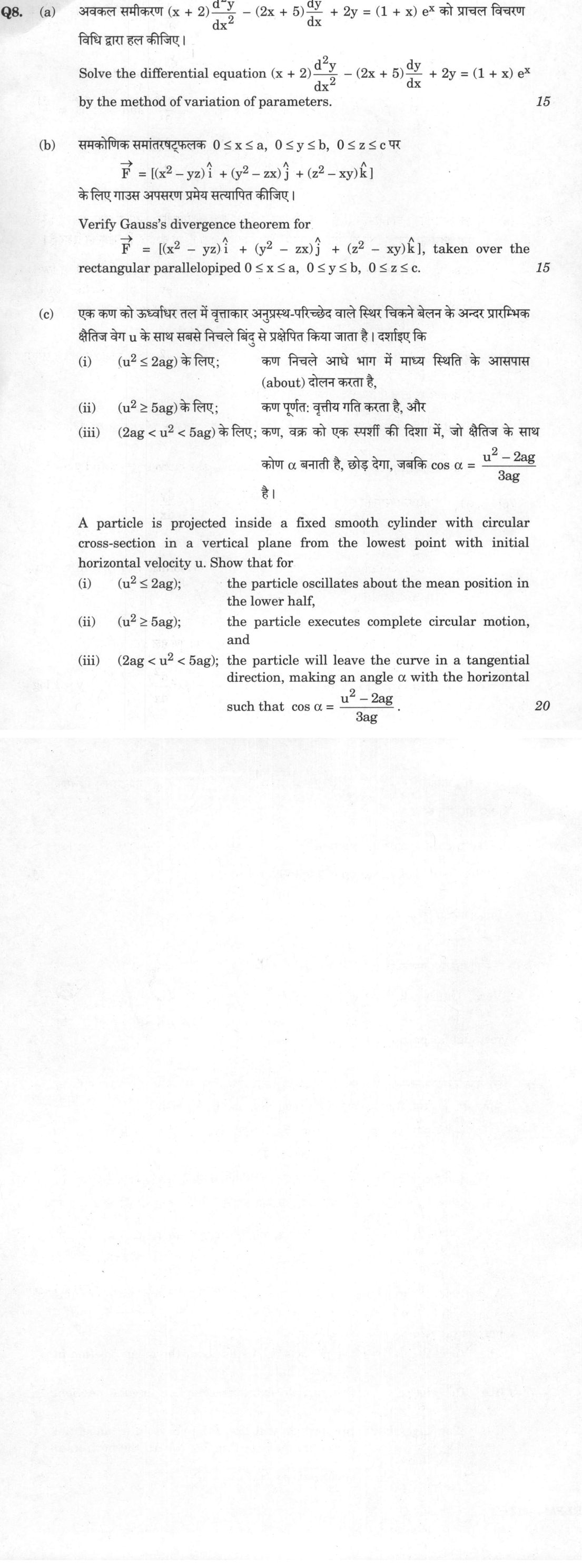
Solve the differential equation (x + 2)(d^2y)/(dx²) - (2x + 5)dy/dx + 2y = (1 + x) e^x by the method of variation of parameters. 15 marks
Verify Gauss's divergence theorem for F⃗ = [(x² - yz)î + (y² - zx)ĵ + (z² - xy)k̂], taken over the rectangular parallelopiped 0 ≤ x ≤ a,0 ≤ y ≤ b,0 ≤ z ≤ c. 15 marks
A particle is projected inside a fixed smooth cylinder with circular cross-section in a vertical plane from the lowest point with initial horizontal velocity u. Show that for (i) (u² ≤ 2ag); the particle oscillates about the mean position in the lower half, (ii) (u² ≥ 5ag); the particle executes complete circular motion, and (iii) (2ag < u² < 5ag); the particle will leave the curve in a tangential direction, making an angle α with the horizontal such that cos α = (u² - 2ag)/3ag. 20 marks
हिंदी में प्रश्न पढ़ें
अवकल समीकरण (x + 2)(d^2y)/(dx²) - (2x + 5)dy/dx + 2y = (1 + x) e^x को प्राचल विचरण विधि द्वारा हल कीजिए। (15 अंक)
समकोणिक समांतरपटलक 0 ≤ x ≤ a,0 ≤ y ≤ b,0 ≤ z ≤ cपरF⃗ = [(x² - yz)î + (y² - zx)ĵ + (z² - xy)k̂] के लिए गॉस अपसरण प्रमेय सत्यापित कीजिए। (15 अंक)
एक कण को उच्चाधर तल में वृत्ताकर अनुप्रस्थ-परिच्छेद वाले स्थिर चिकने बेलन के अंदर प्रारंभिक क्षैतिज वेग u के साथ सबसे निचले बिंदु से प्रक्षेपित किया जाता है। दर्शाइए कि (i) (u² ≤ 2ag) के लिए; कण निचले आधे भाग में माध्य स्थिति के आसपास (about) दोलन करता है, (ii) (u² ≥ 5ag) के लिए; कण पूर्णतः वृत्तीय गति करता है, और (iii) (2ag < u² < 5ag) के लिए; कण, वक्र को एक स्पर्श की दिशा में, जो क्षैतिज के साथ कोण α बनाती है, छोड़ देगा, जबकि cos α = (u² - 2ag)/3ag है। (20 अंक)
Model answer
Written by UPSC Answer Check against this question's marking rubric, to the expected length. UPSC does not publish answers for Mains — this is one way to score well, not an official key.
(a) The homogeneous equation is (x+2)y'' - (2x+5)y' + 2y = 0. It is satisfied by y1 = e^(2x) and y2 = 2x+5. Their Wronskian is W = e^(2x)·2 - 2e^(2x)(2x+5) = -4(x+2)e^(2x).
Let y = u e^(2x) + v(2x+5). By variation of parameters, u' e^(2x) + v'(2x+5) = 0, 2u' e^(2x) + 2v' = (1+x)e^x/(x+2).
Solving these, u' = (1+x)(2x+5)e^(-x)/[4(x+2)^2], v' = -(1+x)e^x/[4(x+2)^2].
A convenient integration gives u = -(2x+3)e^(-x)/[4(x+2)], v = -e^x/[4(x+2)]. Differentiating these gives exactly the above u', v'. Hence y_p = u e^(2x) + v(2x+5) = -(2x+3)e^x/[4(x+2)] - (2x+5)e^x/[4(x+2)] = -e^x.
Therefore the general solution, valid for x ≠ -2, is y = C1 e^(2x) + C2(2x+5) - e^x.
(b) ∇·F = ∂/∂x(x^2-yz) + ∂/∂y(y^2-zx) + ∂/∂z(z^2-xy) = 2x + 2y + 2z.
Thus ∭_V ∇·F dV = ∫_0^a ∫_0^b ∫_0^c 2(x+y+z) dz dy dx = abc(a+b+c).
Now compute the surface flux over the six faces. x = 0: n = -i, F·n = yz. Flux = (b^2/2)(c^2/2) = b^2c^2/4. x = a: n = i, F·n = a^2 - yz. Flux = a^2bc - b^2c^2/4. Sum over x-faces = a^2bc.
y = 0: n = -j, F·n = zx. Flux = a^2c^2/4. y = b: n = j, F·n = b^2 - zx. Flux = ab^2c - a^2c^2/4. Sum over y-faces = ab^2c.
z = 0: n = -k, F·n = xy. Flux = a^2b^2/4. z = c: n = k, F·n = c^2 - xy. Flux = abc^2 - a^2b^2/4. Sum over z-faces = abc^2.
Therefore ∬_S F·n dS = a^2bc + ab^2c + abc^2 = abc(a+b+c). This equals the volume integral, so Gauss’s divergence theorem is verified.
(c) Let a be the radius and let θ be measured from the lowest point. The height above the lowest point is h = a(1 - cos θ). By conservation of energy, v^2 = u^2 - 2ga(1 - cos θ).
The radial equation, with N as the inward normal reaction, is m v^2/a = N - mg cos θ. Hence N = m(v^2/a + g cos θ) = m[(u^2 - 2ag)/a + 3g cos θ].
(i) If u^2 ≤ 2ag, then at the extreme position v = 0, so u^2 = 2ga(1 - cos θ). Since u^2 ≤ 2ag, this gives cos θ ≥ 0, i.e. θ ≤ π/2. Thus the particle cannot cross the horizontal diameter; it oscillates about the lowest point in the lower half.
(ii) For complete circular motion, contact must be maintained throughout. The minimum reaction occurs at the highest point θ = π: N_top = m[(u^2 - 2ag)/a - 3g] = m(u^2 - 5ag)/a. For N_top ≥ 0, we require u^2 ≥ 5ag. Then N ≥ 0 everywhere, so the particle executes complete circular motion.
(iii) If 2ag < u^2 < 5ag, then at θ = π/2, N > 0, while at θ = π, N < 0. Hence N becomes zero for some θ0 in (π/2, π). Setting N = 0, (u^2 - 2ag)/a + 3g cos θ0 = 0, so cos θ0 = -(u^2 - 2ag)/(3ag).
At this point the particle leaves the curve tangentially. If α is the acute angle made by the tangent with the horizontal, then cos α = |cos θ0| = (u^2 - 2ag)/(3ag). Thus the particle leaves in a tangential direction making the stated angle α with the horizontal.
What "Solve" is asking you to do
Choose the method, then carry it through to a final answer. Identifying what kind of problem this is and why that method applies is the first thing marked; a correct figure arrived at invisibly earns almost nothing.
Structure that answers it
Given data and what is required → method chosen, with the reason it applies → set-up (equation, circuit, free body, trial balance) → working, step by step → answer with units and any condition of validity
Where marks are lost
Doing the middle steps mentally and writing only the result. In mathematics papers, a further loss comes from giving a decimal where the exact value in surds or fractions was wanted, or from skipping the justification a part explicitly asks for.
How this answer will be evaluated
Approach
(a) derive: given > assumptions > stepwise derivation > result > check | (b) derive: given > assumptions > stepwise derivation > result > check | (c) derive: given > assumptions > stepwise derivation > result > check Full marks: Rigorous derivations with all steps shown and verified.
Key points expected
- Find complementary function y_c = c1e^x + c2e^(2x)
- Set up Wronskian W = e^(3x)
- Calculate u1' and u2' integrals correctly
- Combine y_c and particular integral y_p
- Calculate volume integral of div F = 2(x+y+z)
- Evaluate surface integrals over all 6 faces
- Show volume integral equals sum of surface integrals
- Correct limits of integration for rectangular parallelepiped
Evaluation rubric
Each sub-part is marked on its own, against the marks and word limit printed on the paper.
- (a) Complete solution of the ODE using variation of parameters. 15 marks
derive— given → assumptions → stepwise derivation → result → check
Must cover
- Find complementary function y_c = c1e^x + c2e^(2x)
- Set up Wronskian W = e^(3x)
- Calculate u1' and u2' integrals correctly
- Combine y_c and particular integral y_p
Loses marks
- Incorrect Wronskian calculation
- Missing particular integral term
Earns more
- Explicit integration steps for u1 and u2
- Verification by substituting y into ODE
Extra mark
- Alternative method (e.g., undetermined coefficients) noted
- (b) Verification of Gauss's theorem via volume and surface integrals. 15 marks
derive— given → assumptions → stepwise derivation → result → check
Must cover
- Calculate volume integral of div F = 2(x+y+z)
- Evaluate surface integrals over all 6 faces
- Show volume integral equals sum of surface integrals
- Correct limits of integration for rectangular parallelepiped
Loses marks
- Incorrect divergence calculation
- Missing or incorrect surface integral for any face
Earns more
- Clear labeling of outward normals for each face
- Step-by-step evaluation of triple integral
Extra mark
- Sketch of the rectangular parallelepiped
- (c) Analysis of particle motion in a vertical circular cylinder. 20 marks
derive— given → assumptions → stepwise derivation → result → check
Must cover
- Apply energy conservation to find velocity v(θ)
- Derive condition for oscillation (u² ≤ 2ag)
- Derive condition for complete circular motion (u² ≥ 5ag)
- Derive cos α = (u² - 2ag)/3ag for intermediate case
Loses marks
- Incorrect energy conservation equation
- Failure to relate N=0 to leaving the curve
Earns more
- Free body diagram showing normal reaction and gravity
- Explicit derivation of normal reaction N(θ)
Extra mark
- Graph of N vs θ for different u values
Practice this exact question
Write your answer and it is marked point by point against the model answer above — what you covered, what you missed, what you got wrong.
Evaluate my answer →More from Mathematics 2025 Paper I
- Q5 (a) Solve (1-y²+(y⁴)/(x²))(dy/dx)²-2y/xdy/dx+(y²)/(x²)=0. 10 marks (b) Form the different…
- Q6 (a) If F(s) and G(s) are Laplace transforms of f(t) and g(t) respectively, then prove tha…
- Q7 (a) A solid sphere rests inside a fixed rough and hemispherical bowl of twice its radius.…
- Q8 (a) Solve the differential equation (x + 2)(d^2y)/(dx²) - (2x + 5)dy/dx + 2y = (1 + x) e^…