Paper I — Q7
(a) A solid sphere rests inside a fixed rough and hemispherical bowl of twice its radius. If a large amount of weight…
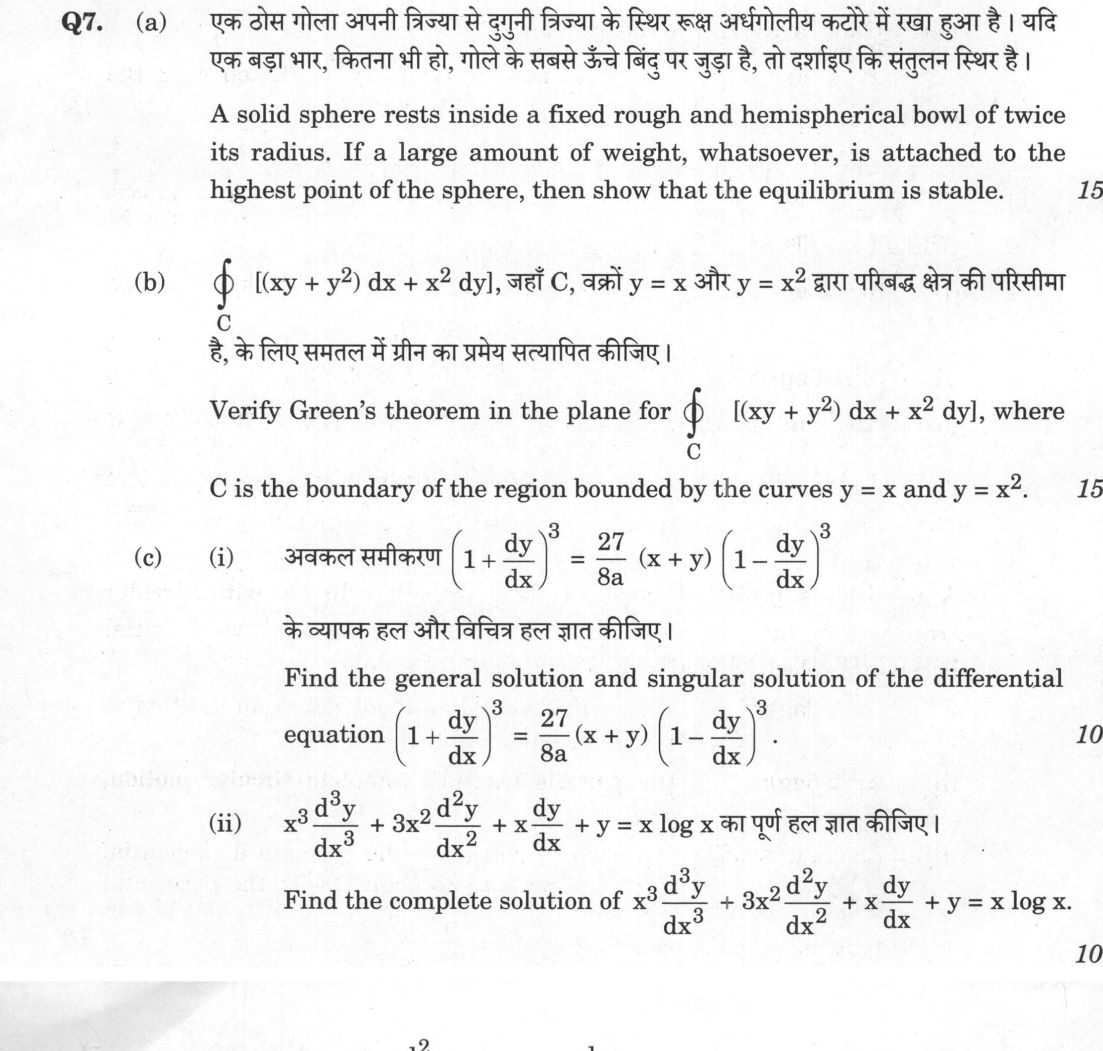
A solid sphere rests inside a fixed rough and hemispherical bowl of twice its radius. If a large amount of weight, whatsoever, is attached to the highest point of the sphere, then show that the equilibrium is stable. 15 marks
Verify Green's theorem in the plane for ∮limits_C[(x y+y²) d x+x² d y], where C is the boundary of the region bounded by the curves y=x and y=x². 15 marks
Find the general solution and singular solution of the differential equation (1+(d y)/(d x))³=27/(8 a)(x+y)(1-(d y)/(d x))³. 10 marks
Find the complete solution of x³ (d³ y)/(d x³)+3 x² (d² y)/(d x²)+x (d y)/(d x)+y=x log x. 10 marks
हिंदी में प्रश्न पढ़ें
एक ठोस गोला अपनी त्रिज्या से दुगुनी त्रिज्या के स्थिर रूक्ष अर्धगोलीय कटोरे में रखा हुआ है। यदि एक बड़ा भार, कितना भी हो, गोले के सबसे ऊँचे बिंदु पर जुड़ा है, तो दर्शाइए कि संतुलन स्थिर है। (15 अंक)
∮limits_C[(x y+y²) d x+x² d y], जहाँ C, वक्रों y=x और y=x² द्वारा परिबद्ध क्षेत्र की परिसीमा है, के लिए समतल में ग्रीन का प्रमेय सत्यापित कीजिए। (15 अंक)
अवकल समीकरण (1+(d y)/(d x))³=27/(8 a)(x+y)(1-(d y)/(d x))³ के व्यापक हल और विचित्र हल ज्ञात कीजिए। (10 अंक)
x³ (d³ y)/(d x³)+3 x² (d² y)/(d x²)+x (d y)/(d x)+y=x log x का पूर्ण हल ज्ञात कीजिए। (10 अंक)
Model answer
Written by UPSC Answer Check against this question's marking rubric, to the expected length. UPSC does not publish answers for Mains — this is one way to score well, not an official key.
(a) Let the sphere radius be r m and the bowl radius be 2r m. Let O be the bowl centre and let the line OG from O to the sphere centre G make angle θ rad with the downward vertical. Then G = (r sin θ, −r cos θ) m. For rolling without slipping inside a bowl of twice radius, the rotation angle of the sphere is −θ. The material point A initially at the highest point of the sphere has vector GA = (0, r) m. After rolling, GA = (r sin θ, r cos θ) m, so A = G + GA = (2r sin θ, 0) m. Thus the attached weight moves on a fixed horizontal line through O, so its potential energy is constant. Total potential energy: V(θ) = −Mgr cos θ + constant. Hence dV/dθ = Mgr sin θ, so θ = 0 is equilibrium. Also d²V/dθ² = Mgr cos θ, and at θ = 0 this equals Mgr > 0. By the potential-energy criterion, the equilibrium is stable for any attached weight. Final: stable.
(b) Green’s theorem states ∮_C (P dx + Q dy) = ∬_R (∂Q/∂x − ∂P/∂y) dx dy. Here P = xy + y², Q = x², and R is bounded by y = x² and y = x. They meet at x = 0 and x = 1. Positively orient C as y = x² from x = 0 to 1, then y = x from x = 1 to 0.
On y = x², dy = 2x dx: ∫_0^1 [(x³ + x⁴) + x²·2x] dx = ∫_0^1 (3x³ + x⁴) dx = 3/4 + 1/5 = 19/20.
On y = x, dy = dx, x goes from 1 to 0: ∫_1^0 [(x² + x²) + x²] dx = ∫_1^0 3x² dx = −1. Therefore ∮_C (P dx + Q dy) = 19/20 − 1 = −1/20.
Now ∂Q/∂x − ∂P/∂y = 2x − (x + 2y) = x − 2y. Thus ∬_R (x − 2y) dx dy = ∫_0^1 ∫_x²^x (x − 2y) dy dx = ∫_0^1 [xy − y²]_x²^x dx = ∫_0^1 (x⁴ − x³) dx = 1/5 − 1/4 = −1/20. Both sides agree. Final: Green’s theorem is verified; common value = −1/20.
(c)(i) Let p = dy/dx and u = x + y. Then du/dx = 1 + p. The equation becomes (1 + p)³ = (27/(8a))u(1 − p)³. Put r = (1 + p)/(1 − p). Then r³ = 27u/(8a), so r = (3/2)(u/a)^(1/3). Also p = (r − 1)/(r + 1), hence du/dx = 1 + p = 2r/(r + 1). Thus dx/du = (r + 1)/(2r) = 1/2 + 1/(2r). Substituting r, dx/du = 1/2 + a^(1/3)/(3u^(1/3)). Integrating, x = u/2 + (a^(1/3)/2)u^(2/3) + C. So 2x = u + a^(1/3)u^(2/3) + 2C. Since u = x + y, x − y − 2C = a^(1/3)(x + y)^(2/3). Let c = 2C. General solution: (x − y − c)³ = a(x + y)².
For the singular solution, differentiate the family with respect to c: −3(x − y − c)² = 0 ⇒ x − y − c = 0. Using this in the family gives a(x + y)² = 0, hence x + y = 0. Singular solution: y = −x.
(c)(ii) Let θ = x d/dx. Then θ³ y = x³ y''' + 3x² y'' + x y'. So the equation becomes (θ³ + 1)y = x log x.
Homogeneous part: for y = x^m, θy = m x^m, so m³ + 1 = 0. Thus m = −1 and m = (1 ± i√3)/2. Hence y_c = C1/x + √x [C2 cos((√3/2) log x) + C3 sin((√3/2) log x)].
For particular integral, put t = log x, so x = e^t and θ = d/dt. The equation becomes (D³ + 1)y = e^t t. Try y_p = e^t(At² + Bt + C). Then (D³ + 1)(e^t v) = e^t(v''' + 3v'' + 3v' + 2v). Thus v''' + 3v'' + 3v' + 2v = t. With v = At² + Bt + C, comparing coefficients gives A = 0, B = 1/2, C = −3/4. So y_p = x[(1/2) log x − 3/4]. Therefore the complete solution is y = C1/x + √x [C2 cos((√3/2) log x) + C3 sin((√3/2) log x)] + (x/2) log x − 3x/4, x > 0.
What "Prove" is asking you to do
Establish that the statement holds for every case it claims, not for one representative case. The argument must be closed: each line follows from a definition, a hypothesis, or a named theorem you are entitled to use.
Structure that answers it
Given and to prove, restated → theorem or construction to be used, named → the argument line by line → conclusion stated as proved
Where marks are lost
Testing one example, which illustrates but proves nothing. On an if and only if claim, proving one direction and stopping forfeits that half outright, and degenerate cases — zero, the empty set, the equality case — have to be disposed of rather than assumed away.
How this answer will be evaluated
Approach
(a) justify: claim > 3-4 reasons > evidence > conclusion | (b) justify: claim > 3-4 reasons > evidence > conclusion | (c(i)) derive: given > assumptions > stepwise derivation > result > check | (c(ii)) derive: given > assumptions > stepwise derivation > result > check Full marks: Complete derivations with all steps, correct results, and verification.
Key points expected
- Define geometry: bowl radius 2R, sphere radius R
- Identify center of mass position with added weight
- Derive potential energy as function of angle
- Show second derivative of PE is positive
- Compute line integral over boundary C
- Compute double integral over region D
- Show both integrals yield equal values
- State Green's theorem explicitly
Evaluation rubric
Each sub-part is marked on its own, against the marks and word limit printed on the paper.
- (a) Prove equilibrium is stable for a sphere in a bowl with added weight. 15 marks
justify— claim → 3-4 reasons → evidence → conclusion
Must cover
- Define geometry: bowl radius 2R, sphere radius R
- Identify center of mass position with added weight
- Derive potential energy as function of angle
- Show second derivative of PE is positive
Loses marks
- Missing geometric setup or angle definition
- No second derivative test for stability
- Assuming stability without proof
Earns more
- Neat diagram of sphere in bowl
- Explicit calculation of CM height
- Verification of stable condition d²U/dθ² > 0
Extra mark
- Alternative energy method
- Force balance verification
- (b) Verify Green's theorem for the given line integral and region. 15 marks
justify— claim → 3-4 reasons → evidence → conclusion
Must cover
- Compute line integral over boundary C
- Compute double integral over region D
- Show both integrals yield equal values
- State Green's theorem explicitly
Loses marks
- Incorrect limits of integration
- Skipping line integral or double integral
- Not stating Green's theorem
Earns more
- Correct identification of intersection points (0,0) and (1,1)
- Clear parameterization of curves y=x and y=x²
- Step-by-step integration showing intermediate results
Extra mark
- Sketch of region D
- Alternative integration order
- (c(i)) Find general and singular solutions of the given differential equation. 10 marks
derive— given → assumptions → stepwise derivation → result → check
Must cover
- Identify equation type (Clairaut's or Lagrange's)
- Derive general solution with arbitrary constant
- Find singular solution via envelope condition
- Verify solutions satisfy original equation
Loses marks
- Missing singular solution
- Incorrect general solution form
- No verification of solutions
Earns more
- Correct substitution for simplification
- Clear differentiation steps
- Explicit envelope calculation
Extra mark
- Geometric interpretation of singular solution
- Alternative solution method
- (c(ii)) Find complete solution of the given third-order differential equation. 10 marks
derive— given → assumptions → stepwise derivation → result → check
Must cover
- Identify Cauchy-Euler equation type
- Find complementary function via auxiliary equation
- Determine particular integral for x log x
- Combine CF and PI for complete solution
Loses marks
- Incorrect auxiliary equation
- Missing particular integral
- Wrong CF form
Earns more
- Correct substitution x = e^t
- Accurate auxiliary equation roots
- Systematic PI calculation
Extra mark
- Verification by substitution
- Alternative PI method
Practice this exact question
Write your answer and it is marked point by point against the model answer above — what you covered, what you missed, what you got wrong.
Evaluate my answer →More from Mathematics 2025 Paper I
- Q4 (a) Show that there is no tangent plane to the sphere x² + y² + z² - 4x + 2y - 4z + 4 = 0…
- Q5 (a) Solve (1-y²+(y⁴)/(x²))(dy/dx)²-2y/xdy/dx+(y²)/(x²)=0. 10 marks (b) Form the different…
- Q6 (a) If F(s) and G(s) are Laplace transforms of f(t) and g(t) respectively, then prove tha…
- Q7 (a) A solid sphere rests inside a fixed rough and hemispherical bowl of twice its radius.…
- Q8 (a) Solve the differential equation (x + 2)(d^2y)/(dx²) - (2x + 5)dy/dx + 2y = (1 + x) e^…