Paper I — Q3
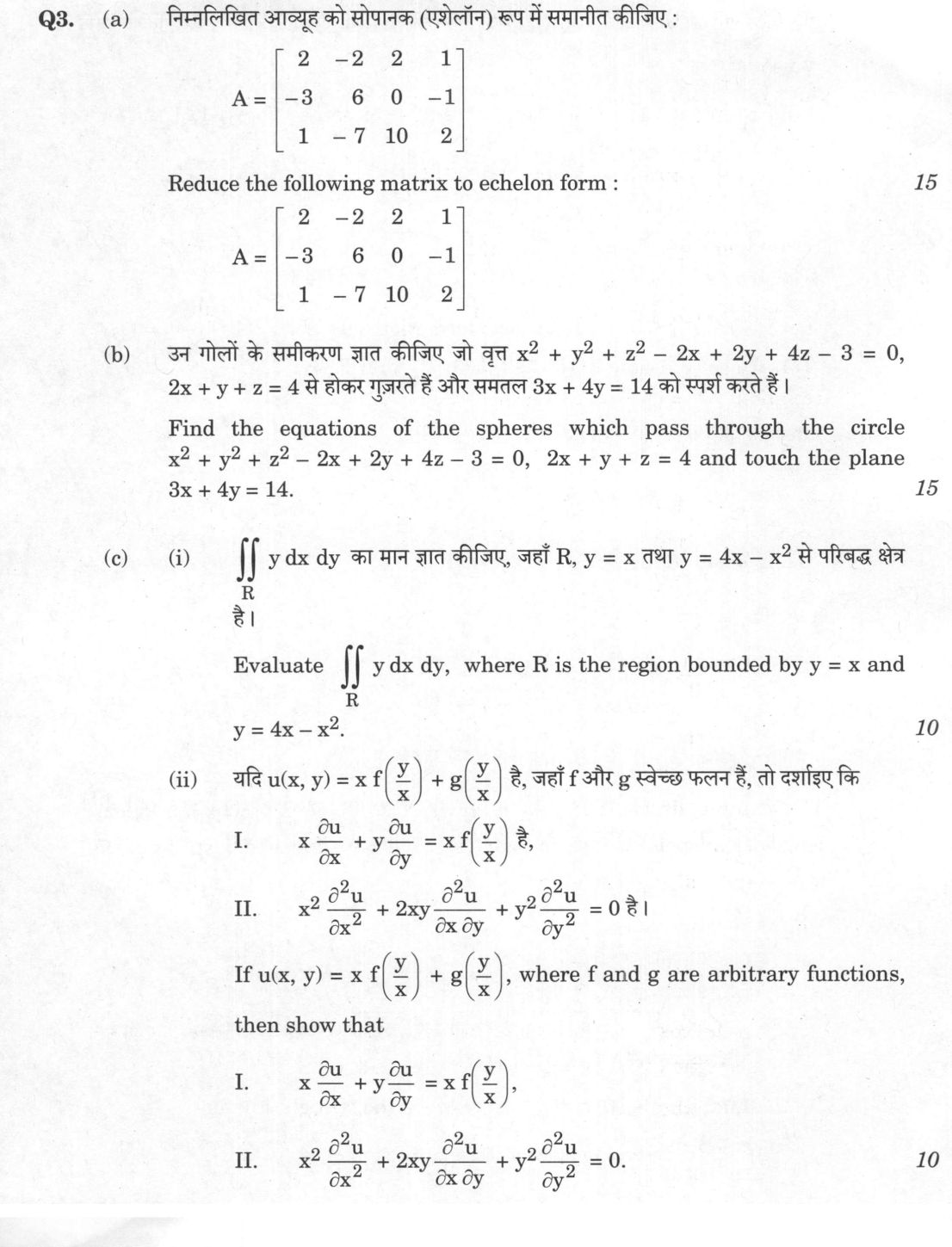
(a) Reduce the following matrix to echelon form: A = 2 & -2 & 2 & 1 -3 & 6 & 0 & -1 1 & -7 & 10 & 2 (15 marks) (b) Find the…
Reduce the following matrix to echelon form: A = 2 & -2 & 2 & 1 -3 & 6 & 0 & -1 1 & -7 & 10 & 2 15 marks
Find the equations of the spheres which pass through the circle x² + y² + z² - 2x + 2y + 4z - 3 = 0, 2x + y + z = 4and touch the plane3x + 4y = 14. 15 marks
Evaluate displaystyle∬limits_R y dx dy, where R is the region bounded by y = x and y = 4x - x². 10 marks
If u(x,y) = x f(y/x) + g(y/x), where f and g are arbitrary functions, then show that I. x (∂ u)/(∂ x) + y (∂ u)/(∂ y) = x f(y/x), II. x² (∂² u)/(∂ x²) + 2xy (∂² u)/(∂ x ∂ y) + y² (∂² u)/(∂ y²) = 0. 10 marks
हिंदी में प्रश्न पढ़ें
निम्नलिखित आव्यूह को सोपानक (एशेलोन) रूप में समानीत कीजिए : A = 2 & -2 & 2 & 1 -3 & 6 & 0 & -1 1 & -7 & 10 & 2 (15 अंक)
उन गोलों के समीकरण ज्ञात कीजिए जो वृत्त x² + y² + z² - 2x + 2y + 4z - 3 = 0, 2x + y + z = 4से होकर गुजरते हैं और समतल3x + 4y = 14 को स्पर्श करते हैं। (15 अंक)
displaystyle∬limits_R y dx dy का मान ज्ञात कीजिए, जहाँ R, y = x तथा y = 4x - x² से परिवृत क्षेत्र है। (10 अंक)
यदि u(x,y) = x f(y/x) + g(y/x) है, जहाँ f और g स्वेच्छ फलन हैं, तो दर्शाइए कि I. x (∂ u)/(∂ x) + y (∂ u)/(∂ y) = x f(y/x) है, II. x² (∂² u)/(∂ x²) + 2xy (∂² u)/(∂ x ∂ y) + y² (∂² u)/(∂ y²) = 0 है। (10 अंक)
Model answer
Written by UPSC Answer Check against this question's marking rubric, to the expected length. UPSC does not publish answers for Mains — this is one way to score well, not an official key.
(a) Use Gaussian elimination. Starting with A = [2 -2 2 1; -3 6 0 -1; 1 -7 10 2].
Interchange R1 and R3: [1 -7 10 2; -3 6 0 -1; 2 -2 2 1].
Apply R2 → R2 + 3R1 and R3 → R3 - 2R1: [1 -7 10 2; 0 -15 30 5; 0 12 -18 -3].
Apply R3 → R3 + (4/5)R2: [1 -7 10 2; 0 -15 30 5; 0 0 6 1].
Normalize the second and third rows: [1 -7 10 2; 0 1 -2 -1/3; 0 0 1 1/6] .
This is a row echelon form. The rank is 3, since there are three non-zero rows.
(b) Let S = x² + y² + z² - 2x + 2y + 4z - 3 = 0 and P = 2x + y + z - 4 = 0. By the theorem on spheres through a circle, every sphere through the given circle has equation S + λP = 0. Hence
x² + y² + z² + (-2 + 2λ)x + (2 + λ)y + (4 + λ)z - (3 + 4λ) = 0.
Its centre is C = (1 - λ, -(2 + λ)/2, -(4 + λ)/2).
The radius squared is r² = (1 - λ)² + ((2 + λ)/2)² + ((4 + λ)/2)² + 3 + 4λ = (3/2)λ² + 5λ + 9.
The plane is 3x + 4y - 14 = 0. Distance from C to this plane is d = |3(1 - λ) + 4 (-(2 + λ)/2) - 14| / √(3² + 4²) = | -15 - 5λ | / 5 = |λ + 3|.
Tangency requires d² = r². Thus (λ + 3)² = (3/2)λ² + 5λ + 9 ⇒ λ² + 6λ + 9 = (3/2)λ² + 5λ + 9 ⇒ λ(λ - 2) = 0, so λ = 0 or λ = 2.
Therefore the two spheres are λ = 0: x² + y² + z² - 2x + 2y + 4z - 3 = 0 , λ = 2: x² + y² + z² + 2x + 4y + 6z - 11 = 0 .
(c)(i) Use iterated integration. The curves y = x and y = 4x - x² meet where x = 4x - x² ⇒ x(x - 3) = 0, so x = 0, 3.
For 0 ≤ x ≤ 3, the lower curve is y = x and the upper curve is y = 4x - x². Hence
∬_R y dx dy = ∫₀³ ∫_x^4x - x² y dy dx = (1/2)∫₀³ [(4x - x²)² - x²] dx = (1/2)∫₀³ (15x² - 8x³ + x⁴) dx = (1/2)[5x³ - 2x⁴ + x⁵/5]₀³ = (1/2)(135 - 162 + 243/5) = (1/2)(108/5) = 54/5.
(c)(ii) Put t = y/x. Then u = x f(t) + g(t).
By the chain rule, ∂u/∂x = f(t) - t f′(t) - (t/x) g′(t), ∂u/∂y = f′(t) + (1/x) g′(t).
Therefore, for I, x ∂u/∂x + y ∂u/∂y = x[f - t f′ - (t/x)g′] + y[f′ + (1/x)g′] = x f(t) - y f′(t) - t g′(t) + y f′(t) + t g′(t) = x f(y/x).
For II, differentiating again, ∂²u/∂x² = (y²/x³) f″ + (2y/x³) g′ + (y²/x⁴) g″, ∂²u/∂x∂y = -(y/x²) f″ - (1/x²) g′ - (y/x³) g″, ∂²u/∂y² = (1/x) f″ + (1/x²) g″.
Hence x² ∂²u/∂x² = (y²/x) f″ + (2y/x) g′ + (y²/x²) g″, 2xy ∂²u/∂x∂y = -(2y²/x) f″ - (2y/x) g′ - (2y²/x²) g″, y² ∂²u/∂y² = (y²/x) f″ + (y²/x²) g″.
Adding the three lines, every term cancels. Thus x² ∂²u/∂x² + 2xy ∂²u/∂x∂y + y² ∂²u/∂y² = 0 .
What "Solve" is asking you to do
Choose the method, then carry it through to a final answer. Identifying what kind of problem this is and why that method applies is the first thing marked; a correct figure arrived at invisibly earns almost nothing.
Structure that answers it
Given data and what is required → method chosen, with the reason it applies → set-up (equation, circuit, free body, trial balance) → working, step by step → answer with units and any condition of validity
Where marks are lost
Doing the middle steps mentally and writing only the result. In mathematics papers, a further loss comes from giving a decimal where the exact value in surds or fractions was wanted, or from skipping the justification a part explicitly asks for.
How this answer will be evaluated
Approach
(a) calculate: given > formula > substitution > result with units > interpretation | (b) calculate: given > formula > substitution > result with units > interpretation | (c(i)) calculate: given > formula > substitution > result with units > interpretation | (c(ii)) derive: given > assumptions > stepwise derivation > result > check Full marks: Complete working with all steps shown, correct results, and verification
Key points expected
- Apply elementary row operations (R_i -> R_i + kR_j) systematically
- Show intermediate matrices after each operation
- Achieve leading 1s in pivot positions
- Ensure zeros below each pivot
- Use family of spheres: S + λL = 0
- Determine center and radius in terms of λ
- Apply tangency condition: distance = radius
- Solve for λ and write final equations
Evaluation rubric
Each sub-part is marked on its own, against the marks and word limit printed on the paper.
- (a) Row-reduce matrix A to echelon form using elementary row operations. 15 marks
calculate— given → formula → substitution → result with units → interpretation
Must cover
- Apply elementary row operations (R_i -> R_i + kR_j) systematically
- Show intermediate matrices after each operation
- Achieve leading 1s in pivot positions
- Ensure zeros below each pivot
Loses marks
- Skipping intermediate steps
- Arithmetic errors in row operations
- No justification for operations
Earns more
- State rank of the matrix
- Verify row independence
Extra mark
- Check by back-substitution
- (b) Find equations of spheres passing through given circle and touching given plane. 15 marks
calculate— given → formula → substitution → result with units → interpretation
Must cover
- Use family of spheres: S + λL = 0
- Determine center and radius in terms of λ
- Apply tangency condition: distance = radius
- Solve for λ and write final equations
Loses marks
- Incorrect family of spheres
- Algebraic errors in distance formula
- Missing tangency condition
Earns more
- Verify tangency condition
- Check circle lies on sphere
Extra mark
- Geometric interpretation of tangency
- (c(i)) Evaluate double integral ∬_R y dx dy over region bounded by y=x and y=4x-x². 10 marks
calculate— given → formula → substitution → result with units → interpretation
Must cover
- Find intersection points of curves
- Set up correct limits of integration
- Integrate y with respect to x first
- Compute final numerical value
Loses marks
- Incorrect intersection points
- Wrong limits of integration
- Integration errors
Earns more
- Sketch region R
- Verify limits by substitution
Extra mark
- Alternative order of integration
- (c(ii)) Show that u(x,y) = xf(y/x) + g(y/x) satisfies given PDEs. 10 marks
derive— given → assumptions → stepwise derivation → result → check
Must cover
- Compute ∂u/∂x and ∂u/∂y using chain rule
- Substitute into first PDE and simplify
- Compute second partial derivatives
- Substitute into second PDE and show equals zero
Loses marks
- Incorrect chain rule application
- Missing second derivative terms
- Algebraic simplification errors
Earns more
- Define f' and g' notation clearly
- Show intermediate derivative steps
Extra mark
- Note homogeneity of PDEs
Practice this exact question
Write your answer and it is marked point by point against the model answer above — what you covered, what you missed, what you got wrong.
Evaluate my answer →More from Mathematics 2025 Paper I
- Q1 (a) Can the set {(0, 0, 0, 3), (1, 1, 0, 0), (0, 1, –1, 0)} be extended to form a basis o…
- Q2 (a) Let T : ℝ³ → ℝ² be a linear transformation such that T(1, 1, -1) = (1, 0), T(4, 1, 1)…
- Q3 (a) Reduce the following matrix to echelon form: A = 2 & -2 & 2 & 1 -3 & 6 & 0 & -1 1 & -…
- Q4 (a) Show that there is no tangent plane to the sphere x² + y² + z² - 4x + 2y - 4z + 4 = 0…
- Q5 (a) Solve (1-y²+(y⁴)/(x²))(dy/dx)²-2y/xdy/dx+(y²)/(x²)=0. 10 marks (b) Form the different…
- Q6 (a) If F(s) and G(s) are Laplace transforms of f(t) and g(t) respectively, then prove tha…