Paper I — Q2
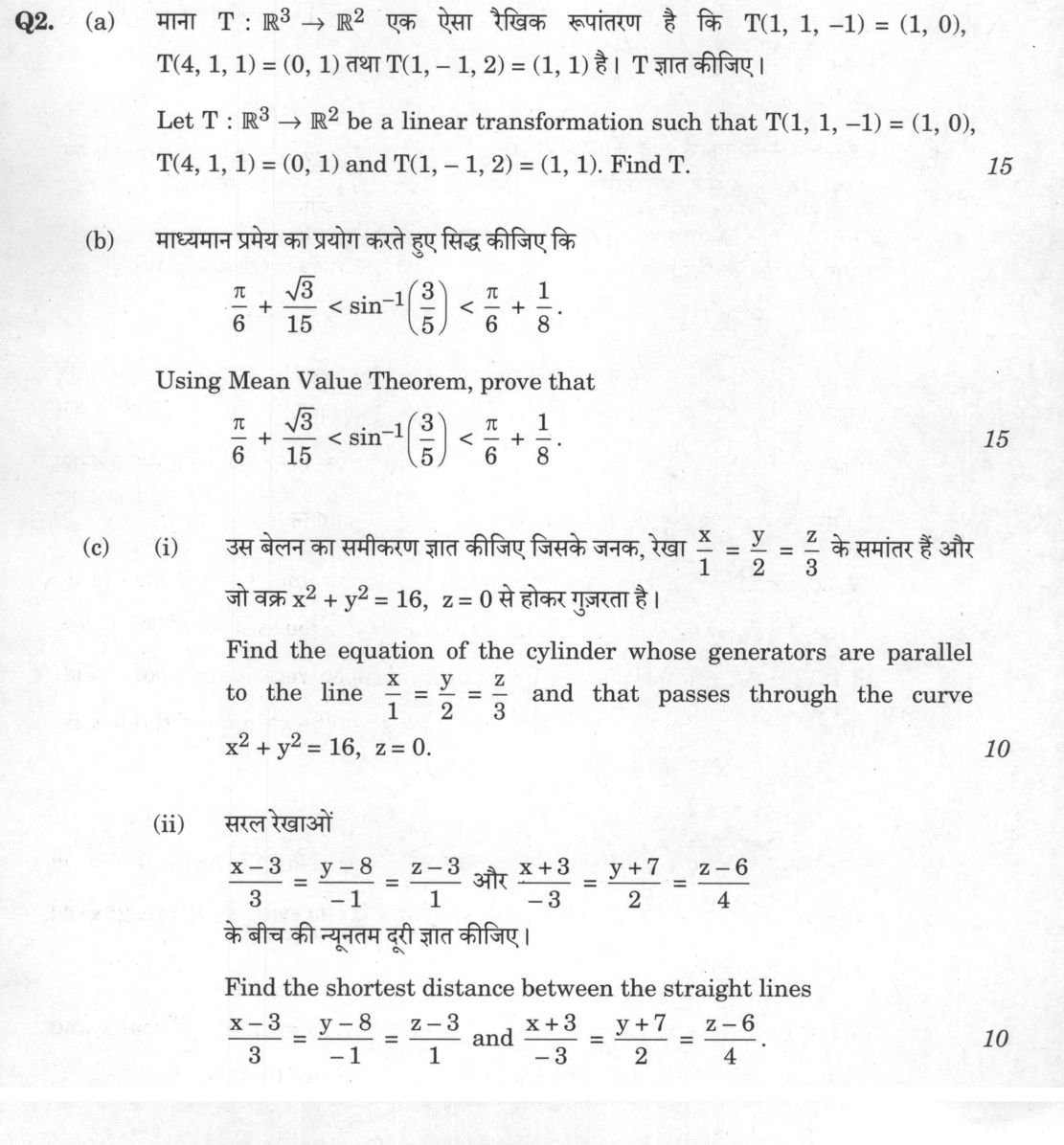
(a) Let T : ℝ³ → ℝ² be a linear transformation such that T(1, 1, -1) = (1, 0), T(4, 1, 1) = (0, 1) and T(1, -1, 2) = (1, 1). Find…
Let T : ℝ³ → ℝ² be a linear transformation such that T(1, 1, -1) = (1, 0), T(4, 1, 1) = (0, 1) and T(1, -1, 2) = (1, 1). Find T. 15 marks
Using Mean Value Theorem, prove that
π/6 + √3/15 < sin⁻¹(3/5) < π/6 + 1/8 15 marks
Find the equation of the cylinder whose generators are parallel to the line x/1 = y/2 = z/3 and that passes through the curve x² + y² = 16, z = 0. 10 marks
Find the shortest distance between the straight lines
(x-3)/3 = (y-8)/(-1) = (z-3)/1 and (x+3)/(-3) = (y+7)/2 = (z-6)/4. 10 marks
हिंदी में प्रश्न पढ़ें
माना T : ℝ³ → ℝ² एक ऐसा रैखिक रूपांतरण है कि T(1, 1, -1) = (1, 0), T(4, 1, 1) = (0, 1) तथा T(1, -1, 2) = (1, 1) है। T ज्ञात कीजिए। 15 अंक
माध्यमान प्रमेय का प्रयोग करते हुए सिद्ध कीजिए कि
π/6 + √3/15 < sin⁻¹(3/5) < π/6 + 1/8 15 अंक
उस बेलन का समीकरण ज्ञात कीजिए जिसके जनक, रेखा x/1 = y/2 = z/3 के समांतर हैं और जो वक्र x² + y² = 16, z = 0 से होकर गुजरता है। 10 अंक
सरल रेखाओं
(x-3)/3 = (y-8)/(-1) = (z-3)/1 और (x+3)/(-3) = (y+7)/2 = (z-6)/4
के बीच की न्यूनतम दूरी ज्ञात कीजिए। 10 अंक
Model answer
Written by UPSC Answer Check against this question's marking rubric, to the expected length. UPSC does not publish answers for Mains — this is one way to score well, not an official key.
(a) Let T(x, y, z) = (a x + b y + c z, d x + e y + f z). Using the given values:
For v₁ = (1, 1, -1), T(v₁) = (1, 0), so a + b - c = 1, d + e - f = 0.
For v₂ = (4, 1, 1), T(v₂) = (0, 1), so 4a + b + c = 0, 4d + e + f = 1.
For v₃ = (1, -1, 2), T(v₃) = (1, 1), so a - b + 2c = 1, d - e + 2f = 1.
Solving the first system: a + b - c = 1, 4a + b + c = 0, a - b + 2c = 1. Subtracting the first from the third gives -2b + 3c = 0, so c = 2b/3. Then a = 1 - b/3. Substituting in the second equation gives b = -12, hence c = -8 and a = 5.
Solving the second system: d + e - f = 0, 4d + e + f = 1, d - e + 2f = 1. From the first, f = d + e. Then 5d + 2e = 1 and 3d + e = 1. Hence d = 1, e = -2, f = -1.
Therefore, T(x, y, z) = (5x - 12y - 8z, x - 2y - z).
Check: T(1, 1, -1) = (1, 0), T(4, 1, 1) = (0, 1), T(1, -1, 2) = (1, 1).
(b) Let f(x) = sin⁻¹x on [1/2, 3/5]. Since f is continuous on [1/2, 3/5] and differentiable on (1/2, 3/5), the Mean Value Theorem gives some c ∈ (1/2, 3/5) such that
sin⁻¹(3/5) - sin⁻¹(1/2) = f′(c)(3/5 - 1/2).
Now sin⁻¹(1/2) = π/6 and 3/5 - 1/2 = 1/10. Also, f′(x) = 1/√(1 - x²).
On [1/2, 3/5], f′(x) is increasing, so f′(1/2) < f′(c) < f′(3/5).
f′(1/2) = 1/√(1 - 1/4) = 1/(√3/2) = 2/√3. f′(3/5) = 1/√(1 - 9/25) = 1/(4/5) = 5/4.
Thus (2/√3)(1/10) < sin⁻¹(3/5) - π/6 < (5/4)(1/10).
That is, 1/(5√3) < sin⁻¹(3/5) - π/6 < 1/8.
Since 1/(5√3) = √3/15, we get π/6 + √3/15 < sin⁻¹(3/5) < π/6 + 1/8.
(c)(i) Let the directrix be the curve x² + y² = 16, z = 0. Take a point (X, Y, 0) on it, so X² + Y² = 16. The generators are parallel to the line x/1 = y/2 = z/3, whose direction vector is (1, 2, 3).
A general point (x, y, z) on the cylinder lies on the generator through (X, Y, 0): (x, y, z) = (X, Y, 0) + t(1, 2, 3).
Hence x = X + t, y = Y + 2t, z = 3t. So t = z/3, and therefore X = x - z/3, Y = y - 2z/3.
Substitute into X² + Y² = 16: (x - z/3)² + (y - 2z/3)² = 16.
Multiplying by 9: (3x - z)² + (3y - 2z)² = 144.
Expanding: 9x² - 6xz + z² + 9y² - 12yz + 4z² = 144.
Thus the cylinder is 9x² + 9y² + 5z² - 6xz - 12yz = 144.
(c)(ii) For the first line, direction d₁ = (3, -1, 1), point a = (3, 8, 3).
For the second line, direction d₂ = (-3, 2, 4), point b = (-3, -7, 6).
Then b - a = (-3 - 3, -7 - 8, 6 - 3) = (-6, -15, 3).
Compute d₁ × d₂: d₁ × d₂ = ((-1)(4) - (1)(2), (1)(-3) - (3)(4), (3)(2) - (-1)(-3)) = (-6, -15, 3).
Hence |d₁ × d₂| = √((-6)² + (-15)² + 3²) = √(36 + 225 + 9) = √270 = 3√30.
The shortest distance between skew lines is |(b - a) · (d₁ × d₂)| / |d₁ × d₂|.
Now (b - a) · (d₁ × d₂) = (-6, -15, 3) · (-6, -15, 3) = 36 + 225 + 9 = 270.
Therefore, distance = 270/√270 = √270 = 3√30.
Shortest distance = 3√30 units.
What "Solve" is asking you to do
Choose the method, then carry it through to a final answer. Identifying what kind of problem this is and why that method applies is the first thing marked; a correct figure arrived at invisibly earns almost nothing.
Structure that answers it
Given data and what is required → method chosen, with the reason it applies → set-up (equation, circuit, free body, trial balance) → working, step by step → answer with units and any condition of validity
Where marks are lost
Doing the middle steps mentally and writing only the result. In mathematics papers, a further loss comes from giving a decimal where the exact value in surds or fractions was wanted, or from skipping the justification a part explicitly asks for.
How this answer will be evaluated
Approach
(a) calculate: given > formula > substitution > result with units > interpretation | (b) justify: claim > 3-4 reasons > evidence > conclusion | (c(i)) calculate: given > formula > substitution > result with units > interpretation | (c(ii)) calculate: given > formula > substitution > result with units > interpretation Full marks: Complete, rigorous derivations with all steps justified and verified.
Key points expected
- Verify input vectors form a basis of R3
- Express standard basis vectors as linear combinations
- Apply linearity to find T(e1), T(e2), T(e3)
- State final formula T(x,y,z) = (ax+by+cz, dx+ey+fz)
- State Mean Value Theorem explicitly
- Define f(x) = sin^-1(x) and interval [1/2, 3/5]
- Calculate f'(c) = 1/sqrt(1-c^2) and bound it
- Derive both lower and upper bounds from the inequality
Evaluation rubric
Each sub-part is marked on its own, against the marks and word limit printed on the paper.
- (a) Determine the explicit formula for the linear transformation T. 15 marks
calculate— given → formula → substitution → result with units → interpretation
Must cover
- Verify input vectors form a basis of R3
- Express standard basis vectors as linear combinations
- Apply linearity to find T(e1), T(e2), T(e3)
- State final formula T(x,y,z) = (ax+by+cz, dx+ey+fz)
Loses marks
- Assuming basis without checking linear independence
- Arithmetic errors in solving linear system
Earns more
- Matrix representation of T
- Verification of result using one given vector
Extra mark
- Alternative method using matrix inversion
- (b) Prove the given inequality for sin^-1(3/5) using the Mean Value Theorem. 15 marks
justify— claim → 3-4 reasons → evidence → conclusion
Must cover
- State Mean Value Theorem explicitly
- Define f(x) = sin^-1(x) and interval [1/2, 3/5]
- Calculate f'(c) = 1/sqrt(1-c^2) and bound it
- Derive both lower and upper bounds from the inequality
Loses marks
- Using Taylor series instead of MVT
- Failing to bound the derivative correctly
Earns more
- Clear identification of c in the interval
- Logical flow connecting MVT to the final inequality
Extra mark
- Geometric interpretation of the derivative bound
- (c(i)) Find the equation of the cylinder with given generators and curve. 10 marks
calculate— given → formula → substitution → result with units → interpretation
Must cover
- Identify direction ratios of generators (1, 2, 3)
- Use standard cylinder equation method (x-x0, y-y0, z-z0)
- Substitute z=0 and x^2+y^2=16 into the general form
- Simplify to obtain the final equation
Loses marks
- Incorrect direction ratios for generators
- Algebraic errors in eliminating parameters
Earns more
- Correct setup of the auxiliary equation
- Verification that the curve lies on the cylinder
Extra mark
- Alternative method using projection
- (c(ii)) Find the shortest distance between the two given straight lines. 10 marks
calculate— given → formula → substitution → result with units → interpretation
Must cover
- Identify points and direction vectors for both lines
- Calculate cross product of direction vectors
- Apply shortest distance formula for skew lines
- Compute the final numerical value
Loses marks
- Using wrong formula for parallel lines
- Arithmetic errors in vector operations
Earns more
- Correct identification of line parameters
- Step-by-step calculation of the cross product
Extra mark
- Verification using vector projection method
Practice this exact question
Write your answer and it is marked point by point against the model answer above — what you covered, what you missed, what you got wrong.
Evaluate my answer →More from Mathematics 2025 Paper I
- Q1 (a) Can the set {(0, 0, 0, 3), (1, 1, 0, 0), (0, 1, –1, 0)} be extended to form a basis o…
- Q2 (a) Let T : ℝ³ → ℝ² be a linear transformation such that T(1, 1, -1) = (1, 0), T(4, 1, 1)…
- Q3 (a) Reduce the following matrix to echelon form: A = 2 & -2 & 2 & 1 -3 & 6 & 0 & -1 1 & -…
- Q4 (a) Show that there is no tangent plane to the sphere x² + y² + z² - 4x + 2y - 4z + 4 = 0…
- Q5 (a) Solve (1-y²+(y⁴)/(x²))(dy/dx)²-2y/xdy/dx+(y²)/(x²)=0. 10 marks (b) Form the different…