Paper I — Q6
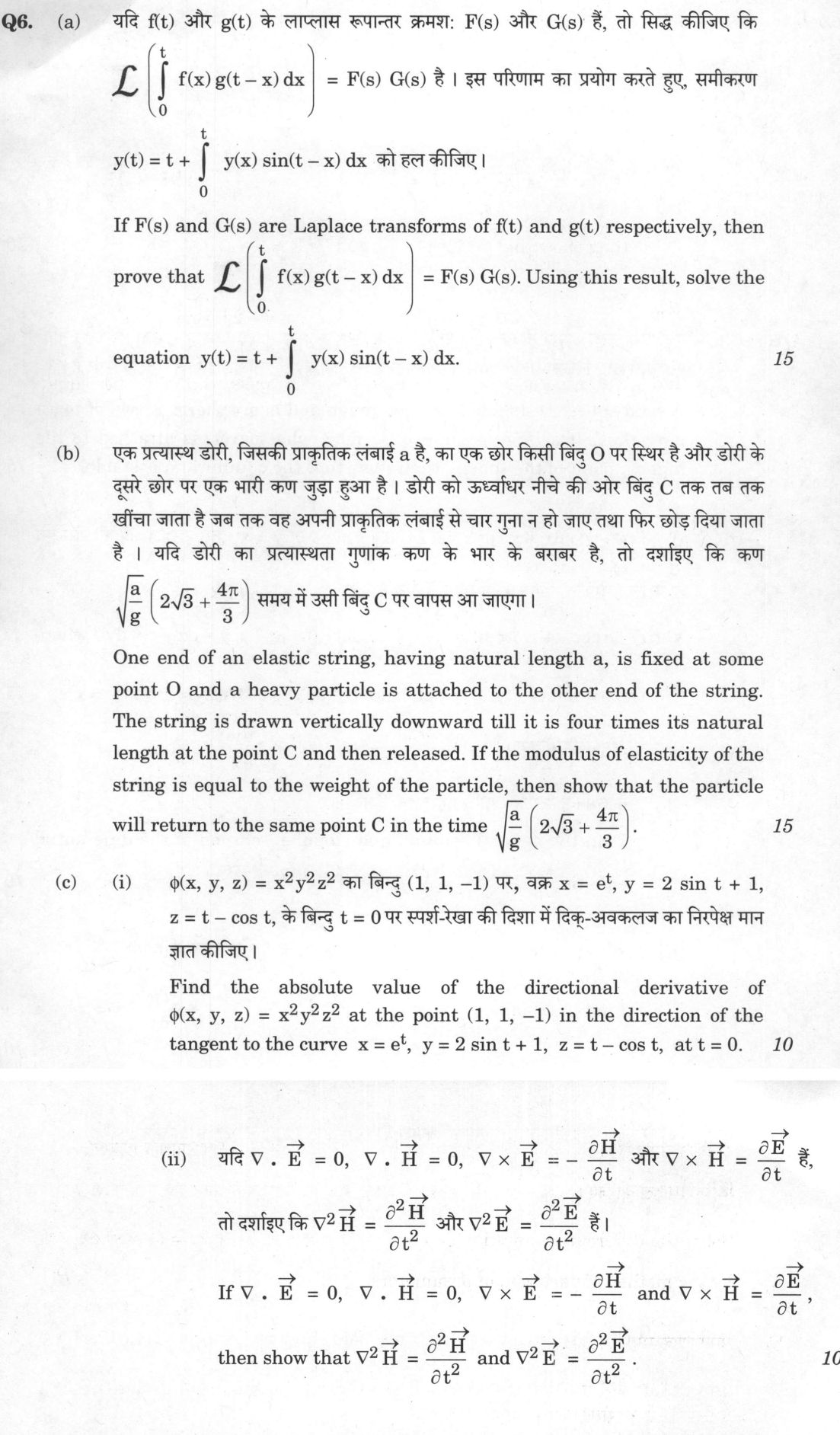
(a) If F(s) and G(s) are Laplace transforms of f(t) and g(t) respectively, then prove that L∫₀^t f(x) g(t-x) dx = F(s)…
If F(s) and G(s) are Laplace transforms of f(t) and g(t) respectively, then prove that
L∫₀^t f(x) g(t-x) dx = F(s) G(s).
Using this result, solve the equation
y(t) = t + ∫₀^t y(x) sin(t-x) dx. 15 marks
One end of an elastic string, having natural length a, is fixed at some point O and a heavy particle is attached to the other end of the string. The string is drawn vertically downward till it is four times its natural length at the point C and then released. If the modulus of elasticity of the string is equal to the weight of the particle, then show that the particle will return to the same point C in the time
√(a/g)(2√3 + (4π)/3). 15 marks
Find the absolute value of the directional derivative of φ(x, y, z) = x^2y^2z² at the point (1, 1, -1) in the direction of the tangent to the curve x = e^t, y = 2sin t + 1, z = t - cos t, at t = 0. 10 marks
If ∇ · overrightarrowE=0, ∇ · overrightarrowH=0, ∇ × overrightarrowE=-(∂ overrightarrowH)/(∂ t) and ∇ × overrightarrowH=(∂ overrightarrowE)/(∂ t),
then show that ∇² overrightarrowH=(∂² overrightarrowH)/(∂ t²) and ∇² overrightarrowE=(∂² overrightarrowE)/(∂ t²). 10 marks
हिंदी में प्रश्न पढ़ें
यदि f(t) और g(t) के लाप्लास रूपान्तर क्रमशः F(s) और G(s) हैं, तो सिद्ध कीजिए कि
L∫₀^t f(x) g(t-x) dx = F(s) G(s)
है। इस परिणाम का प्रयोग करते हुए, समीकरण
y(t) = t + ∫₀^t y(x) sin(t-x) dx
को हल कीजिए। 15 अंक
एक प्रत्यास्थ डोरी, जिसकी प्राकृतिक लंबाई a है, का एक छोर किसि बिंदु O पर स्थिर है और डोरी के दूसरे छोर पर एक भारी कण जुड़ा हुआ है। डोरी को उर्ध्वाधर नीचे की ओर बिंदु C तक तब तक खींचा जाता है जब तक वह अपनी प्राकृतिक लंबाई से चार गुना न हो जाए तथा फिर छोड़ दिया जाता है। यदि डोरी का प्रत्यास्थता गुणांक कण के भार के बराबर है, तो दर्शाइए कि कण
√(a/g)(2√3 + (4π)/3)
समय में उसी बिंदु C पर वापस आ जाएगा। 15 अंक
φ(x, y, z) = x^2y^2z² का बिंदु (1, 1, -1) पर, वक्र x = e^t, y = 2sin t + 1, z = t - cos t, के बिंदु t = 0 पर स्पर्श-रेखा की दिशा में दिक्-अवकलज का निरपेक्ष मान ज्ञात कीजिए। 10 अंक
यदि ∇ · overrightarrowE=0, ∇ · overrightarrowH=0, ∇ × overrightarrowE=-(∂ overrightarrowH)/(∂ t) और ∇ × overrightarrowH=(∂ overrightarrowE)/(∂ t) है,
तो दर्शाइए कि ∇² overrightarrowH=(∂² overrightarrowH)/(∂ t²) और ∇² overrightarrowE=(∂² overrightarrowE)/(∂ t²) है। 10 अंक
Model answer
Written by UPSC Answer Check against this question's marking rubric, to the expected length. UPSC does not publish answers for Mains — this is one way to score well, not an official key.
(a) Let F(s)=∫ from 0 to ∞ e^(−st)f(t)dt and G(s)=∫ from 0 to ∞ e^(−st)g(t)dt, assuming f and g are piecewise continuous and of exponential order so the transforms exist. By definition,
L{∫₀ᵗ f(x)g(t−x)dx}=∫ from 0 to ∞ e^(−st)∫₀ᵗ f(x)g(t−x)dx dt.
Change the order of integration. Here x runs from 0 to ∞ and, for fixed x, t runs from x to ∞. Put u=t−x, so dt=du and t=x+u. Then
=∫₀∞ f(x)∫₀∞ e^(−s(x+u))g(u)du dx =(∫₀∞ e^(−sx)f(x)dx)(∫₀∞ e^(−su)g(u)du) =F(s)G(s).
This proves the convolution theorem.
Now take Laplace transform of
y(t)=t+∫₀ᵗ y(x)sin(t−x)dx.
The integral is y(t) convolved with sin t. Hence
Y(s)=1/s²+Y(s)L{sin t}=1/s²+Y(s)/(s²+1).
Therefore
Y(s)(1−1/(s²+1))=1/s², Y(s)= (s²+1)/s⁴=1/s²+1/s⁴.
Using L⁻¹{1/s²}=t and L⁻¹{1/s⁴}=t³/6,
y(t)=t+t³/6.
(b) Let m be the mass of the particle, so its weight is mg. The modulus of elasticity is given equal to the weight, so λ=mg. Let y be the distance of the particle below O. For y≥a, the tension is
T=λ(y−a)/a=mg(y−a)/a.
The equation of motion downward is
m y¨=mg−T=mg−mg(y−a)/a=(mg/a)(2a−y).
Put X=y−2a. Then
X¨=−(g/a)X.
Thus the motion is simple harmonic about y=2a with angular frequency ω=√(g/a). At C, y=4a, so X=2a. The particle is released from rest there. Therefore
X=2a cos ωt.
The string becomes slack when y=a, i.e. X=−a. Then
2a cos ωt=−a, so cos ωt=−1/2.
The first such time is
t₁=2π/(3ω)=(2π/3)√(a/g).
At this instant,
X˙=−2aω sin(2π/3)=−√(3ag),
so the particle is moving upward with speed √(3ag).
During the slack phase, y<a and T=0, so only gravity acts. The time to go up to the highest point and return to y=a is
t₂=2(√(3ag)/g)=2√(3a/g).
The highest point is y=a−3a/2=−a/2, so the string remains slack throughout this phase.
When the particle returns to y=a, its downward speed is again √(3ag). The string becomes taut and SHM resumes. At X=−a with X˙=+√(3ag), the amplitude is again 2a and the initial phase is 4π/3. Hence the time to reach C, where X=2a, is
t₃=2π/(3ω)=(2π/3)√(a/g).
Total time to first return to C is
t₁+t₂+t₃=√(a/g)(2√3+4π/3).
Hence shown.
(c)(i) Given φ=x²y²z². At P(1,1,−1),
∇φ=(∂φ/∂x,∂φ/∂y,∂φ/∂z) =(2xy²z²,2x²yz²,2x²y²z) =(2,2,−2).
The curve is r(t)=(eᵗ,2sin t+1,t−cos t). Its tangent vector is
r′(t)=(eᵗ,2cos t,1+sin t).
At t=0,
r′(0)=(1,2,1).
The unit tangent is
u=(1,2,1)/√6.
Thus the directional derivative is
∇φ·u=(2+4−2)/√6=4/√6=2√6/3.
Therefore, its absolute value is
2√6/3.
(c)(ii) Use the vector identity
∇×(∇×A)=∇(∇·A)−∇²A.
For E,
∇×(∇×E)=∇(∇·E)−∇²E.
But
∇×(∇×E)=∇×(−∂H/∂t) =−∂/∂t(∇×H) =−∂/∂t(∂E/∂t) =−∂²E/∂t².
Since ∇·E=0, the left side is −∇²E. Hence
−∇²E=−∂²E/∂t²,
so
∇²E=∂²E/∂t².
For H,
∇×(∇×H)=∇(∇·H)−∇²H.
Also,
∇×(∇×H)=∇×(∂E/∂t) =∂/∂t(∇×E) =∂/∂t(−∂H/∂t) =−∂²H/∂t².
Since ∇·H=0, the left side is −∇²H. Therefore,
−∇²H=−∂²H/∂t²,
so
∇²H=∂²H/∂t².
What "Prove" is asking you to do
Establish that the statement holds for every case it claims, not for one representative case. The argument must be closed: each line follows from a definition, a hypothesis, or a named theorem you are entitled to use.
Structure that answers it
Given and to prove, restated → theorem or construction to be used, named → the argument line by line → conclusion stated as proved
Where marks are lost
Testing one example, which illustrates but proves nothing. On an if and only if claim, proving one direction and stopping forfeits that half outright, and degenerate cases — zero, the empty set, the equality case — have to be disposed of rather than assumed away.
How this answer will be evaluated
Approach
(a) derive: given > assumptions > stepwise derivation > result > check | (b) derive: given > assumptions > stepwise derivation > result > check | (c(i)) calculate: given > formula > substitution > result with units > interpretation | (c(ii)) derive: given > assumptions > stepwise derivation > result > check Full marks: Rigorous step-by-step derivation with all theorems named and results verified.
Key points expected
- Prove L{∫f(x)g(t-x)dx} = F(s)G(s) via double integration
- Identify f(t)=t and g(t)=sin(t) in the given equation
- Apply Laplace transform to both sides of the equation
- Perform partial fraction decomposition of Y(s)
- Formulate equation of motion for the elastic string
- Determine the equilibrium position and angular frequency
- Calculate the time for the first quarter period (C to equilibrium)
- Calculate the time for the remaining three-quarter period
Evaluation rubric
Each sub-part is marked on its own, against the marks and word limit printed on the paper.
- (a) Prove the convolution theorem and solve the integral equation. 15 marks
derive— given → assumptions → stepwise derivation → result → check
Must cover
- Prove L{∫f(x)g(t-x)dx} = F(s)G(s) via double integration
- Identify f(t)=t and g(t)=sin(t) in the given equation
- Apply Laplace transform to both sides of the equation
- Perform partial fraction decomposition of Y(s)
Loses marks
- Skipping the proof of the convolution theorem
- Incorrect partial fraction decomposition
- Failing to identify the convolution structure in the integral
Earns more
- Correctly identifies F(s) = 1/s² and G(s) = 1/(s²+1)
- Solves for Y(s) = 1/(s²(s²+1))
- Correctly applies inverse Laplace transform
- Final answer y(t) = t - sin(t)
Extra mark
- Mentions the name 'Convolution Theorem' explicitly
- Verifies the solution by substituting back into the integral
- (b) Show the time for the particle to return to point C. 15 marks
derive— given → assumptions → stepwise derivation → result → check
Must cover
- Formulate equation of motion for the elastic string
- Determine the equilibrium position and angular frequency
- Calculate the time for the first quarter period (C to equilibrium)
- Calculate the time for the remaining three-quarter period
Loses marks
- Incorrectly setting up the force balance equation
- Failing to account for the natural length 'a' in the extension
- Incorrect calculation of the time period components
Earns more
- Correctly identifies the modulus of elasticity λ = mg
- Derives the differential equation mẍ = -mg - λ(x-a)/a
- Identifies the motion as simple harmonic about the equilibrium point
- Correctly sums the time intervals to get √(a/g)(2√3 + 4π/3)
Extra mark
- Draws a neat diagram of the string and particle
- Explicitly states the boundary conditions at t=0
- (c(i)) Find the absolute value of the directional derivative. 10 marks
calculate— given → formula → substitution → result with units → interpretation
Must cover
- Calculate the gradient ∇φ at the point (1, 1, -1)
- Find the tangent vector to the curve at t=0
- Normalize the tangent vector to get the unit direction vector
- Compute the dot product of the gradient and unit vector
Loses marks
- Forgetting to normalize the tangent vector
- Incorrect calculation of the gradient components
- Failing to take the absolute value of the final result
Earns more
- Correctly computes ∇φ = (2xy²z², 2x²y z², 2x²y²z) at (1,1,-1)
- Correctly finds the tangent vector (1, 2, 1) at t=0
- Correctly normalizes the vector to (1, 2, 1)/√6
- Final answer is 10/√6 or 5√6/3
Extra mark
- Explicitly states the formula for directional derivative
- Shows the intermediate step of evaluating the curve derivatives
- (c(ii)) Show the wave equations for E and H. 10 marks
derive— given → assumptions → stepwise derivation → result → check
Must cover
- Apply the vector identity ∇×(∇×A) = ∇(∇·A) - ∇²A
- Substitute the given Maxwell's equations into the identity
- Use the divergence-free conditions ∇·E=0 and ∇·H=0
- Differentiate the curl equations with respect to time
Loses marks
- Incorrect application of the vector identity
- Failing to use the divergence-free conditions
- Algebraic errors in the time differentiation step
Earns more
- Correctly applies the identity to ∇×(∇×E) and ∇×(∇×H)
- Correctly substitutes ∂H/∂t and ∂E/∂t from the given equations
- Correctly simplifies to ∇²H = ∂²H/∂t² and ∇²E = ∂²E/∂t²
- Clearly states the vector identity used
Extra mark
- Mentions the name 'Vector Wave Equation'
- Shows the intermediate step of the double curl expansion
Practice this exact question
Write your answer and it is marked point by point against the model answer above — what you covered, what you missed, what you got wrong.
Evaluate my answer →More from Mathematics 2025 Paper I
- Q3 (a) Reduce the following matrix to echelon form: A = 2 & -2 & 2 & 1 -3 & 6 & 0 & -1 1 & -…
- Q4 (a) Show that there is no tangent plane to the sphere x² + y² + z² - 4x + 2y - 4z + 4 = 0…
- Q5 (a) Solve (1-y²+(y⁴)/(x²))(dy/dx)²-2y/xdy/dx+(y²)/(x²)=0. 10 marks (b) Form the different…
- Q6 (a) If F(s) and G(s) are Laplace transforms of f(t) and g(t) respectively, then prove tha…
- Q7 (a) A solid sphere rests inside a fixed rough and hemispherical bowl of twice its radius.…
- Q8 (a) Solve the differential equation (x + 2)(d^2y)/(dx²) - (2x + 5)dy/dx + 2y = (1 + x) e^…