Paper I — Q1
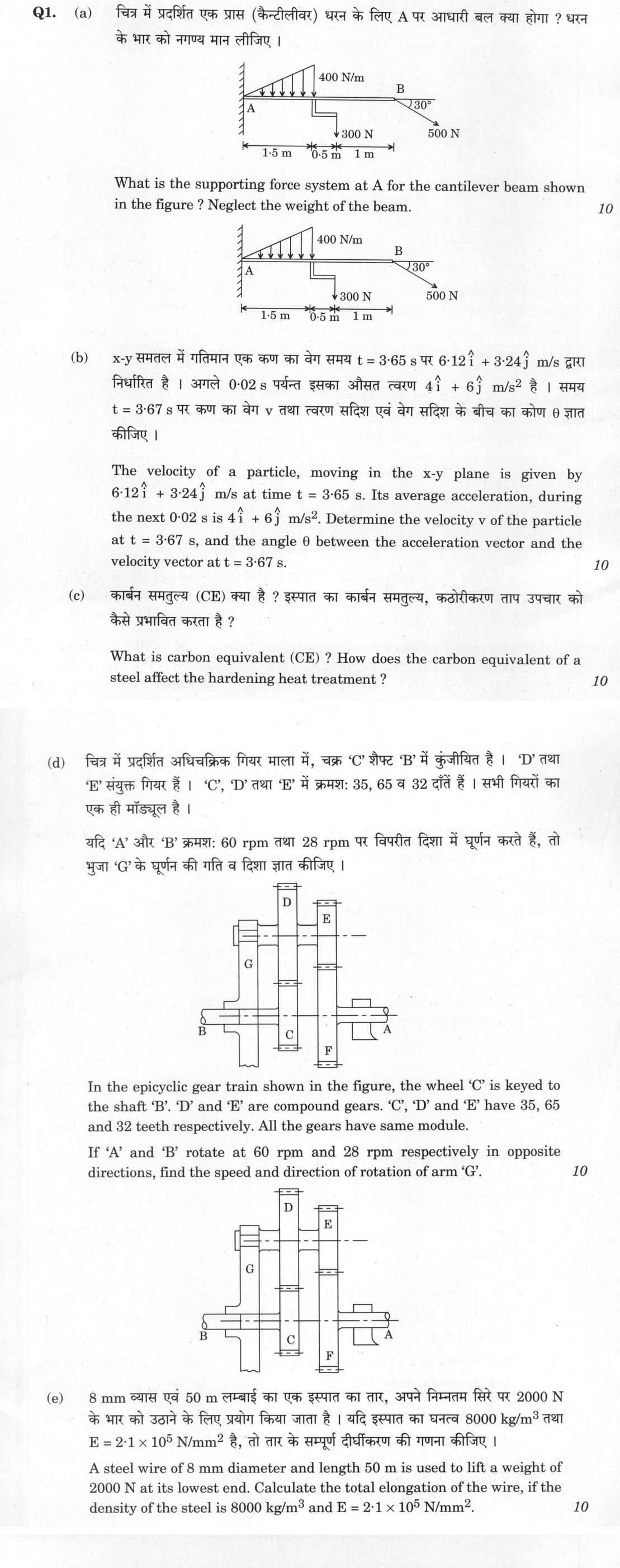
(a) What is the supporting force system at A for the cantilever beam shown in the figure ? Neglect the weight of the beam. (10…
What is the supporting force system at A for the cantilever beam shown in the figure ? Neglect the weight of the beam. 10 marks
The velocity of a particle, moving in the x-y plane is given by 6·12 î + 3·24 ĵ m/s at time t = 3·65 s. Its average acceleration, during the next 0·02 s is 4 î + 6 ĵ m/s². Determine the velocity v of the particle at t = 3·67 s, and the angle θ between the acceleration vector and the velocity vector at t = 3·67 s. 10 marks
What is carbon equivalent (CE) ? How does the carbon equivalent of a steel affect the hardening heat treatment ? 10 marks
In the epicyclic gear train shown in the figure, the wheel 'C' is keyed to the shaft 'B'. 'D' and 'E' are compound gears. 'C', 'D' and 'E' have 35, 65 and 32 teeth respectively. All the gears have same module. If 'A' and 'B' rotate at 60 rpm and 28 rpm respectively in opposite directions, find the speed and direction of rotation of arm 'G'. 10 marks
A steel wire of 8 mm diameter and length 50 m is used to lift a weight of 2000 N at its lowest end. Calculate the total elongation of the wire, if the density of the steel is 8000 kg/m³ and E = 2·1 × 10⁵ N/mm². 10 marks
हिंदी में प्रश्न पढ़ें
चित्र में प्रदर्शित एक प्रास (कैन्टीलिवर) धरन के लिए A पर आधारी बल क्या होगा ? धरन के भार को नगण्य मान लीजिए । (10 अंक)
x-y समतल में गतिमान एक कण का वेग समय t = 3·65 s पर 6·12 î + 3·24 ĵ m/s द्वारा निर्धारित है । अगले 0·02 s पर्यन्त इसका औसत त्वरण 4 î + 6 ĵ m/s² है । समय t = 3·67 s पर कण का वेग v तथा त्वरण सदिश एवं वेग सदिश के बीच का कोण θ ज्ञात कीजिए । (10 अंक)
कार्बन समतुल्य (CE) क्या है ? इसपात का कार्बन समतुल्य, कठोरीकरण ताप उपचार को कैसे प्रभावित करता है ? (10 अंक)
चित्र में प्रदर्शित अधिचक्रिक गियर माला में, चक्र 'C' शैफ्ट 'B' में कुंजीयित है । 'D' तथा 'E' संयुक्त गियर हैं । 'C', 'D' तथा 'E' में क्रमशः 35, 65 व 32 दांते हैं । सभी गियरों का एक ही मॉड्यूल है । यदि 'A' और 'B' क्रमशः 60 rpm तथा 28 rpm पर विपरीत दिशा में घूर्णन करते हैं, तो भुजा 'G' के घूर्णन की गति व दिशा ज्ञात कीजिए । (10 अंक)
8 mm व्यास एवं 50 m लंबाई का एक इस्पात का तार, अपने निम्नतम सिरे पर 2000 N के भार को उठाने के लिए प्रयोग किया जाता है । यदि इस्पात का घनत्व 8000 kg/m³ तथा E = 2·1 × 10⁵ N/mm² है, तो तार के सम्पूर्ण दीर्घीकरण की गणना कीजिए । (10 अंक)
The figure this question refers to, in words
The question paper is a scan and the diagram did not survive as text. This is the figure as read from the original page — every component, value and label — so the question can be worked from the text below.
(a) A cantilever beam fixed to a vertical wall at the left end, labeled point A. The beam extends horizontally to the right. A triangular distributed load acts downwards on the first 1.5 m of the beam, starting at zero intensity at A and increasing linearly to a maximum intensity of 400 N/m at the 1.5 m mark. At a distance of 2.0 m from A (which is 0.5 m past the end of the distributed load), a vertical point load of 300 N acts downwards. The beam continues for another 1 m to the right end, labeled point B. At point B, a force of 500 N is applied, directed downwards and to the right at an angle of 30 degrees below the horizontal axis. The total length of the beam is 3.0 m.
(d) A schematic diagram of an epicyclic gear train. A central vertical shaft supports a compound gear consisting of two gears, 'D' (upper) and 'E' (lower), which are fixed together. To the left, a horizontal shaft 'B' supports a gear 'C' which meshes with the lower gear 'E'. To the right, a horizontal shaft 'A' supports a gear 'F' which meshes with the upper gear 'D'. An arm 'G' is shown connected to the central shaft, pivoting around the center to hold the compound gear assembly. The labels 'A', 'B', 'C', 'D', 'E', 'F', and 'G' identify the shafts and gears.
What "Calculate" is asking you to do
Apply the standard formula or schedule to data the question has already supplied — a table of readings, cost records, a balance sheet — and produce the number. The method is rarely in doubt; the marks sit in the named intermediate quantities, each of which has to appear as a labelled line.
Structure that answers it
Data as given → formula or standard treatment, named → substitution → each intermediate, labelled → result with units
Where marks are lost
Omitting an intermediate the marking scheme pays for separately, or rounding at an intermediate line so the final figure drifts. In commerce and accountancy, any figure in a statement that no numbered working note supports is treated as unearned.
How this answer will be evaluated
Approach
(a) calculate: given > formula > substitution > result with units > interpretation | (b) calculate: given > formula > substitution > result with units > interpretation | (c) explain: definition/context > points in order > small example > short close | (d) calculate: given > formula > substitution > result with units > interpretation | (e) calculate: given > formula > substitution > result with units > interpretation Full marks: All parts solved with correct formulas, clear steps, and accurate final values with units.
Key points expected
- Resolve 500 N force into horizontal and vertical components
- Calculate resultant of triangular distributed load (400 N/m)
- Apply equilibrium equations (ΣFx=0, ΣFy=0, ΣM=0)
- State magnitude and direction of resultant reaction at A
- Use kinematic equation v = u + at for vector calculation
- Calculate final velocity components (vx, vy) at t=3.67s
- Compute magnitude of the final velocity vector
- Calculate angle θ using dot product or trigonometry
Evaluation rubric
Each sub-part is marked on its own, against the marks and word limit printed on the paper.
- (a) Determine the supporting force system (reactions) at A for the cantilever beam. 10 marks
calculate— given → formula → substitution → result with units → interpretation
Must cover
- Resolve 500 N force into horizontal and vertical components
- Calculate resultant of triangular distributed load (400 N/m)
- Apply equilibrium equations (ΣFx=0, ΣFy=0, ΣM=0)
- State magnitude and direction of resultant reaction at A
Loses marks
- Ignoring the horizontal component of the 500 N force
- Incorrect centroid location for the triangular load
Earns more
- Correct calculation of moment arm for distributed load
- Clear free-body diagram with all forces labelled
Extra mark
- Verification of equilibrium using a second point
- (b) Determine velocity vector at t=3.67s and the angle between velocity and acceleration. 10 marks
calculate— given → formula → substitution → result with units → interpretation
Must cover
- Use kinematic equation v = u + at for vector calculation
- Calculate final velocity components (vx, vy) at t=3.67s
- Compute magnitude of the final velocity vector
- Calculate angle θ using dot product or trigonometry
Loses marks
- Treating vectors as scalars
- Incorrect time interval usage (using 3.67s instead of 0.02s)
Earns more
- Explicit vector notation for all steps
- Correct unit conversion or handling of time interval
Extra mark
- Sketch of velocity and acceleration vectors
- (c) Define Carbon Equivalent (CE) and explain its effect on hardening heat treatment. 10 marks
explain— definition/context → points in order → small example → short close
Must cover
- Provide the standard formula for Carbon Equivalent (e.g., IIW or CEA)
- Explain that higher CE increases hardenability
- Link high CE to increased risk of cracking during welding
- Mention the need for pre-heating for high CE steels
Loses marks
- Defining CE without the formula
- Failing to link CE to the specific issue of cracking
Earns more
- Mention specific alloying elements (Mn, Cr, Mo) in the formula
- Reference to specific steel grades (e.g., high-strength low-alloy)
Extra mark
- Mention of specific standards (e.g., AWS, IIW)
- (d) Find the speed and direction of rotation of arm 'G' in the epicyclic gear train. 10 marks
calculate— given → formula → substitution → result with units → interpretation
Must cover
- Identify the gear train configuration (Sun, Planet, Ring)
- Apply the tabular method or formula for epicyclic gears
- Use the given tooth numbers (35, 65, 32) in the ratio
- Determine the final speed and specify the direction (CW/CCW)
Loses marks
- Incorrect gear ratio calculation
- Failing to account for the direction of rotation
Earns more
- Correct identification of the compound gear effect
- Clear step-by-step tabular method
Extra mark
- Verification of the result using the formula method
- (e) Calculate the total elongation of the steel wire under its own weight and load. 10 marks
calculate— given → formula → substitution → result with units → interpretation
Must cover
- Calculate the cross-sectional area of the wire
- Calculate the weight of the wire (self-weight)
- Apply the formula for elongation due to self-weight (δ = ρgL²/2E)
- Apply the formula for elongation due to load (δ = PL/AE)
Loses marks
- Ignoring the self-weight of the wire
- Incorrect unit conversion leading to order of magnitude error
Earns more
- Correct unit conversion (N to kg, mm to m)
- Summing the two elongation components correctly
Extra mark
- Mentioning the assumption of uniform cross-section
Model answer coming soon
Every evaluation on this site is marked against a verified model answer. This question's answer is still being written; evaluation opens the moment it lands.
More from Mechanical Engineering 2021 Paper I
- Q1 (a) What is the supporting force system at A for the cantilever beam shown in the figure…
- Q2 (a) In a slider-crank mechanism, the lengths of the crank and connecting rod are 150 mm a…
- Q3 (a) What is the purpose of tempering of hardened steel? Explain the principle of temperin…
- Q4 (a) Find out the value of atomic packing factor for the FCC crystal structure. Calculate…