Paper I — Q6
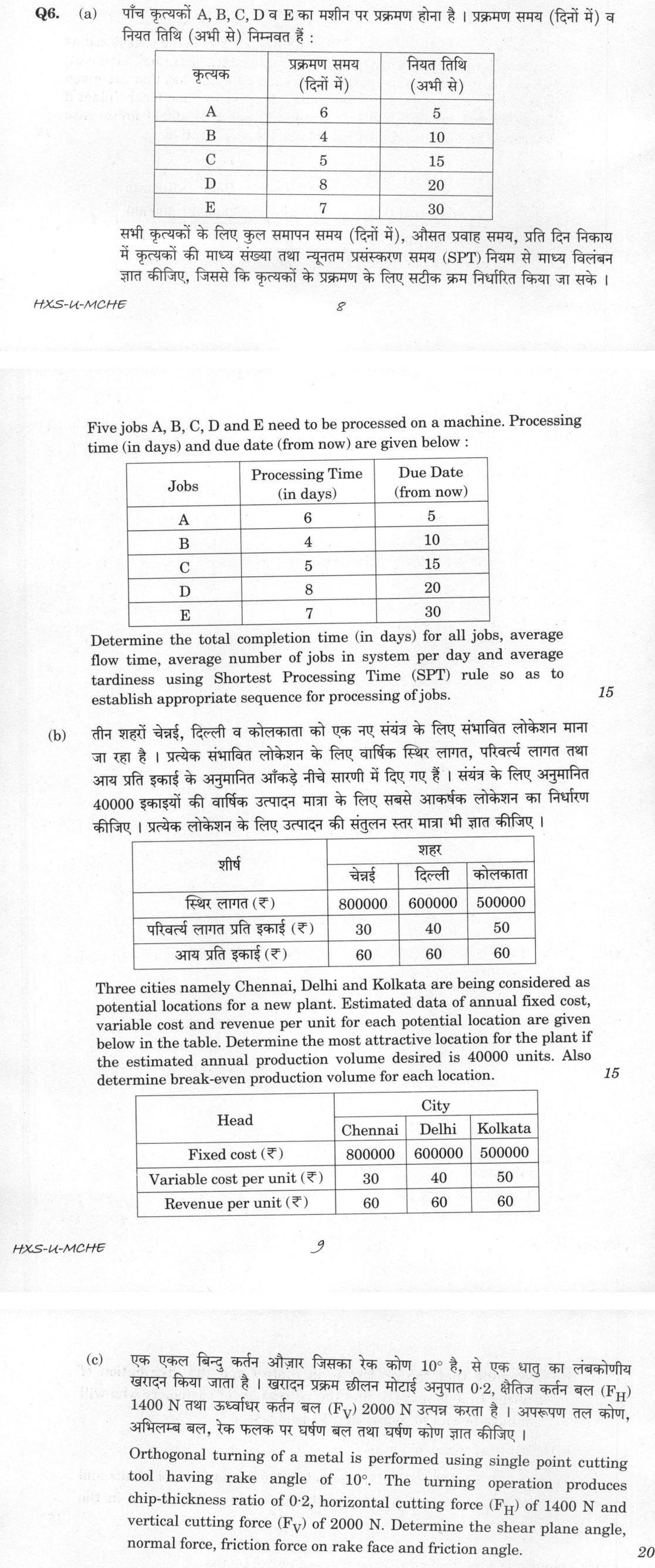
(a) Five jobs A, B, C, D and E need to be processed on a machine. Processing time (in days) and due date (from now) are given…
Five jobs A, B, C, D and E need to be processed on a machine. Processing time (in days) and due date (from now) are given below :
| Jobs | Processing Time (in days) | Due Date (from now) |
|---|---|---|
| A | 6 | 5 |
| B | 4 | 10 |
| C | 5 | 15 |
| D | 8 | 20 |
| E | 7 | 30 |
Determine the total completion time (in days) for all jobs, average flow time, average number of jobs in system per day and average tardiness using Shortest Processing Time (SPT) rule so as to establish appropriate sequence for processing of jobs. 15 marks
Three cities namely Chennai, Delhi and Kolkata are being considered as potential locations for a new plant. Estimated data of annual fixed cost, variable cost and revenue per unit for each potential location are given below in the table. Determine the most attractive location for the plant if the estimated annual production volume desired is 40000 units. Also determine break-even production volume for each location. 15 marks
| Head | City | ||
|---|---|---|---|
| Chennai | Delhi | Kolkata | |
| Fixed cost (₹) | 800000 | 600000 | 500000 |
| Variable cost per unit (₹) | 30 | 40 | 50 |
| Revenue per unit (₹) | 60 | 60 | 60 |
Orthogonal turning of a metal is performed using single point cutting tool having rake angle of 10°. The turning operation produces chip-thickness ratio of 0·2, horizontal cutting force (F_H) of 1400 N and vertical cutting force (F_V) of 2000 N. Determine the shear plane angle, normal force, friction force on rake face and friction angle. 20 marks
हिंदी में प्रश्न पढ़ें
पाँच कृत्यों A, B, C, D व E का मशीन पर प्रक्रमण होना है । प्रक्रमण समय (दिनों में) व नियत तिथि (अभी से) निम्नवत हैं :
| कृत्यक | प्रक्रमण समय (दिनों में) | नियत तिथि (अभी से) |
|---|---|---|
| A | 6 | 5 |
| B | 4 | 10 |
| C | 5 | 15 |
| D | 8 | 20 |
| E | 7 | 30 |
सभी कृत्यों के लिए कुल समापन समय (दिनों में), औसत प्रवाह समय, प्रति दिन निकाय में कृत्यों की माध्य संख्या तथा न्यूनतम प्रसंस्करण समय (SPT) नियम से माध्य विलंबन ज्ञात कीजिए, जिससे कि कृत्यों के प्रक्रमण के लिए सटीक क्रम निर्धारित किया जा सके । (15 अंक)
तीन शहरों चेन्नई, दिल्ली व कोलकाता को एक नए संयंत्र के लिए संभावित लोकेशन माना जा रहा है । प्रत्येक संभावित लोकेशन के लिए वार्षिक स्थिर लागत, परिवर्त्य लागत तथा आय प्रति इकाई के अनुमानित आँकड़े नीचे सारणी में दिए गए हैं । संयंत्र के लिए अनुमानित 40000 इकाइयों की वार्षिक उत्पादन मात्रा के लिए सबसे आकर्षक लोकेशन का निर्धारण कीजिए । प्रत्येक लोकेशन के लिए उत्पादन की संतुलन स्तर मात्रा भी ज्ञात कीजिए । (15 अंक)
| शीर्ष | शहर | ||
|---|---|---|---|
| चेन्नई | दिल्ली | कोलकाता | |
| स्थिर लागत (₹) | 800000 | 600000 | 500000 |
| परिवर्त्य लागत प्रति इकाई (₹) | 30 | 40 | 50 |
| आय प्रति इकाई (₹) | 60 | 60 | 60 |
एक एकल बिंदु कतन औजार जिसका रेक कोण 10° है, से एक धातु का लंबकोणीय खरादन किया जाता है । खरादन प्रक्रम छीलन मोटाई अनुपात 0·2, क्षैतिज कतन बल (F_H) 1400 N तथा उद्वधार कतन बल (F_V) 2000 N उत्पन्न करता है । अपरूपण तल कोण, अभिलंब बल, रेक फलक पर घर्षण बल तथा घर्षण कोण ज्ञात कीजिए । (20 अंक)
Model answer
Written by UPSC Answer Check against this question's marking rubric, to the expected length. UPSC does not publish answers for Mains — this is one way to score well, not an official key.
(a) Using the SPT (Shortest Processing Time) rule, arrange jobs in increasing processing time:
- B: 4 days
- C: 5 days
- A: 6 days
- E: 7 days
- D: 8 days
So the sequence is B-C-A-E-D.
Completion times:
- C_B = 4 days
- C_C = 4 + 5 = 9 days
- C_A = 9 + 6 = 15 days
- C_E = 15 + 7 = 22 days
- C_D = 22 + 8 = 30 days
Sum of completion times = 4 + 9 + 15 + 22 + 30 = 80 job-days. Makespan, i.e. time to complete all jobs = 30 days.
Average flow time = 80/5 = 16 days.
Using Little’s formula for scheduling, average number of jobs in system = total flow time / makespan = 80/30 = 8/3 ≈ 2.67 jobs.
Tardiness = max(0, completion time − due date):
- B: max(0, 4 − 10) = 0
- C: max(0, 9 − 15) = 0
- A: max(0, 15 − 5) = 10
- E: max(0, 22 − 30) = 0
- D: max(0, 30 − 20) = 10
Total tardiness = 20 days. Average tardiness = 20/5 = 4 days.
Hence SPT sequence is B-C-A-E-D; total completion sum = 80 job-days, makespan = 30 days, average flow time = 16 days, average jobs in system = 8/3 ≈ 2.67 jobs, average tardiness = 4 days.
(b) For break-even analysis, break-even volume is Q_BE = Fixed cost / (Revenue per unit − Variable cost per unit). Profit at volume Q = (Revenue − Variable cost)Q − Fixed cost.
Chennai: Contribution per unit = 60 − 30 = ₹30. Total cost at 40000 units = 800000 + 30 × 40000 = ₹20,00,000. Revenue = 60 × 40000 = ₹24,00,000. Profit = 24,00,000 − 20,00,000 = ₹4,00,000. Q_BE = 800000/30 = 80000/3 ≈ 26,666.67 units.
Delhi: Contribution per unit = 60 − 40 = ₹20. Total cost = 600000 + 40 × 40000 = ₹22,00,000. Profit = 24,00,000 − 22,00,000 = ₹2,00,000. Q_BE = 600000/20 = 30,000 units.
Kolkata: Contribution per unit = 60 − 50 = ₹10. Total cost = 500000 + 50 × 40000 = ₹25,00,000. Profit = 24,00,000 − 25,00,000 = −₹1,00,000, i.e. loss of ₹1,00,000. Q_BE = 500000/10 = 50,000 units.
At the desired volume of 40000 units, the most attractive location is Chennai, because it gives the highest profit, ₹4,00,000, and the lowest break-even volume, 26,666.67 units.
(c) For orthogonal cutting, use the chip-thickness ratio relation and Merchant’s force circle.
Given: Rake angle α = 10°, chip-thickness ratio r = t₁/t₂ = 0.2. Horizontal cutting force F_H = 1400 N, vertical cutting force F_V = 2000 N.
Shear plane angle φ is found from tan φ = r cos α / (1 − r sin α).
Substitute values: tan φ = 0.2 cos 10° / (1 − 0.2 sin 10°) = 0.2 × 0.9848078 / (1 − 0.2 × 0.1736482) = 0.1969616 / 0.9652704 = 0.204048.
Therefore, φ = tan⁻¹(0.204048) = 11.53°.
Friction force on rake face: F = F_H sin α + F_V cos α = 1400 sin 10° + 2000 cos 10° = 1400 × 0.1736482 + 2000 × 0.9848078 = 243.107 + 1969.616 = 2212.72 N.
Normal force on rake face: N = F_H cos α − F_V sin α = 1400 cos 10° − 2000 sin 10° = 1400 × 0.9848078 − 2000 × 0.1736482 = 1378.731 − 347.296 = 1031.43 N.
Friction angle β = tan⁻¹(F/N) = tan⁻¹(2212.72/1031.43) = tan⁻¹(2.1453) = 65.01°.
Alternatively, β = α + tan⁻¹(F_V/F_H) = 10° + tan⁻¹(2000/1400) = 10° + 55.01° = 65.01°.
Thus: Shear plane angle φ = 11.53°, Normal force N = 1031.43 N, Friction force F = 2212.72 N, Friction angle β = 65.01°.
These results assume ideal orthogonal cutting, continuous chip formation, and validity of Merchant’s force-circle analysis.
What "Calculate" is asking you to do
Apply the standard formula or schedule to data the question has already supplied — a table of readings, cost records, a balance sheet — and produce the number. The method is rarely in doubt; the marks sit in the named intermediate quantities, each of which has to appear as a labelled line.
Structure that answers it
Data as given → formula or standard treatment, named → substitution → each intermediate, labelled → result with units
Where marks are lost
Omitting an intermediate the marking scheme pays for separately, or rounding at an intermediate line so the final figure drifts. In commerce and accountancy, any figure in a statement that no numbered working note supports is treated as unearned.
How this answer will be evaluated
Approach
Framework: Mechanical Engineering, Paper 1. (a) calculate: given > formula > substitution > result with units > interpretation | (b) calculate: given > formula > substitution > result with units > interpretation | (c) calculate: given > formula > substitution > result with units > interpretation Full marks: Correct sequence/logic, all formulas stated, accurate calculations, clear diagrams/tables, and physical interpretation of results.
Key points expected
- Jobs sorted by ascending processing time (B, C, A, E, D)
- Flow time and completion time calculated for each job
- Tardiness calculated as max(0, completion - due date)
- Average flow time and average tardiness computed
- Break-even formula: Fixed Cost / (Revenue - Variable Cost)
- Break-even volume calculated for Chennai, Delhi, and Kolkata
- Total cost or profit calculated at 40,000 units for each city
- Most attractive location identified based on lowest cost or highest profit
Evaluation rubric
Each sub-part is marked on its own, against the marks and word limit printed on the paper.
- (a) SPT sequence and four performance metrics (total completion, avg flow, avg jobs, avg tardiness). 15 marks
calculate— given → formula → substitution → result with units → interpretation
Must cover
- Jobs sorted by ascending processing time (B, C, A, E, D)
- Flow time and completion time calculated for each job
- Tardiness calculated as max(0, completion - due date)
- Average flow time and average tardiness computed
Loses marks
- Incorrect SPT sequence (e.g., sorting by due date)
- Tardiness calculated as negative values instead of zero
- Missing units (days) in final metrics
Earns more
- Average number of jobs in system derived from total flow time
- Explicit table showing cumulative completion times
Extra mark
- Comparison of SPT result with EDD or FCFS rule
- (b) Break-even volume for each city and most attractive location at 40,000 units. 15 marks
calculate— given → formula → substitution → result with units → interpretation
Must cover
- Break-even formula: Fixed Cost / (Revenue - Variable Cost)
- Break-even volume calculated for Chennai, Delhi, and Kolkata
- Total cost or profit calculated at 40,000 units for each city
- Most attractive location identified based on lowest cost or highest profit
Loses marks
- Using revenue instead of contribution margin in break-even formula
- Failing to compare all three cities at the specific volume
- Arithmetic errors in cost calculation
Earns more
- Cost-volume-profit (CVP) graph or table showing comparison
- Explicit statement of contribution margin per unit
Extra mark
- Sensitivity analysis on fixed cost or volume
- (c) Shear plane angle, normal force, friction force, and friction angle for orthogonal turning. 20 marks
calculate— given → formula → substitution → result with units → interpretation
Must cover
- Shear plane angle calculated using chip thickness ratio and rake angle
- Resultant force and friction angle derived from horizontal and vertical forces
- Normal and friction forces resolved on the rake face
- Friction angle calculated from force components
Loses marks
- Confusing rake angle with friction angle
- Incorrect force resolution (e.g., using wrong trigonometric functions)
- Missing units (N, degrees) in final answers
Earns more
- Force vector diagram (Merchant's circle) clearly labelled
- Correct application of trigonometric identities for force resolution
Extra mark
- Calculation of shear stress on the shear plane
Practice this exact question
Write your answer and it is marked point by point against the model answer above — what you covered, what you missed, what you got wrong.
Evaluate my answer →More from Mechanical Engineering 2021 Paper I
- Q3 (a) What is the purpose of tempering of hardened steel? Explain the principle of temperin…
- Q4 (a) Find out the value of atomic packing factor for the FCC crystal structure. Calculate…
- Q5 (a) TIG welding of two sheets of 5 mm thickness is performed using welding current (I) of…
- Q6 (a) Five jobs A, B, C, D and E need to be processed on a machine. Processing time (in day…
- Q7 A car servicing company is interested in reducing the waiting time for its customers. The…
- Q8 The frontal working area of the electrode is 2000 mm² in a certain ECM operation in which…