Paper I — Q8
The frontal working area of the electrode is 2000 mm² in a certain ECM operation in which the applied current = 1800 amps and the…
The frontal working area of the electrode is 2000 mm² in a certain ECM operation in which the applied current = 1800 amps and the voltage = 12 volts. The material being cut is nickel (Valency = 2), whose specific removal rate is 3·42 × 10⁻² mm³/A-s.
If the process is 90% efficient, determine the rate of material removal in mm³/minute.
If the resistivity of the electrolyte is 140 ohm-mm, determine the working gap.
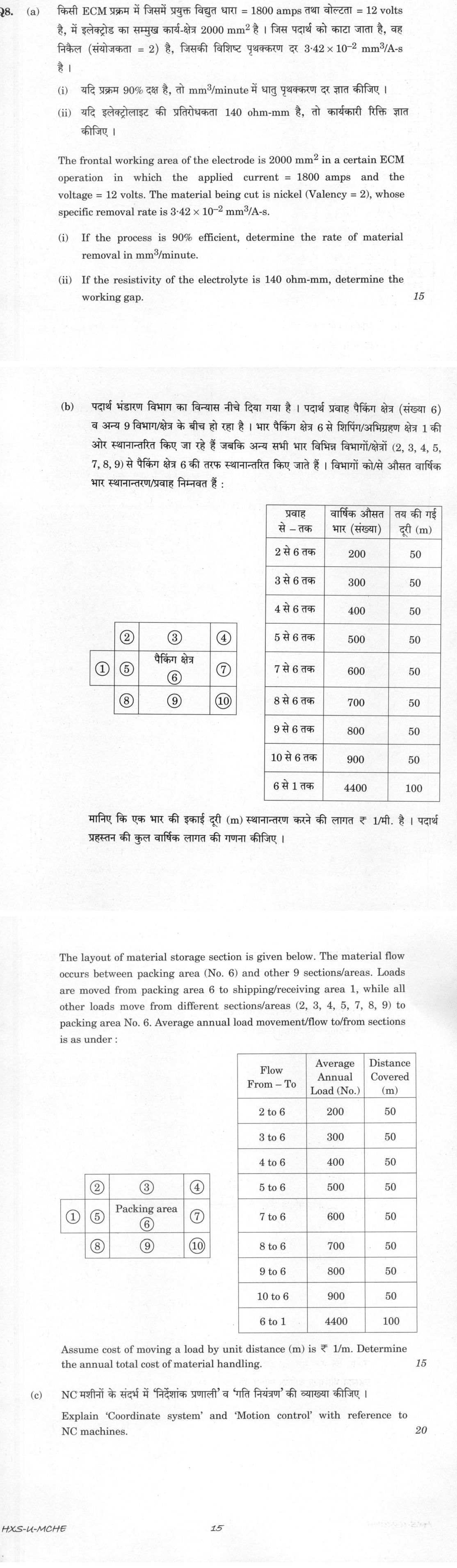
The layout of material storage section is given below. The material flow occurs between packing area (No. 6) and other 9 sections/areas. Loads are moved from packing area 6 to shipping/receiving area 1, while all other loads move from different sections/areas (2, 3, 4, 5, 7, 8, 9) to packing area No. 6. Average annual load movement/flow to/from sections is as under:
| Flow From – To | Average Annual Load (No.) | Distance Covered (m) |
|---|---|---|
| 2 to 6 | 200 | 50 |
| 3 to 6 | 300 | 50 |
| 4 to 6 | 400 | 50 |
| 5 to 6 | 500 | 50 |
| 7 to 6 | 600 | 50 |
| 8 to 6 | 700 | 50 |
| 9 to 6 | 800 | 50 |
| 10 to 6 | 900 | 50 |
| 6 to 1 | 4400 | 100 |
Assume cost of moving a load by unit distance (m) is ₹ 1/m. Determine the annual total cost of material handling.
Explain 'Coordinate system' and 'Motion control' with reference to NC machines.
हिंदी में प्रश्न पढ़ें
किसी ECM प्रक्रम में जिसमें प्रयुक्त विद्युत धारा = 1800 amps तथा वोल्टता = 12 volts है, में इलेक्ट्रोड का सम्मुख कार्य-क्षेत्र 2000 mm² है। जिस पदार्थ को काटा जाता है, वह निकेल (संयोजकता = 2) है, जिसकि विशिष्ट पृथक्करण दर 3·42 × 10⁻² mm³/A-s है।
यदि प्रक्रम 90% दक्ष है, तो mm³/minute में धातु पृथक्करण दर ज्ञात कीजिए।
यदि इलेक्ट्रोलाइट की प्रतिरोधकता 140 ohm-mm है, तो कार्यकारी रिक्ति ज्ञात कीजिए।
पदार्थ भंडारण विभाग का विन्यास नीचे दिया गया है। पदार्थ प्रवाह पैकिंग क्षेत्र (संख्या 6) व अन्य 9 विभाग/क्षेत्र के बीच हो रहा है। भार पैकिंग क्षेत्र 6 से शिपिंग/अभिग्रहण क्षेत्र 1 की ओर स्थानांतरित किए जा रहे हैं जबकि अन्य सभी भार विभिन्न विभागों/क्षेत्रों (2, 3, 4, 5, 7, 8, 9) से पैकिंग क्षेत्र 6 की तरफ स्थानांतरित किए जाते हैं। विभागों को/से औसत वार्षिक भार स्थानांतरण/प्रवाह निम्नवत है:
| प्रवाह से – तक | वार्षिक औसत भार (संख्या) | तय की गई दूरी (m) |
|---|---|---|
| 2 से 6 तक | 200 | 50 |
| 3 से 6 तक | 300 | 50 |
| 4 से 6 तक | 400 | 50 |
| 5 से 6 तक | 500 | 50 |
| 7 से 6 तक | 600 | 50 |
| 8 से 6 तक | 700 | 50 |
| 9 से 6 तक | 800 | 50 |
| 10 से 6 तक | 900 | 50 |
| 6 से 1 तक | 4400 | 100 |
मानिए कि एक भार की इकाई दूरी (m) स्थानांतरण करने की लागत ₹ 1/मी. है। पदार्थ प्रहस्तन की कुल वार्षिक लागत की गणना कीजिए।
NC मशीनों के संदर्भ में 'निर्देशांक प्रणाली' व 'गति नियंत्रण' की व्याख्या कीजिए।
The figure this question refers to, in words
The question paper is a scan and the diagram did not survive as text. This is the figure as read from the original page — every component, value and label — so the question can be worked from the text below.
(a) Table with columns: Jobs, Processing Time (in days), Due Date (from now) A, 6, 5 B, 4, 10 C, 5, 15 D, 8, 20 E, 7, 30
(b) Table with City as the major column header over Chennai, Delhi, and Kolkata: Head, Chennai, Delhi, Kolkata Fixed cost (Rupees), 800000, 600000, 500000 Variable cost per unit (Rupees), 30, 40, 50 Revenue per unit (Rupees), 60, 60, 60
(b) Layout diagram and flow table:
- Layout Diagram: A grid layout consisting of 10 square areas:
- Top row: section (2), section (3), section (4) from left to right.
- Middle row: section (1) on the far left, connected to section (5), which is to the left of 'Packing area (6)', followed by section (7) on the right.
- Bottom row: section (8) directly below (5), section (9) directly below (6), and section (10) directly below (7). Section (1) is attached only to the left side of section (5).
- Data Table: Flow From - To | Average Annual Load (No.) | Distance Covered (m) 2 to 6 | 200 | 50 3 to 6 | 300 | 50 4 to 6 | 400 | 50 5 to 6 | 500 | 50 7 to 6 | 600 | 50 8 to 6 | 700 | 50 9 to 6 | 800 | 50 10 to 6 | 900 | 50 6 to 1 | 4400 | 100
Model answer
Written by UPSC Answer Check against this question's marking rubric, to the expected length. UPSC does not publish answers for Mains — this is one way to score well, not an official key.
(a) (i) For ECM, actual material removal rate is found from the given specific removal rate, applied current and current efficiency. Given: specific removal rate = 3.42 × 10⁻² mm³/A-s, current I = 1800 A, efficiency η = 90% = 0.90.
Actual MRR = η × (specific removal rate) × I = 0.90 × 3.42 × 10⁻² mm³/A-s × 1800 A = 55.404 mm³/s.
Rate in mm³/minute = 55.404 × 60 = 3324.24 mm³/min.
(ii) Name the method: Ohm’s law applied to the electrolyte-filled working gap. Resistance of electrolyte gap is R = V/I = 12 V / 1800 A = 0.006667 ohm = 1/150 ohm.
For gap h, electrolyte resistivity ρ = 140 ohm-mm and frontal area A = 2000 mm², R = ρh/A, so h = RA/ρ = (1/150 × 2000) / 140 = (2000/150)/140 = 40/(3×140) = 2/21 mm = 0.09524 mm.
(b) The annual material handling cost is obtained by multiplying each load by its travel distance and by ₹1/m, then summing.
- 2 to 6: 200 × 50 = 10,000
- 3 to 6: 300 × 50 = 15,000
- 4 to 6: 400 × 50 = 20,000
- 5 to 6: 500 × 50 = 25,000
- 7 to 6: 600 × 50 = 30,000
- 8 to 6: 700 × 50 = 35,000
- 9 to 6: 800 × 50 = 40,000
- 10 to 6: 900 × 50 = 45,000
- 6 to 1: 4400 × 100 = 440,000
Total cost = 10,000 + 15,000 + 20,000 + 25,000 + 30,000 + 35,000 + 40,000 + 45,000 + 440,000 = ₹6,60,000 per year.
(c) In NC machines, the coordinate system is the geometric reference frame used to define the position of the tool and workpiece. Normally a right-hand Cartesian system is used, with X, Y and Z axes mutually perpendicular. The Z-axis is generally parallel to the spindle axis. The origin, or zero point, may be the machine zero, workpiece zero or program zero. Coordinates can be absolute, measured from a fixed origin, or incremental, measured from the previous tool position. Rotational axes A, B and C are used for rotary motion about X, Y and Z respectively. Work offsets and tool offsets are applied so that the programmed coordinates match the actual workpiece location. Thus the coordinate system provides an unambiguous numerical language for describing the tool path.
Motion control refers to the manner in which the NC controller drives the machine axes to achieve the commanded positions and paths. The controller reads each block of the part program, determines the required displacement, feed rate and direction, and sends signals to the axis drives. Common motion types are:
- Point-to-point motion, where only the final position matters, as in drilling.
- Straight-line or linear motion, where the tool moves along a programmed straight line, usually by G01.
- Contour or continuous-path motion, where two or more axes are coordinated to produce curved profiles, using circular interpolation G02/G03, helical or spline interpolation.
Motion control also includes feed-rate control, rapid traverse, acceleration and deceleration, backlash compensation, pitch-error compensation, tool-length compensation and cutter-radius compensation. Open-loop NC uses stepper motors without feedback, while closed-loop CNC uses servomotors with position and velocity feedback from encoders or tachometers. Accurate motion control is essential for dimensional accuracy, surface finish, repeatability and safe operation of NC machine tools.
What "Calculate" is asking you to do
Apply the standard formula or schedule to data the question has already supplied — a table of readings, cost records, a balance sheet — and produce the number. The method is rarely in doubt; the marks sit in the named intermediate quantities, each of which has to appear as a labelled line.
Structure that answers it
Data as given → formula or standard treatment, named → substitution → each intermediate, labelled → result with units
Where marks are lost
Omitting an intermediate the marking scheme pays for separately, or rounding at an intermediate line so the final figure drifts. In commerce and accountancy, any figure in a statement that no numbered working note supports is treated as unearned.
How this answer will be evaluated
Approach
(a(i)) calculate: given > formula > substitution > result with units > interpretation | (a(ii)) calculate: given > formula > substitution > result with units > interpretation | (b) calculate: given > formula > substitution > result with units > interpretation | (c) explain: definition/context > points in order > small example > short close Full marks: All parts solved with correct formulas, units, and clear steps; part (c) has precise definitions and examples.
Key points expected
- State given current, specific removal rate, and efficiency
- Apply formula: MRR = η × I × k
- Convert time unit from seconds to minutes
- State final answer with units mm³/min
- State given voltage, current, area, and resistivity
- Apply Ohm's law: V = I × R
- Use resistance formula: R = ρ × L / A
- Solve for L (working gap) and state units
Evaluation rubric
Each sub-part is marked on its own, against the marks and word limit printed on the paper.
- (a(i)) Determine the rate of material removal in mm³/minute.
calculate— given → formula → substitution → result with units → interpretation
Must cover
- State given current, specific removal rate, and efficiency
- Apply formula: MRR = η × I × k
- Convert time unit from seconds to minutes
- State final answer with units mm³/min
Loses marks
- Forgetting to convert seconds to minutes
- Omitting the efficiency factor in calculation
Earns more
- Explicitly state the efficiency factor (0.90)
- Show dimensional consistency check
Extra mark
- Mention Faraday's law as the underlying principle
- (a(ii)) Determine the working gap given electrolyte resistivity.
calculate— given → formula → substitution → result with units → interpretation
Must cover
- State given voltage, current, area, and resistivity
- Apply Ohm's law: V = I × R
- Use resistance formula: R = ρ × L / A
- Solve for L (working gap) and state units
Loses marks
- Using wrong formula for resistance
- Unit mismatch in resistivity or area
Earns more
- Show substitution of values clearly
- Verify units of resistivity (ohm-mm)
Extra mark
- Mention the physical significance of working gap
- (b) Determine the annual total cost of material handling. 15 marks
calculate— given → formula → substitution → result with units → interpretation
Must cover
- List all flow pairs with load and distance
- Calculate cost for each flow: Load × Distance × Rate
- Sum all individual costs to get total
- State final answer in ₹
Loses marks
- Missing any flow pair in calculation
- Arithmetic errors in multiplication or summation
Earns more
- Present calculation in a clear table format
- Show the rate (₹1/m) explicitly in each step
Extra mark
- Mention the concept of 'load-distance' product
- (c) Explain 'Coordinate system' and 'Motion control' in NC machines. 20 marks
explain— definition/context → points in order → small example → short close
Must cover
- Define coordinate system (Cartesian, axes X, Y, Z)
- Explain motion control (servo systems, feedback)
- Link both to NC machine operation
- Provide a small example or diagram reference
Loses marks
- Confusing coordinate system with tool path
- Vague description of motion control without feedback mechanism
Earns more
- Mention specific types of coordinate systems (e.g., absolute vs incremental)
- Describe the role of encoders or resolvers in motion control
Extra mark
- Reference a specific NC machine model or standard (e.g., ISO 841)
Practice this exact question
Write your answer and it is marked point by point against the model answer above — what you covered, what you missed, what you got wrong.
Evaluate my answer →More from Mechanical Engineering 2021 Paper I
- Q5 (a) TIG welding of two sheets of 5 mm thickness is performed using welding current (I) of…
- Q6 (a) Five jobs A, B, C, D and E need to be processed on a machine. Processing time (in day…
- Q7 A car servicing company is interested in reducing the waiting time for its customers. The…
- Q8 The frontal working area of the electrode is 2000 mm² in a certain ECM operation in which…