Paper I — Q3
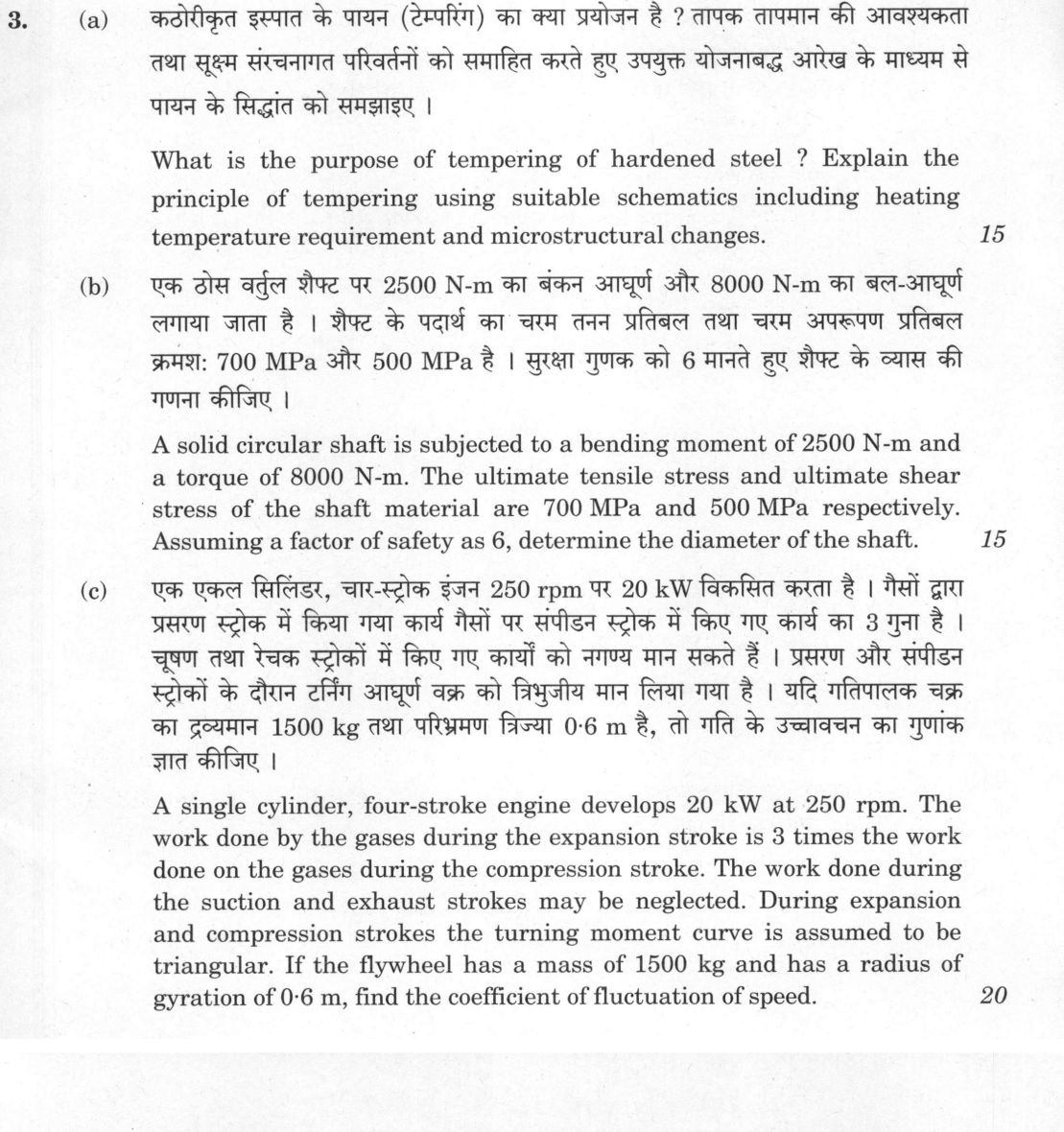
(a) What is the purpose of tempering of hardened steel? Explain the principle of tempering using suitable schematics including…
What is the purpose of tempering of hardened steel? Explain the principle of tempering using suitable schematics including heating temperature requirement and microstructural changes. 15 marks
A solid circular shaft is subjected to a bending moment of 2500 N-m and a torque of 8000 N-m. The ultimate tensile stress and ultimate shear stress of the shaft material are 700 MPa and 500 MPa respectively. Assuming a factor of safety as 6, determine the diameter of the shaft. 15 marks
A single cylinder, four-stroke engine develops 20 kW at 250 rpm. The work done by the gases during the expansion stroke is 3 times the work done on the gases during the compression stroke. The work done during the suction and exhaust strokes may be neglected. During expansion and compression strokes the turning moment curve is assumed to be triangular. If the flywheel has a mass of 1500 kg and has a radius of gyration of 0.6 m, find the coefficient of fluctuation of speed. 20 marks
हिंदी में प्रश्न पढ़ें
कठोरीकृत इस्पात के पायन (टेम्परिंग) का क्या प्रयोजन है? तापक तापमान की आवश्यकता तथा सूक्ष्म संरचनागत परिवर्तनों को समाहित करते हुए उपयुक्त योजनाबद्ध आरेख के माध्यम से पायन के सिद्धांत को समझाइए। (15 अंक)
एक ठोस वृत्तीय शैफ्ट पर 2500 N-m का बंकन आघूर्ण और 8000 N-m का बल-आघूर्ण लगाया जाता है। शैफ्ट के पदार्थ का चरम तनन प्रतिबल तथा चरम अपरूपण प्रतिबल क्रमशः 700 MPa और 500 MPa है। सुरक्षा गुणक को 6 मानते हुए शैफ्ट के व्यास की गणना कीजिए। (15 अंक)
एक एकल सिलिंडर, चार-स्ट्रोक इंजन 250 rpm पर 20 kW विकसित करता है। गैसों द्वारा प्रसरण स्ट्रोक में किया गया कार्य गैसों पर संपीडन स्ट्रोक में किए गए कार्य का 3 गुना है। चूषण तथा रेचक स्ट्रोकों में किए गए कार्यों को नगण्य मान सकते हैं। प्रसरण और संपीडन स्ट्रोकों के दौरान टर्निंग आघूर्ण वक्र को त्रिभुजीय मान लिया गया है। यदि गतिपालक चक्र का द्रव्यमान 1500 kg तथा परिभ्रमण त्रिज्या 0.6 m है, तो गति के उच्चावचन का गुणांक ज्ञात कीजिए। (20 अंक)
Model answer
Written by UPSC Answer Check against this question's marking rubric, to the expected length. UPSC does not publish answers for Mains — this is one way to score well, not an official key.
(a) Tempering is a heat treatment given immediately after hardening (quenching). Its purpose is to relieve internal stresses, reduce brittleness, improve toughness and ductility, stabilise the size and structure, and adjust the hardness/strength to the required service condition.
Principle: hardened steel consists mainly of tetragonal martensite, a supersaturated and highly strained solution of carbon in α-iron, often with retained austenite. On reheating to a temperature below the lower critical temperature A₁, carbon atoms diffuse and precipitate as carbides. The structure gradually becomes tempered martensite: fine cementite particles in a ferrite matrix. Higher tempering temperature gives coarser carbides, lower hardness and higher toughness.
Heating requirement: tempering is done below A₁; for plain carbon steel A₁ ≈ 727°C, but practical tempering range is 150–650°C. It is held at the chosen temperature and then cooled, usually in air.
Schematic: As-quenched martensite (BCT, stressed) → reheat 150–650°C, below A₁, hold → air cool → tempered martensite: α-ferrite + fine Fe₃C.
Microstructural stages:
- 100–250°C: carbon rejects as ε-carbide; low-temperature tempered martensite.
- 200–300°C: retained austenite transforms to ferrite and cementite.
- 250–400°C: ε-carbide converts to Fe₃C; martensite loses tetragonality.
- 400–650°C: carbide coarsening/spheroidisation; toughness increases.
Low tempering (150–250°C) is used for cutting tools; medium (350–450°C) for springs; high (500–650°C) for structural parts needing toughness.
(b) Use the maximum shear stress theory for a ductile shaft. Allowable shear stress: τ_allow = 500/6 = 83.33 MPa. Allowable tensile stress: σ_allow = 700/6 = 116.67 MPa.
Given: M = 2500 N-m, T = 8000 N-m.
Equivalent torque: Te = √(M² + T²) = √(2500² + 8000²) = 500√281 N-m = 8381.53 N-m.
For a solid circular shaft under equivalent torque: τ = 16 Te/(π d³) ≤ τ_allow. So d³ = 16 Te/(π τ_allow) = 16 × 500√281 / [π × (500/6) × 10⁶] = 96√281/(π × 10⁶) m³. Thus d = ∛(96√281/π)/100 m = 0.08001 m ≈ 80.01 mm.
Check by maximum normal stress theory: Me = ½[M + √(M² + T²)] = ½(2500 + 500√281) = 1250 + 250√281 = 5440.76 N-m. σ = 32 Me/(π d³) ≤ σ_allow. This gives d ≈ 78.03 mm.
The shear criterion is more conservative and governs. Diameter of shaft ≈ 80 mm.
(c) For a four-stroke engine, one cycle = 2 revolutions = 4π rad. Mean angular speed: ω = 2πN/60 = 2π × 250/60 = 25π/3 rad/s.
Mean torque: T_m = P/ω = 20,000 ÷ (25π/3) = 2400/π = 763.94 N-m.
Work per cycle: W = T_m × 4π = (2400/π) × 4π = 9600 J.
Let W_c = work done on gases during compression, W_e = work done by gases during expansion. Given W_e = 3W_c and W_e − W_c = 9600 J. So 2W_c = 9600 ⇒ W_c = 4800 J, W_e = 14400 J.
Each stroke is π rad. For triangular turning moment, peak expansion torque: T_e = 2W_e/π = 28800/π = 9167.3 N-m. peak compression torque: T_c = −2W_c/π = −9600/π = −3055.8 N-m.
The mean torque line is T_m = 2400/π. The maximum energy fluctuation occurs during the expansion stroke between the two points where the triangular curve crosses the mean torque line.
Take θ from start of expansion. Rising side: T = (2T_e/π)θ = (57600/π²)θ. Set T = T_m: (57600/π²)θ = 2400/π ⇒ θ₁ = π/24. By symmetry, θ₂ = π − π/24 = 23π/24.
Net expansion work relative to mean: W_e − T_mπ = 14400 − 2400 = 12000 J.
At each end, the small area below the mean line is: D = T_m(π/24) − ½(57600/π²)(π/24)² = (2400/π)(π/24) − (28800/π²)(π²/576) = 100 − 50 = 50 J.
Total area below mean within expansion = 2D = 100 J. Therefore surplus area above mean: ΔE = 12000 + 100 = 12100 J.
Moment of inertia: I = m k² = 1500 × (0.6)² = 540 kg-m².
Coefficient of fluctuation of speed: δ = ΔE/(Iω²) = 12100/[540 × (25π/3)²] = 12100/(37500π²) = 121/(375π²) = 0.03269.
δ ≈ 0.0327 = 3.27%.
What "Solve" is asking you to do
Choose the method, then carry it through to a final answer. Identifying what kind of problem this is and why that method applies is the first thing marked; a correct figure arrived at invisibly earns almost nothing.
Structure that answers it
Given data and what is required → method chosen, with the reason it applies → set-up (equation, circuit, free body, trial balance) → working, step by step → answer with units and any condition of validity
Where marks are lost
Doing the middle steps mentally and writing only the result. In mathematics papers, a further loss comes from giving a decimal where the exact value in surds or fractions was wanted, or from skipping the justification a part explicitly asks for.
How this answer will be evaluated
Approach
(a) explain: definition/context > points in order > small example > short close | (b) calculate: given > formula > substitution > result with units > interpretation | (c) calculate: given > formula > substitution > result with units > interpretation Full marks: Rigorous method, correct schematics, all steps shown with units.
Key points expected
- State purpose: reduce brittleness, relieve stress, increase toughness.
- Define tempering temperature range (below A1 / critical temp).
- Describe microstructural change: martensite to tempered martensite.
- Provide schematic showing heating curve and microstructure.
- State given data (M, T, stresses, FOS).
- Apply failure theory (e.g., Maximum Shear Stress).
- Calculate equivalent bending/torsion moment.
- Derive diameter using torsion/bending formula.
Evaluation rubric
Each sub-part is marked on its own, against the marks and word limit printed on the paper.
- (a) Purpose of tempering and principle with schematics of temperature and microstructure. 15 marks
explain— definition/context → points in order → small example → short close
Must cover
- State purpose: reduce brittleness, relieve stress, increase toughness.
- Define tempering temperature range (below A1 / critical temp).
- Describe microstructural change: martensite to tempered martensite.
- Provide schematic showing heating curve and microstructure.
Loses marks
- Confusing tempering with annealing or quenching.
- No mention of microstructural change.
Earns more
- Mention specific phases (carbide precipitation).
- Link temperature to specific mechanical properties.
Extra mark
- T-T-T or C-C diagram reference.
- (b) Diameter of solid shaft under combined bending and torsion. 15 marks
calculate— given → formula → substitution → result with units → interpretation
Must cover
- State given data (M, T, stresses, FOS).
- Apply failure theory (e.g., Maximum Shear Stress).
- Calculate equivalent bending/torsion moment.
- Derive diameter using torsion/bending formula.
Loses marks
- Plugging numbers without governing equation.
- Ignoring factor of safety.
Earns more
- Check dimensional consistency of units.
- State assumptions (e.g., elastic limit).
Extra mark
- Comparison with another failure theory.
- (c) Coefficient of fluctuation of speed for a flywheel. 20 marks
calculate— given → formula → substitution → result with units → interpretation
Must cover
- Calculate work done per cycle (expansion vs compression).
- Determine energy fluctuation (ΔE) from turning moment curve.
- Calculate moment of inertia (I = m * k²).
- Apply formula ΔE = I * ω² * Cs.
Loses marks
- Neglecting compression work (given as 1/3 expansion).
- Incorrect unit conversion (rpm to rad/s).
Earns more
- Draw turning moment diagram (triangular).
- Explicitly calculate angular velocity (ω).
Extra mark
- Discussion on flywheel design implications.
Practice this exact question
Write your answer and it is marked point by point against the model answer above — what you covered, what you missed, what you got wrong.
Evaluate my answer →More from Mechanical Engineering 2021 Paper I
- Q1 (a) What is the supporting force system at A for the cantilever beam shown in the figure…
- Q2 (a) In a slider-crank mechanism, the lengths of the crank and connecting rod are 150 mm a…
- Q3 (a) What is the purpose of tempering of hardened steel? Explain the principle of temperin…
- Q4 (a) Find out the value of atomic packing factor for the FCC crystal structure. Calculate…
- Q5 (a) TIG welding of two sheets of 5 mm thickness is performed using welding current (I) of…
- Q6 (a) Five jobs A, B, C, D and E need to be processed on a machine. Processing time (in day…