Paper I — Q4
(a) Find out the value of atomic packing factor for the FCC crystal structure. Calculate the radius of an iridium (Ir) atom…
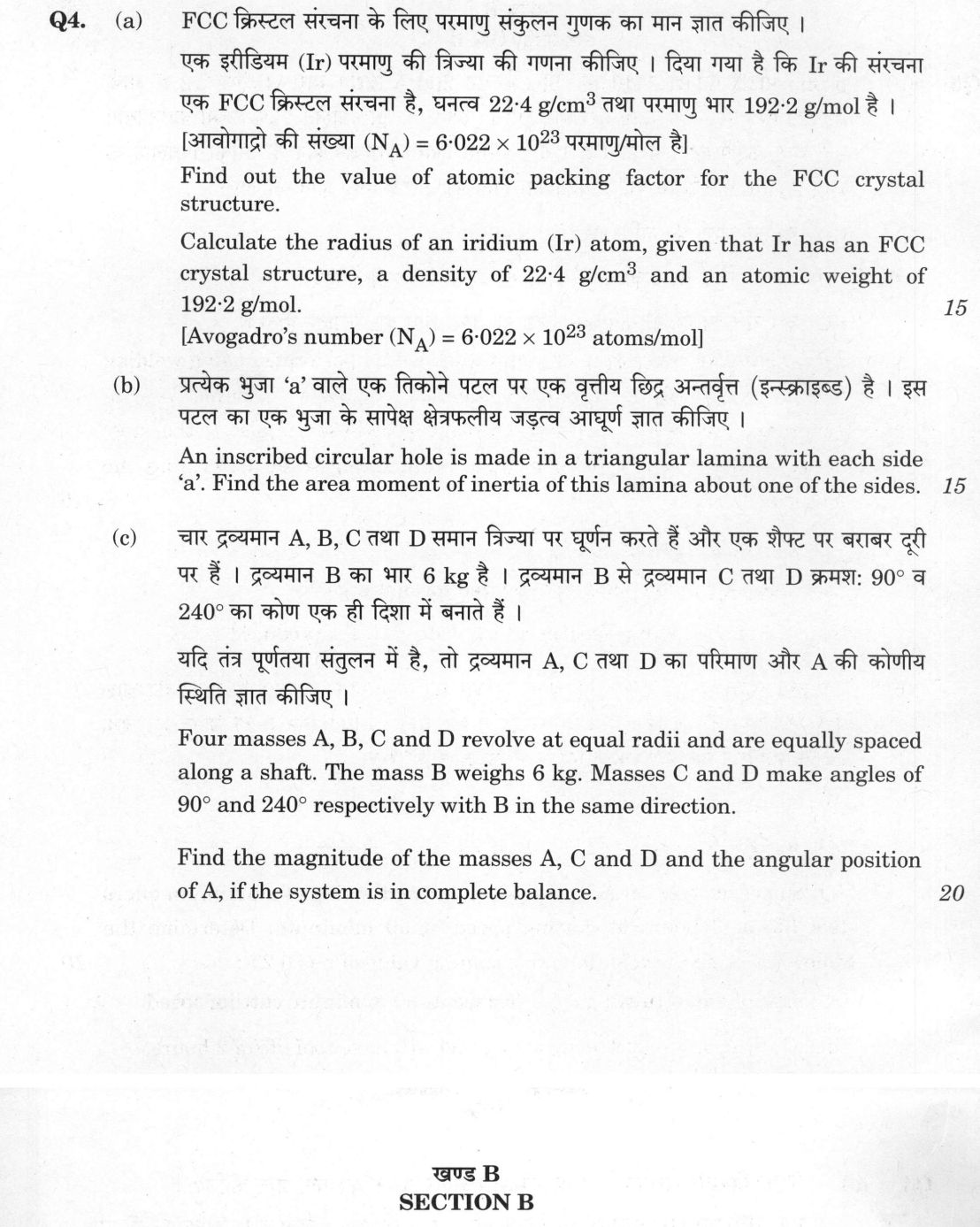
Find out the value of atomic packing factor for the FCC crystal structure.
Calculate the radius of an iridium (Ir) atom, given that Ir has an FCC crystal structure, a density of 22.4 g/cm³ and an atomic weight of 192.2 g/mol.
[Avogadro's number (Nₐ) = 6.022 × 10²³ atoms/mol] 15 marks
An inscribed circular hole is made in a triangular lamina with each side 'a'. Find the area moment of inertia of this lamina about one of the sides. 15 marks
Four masses A, B, C and D revolve at equal radii and are equally spaced along a shaft. The mass B weighs 6 kg. Masses C and D make angles of 90° and 240° respectively with B in the same direction.
Find the magnitude of the masses A, C and D and the angular position of A, if the system is in complete balance. 20 marks
हिंदी में प्रश्न पढ़ें
FCC क्रिस्टल संरचना के लिए परमाणु संकुलन गुणक का मान ज्ञात कीजिए।
एक ईरिडियम (Ir) परमाणु की त्रिज्या की गणना कीजिए। दिया गया है कि Ir की संरचना एक FCC क्रिस्टल संरचना है, घनत्व 22.4 g/cm³ तथा परमाणु भार 192.2 g/mol है।
[आवोगाद्रो की संख्या (Nₐ) = 6.022 × 10²³ परमाणु/मोल है]। (15 अंक)
प्रत्येक भुजा 'a' वाले एक तिकोने पटल पर एक वृत्तीय छिद्र अन्तर्वृत (इन्स्क्राइब्ड) है। इस पटल का एक भुजा के सापेक्ष क्षेत्रफलीय जड़त्व आघूर्ण ज्ञात कीजिए। (15 अंक)
चार द्रव्यमान A, B, C तथा D समान त्रिज्या पर घूर्णन करते हैं और एक शाफ्ट पर बराबर दूरी पर हैं। द्रव्यमान B का भार 6 kg है। द्रव्यमान B से द्रव्यमान C तथा D क्रमशः 90° व 240° का कोण एक ही दिशा में बनाते हैं।
यदि तंत्र पूर्णतया संतुलन में है, तो द्रव्यमान A, C तथा D का परिमाण और A की कोणीय स्थिति ज्ञात कीजिए। (20 अंक)
Model answer
Written by UPSC Answer Check against this question's marking rubric, to the expected length. UPSC does not publish answers for Mains — this is one way to score well, not an official key.
(a)(i) For FCC, atoms touch along a face diagonal. Hence 4R = a√2, so a = 2√2 R. Volume of one cell = a³ = (2√2 R)³ = 16√2 R³. Number of atoms per FCC unit cell = 4. Volume occupied by atoms = 4 × (4/3)πR³ = 16πR³/3. Atomic packing factor, APF = occupied volume / cell volume = (16πR³/3)/(16√2 R³) = π/(3√2) = π√2/6. APF = π√2/6 = 0.7405 = 74.05%. Condition: perfect FCC, atoms treated as hard spheres touching along face diagonal.
(a)(ii) Use density relation ρ = n M/(Nₐ a³), where for FCC n = 4. So a³ = n M/(ρ Nₐ) = 4 × 192.2/(22.4 × 6.022 × 10²³) = 768.8/(1.348928 × 10²⁵) = 5.699 × 10⁻²³ cm³. Thus a = (5.699 × 10⁻²³)^(1/3) = 3.848 × 10⁻⁸ cm. For FCC, R = a/(2√2) = 3.848 × 10⁻⁸/(2√2) = 1.361 × 10⁻⁸ cm. R = 1.361 × 10⁻⁸ cm = 0.1361 nm = 1.361 Å = 136.1 pm.
(b) For an equilateral triangle of side a, height h = √3 a/2. Using the integral method for area moment of inertia about one side, I_tri = ∫ y² dA. Width at distance y from the chosen side is a(1 − y/h). Hence I_tri = ∫₀^h y² a(1 − y/h) dy = a(h³/3 − h³/4) = a h³/12. Substitute h = √3 a/2: I_tri = a(√3 a/2)³/12 = √3 a⁴/32.
The inscribed circle has radius r = a√3/6. Its moment of inertia about the chosen side is found by parallel-axis theorem. Its centre is at distance r from the side, so I_hole = πr⁴/4 + πr² × r² = 5πr⁴/4. Since r⁴ = (a√3/6)⁴ = a⁴/144, I_hole = 5π a⁴/576.
Therefore the remaining lamina has I = I_tri − I_hole = √3 a⁴/32 − 5π a⁴/576 = (18√3 − 5π)a⁴/576. I = (18√3 − 5π)a⁴/576, in length⁴. Condition: uniform equilateral lamina, incircle removed exactly, axis along one side.
(c)(i) Let the planes be in the order A, B, C, D with equal axial spacing. Take B as 0° reference, so m_B = 6 kg at 0°, C at 90°, D at 240°. Let A have mass m_A at angle θ from B. Since all radii are equal, centrifugal forces are proportional to masses.
For complete balance, vector sum of forces and moments must be zero. Take moments about the plane of A. Let spacing be 1 unit: A at 0, B at 1, C at 2, D at 3.
Moment balance: Real part: 6(1) − m_D(3)(1/2) = 0 ⇒ 6 − 1.5m_D = 0 ⇒ m_D = 4 kg. Imaginary part: m_C(2) − m_D(3)(√3/2) = 0 ⇒ 2m_C = 4 × 3√3/2 = 6√3 ⇒ m_C = 3√3 kg = 5.196 kg.
Force balance: Real part: 6 − m_D/2 + m_A cosθ = 0 ⇒ 6 − 2 + m_A cosθ = 0 ⇒ m_A cosθ = −4. Imaginary part: m_C − (√3/2)m_D + m_A sinθ = 0 ⇒ 3√3 − 2√3 + m_A sinθ = 0 ⇒ m_A sinθ = −√3.
Hence m_A = √((−4)² + (−√3)²) = √(16 + 3) = √19. m_A = √19 kg = 4.359 kg. Thus m_A = √19 kg, m_C = 3√3 kg, m_D = 4 kg.
(c)(ii) From m_A cosθ = −4 and m_A sinθ = −√3, both components are negative, so θ lies in the third quadrant. tanθ = (−√3)/(−4) = √3/4. Therefore θ = 180° + tan⁻¹(√3/4) = 180° + 23.41° = 203.41°. Angular position of A = 203.41° from B in the same direction as C and D, i.e. 23.41° beyond the 180° position. Condition: equal radii and equal axial spacing; dynamic balance includes both force and couple balance.
What "Calculate" is asking you to do
Apply the standard formula or schedule to data the question has already supplied — a table of readings, cost records, a balance sheet — and produce the number. The method is rarely in doubt; the marks sit in the named intermediate quantities, each of which has to appear as a labelled line.
Structure that answers it
Data as given → formula or standard treatment, named → substitution → each intermediate, labelled → result with units
Where marks are lost
Omitting an intermediate the marking scheme pays for separately, or rounding at an intermediate line so the final figure drifts. In commerce and accountancy, any figure in a statement that no numbered working note supports is treated as unearned.
How this answer will be evaluated
Approach
(a) calculate: given > formula > substitution > result with units > interpretation | (b) calculate: given > formula > substitution > result with units > interpretation | (c) calculate: given > formula > substitution > result with units > interpretation Full marks: Rigorous derivation with all steps, units, and physical interpretation.
Key points expected
- State APF formula for FCC (0.74)
- Relate lattice parameter a to radius r (a = 2√2 r)
- Use density formula ρ = nA / (Vc NA)
- Substitute given values (ρ, A, NA) to solve for r
- Calculate I for solid equilateral triangle about base
- Determine radius of inscribed circle (r = a/2√3)
- Calculate I for circular hole about its centroid
- Apply parallel axis theorem to shift hole's I to base
Evaluation rubric
Each sub-part is marked on its own, against the marks and word limit printed on the paper.
- (a) Determine APF for FCC and atomic radius of Ir using density and molar mass. 15 marks
calculate— given → formula → substitution → result with units → interpretation
Must cover
- State APF formula for FCC (0.74)
- Relate lattice parameter a to radius r (a = 2√2 r)
- Use density formula ρ = nA / (Vc NA)
- Substitute given values (ρ, A, NA) to solve for r
Loses marks
- Using BCC or SC geometry for FCC
- Omitting Avogadro's number in calculation
Earns more
- Show unit conversion for density or mass
- Explicitly state n=4 for FCC unit cell
Extra mark
- Draw FCC unit cell with atoms marked
- (b) Compute area moment of inertia of triangular lamina with inscribed hole about a side. 15 marks
calculate— given → formula → substitution → result with units → interpretation
Must cover
- Calculate I for solid equilateral triangle about base
- Determine radius of inscribed circle (r = a/2√3)
- Calculate I for circular hole about its centroid
- Apply parallel axis theorem to shift hole's I to base
Loses marks
- Forgetting parallel axis theorem for the hole
- Using wrong formula for triangle's I about base
Earns more
- State centroid distance for triangle (h/3)
- Show subtraction of hole's I from triangle's I
Extra mark
- Labelled diagram of triangle with inscribed circle
- (c) Find magnitudes of masses A, C, D and angular position of A for complete balance. 20 marks
calculate— given → formula → substitution → result with units → interpretation
Must cover
- Set up vector equilibrium equation (Σmr = 0)
- Resolve forces into horizontal and vertical components
- Solve simultaneous equations for unknown masses
- Determine angle of A from component ratio
Loses marks
- Ignoring the 'equal radii' condition
- Incorrect angle measurement direction (CW vs CCW)
Earns more
- Draw vector diagram of mass-radius products
- State assumption of equal radii explicitly
Extra mark
- Graphical solution using polygon of forces
Practice this exact question
Write your answer and it is marked point by point against the model answer above — what you covered, what you missed, what you got wrong.
Evaluate my answer →More from Mechanical Engineering 2021 Paper I
- Q1 (a) What is the supporting force system at A for the cantilever beam shown in the figure…
- Q2 (a) In a slider-crank mechanism, the lengths of the crank and connecting rod are 150 mm a…
- Q3 (a) What is the purpose of tempering of hardened steel? Explain the principle of temperin…
- Q4 (a) Find out the value of atomic packing factor for the FCC crystal structure. Calculate…
- Q5 (a) TIG welding of two sheets of 5 mm thickness is performed using welding current (I) of…
- Q6 (a) Five jobs A, B, C, D and E need to be processed on a machine. Processing time (in day…
- Q7 A car servicing company is interested in reducing the waiting time for its customers. The…