Paper I — Q5
(a) TIG welding of two sheets of 5 mm thickness is performed using welding current (I) of 200 A and arc voltage (V) of 12 V…
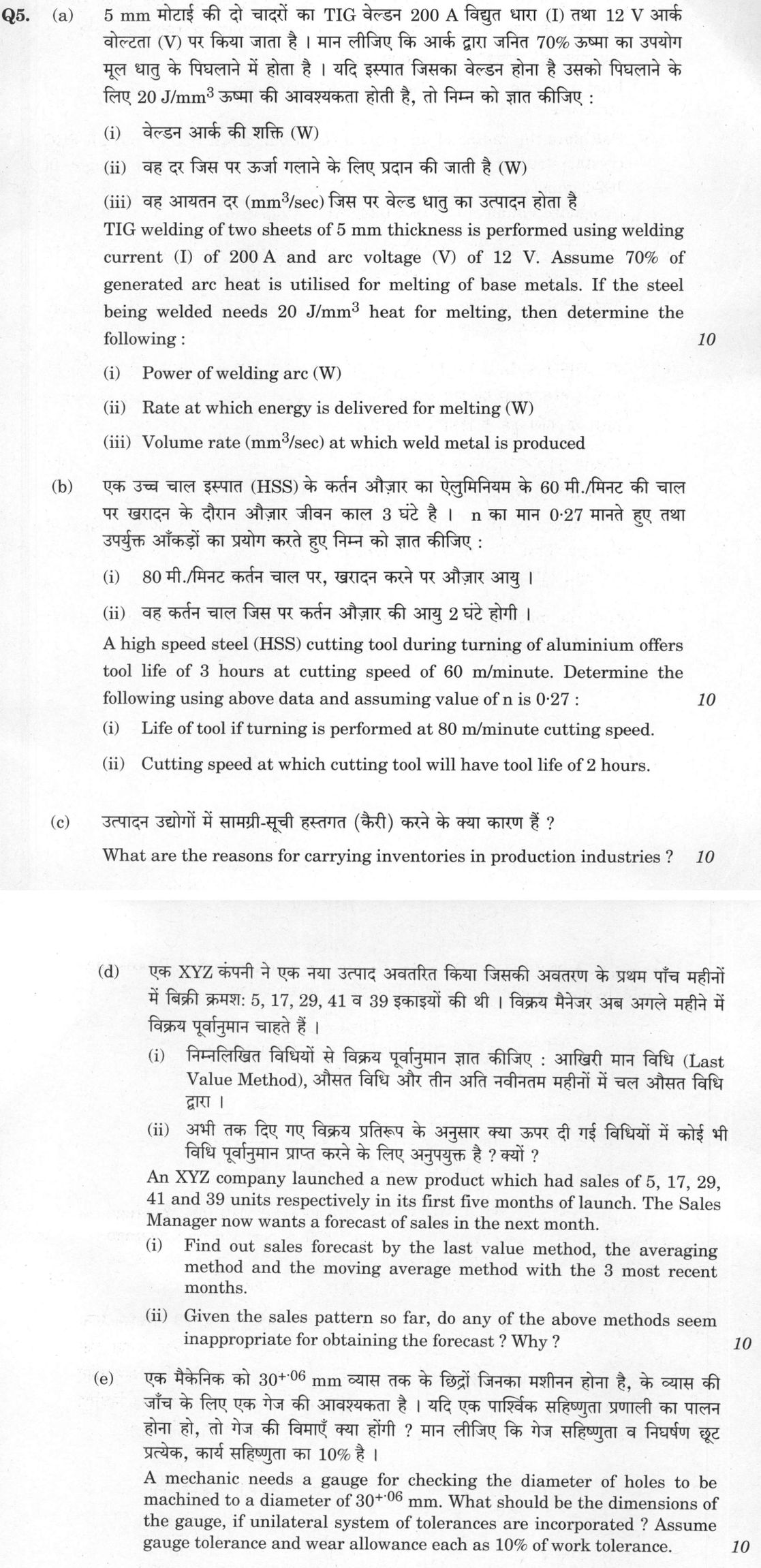
TIG welding of two sheets of 5 mm thickness is performed using welding current (I) of 200 A and arc voltage (V) of 12 V. Assume 70% of generated arc heat is utilised for melting of base metals. If the steel being welded needs 20 J/mm³ heat for melting, then determine the following : (i) Power of welding arc (W) (ii) Rate at which energy is delivered for melting (W) (iii) Volume rate (mm³/sec) at which weld metal is produced 10 marks
A high speed steel (HSS) cutting tool during turning of aluminium offers tool life of 3 hours at cutting speed of 60 m/minute. Determine the following using above data and assuming value of n is 0·27 : (i) Life of tool if turning is performed at 80 m/minute cutting speed. (ii) Cutting speed at which cutting tool will have tool life of 2 hours. 10 marks
What are the reasons for carrying inventories in production industries ? 10 marks
An XYZ company launched a new product which had sales of 5, 17, 29, 41 and 39 units respectively in its first five months of launch. The Sales Manager now wants a forecast of sales in the next month. (i) Find out sales forecast by the last value method, the averaging method and the moving average method with the 3 most recent months. (ii) Given the sales pattern so far, do any of the above methods seem inappropriate for obtaining the forecast ? Why ? 10 marks
A mechanic needs a gauge for checking the diameter of holes to be machined to a diameter of 30⁺⁰·⁰⁶ mm. What should be the dimensions of the gauge, if unilateral system of tolerances are incorporated ? Assume gauge tolerance and wear allowance each as 10% of work tolerance. 10 marks
हिंदी में प्रश्न पढ़ें
5 mm मोटाई की दो चादरों का TIG वेल्डन 200 A विद्युत धारा (I) तथा 12 V आर्क वोल्टता (V) पर किया जाता है । मान लीजिए कि आर्क द्वारा जनित 70% ऊष्मा का उपयोग मूल धातु के पिघलाने में होता है । यदि इस्पात जिसका वेल्डन होना है उसको पिघलाने के लिए 20 J/mm³ ऊष्मा की आवश्यकता होती है, तो निम्न को ज्ञात कीजिए : (i) वेल्डन आर्क की शक्ति (W) (ii) वह दर जिस पर ऊर्जा गलाने के लिए प्रदान की जाती है (W) (iii) वह आयतन दर (mm³/sec) जिस पर वेल्ड धातु का उत्पादन होता है (10 अंक)
एक उच्च चाल इस्पात (HSS) के कतन औजार का ऐलुमिनियम के 60 मी./मिनट की चाल पर खरादन के दौरान औजार जीवन काल 3 घंटे है । n का मान 0·27 मानते हुए तथा उपर्युक्त आँकड़ों का प्रयोग करते हुए निम्न को ज्ञात कीजिए : (i) 80 मी./मिनट कतन चाल पर, खरादन करने पर औजार आयु । (ii) वह कतन चाल जिस पर कतन औजार की आयु 2 घंटे होगी । (10 अंक)
उत्पादन उद्योगों में सामग्री-सूची हस्तगत (कैरी) करने के क्या कारण हैं ? (10 अंक)
एक XYZ कंपनी ने एक नया उत्पाद अवतरित किया जिसकी अवतरण के प्रथम पाँच महीनों में बिक्री क्रमशः: 5, 17, 29, 41 व 39 इकाइयों की थी । बिक्रय मैनेजर अब अगले महीने में बिक्रय पूर्वानुमान चाहते हैं । (i) निम्नलिखित विधियों से बिक्रय पूर्वानुमान ज्ञात कीजिए : आखिरी मान विधि (Last Value Method), औसत विधि और तीन अति नवीनतम महीनों में चल औसत विधि द्वारा । (ii) अभी तक दिए गए बिक्रय प्रतिरूप के अनुसार क्या उपर दी गई विधियों में कोई भी विधि पूर्वानुमान प्राप्त करने के लिए अनुपयुक्त है ? क्यों ? (10 अंक)
एक मैकेनिक को 30⁺⁰·⁰⁶ mm व्यास तक के छिद्रों जिनका मशीनिंग होना है, के व्यास की जाँच के लिए एक गेज की आवश्यकता है । यदि एक पार्श्विक सहिष्णुता प्रणाली का पालन होना हो, तो गेज की विमाएँ क्या होंगी ? मान लीजिए कि गेज सहिष्णुता व निघर्षण छूट प्रत्येक, कार्य सहिष्णुता का 10% है । (10 अंक)
Model answer
Written by UPSC Answer Check against this question's marking rubric, to the expected length. UPSC does not publish answers for Mains — this is one way to score well, not an official key.
(a) Given: welding current I = 200 A, arc voltage V = 12 V, heat utilisation factor η = 0.70, and heat required for melting steel H = 20 J/mm³.
(a)(i) Power of welding arc Using the arc power relation:
- P_arc = V × I
- P_arc = 12 V × 200 A = 2400 W
Final answer: P_arc = 2400 W
(a)(ii) Rate at which energy is delivered for melting Only 70% of the arc heat is utilised for melting. Therefore:
- Q_melting = η × P_arc
- Q_melting = 0.70 × 2400 W = 1680 W
Final answer: Q_melting = 1680 W
(a)(iii) Volume rate at which weld metal is produced Using the energy balance method, the volume rate is energy delivered for melting divided by heat required per unit volume:
- Volume rate = Q_melting / H
- Volume rate = 1680 J/s ÷ 20 J/mm³ = 84 mm³/s
Final answer: Volume rate = 84 mm³/s
The sheet thickness of 5 mm is not needed for this volume-rate calculation. It would be required only if welding speed or weld cross-sectional area were asked. The result assumes steady arc conditions and that the 70% utilised heat goes entirely into melting the base metal.
(b) Use Taylor’s tool life equation:
- V Tⁿ = C where V is cutting speed, T is tool life, n is the Taylor exponent, and C is a constant for the tool-work pair.
Given:
- V₁ = 60 m/min
- T₁ = 3 hours
- n = 0.27
(b)(i) Life of tool at cutting speed 80 m/min For the same tool-work pair, C is constant. Therefore:
- V₁ T₁ⁿ = V₂ T₂ⁿ
- 60 × 3⁰·²⁷ = 80 × T₂⁰·²⁷
- T₂⁰·²⁷ = (60/80) × 3⁰·²⁷ = 0.75 × 3⁰·²⁷
Now, 3⁰·²⁷ ≈ 1.3453. Hence:
- T₂⁰·²⁷ = 0.75 × 1.3453 = 1.00898
- T₂ = (1.00898) raised to the power 1/0.27
- T₂ ≈ 1.0337 hours
- T₂ ≈ 1.0337 × 60 = 62.02 minutes
Final answer: Tool life ≈ 1.034 hours ≈ 62.0 minutes
(b)(ii) Cutting speed for tool life of 2 hours Again use Taylor’s equation:
- V₂ = V₁ × (T₁/T₂)ⁿ
- V₂ = 60 × (3/2)⁰·²⁷
- V₂ = 60 × 1.5⁰·²⁷
Now, 1.5⁰·²⁷ ≈ 1.1157. Therefore:
- V₂ = 60 × 1.1157 = 66.94 m/min
Final answer: Cutting speed ≈ 66.94 m/min
These results are valid provided the same tool material, workpiece material, feed, depth of cut, and coolant conditions are maintained, and n remains 0.27.
(c) Production industries carry inventories for several operational, economic and strategic reasons. The main reasons are:
- Raw material inventory: It covers the lead time between placing an order and receiving the material. It protects production against supplier delays, transport problems, strikes and material shortages.
- Work-in-process inventory: It decouples successive operations. If one machine breaks down or runs slower, the next stage can continue for some time. This smooths production flow and reduces idle time.
- Finished goods inventory: It allows immediate delivery to customers, improves customer service, and helps meet demand during periods when production is stopped or capacity is insufficient.
- Safety stock: It acts as a buffer against uncertain demand, forecast errors, machine breakdowns, quality rejections and supply delays. It prevents stockouts and loss of sales.
- Cycle stock: Industries often purchase or produce in lots. Larger lots may give quantity discounts, lower ordering costs, lower setup costs, and better transportation economies.
- Speculative inventory: Firms may buy extra material when prices are expected to rise or when seasonal availability is limited. This hedges against inflation and price fluctuations.
- Pipeline or transit inventory: Goods moving between plants, warehouses, suppliers and customers must be held in transit. This is unavoidable in a distributed supply chain.
- Maintenance, repair and operating supplies: Spare parts, lubricants, tools and consumables are kept so that machines and facilities can be maintained without long delays.
- Smoothing production: Inventory allows production to remain level even when demand varies. This reduces frequent hiring, firing, overtime and idle capacity.
- Strategic and competitive reasons: Inventory ensures supply security, supports new product launches, maintains bargaining power with suppliers, and helps in meeting sudden large orders.
However, excess inventory increases holding cost, obsolescence risk, insurance, storage space and tied-up working capital. Therefore, industries try to balance inventory levels against service level and cost.
(d) Given sales for the first five months:
- S₁ = 5 units
- S₂ = 17 units
- S₃ = 29 units
- S₄ = 41 units
- S₅ = 39 units
(d)(i) Sales forecast for the next month
- Last value method: Forecast for month 6 = last observed value = S₅ = 39 units. Final answer: 39 units
- Averaging method: Forecast = (S₁ + S₂ + S₃ + S₄ + S₅) / 5 = (5 + 17 + 29 + 41 + 39) / 5 = 131 / 5 = 26.2 units. Final answer: 26.2 units
- Moving average method with the 3 most recent months: Forecast = (S₃ + S₄ + S₅) / 3 = (29 + 41 + 39) / 3 = 109 / 3 = 36⅓ units ≈ 36.33 units. Final answer: 36.33 units
(d)(ii) Suitability of the methods The sales pattern shows a strong upward trend for the first four months: 5 → 17 → 29 → 41, an increase of 12 units each month. In the fifth month, sales fall slightly to 39. This suggests either a turning point or a random fluctuation after a strong rise.
- The averaging method is clearly inappropriate here. It gives equal weight to old low values and recent high values. Because of the strong upward trend, it heavily underestimates the next month’s sales. Its forecast of 26.2 units is far below the latest values of 41 and 39 units.
- The last value method may also be inappropriate if the fall from 41 to 39 is only random. It ignores the earlier trend and reacts only to the latest observation. It would be reasonable only if the process has just shifted to a new stable level near 39 units.
- The 3-month moving average is better than simple averaging, but it still lags behind a trend. It includes the relatively low value of 29, so its forecast, 36.33 units, is below the recent 39–41 units. It cannot quickly capture a sudden turning point.
Therefore, the simple averaging method is unsuitable. The last value and moving average methods should be used cautiously. A trend-adjusted forecasting method, such as regression or exponential smoothing with trend, would be more appropriate for this sales pattern.
(e) The hole is to be machined to diameter 30⁺⁰·⁰⁶ mm. Therefore:
- Lower limit of hole = 30.000 mm
- Upper limit of hole = 30.060 mm
- Work tolerance = 30.060 − 30.000 = 0.060 mm
Given:
- Gauge tolerance = 10% of work tolerance = 0.10 × 0.060 = 0.006 mm
- Wear allowance = 10% of work tolerance = 0.006 mm
For checking a hole, a plug gauge is used. In the unilateral system of tolerances, the GO gauge checks the lower limit and the NO-GO gauge checks the upper limit.
GO plug gauge: The wear allowance is added to the lower limit of the hole:
- Basic GO size = 30.000 + 0.006 = 30.006 mm
- Gauge tolerance is placed on the plus side, so:
- GO gauge limits = 30.006 mm to 30.006 + 0.006 = 30.012 mm
GO gauge dimensions: 30.006 mm to 30.012 mm
NO-GO plug gauge: The basic size is the upper limit of the hole:
- Basic NO-GO size = 30.060 mm
- Gauge tolerance is placed on the minus side, so:
- NO-GO gauge limits = 30.060 − 0.006 = 30.054 mm to 30.060 mm
NO-GO gauge dimensions: 30.054 mm to 30.060 mm
Wear allowance is normally not added to the NO-GO gauge because wear makes it smaller, which only causes additional rejection of good holes, not acceptance of oversize holes.
Final answer: GO plug gauge = 30.006 mm to 30.012 mm; NO-GO plug gauge = 30.054 mm to 30.060 mm.
What "Calculate" is asking you to do
Apply the standard formula or schedule to data the question has already supplied — a table of readings, cost records, a balance sheet — and produce the number. The method is rarely in doubt; the marks sit in the named intermediate quantities, each of which has to appear as a labelled line.
Structure that answers it
Data as given → formula or standard treatment, named → substitution → each intermediate, labelled → result with units
Where marks are lost
Omitting an intermediate the marking scheme pays for separately, or rounding at an intermediate line so the final figure drifts. In commerce and accountancy, any figure in a statement that no numbered working note supports is treated as unearned.
How this answer will be evaluated
Approach
(a) calculate: given > formula > substitution > result with units > interpretation | (b) calculate: given > formula > substitution > result with units > interpretation | (c) explain: definition/context > points in order > small example > short close | (d) calculate: given > formula > substitution > result with units > interpretation | (e) calculate: given > formula > substitution > result with units > interpretation Full marks: All parts solved with correct formulas, units, and clear justification; no calculation errors.
Key points expected
- Calculate arc power using P = V × I
- Apply 70% efficiency to find melting energy rate
- Divide energy rate by 20 J/mm³ for volume rate
- State final answers with correct units (W, mm³/s)
- Apply Taylor's tool life equation VⁿT = C
- Calculate constant C using given V=60, T=3, n=0.27
- Solve for T when V=80 m/min
- Solve for V when T=2 hours
Evaluation rubric
Each sub-part is marked on its own, against the marks and word limit printed on the paper.
- (a) Determine arc power, melting energy rate, and weld metal volume rate. 10 marks
calculate— given → formula → substitution → result with units → interpretation
Must cover
- Calculate arc power using P = V × I
- Apply 70% efficiency to find melting energy rate
- Divide energy rate by 20 J/mm³ for volume rate
- State final answers with correct units (W, mm³/s)
Loses marks
- Omitting units in final answers
- Ignoring the 70% efficiency factor
Earns more
- Explicitly state the 70% efficiency assumption
- Show dimensional consistency in calculations
Extra mark
- Mention specific heat of steel if used
- (b) Determine tool life at 80 m/min and cutting speed for 2-hour life. 10 marks
calculate— given → formula → substitution → result with units → interpretation
Must cover
- Apply Taylor's tool life equation VⁿT = C
- Calculate constant C using given V=60, T=3, n=0.27
- Solve for T when V=80 m/min
- Solve for V when T=2 hours
Loses marks
- Using wrong exponent for n
- Failing to convert time units consistently
Earns more
- Show step-by-step substitution in Taylor's equation
- Verify units for speed and time
Extra mark
- Mention limitations of Taylor's equation
- (c) Explain reasons for carrying inventories in production industries. 10 marks
explain— definition/context → points in order → small example → short close
Must cover
- List at least 4 distinct reasons for inventory
- Explain each reason with production context
- Mention trade-offs or costs associated
- Provide one example of inventory type
Loses marks
- Listing reasons without explanation
- Ignoring cost implications of inventory
Earns more
- Differentiate between raw material and finished goods
- Link inventory to production scheduling
Extra mark
- Reference JIT or lean inventory concepts
- (d) Forecast sales using three methods and evaluate their appropriateness. 10 marks
calculate— given → formula → substitution → result with units → interpretation
Must cover
- Calculate forecast using last value method
- Calculate forecast using averaging method
- Calculate forecast using 3-month moving average
- Justify why one method is inappropriate
Loses marks
- Using wrong data points for moving average
- Failing to justify method appropriateness
Earns more
- Show calculations for each method clearly
- Compare results across methods
Extra mark
- Suggest a better forecasting method
- (e) Determine gauge dimensions for 30⁺⁰·⁰⁶ mm hole with unilateral tolerances. 10 marks
calculate— given → formula → substitution → result with units → interpretation
Must cover
- Calculate work tolerance from 30⁺⁰·⁰⁶ mm
- Apply 10% gauge tolerance and wear allowance
- Determine gauge dimensions using unilateral system
- State final gauge dimensions with units
Loses marks
- Confusing gauge tolerance with work tolerance
- Failing to apply wear allowance correctly
Earns more
- Show calculation of gauge tolerance and wear allowance
- Explain unilateral tolerance system application
Extra mark
- Mention gauge design standards
Practice this exact question
Write your answer and it is marked point by point against the model answer above — what you covered, what you missed, what you got wrong.
Evaluate my answer →More from Mechanical Engineering 2021 Paper I
- Q2 (a) In a slider-crank mechanism, the lengths of the crank and connecting rod are 150 mm a…
- Q3 (a) What is the purpose of tempering of hardened steel? Explain the principle of temperin…
- Q4 (a) Find out the value of atomic packing factor for the FCC crystal structure. Calculate…
- Q5 (a) TIG welding of two sheets of 5 mm thickness is performed using welding current (I) of…
- Q6 (a) Five jobs A, B, C, D and E need to be processed on a machine. Processing time (in day…
- Q7 A car servicing company is interested in reducing the waiting time for its customers. The…
- Q8 The frontal working area of the electrode is 2000 mm² in a certain ECM operation in which…