Paper I — Q2
(a) In a slider-crank mechanism, the lengths of the crank and connecting rod are 150 mm and 600 mm respectively. Locate all the…
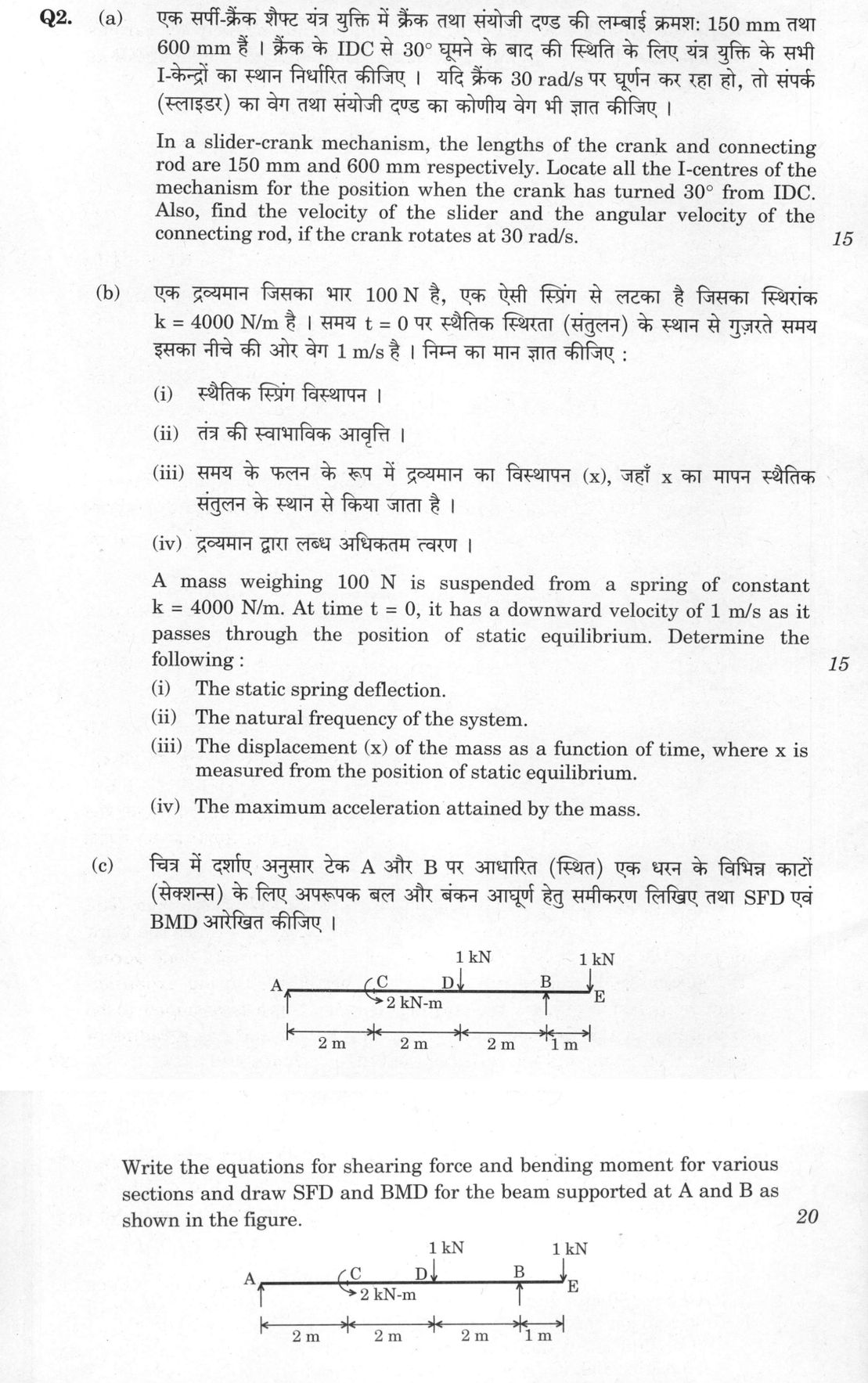
In a slider-crank mechanism, the lengths of the crank and connecting rod are 150 mm and 600 mm respectively. Locate all the I-centres of the mechanism for the position when the crank has turned 30° from IDC. Also, find the velocity of the slider and the angular velocity of the connecting rod, if the crank rotates at 30 rad/s. 15 marks
A mass weighing 100 N is suspended from a spring of constant k = 4000 N/m. At time t = 0, it has a downward velocity of 1 m/s as it passes through the position of static equilibrium. Determine the following : (i) The static spring deflection. (ii) The natural frequency of the system. (iii) The displacement (x) of the mass as a function of time, where x is measured from the position of static equilibrium. (iv) The maximum acceleration attained by the mass. 15 marks
Write the equations for shearing force and bending moment for various sections and draw SFD and BMD for the beam supported at A and B as shown in the figure. 20 marks
हिंदी में प्रश्न पढ़ें
एक सर्पी-क्रैंक शेप्ट यंत्र युक्ति में क्रैंक तथा संयोजी दंड की लंबाई क्रमशः 150 mm तथा 600 mm है। क्रैंक के IDC से 30° घूमने के बाद की स्थिति के लिए यंत्र युक्ति के सभी I-केंद्रों का स्थान निर्धारित कीजिए। यदि क्रैंक 30 rad/s पर घूर्णन कर रहा हो, तो स्पर्क (स्लाइडर) का वेग तथा संयोजी दंड का कोणीय वेग भी ज्ञात कीजिए। (15 अंक)
एक द्रव्यमान जिसका भार 100 N है, एक ऐसी स्प्रिंग से लटका है जिसका स्थिरांक k = 4000 N/m है। समय t = 0 पर स्थैतिक स्थिरता (संतुलन) के स्थान से गुजरते समय इसका नीचे की ओर वेग 1 m/s है। निम्न का मान ज्ञात कीजिए : (i) स्थैतिक स्प्रिंग विस्थापन। (ii) तंत्र की स्वाभाविक आवृत्ति। (iii) समय के फलन के रूप में द्रव्यमान का विस्थापन (x), जहाँ x का मापन स्थैतिक संतुलन के स्थान से किया जाता है। (iv) द्रव्यमान द्वारा लब्ध अधिकतम त्वरण। (15 अंक)
चित्र में दर्शाए अनुसार टेक A और B पर आधारित (स्थित) एक धरन के विभिन्न काटों (सेक्शन्स) के लिए अपरूपक बल और बंकन आघूर्ण हेतु समीकरण लिखिए तथा SFD एवं BMD आरेखित कीजिए। (20 अंक)
The figure this question refers to, in words
The question paper is a scan and the diagram did not survive as text. This is the figure as read from the original page — every component, value and label — so the question can be worked from the text below.
(c) A horizontal beam AE of total length 7 m supported at points A and B. A is at the left end with a support. Point C is 2 m to the right of A, where a clockwise concentrated moment of 2 kN-m is applied. Point D is 2 m to the right of C (4 m from A), where a downward vertical point load of 1 kN is applied. Point B is a support located 2 m to the right of D (6 m from A). The beam extends as an overhang from B to point E for a length of 1 m. At the right free end E (7 m from A), a downward vertical point load of 1 kN is applied. The span intervals between points A-C, C-D, D-B, and B-E are dimensioned as 2 m, 2 m, 2 m, and 1 m respectively.
A horizontal beam of total length 7 m with points labelled from left to right as A, C, D, B, and E. Supports are located at point A (left end) and point B, both shown with upward vertical support arrows. The span between A and C is 2 m, between C and D is 2 m, between D and B is 2 m, and between B and E (overhang) is 1 m. At point C, there is an applied clockwise concentrated moment of 2 kN-m. At point D, there is a downward vertical point load of 1 kN. At point E (the rightmost free end), there is a downward vertical point load of 1 kN.
Model answer
Written by UPSC Answer Check against this question's marking rubric, to the expected length. UPSC does not publish answers for Mains — this is one way to score well, not an official key.
(a) Let links be: 1 = frame, 2 = crank OA, 3 = connecting rod AB, 4 = slider. Use Kennedy’s theorem. Take O = (0, 0), slider path along +x. Let IDC be when crank points along −x. For a 30° clockwise turn from IDC, crank OA makes θ = 150° with +x. r = 0.15 m, l = 0.60 m.
A = (r cos θ, r sin θ) = (−0.1299, 0.0750) m. B = (r cos θ + √(l² − r² sin² θ), 0) = (0.4654, 0) m.
The six I-centres are:
- I₁₂ = O = (0, 0)
- I₂₃ = A = (−0.1299, 0.0750) m
- I₃₄ = B = (0.4654, 0) m
- I₁₄ = at infinity in the vertical direction, perpendicular to the slider path
- I₁₃ = OA ∩ vertical through B = (0.4654, −0.2687) m
- I₂₄ = AB ∩ vertical through O = (0, 0.0586) m
If the 30° turn is anticlockwise instead, mirror the y-coordinates of I₁₃ and I₂₄.
Velocity: v_A = ω₂ r = 30 × 0.15 = 4.5 m/s. I₁₃A = √((0.5953)² + (0.3437)²) = 0.6874 m. |ω₃| = v_A / I₁₃A = 4.5 / 0.6874 = 6.55 rad/s. v_slider = |ω₃| × I₁₃B = 6.55 × 0.2687 = 1.76 m/s.
Final: ω_connecting rod = 6.55 rad/s; slider velocity = 1.76 m/s. The slider moves away from IDC, to the right in this coordinate. The connecting rod has the same sense of rotation as the crank; reversing the crank sense reverses only the rod’s sense and the y-coordinates of I₁₃ and I₂₄, not the slider speed.
(b) Take g = 9.81 m/s². m = W/g = 100/9.81 = 10.194 kg.
(i) Static spring deflection: δ_st = W/k = 100/4000 = 0.025 m = 25 mm.
(ii) Natural frequency: ω_n = √(k/m) = √(4000/10.194) = √392.4 = 19.81 rad/s. f_n = ω_n/(2π) = 3.153 Hz.
(iii) At t = 0, x = 0 and ẋ = 1 m/s downward. x(t) = (v₀/ω_n) sin(ω_n t) x(t) = (1/19.81) sin(19.81 t) = 0.0505 sin(19.81 t) m, downward positive.
(iv) Maximum acceleration: a_max = ω_n² X = ω_n v₀ = 19.81 × 1 = 19.81 m/s².
(c) Let x be measured from A. Reactions R_A and R_B are vertical. ΣF_y = 0: R_A + R_B = 1 + 1 = 2 kN. ΣM_A = 0: 6R_B − 1×4 − 1×7 − 2 = 0 6R_B = 13, so R_B = 13/6 kN upward. R_A = 2 − 13/6 = −1/6 kN, i.e. 1/6 kN downward.
Shear force equations:
- For 0 < x < 4 m: V = −1/6 kN
- For 4 < x < 6 m: V = −1/6 − 1 = −7/6 kN
- For 6 < x < 7 m: V = −7/6 + 13/6 = +1 kN
Bending moment equations:
- For 0 ≤ x < 2 m: M = −x/6 kN-m
- At C, due to clockwise 2 kN-m moment, M jumps by +2 kN-m.
- For 2 < x < 4 m: M = 2 − x/6 kN-m
- For 4 < x < 6 m: M = 6 − 7x/6 kN-m
- For 6 < x < 7 m: M = x − 7 kN-m
Key BMD values: M_A = 0, M_C⁻ = −1/3 kN-m, M_C⁺ = 5/3 kN-m, M_D = 4/3 kN-m, M_B = −1 kN-m, M_E = 0.
SFD is a step diagram: it drops by 1/6 kN at A, drops by 1 kN at D, jumps up by 13/6 kN at B, and drops by 1 kN at E. BMD is piecewise linear, with a vertical jump of 2 kN-m at C. Maximum positive bending moment = 5/3 kN-m at C⁺; maximum negative bending moment = −1 kN-m at B.
What "Calculate" is asking you to do
Apply the standard formula or schedule to data the question has already supplied — a table of readings, cost records, a balance sheet — and produce the number. The method is rarely in doubt; the marks sit in the named intermediate quantities, each of which has to appear as a labelled line.
Structure that answers it
Data as given → formula or standard treatment, named → substitution → each intermediate, labelled → result with units
Where marks are lost
Omitting an intermediate the marking scheme pays for separately, or rounding at an intermediate line so the final figure drifts. In commerce and accountancy, any figure in a statement that no numbered working note supports is treated as unearned.
How this answer will be evaluated
Approach
(a) calculate: given > formula > substitution > result with units > interpretation | (b) calculate: given > formula > substitution > result with units > interpretation | (c) describe: define > structure or process in order > labelled diagram > significance Full marks: Complete working with all diagrams, correct equations, proper units, and physical interpretation throughout.
Key points expected
- Identify all 10 I-centres for the 4-link mechanism
- Locate I-centres using Kennedy's theorem
- Calculate slider velocity using I-centre method
- Calculate angular velocity of connecting rod
- Calculate static spring deflection using W/k
- Determine natural frequency using sqrt(k/m)
- Derive displacement function x(t) with initial conditions
- Calculate maximum acceleration from displacement function
Evaluation rubric
Each sub-part is marked on its own, against the marks and word limit printed on the paper.
- (a) Locate I-centres and calculate slider velocity and connecting rod angular velocity. 15 marks
calculate— given → formula → substitution → result with units → interpretation
Must cover
- Identify all 10 I-centres for the 4-link mechanism
- Locate I-centres using Kennedy's theorem
- Calculate slider velocity using I-centre method
- Calculate angular velocity of connecting rod
Loses marks
- Missing I-centres or incorrect locations
- No governing equation for velocity calculation
- Confusing crank angle with connecting rod angle
Earns more
- Correct schematic diagram with all I-centres marked
- Clear geometric construction for I-centre locations
- Proper application of velocity ratio formula
- Units included in final answers
Extra mark
- Velocity polygon as verification
- Clear labeling of all points and angles
- (b) Determine static deflection, natural frequency, displacement function, and maximum acceleration. 15 marks
calculate— given → formula → substitution → result with units → interpretation
Must cover
- Calculate static spring deflection using W/k
- Determine natural frequency using sqrt(k/m)
- Derive displacement function x(t) with initial conditions
- Calculate maximum acceleration from displacement function
Loses marks
- Confusing weight with mass in calculations
- Incorrect initial conditions in displacement function
- Missing units in frequency or acceleration
Earns more
- Correct identification of mass from weight
- Proper application of initial conditions at t=0
- Clear derivation of equation of motion
- Physical interpretation of results
Extra mark
- Time-domain plot of displacement
- Energy method verification
- (c) Write SF and BM equations for each section and draw SFD and BMD. 20 marks
describe— define → structure or process in order → labelled diagram → significance
Must cover
- Calculate reactions at supports A and B
- Write SF and BM equations for each segment
- Draw complete SFD with all values marked
- Draw complete BMD with all values marked
Loses marks
- Incorrect support reactions
- Missing segments in SF or BM equations
- Diagrams without proper labeling or scaling
Earns more
- Correct sign convention for SF and BM
- Clear identification of critical points
- Proper scaling of diagrams
- Marking of all load positions on diagrams
Extra mark
- Tabulation of SF and BM values
- Verification using area-moment method
Practice this exact question
Write your answer and it is marked point by point against the model answer above — what you covered, what you missed, what you got wrong.
Evaluate my answer →More from Mechanical Engineering 2021 Paper I
- Q1 (a) What is the supporting force system at A for the cantilever beam shown in the figure…
- Q2 (a) In a slider-crank mechanism, the lengths of the crank and connecting rod are 150 mm a…
- Q3 (a) What is the purpose of tempering of hardened steel? Explain the principle of temperin…
- Q4 (a) Find out the value of atomic packing factor for the FCC crystal structure. Calculate…
- Q5 (a) TIG welding of two sheets of 5 mm thickness is performed using welding current (I) of…