Paper I — Q7
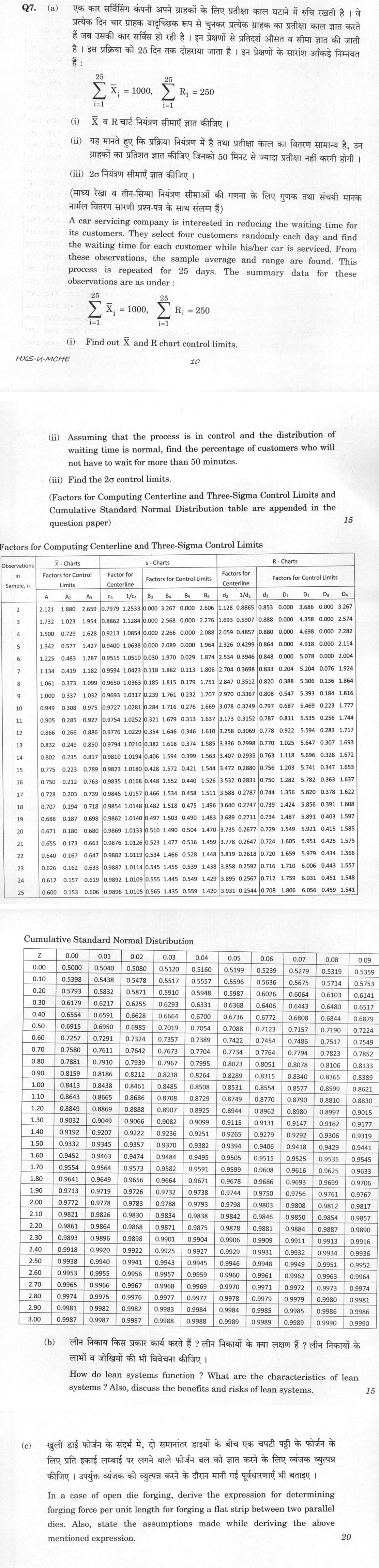
A car servicing company is interested in reducing the waiting time for its customers. They select four customers randomly each…
A car servicing company is interested in reducing the waiting time for its customers. They select four customers randomly each day and find the waiting time for each customer while his/her car is serviced. From these observations, the sample average and range are found. This process is repeated for 25 days. The summary data for these observations are as under:
Σᵢ₌₁²⁵ X̄ᵢ = 1000, Σᵢ₌₁²⁵ Rᵢ = 250
Find out X̄ and R chart control limits.
Assuming that the process is in control and the distribution of waiting time is normal, find the percentage of customers who will not have to wait for more than 50 minutes.
Find the 2σ control limits.
(Factors for Computing Centerline and Three-Sigma Control Limits and Cumulative Standard Normal Distribution table are appended in the question paper)
How do lean systems function? What are the characteristics of lean systems? Also, discuss the benefits and risks of lean systems.
In a case of open die forging, derive the expression for determining forging force per unit length for forging a flat strip between two parallel dies. Also, state the assumptions made while deriving the above mentioned expression.
हिंदी में प्रश्न पढ़ें
एक कार सर्विसिंग कंपनी अपने ग्राहकों के लिए प्रतीक्षा काल घटाने में रुचि रखती है। वे प्रत्येक दिन चार ग्राहक यादृच्छिक रूप से चुनकर प्रत्येक ग्राहक का प्रतीक्षा काल ज्ञात करते हैं जब उसकी कार सर्विस हो रही है। इन प्रेक्षणों से प्रतिदर्श औसत व सीमा ज्ञात की जाती हैं। इस प्रक्रिया को 25 दिन तक दोहराया जाता है। इन प्रेक्षणों के सारांश आँकड़े निम्नवत हैं:
Σᵢ₌₁²⁵ X̄ᵢ = 1000, Σᵢ₌₁²⁵ Rᵢ = 250
X̄ व R चार्ट नियंत्रण सीमाएँ ज्ञात कीजिए।
यह मानते हुए कि प्रक्रिया नियंत्रण में है तथा प्रतीक्षा काल का वितरण सामान्य है, उन ग्राहकों का प्रतिशत ज्ञात कीजिए जिनको 50 मिनट से ज्यादा प्रतीक्षा नहीं करनी होगी।
2σ नियंत्रण सीमाएँ ज्ञात कीजिए।
(माध्य रेखा व तीन-सिग्मा नियंत्रण सीमाओं की गणना के लिए गुणक तथा संचयी मानक नामल वितरण सारणी प्रश्न-पत्र के साथ संलग्न हैं)
लीन निकाय किस प्रकार कार्य करते हैं? लीन निकायों के क्या लक्षण हैं? लीन निकायों के लाभों व जोखिमों की भी विवेचना कीजिए।
खुली डाई फोर्जन के संदर्भ में, दो समांतर डाइयों के बीच एक चपटी पट्टी के फोर्जन के लिए प्रति इकाई लंबाई पर लगने वाले फोर्जन बल को ज्ञात करने के लिए व्यंजक व्युत्पन्न कीजिए। उपर्युक्त व्यंजक को व्युत्पन्न करने के दौरान मानी गई पूर्वधारणाएं भी बताइए।
Model answer
Written by UPSC Answer Check against this question's marking rubric, to the expected length. UPSC does not publish answers for Mains — this is one way to score well, not an official key.
(i) For n = 4, m = 25: X̄_g = Σ X̄ᵢ / 25 = 1000/25 = 40 min R̄ = Σ Rᵢ / 25 = 250/25 = 10 min
From the appended table, for n = 4: A₂ = 0.729, D₃ = 0, D₄ = 2.282.
X̄ chart control limits: CL = X̄_g = 40 min UCL = X̄_g + A₂ R̄ = 40 + 0.729 × 10 = 47.29 min LCL = X̄_g − A₂ R̄ = 40 − 0.729 × 10 = 32.71 min
R chart control limits: CL = R̄ = 10 min UCL = D₄ R̄ = 2.282 × 10 = 22.82 min LCL = D₃ R̄ = 0 × 10 = 0 min
(ii) The process standard deviation is estimated by: σ = R̄ / d₂ = 10 / 2.059 = 4.857 min.
For a normal distribution: z = (50 − 40) / 4.857 = 2.059.
From the standard normal table: Φ(2.059) ≈ 0.9803.
Therefore, 98.03% of customers will not have to wait for more than 50 minutes.
(iii) 2σ control limits:
X̄ chart: σ_X̄ = σ / √n = 4.857 / 2 = 2.428 min 2σ_X̄ = 4.857 min Limits = 40 ± 4.86 = 35.14 min and 44.86 min
R chart: σ_R = d₃ σ = 0.880 × 4.857 = 4.274 min 2σ_R = 8.548 min Limits = 10 ± 8.548 = 1.45 min and 18.55 min
(b) Lean systems function by identifying value from the customer’s viewpoint and eliminating waste, called muda, from the value stream. Production is pulled by downstream demand rather than pushed by forecasts. Kanban, takt time, continuous flow, small lots, quick changeovers, levelled schedules, standard work, visual control, total productive maintenance, total quality management and supplier partnerships keep material and information flowing smoothly. Problems are exposed and removed through kaizen and employee involvement.
Characteristics: waste elimination—overproduction, waiting, transport, overprocessing, inventory, motion and defects; JIT delivery; pull/Kanban; one-piece or small-batch flow; cellular layout; multi-skilled workers; continuous improvement; respect for people; stable and levelled schedules; close supplier links; visual management.
Benefits: lower inventory and WIP, shorter lead times, improved quality, lower cost, higher productivity, reduced space, greater flexibility, better customer satisfaction and higher employee morale.
Risks: little buffer stock makes the system vulnerable to supplier failure, transport delay, demand spikes and machine breakdown; it demands reliable suppliers, disciplined workers and strong management; implementation and training costs are high; cultural resistance can occur; it may not suit highly variable demand or job-shop production; continuous pressure can cause worker burnout.
(c) Let a flat strip of thickness h and total width L = 2a be forged between parallel dies; depth is taken as unity. Let p be die pressure, σₓ horizontal compressive stress, τ friction shear stress, μ coefficient of friction and K shear yield strength. For plane strain, the yield condition is p − σₓ = 2K. At the free edge x = a, σₓ = 0, so p(a) = 2K.
Using the slab method, consider a slab of width dx at distance x from the centre in the right half. Equilibrium in the x-direction gives: σₓ h − (σₓ + dσₓ)h − 2τ dx = 0 ⇒ dσₓ/dx = −2τ/h.
Taking Coulomb friction τ = μp and using p = σₓ + 2K: dp/dx = −2μp/h.
Integrating from x to a: ∫ dp/p (from p(x) to p(a)) = −(2μ/h) ∫ dx (from x to a) ⇒ ln[p(a)/p(x)] = −(2μ/h)(a − x) ⇒ p(x) = 2K exp[2μ(a − x)/h].
Total forging force per unit depth on one die: F = ∫ p(x) dx (from −a to a) = 2∫ p(x) dx (from 0 to a) = 4K ∫ exp[2μ(a − x)/h] dx (from 0 to a) = (2K h/μ)[exp(2μa/h) − 1].
With L = 2a and Y′ = 2K, this becomes: F = (Y′ h/μ)[exp(μL/h) − 1] per unit length.
For von Mises plane strain, Y′ = 2Y/√3, so: F = (2Y h/(√3 μ))[exp(μL/h) − 1] per unit length.
Assumptions: plane strain; homogeneous, isotropic, rigid-plastic material with constant flow stress; rigid, parallel, flat dies; Coulomb sliding friction τ = μp over the whole interface; stresses uniform over any vertical section; inertia and body forces neglected; symmetry about the centreline; no bulging and no strain hardening; quasi-static deformation.
What "Calculate" is asking you to do
Apply the standard formula or schedule to data the question has already supplied — a table of readings, cost records, a balance sheet — and produce the number. The method is rarely in doubt; the marks sit in the named intermediate quantities, each of which has to appear as a labelled line.
Structure that answers it
Data as given → formula or standard treatment, named → substitution → each intermediate, labelled → result with units
Where marks are lost
Omitting an intermediate the marking scheme pays for separately, or rounding at an intermediate line so the final figure drifts. In commerce and accountancy, any figure in a statement that no numbered working note supports is treated as unearned.
How this answer will be evaluated
Approach
Framework: null. (a(i)) calculate: given > formula > substitution > result with units > interpretation | (a(ii)) calculate: given > formula > substitution > result with units > interpretation | (a(iii)) calculate: given > formula > substitution > result with units > interpretation | (b) discuss: intro > 3-4 dimensions > example > balanced close | (c) derive: given > assumptions > stepwise derivation > result > check Full marks: Precise calculations with correct factors; clear derivation with FBD; comprehensive discussion of lean risks/benefits.
Key points expected
- Calculate grand mean (X-double-bar) and mean range (R-bar)
- Identify correct factors (A2, D3, D4) for n=4
- Compute UCL and LCL for both X-bar and R charts
- State final limits with units
- Estimate process standard deviation (sigma) from R-bar
- Calculate Z-score for 50 minutes
- Use normal distribution table to find probability
- Convert probability to percentage
Evaluation rubric
Each sub-part is marked on its own, against the marks and word limit printed on the paper.
- (a(i)) Determine X-bar and R chart control limits from summary data.
calculate— given → formula → substitution → result with units → interpretation
Must cover
- Calculate grand mean (X-double-bar) and mean range (R-bar)
- Identify correct factors (A2, D3, D4) for n=4
- Compute UCL and LCL for both X-bar and R charts
- State final limits with units
Loses marks
- Using wrong factors for n=4
- Omitting LCL for R chart
- No units on final limits
Earns more
- Explicitly state sample size n=4
- Show formula for control limits
Extra mark
- Mention process capability context
- (a(ii)) Find percentage of customers waiting less than 50 minutes.
calculate— given → formula → substitution → result with units → interpretation
Must cover
- Estimate process standard deviation (sigma) from R-bar
- Calculate Z-score for 50 minutes
- Use normal distribution table to find probability
- Convert probability to percentage
Loses marks
- Using range directly as sigma
- Incorrect Z-table lookup
- Confusing P(X<50) with P(X>50)
Earns more
- State assumption of normal distribution
- Show Z-score calculation clearly
Extra mark
- Mention 6-sigma quality context
- (a(iii)) Determine 2-sigma control limits for the process.
calculate— given → formula → substitution → result with units → interpretation
Must cover
- Recalculate limits using 2-sigma instead of 3-sigma
- Adjust A2 factor or multiply 3-sigma limits by 2/3
- Provide new UCL and LCL for X-bar chart
- Provide new UCL and LCL for R chart
Loses marks
- Using 3-sigma limits without adjustment
- Only providing X-bar limits, omitting R chart
Earns more
- Explicitly state the 2-sigma adjustment factor
Extra mark
- Compare width of 2-sigma vs 3-sigma limits
- (b) Explain lean system function, characteristics, benefits, and risks. 15 marks
discuss— intro → 3-4 dimensions → example → balanced close
Must cover
- Define lean system and its core function
- List key characteristics (e.g., waste reduction, flow)
- Discuss specific benefits (cost, quality, speed)
- Discuss specific risks (rigidity, overwork, supply chain)
Loses marks
- Only listing benefits without risks
- Vague definitions without specific characteristics
- Ignoring the 'how it functions' aspect
Earns more
- Mention specific lean tools (Kaizen, Kanban, 5S)
- Provide a real-world example
Extra mark
- Reference Toyota Production System (TPS)
- (c) Derive forging force expression for flat strip and state assumptions. 20 marks
derive— given → assumptions → stepwise derivation → result → check
Must cover
- Draw free body diagram of the strip element
- State assumptions (friction, plane strain, yield criterion)
- Set up force balance equation (differential form)
- Integrate to find final force expression
Loses marks
- Missing free body diagram
- Skipping integration steps
- Failing to state assumptions
Earns more
- Clearly define variables (friction coefficient, width, height)
- Show the integration limits clearly
Extra mark
- Mention specific yield criterion used (e.g., von Mises)
Practice this exact question
Write your answer and it is marked point by point against the model answer above — what you covered, what you missed, what you got wrong.
Evaluate my answer →More from Mechanical Engineering 2021 Paper I
- Q4 (a) Find out the value of atomic packing factor for the FCC crystal structure. Calculate…
- Q5 (a) TIG welding of two sheets of 5 mm thickness is performed using welding current (I) of…
- Q6 (a) Five jobs A, B, C, D and E need to be processed on a machine. Processing time (in day…
- Q7 A car servicing company is interested in reducing the waiting time for its customers. The…
- Q8 The frontal working area of the electrode is 2000 mm² in a certain ECM operation in which…