Paper II — Q1
(a) Discuss briefly the functional differences between a fan, a blower and a compressor. (10 marks) (b) Prove that shock cannot…
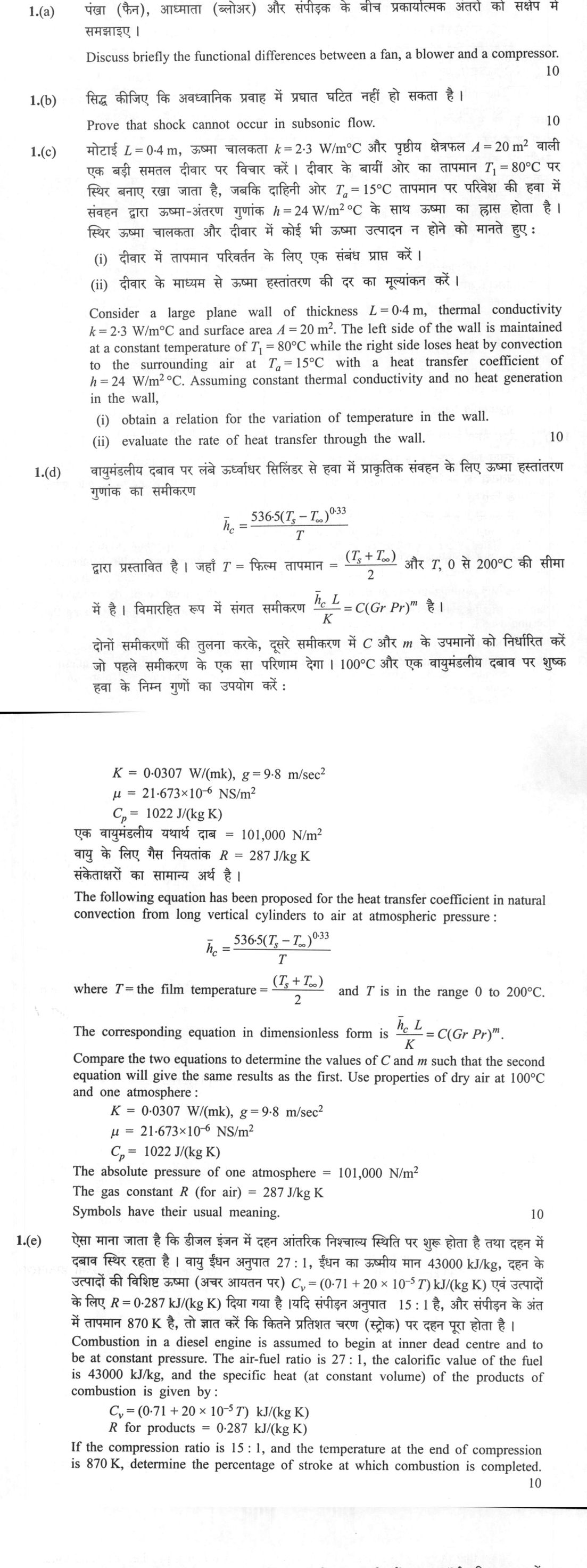
Discuss briefly the functional differences between a fan, a blower and a compressor. 10 marks
Prove that shock cannot occur in subsonic flow. 10 marks
Consider a large plane wall of thickness L = 0·4 m, thermal conductivity k = 2·3 W/m°C and surface area A = 20 m². The left side of the wall is maintained at a constant temperature of T₁ = 80°C while the right side loses heat by convection to the surrounding air at Tₐ = 15°C with a heat transfer coefficient of h = 24 W/m²°C. Assuming constant thermal conductivity and no heat generation in the wall, (i) obtain a relation for the variation of temperature in the wall. (ii) evaluate the rate of heat transfer through the wall. 10 marks
The following equation has been proposed for the heat transfer coefficient in natural convection from long vertical cylinders to air at atmospheric pressure: h̄_c = (536.5(Tₛ - T_∞)⁰.33)/T where T = the film temperature = ((Tₛ + T_∞))/2 and T is in the range 0 to 200°C. The corresponding equation in dimensionless form is (h̄_c L)/K = C(Gr Pr)^m. Compare the two equations to determine the values of C and m such that the second equation will give the same results as the first. Use properties of dry air at 100°C and one atmosphere: K = 0·0307 W/(mk), g = 9·8 m/sec², μ = 21·673×10⁻⁶ NS/m², Cₚ = 1022 J/(kg K). The absolute pressure of one atmosphere = 101,000 N/m². The gas constant R (for air) = 287 J/kg K. Symbols have their usual meaning. 10 marks
Combustion in a diesel engine is assumed to begin at inner dead centre and to be at constant pressure. The air-fuel ratio is 27 : 1, the calorific value of the fuel is 43000 kJ/kg, and the specific heat (at constant volume) of the products of combustion is given by: Cᵥ = (0·71 + 20 × 10⁻⁵ T) kJ/(kg K). R for products = 0·287 kJ/(kg K). If the compression ratio is 15 : 1, and the temperature at the end of compression is 870 K, determine the percentage of stroke at which combustion is completed. 10 marks
हिंदी में प्रश्न पढ़ें
पंखा (फैन), आधमाता (ब्लोअर) और संपीडक के बीच प्रकार्यात्मक अंतरों को संक्षेप में समझाइए। (10 अंक)
सिद्ध कीजिए कि अवध्वनिक प्रवाह में प्रघात घटित नहीं हो सकता है। (10 अंक)
मोटाई L = 0·4 m, ऊष्मा चालकता k = 2·3 W/m°C और पृष्ठीय क्षेत्रफल A = 20 m² वाली एक बड़ी समतल दीवार पर विचार करें। दीवार के बायीं ओर का तापमान T₁ = 80°C पर स्थिर बनाए रखा जाता है, जबकि दाहिनी ओर Tₐ = 15°C तापमान पर परिवेश की हवा में संवहन द्वारा ऊष्मा-अंतरण गुणांक h = 24 W/m²°C के साथ ऊष्मा का ह्रास होता है। स्थिर ऊष्मा चालकता और दीवार में कोई भी ऊष्मा उत्पादन न होने को मानते हुए: (i) दीवार में तापमान परिवर्तन के लिए एक संबंध प्राप्त करें। (ii) दीवार के माध्यम से ऊष्मा हस्तांतरण की दर का मूल्यांकन करें। (10 अंक)
वायुमंडलीय दबाव पर लंबे उर्ध्वाधर सिलिंडर से हवा में प्राकृतिक संवहन के लिए ऊष्मा हस्तांतरण गुणांक का समीकरण h̄_c = (536 · 5(Tₛ-T_∞)⁰ · 33)/T द्वारा प्रस्तावित है। जहाँ T = फिल्म तापमान = ((Tₛ+T_∞))/2 और T, 0 से 200°C की सीमा में है। विमारहित रूप में संगत समीकरण (h̄_c L)/K = C(Gr Pr)^m है। दोनों समीकरणों की तुलना करके, दूसरे समीकरण में C और m के उपमानों को निर्धारित करें जो पहले समीकरण के एक सा परिणाम देगा। 100°C और एक वायुमंडलीय दबाव पर शुष्क हवा के निम्न गुणों का उपयोग करें: K = 0·0307 W/(mk), g = 9·8 m/sec², μ = 21·673×10⁻⁶ NS/m², Cₚ = 1022 J/(kg K), एक वायुमंडलीय यथार्थ दाब = 101,000 N/m², वायु के लिए गैस नियतांक R = 287 J/kg K। संकेताक्षरों का सामान्य अर्थ है। (10 अंक)
ऐसा माना जाता है कि डीजल इंजन में दहन आंतरिक निश्चल्य स्थिति पर शुरू होता है तथा दहन में दबाव स्थिर रहता है। वायु ईंधन अनुपात 27 : 1, ईंधन का ऊष्मीय मान 43000 kJ/kg, दहन के उत्पादों की विशिष्ट ऊष्मा (अचर आयतन पर) Cᵥ = (0·71 + 20 × 10⁻⁵ T) kJ/(kg K) एवं उत्पादों के लिए R = 0·287 kJ/(kg K) दिया गया है। यदि संपीडन अनुपात 15 : 1 है, और संपीडन के अंत में तापमान 870 K है, तो ज्ञात करें कि कितने प्रतिशत चरण (स्ट्रोक) पर दहन पूरा होता है। (10 अंक)
Model answer
Written by UPSC Answer Check against this question's marking rubric, to the expected length. UPSC does not publish answers for Mains — this is one way to score well, not an official key.
(a) A fan, a blower and a compressor all move gases, but their pressure-rise levels and thermodynamic behaviour differ.
- Fan: Produces a very small pressure rise, usually below about 1 kPa, giving a pressure ratio near 1. It moves large volumes of gas at low pressure. The gas density changes negligibly, so the flow is often treated as incompressible. Fans are used for ventilation, cooling, air conditioning, mine ventilation and draught in furnaces. Energy transfer is mainly kinetic; Bernoulli’s equation is often adequate.
- Blower: Produces a moderate pressure rise, roughly from a few kPa to about 0·1 MPa. Density change is small but not always negligible. Blowers are used for forced draught, exhaust systems, conveying light materials and industrial air supply. Both centrifugal and positive-displacement types are common.
- Compressor: Produces a high pressure rise, generally with pressure ratio greater than about 1·1 to 1·2, often much higher. Density and temperature rise significantly, so compressibility, enthalpy rise, cooling and thermodynamic irreversibility must be considered. Compressors are used in refrigeration, supercharging, gas turbines, pneumatic systems and chemical process plants. They require closer clearances and better sealing than fans and blowers.
Thus, the essential functional difference is the pressure rise and resulting density change: fan is low pressure, blower is medium pressure, and compressor is high pressure.
(b) Consider a steady, adiabatic normal shock in a perfect gas. Let state 1 be upstream and state 2 downstream. The basic conservation equations are:
- Continuity: ρ₁V₁ = ρ₂V₂
- Momentum: p₁ + ρ₁V₁² = p₂ + ρ₂V₂²
- Energy: h₁ + V₁²/2 = h₂ + V₂²/2
Combining these with the perfect-gas relations gives the normal-shock Mach-number relation:
M₂² = (1 + ((γ - 1)/2)M₁²)/(γM₁² - (γ - 1)/2)
The pressure ratio is:
p₂/p₁ = 1 + 2γ/(γ + 1)(M₁² - 1)
The entropy change for a perfect gas is:
s₂ - s₁ = Cₚ ln(T₂/T₁) - R ln(p₂/p₁)
Using the normal-shock relations, this becomes:
Δs/R = (1/(γ - 1)) ln A + (γ/(γ - 1)) ln B
where
A = (2γM₁² - (γ - 1))/(γ + 1)
and
B = ((γ - 1)M₁² + 2)/((γ + 1)M₁²)
Differentiating with respect to M₁²:
d(Δs/R)/d(M₁²) = 2γ(M₁² - 1)²/[M₁²(2γM₁² - (γ - 1))((γ - 1)M₁² + 2)] ≥ 0
At M₁ = 1, the shock is infinitely weak and Δs = 0. Since the derivative is non-negative, for M₁ < 1 we must have Δs < 0. But the second law of thermodynamics requires Δs ≥ 0 for an adiabatic shock. Therefore a normal shock cannot have an upstream subsonic Mach number. Hence shock cannot occur in subsonic flow; it must be supersonic upstream.
(c)(i) For steady one-dimensional conduction with constant k and no heat generation:
d²T/dx² = 0
Therefore:
T(x) = C₁x + C₂
At x = 0, T = T₁ = 80°C, so C₂ = 80°C.
At x = L, the conduction heat flux equals the convection heat loss:
-k dT/dx|ₓ₌ₗ = h(T(L) - T∞)
But dT/dx = C₁, and T(L) = 80 + C₁L. Thus:
-kC₁ = h(80 + C₁L - 15)
-kC₁ = h(65 + C₁L)
C₁(-k - hL) = 65h
C₁ = -65h/(k + hL)
Now h = 24 W/m²°C, L = 0·4 m, k = 2·3 W/m°C:
hL = 24 × 0·4 = 9·6 W/m°C
k + hL = 2·3 + 9·6 = 11·9 W/m°C
C₁ = -65 × 24/11·9 = -1560/11·9 = -15600/119 = -131·092 °C/m
Hence:
T(x) = 80 - (15600/119)x °C
or approximately:
T(x) = 80 - 131·092x °C
At the right face:
T(L) = 80 - (15600/119)(0·4) = 80 - 6240/119 = 3280/119 = 27·563°C
(c)(ii) The steady heat transfer rate through the wall is:
Q = -kA dT/dx = -kA C₁
Q = 2·3 × 20 × (15600/119)
Q = 717600/119 = 6030·25 W
Thus:
Q = 6·030 kW
Alternatively, using convection at the right surface:
Q = hA(T(L) - T∞) = 24 × 20 × (3280/119 - 15)
= 480 × 1495/119 = 717600/119 = 6030·25 W
Q = 6·030 kW
This result assumes steady state, constant thermal conductivity, no heat generation and negligible radiation.
(d) The proposed equation is:
h̄꜀ = 536.5(Tₛ - T∞)⁰·³³/T
with T = (Tₛ + T∞)/2. The problem states T is in °C, so at the film temperature 100°C, T = 100.
The dimensionless equation is:
h̄꜀L/K = C(Gr Pr)ᵐ
For the RHS to give the same dependence on L, the exponent must be m = 1/3, since Gr ∝ L³ and h is independent of L in the given correlation. The given exponent 0·33 is the rounded value of 1/3.
Take the film temperature as 100°C = 373·15 K for property evaluation.
Density of air:
ρ = P/(RT) = 101000/(287 × 373·15)
ρ = 0·9431 kg/m³
Kinematic viscosity:
ν = μ/ρ = 21·673 × 10⁻⁶/0·9431
ν = 22·98 × 10⁻⁶ m²/s
Prandtl number:
Pr = μCₚ/K = (21·673 × 10⁻⁶ × 1022)/0·0307
Pr = 0·7215
For an ideal gas:
β = 1/T = 1/373·15 = 2·680 × 10⁻³ K⁻¹
Now:
GrPr = gβΔT L³Pr/ν²
= (9·8 × 2·680 × 10⁻³ × 0·7215)/(22·98 × 10⁻⁶)² ΔT L³
= 3·588 × 10⁷ ΔT L³
Using m = 1/3:
hL/K = C(GrPr)¹/³
536·5 ΔT¹/³ L/(T K) = C(3·588 × 10⁷ ΔT L³)¹/³
536·5 ΔT¹/³ L/(100 × 0·0307) = C × 329·8 ΔT¹/³ L
C = 536·5/(100 × 0·0307 × 329·8)
C = 536·5/1012·5
C = 0·530
Therefore:
m = 1/3 = 0·333
C = 0·530
(e) Let the air-fuel ratio be A/F = 27. For 1 kg of air, fuel mass is 1/27 kg, and products mass is:
mₚ = 1 + 1/27 = 28/27 kg
Heat released per kg of products:
q = 43000/28 = 1535·714 kJ/kg
The specific heat at constant pressure is:
Cₚ = Cᵥ + R
Cₚ = (0·71 + 20 × 10⁻⁵T) + 0·287
Cₚ = 0·997 + 0·0002T kJ/kg K
At constant pressure, heat added equals enthalpy rise:
q = ∫ Cₚ dT from T₂ to T₃
1535·714 = ∫(0·997 + 0·0002T)dT from 870 K to T₃
1535·714 = 0·997(T₃ - 870) + 0·0001(T₃² - 870²)
1535·714 = 0·997T₃ - 867·39 + 0·0001T₃² - 75·69
0·0001T₃² + 0·997T₃ - 2478·794 = 0
Solving the quadratic:
T₃ = 2060·436 K
At constant pressure, using ideal gas law and including the added fuel mass:
V₃/V₂ = (mₚ/mₐ)(T₃/T₂)
V₃/V₂ = (28/27)(2060·436/870)
V₃/V₂ = 2·4560
The percentage of stroke at which combustion is completed is:
Percentage = (V₃ - V₂)/(V₁ - V₂) × 100
For compression ratio r = V₁/V₂ = 15:
V₁ - V₂ = 14V₂
Percentage = (V₃/V₂ - 1)/14 × 100
= (2·4560 - 1)/14 × 100
= 1·4560/14 × 100
= 10·40%
Combustion is completed at 10·40% of the stroke.
What "Prove" is asking you to do
Establish that the statement holds for every case it claims, not for one representative case. The argument must be closed: each line follows from a definition, a hypothesis, or a named theorem you are entitled to use.
Structure that answers it
Given and to prove, restated → theorem or construction to be used, named → the argument line by line → conclusion stated as proved
Where marks are lost
Testing one example, which illustrates but proves nothing. On an if and only if claim, proving one direction and stopping forfeits that half outright, and degenerate cases — zero, the empty set, the equality case — have to be disposed of rather than assumed away.
How this answer will be evaluated
Approach
(a) discuss: intro > 3-4 dimensions > example > balanced close | (b) justify: claim > 3-4 reasons > evidence > conclusion | (c) calculate: given > formula > substitution > result with units > interpretation | (d) analyse: intro > causes > effects > stakeholders/linkages > way forward | (e) calculate: given > formula > substitution > result with units > interpretation Full marks: All parts answered with correct method, clear steps, and accurate calculations.
Key points expected
- Define pressure ratio for each device
- Specify typical pressure ratio ranges
- Identify flow type (incompressible vs compressible)
- Mention typical applications for each
- State the Second Law of Thermodynamics
- Apply entropy change equation for normal shock
- Show entropy change is negative for Ma < 1
- Conclude that this violates the Second Law
Evaluation rubric
Each sub-part is marked on its own, against the marks and word limit printed on the paper.
- (a) Functional differences between fan, blower, and compressor. 10 marks
discuss— intro → 3-4 dimensions → example → balanced close
Must cover
- Define pressure ratio for each device
- Specify typical pressure ratio ranges
- Identify flow type (incompressible vs compressible)
- Mention typical applications for each
Loses marks
- Confusing blower with compressor
- Omitting pressure ratio definition
Earns more
- Comparison table of parameters
- Mention of volumetric flow rate differences
Extra mark
- Schematic of pressure vs flow curves
- (b) Proof that shock cannot occur in subsonic flow. 10 marks
justify— claim → 3-4 reasons → evidence → conclusion
Must cover
- State the Second Law of Thermodynamics
- Apply entropy change equation for normal shock
- Show entropy change is negative for Ma < 1
- Conclude that this violates the Second Law
Loses marks
- Using only the Rankine-Hugoniot relations
- Failing to link to the Second Law
Earns more
- Use of T-s diagram to illustrate
- Mention of Prandtl's theorem
Extra mark
- Derivation of entropy change formula
- (c) Temperature variation relation and heat transfer rate for a plane wall. 10 marks
calculate— given → formula → substitution → result with units → interpretation
Must cover
- State the 1D steady-state heat conduction equation
- Apply boundary conditions (T1 and convection)
- Derive the linear temperature distribution T(x)
- Calculate the heat transfer rate Q
Loses marks
- Using the wrong boundary condition
- Arithmetic errors in the final value
Earns more
- Drawing a schematic of the wall
- Checking units in the final calculation
Extra mark
- Plotting the temperature profile
- (d) Determine constants C and m for the dimensionless convection equation. 10 marks
analyse— intro → causes → effects → stakeholders/linkages → way forward
Must cover
- Write the definitions of Grashof and Prandtl numbers
- Substitute the given properties into the dimensionless form
- Equate the two forms of the heat transfer coefficient
- Solve for the values of C and m
Loses marks
- Incorrect definition of Grashof number
- Algebraic errors in solving for C and m
Earns more
- Showing the step-by-step substitution
- Verifying the dimensional consistency
Extra mark
- Comparing the result with standard correlations
- (e) Percentage of stroke at which combustion is completed in a diesel engine. 10 marks
calculate— given → formula → substitution → result with units → interpretation
Must cover
- State the constant pressure heat addition process
- Calculate the temperature at the end of combustion
- Use the ideal gas law to find the volume ratio
- Convert the volume ratio to a percentage of stroke
Loses marks
- Using the wrong specific heat value
- Confusing the compression ratio with the expansion ratio
Earns more
- Drawing a p-V diagram of the cycle
- Showing the calculation of the heat added
Extra mark
- Mentioning the effect of variable specific heats
Practice this exact question
Write your answer and it is marked point by point against the model answer above — what you covered, what you missed, what you got wrong.
Evaluate my answer →More from Mechanical Engineering 2021 Paper II
- Q1 (a) Discuss briefly the functional differences between a fan, a blower and a compressor.…
- Q2 (a)(i) 3 kg of air is compressed in a reversible steady flow polytropic process from 100…
- Q3 (a)(i) Show that the effective conductance, (A_1F̄₁₂) for two black, parallel plates of e…
- Q4 (a) Two walls A and B are maintained at temperatures T_A and T_B, respectively. One end o…