Paper II — Q2
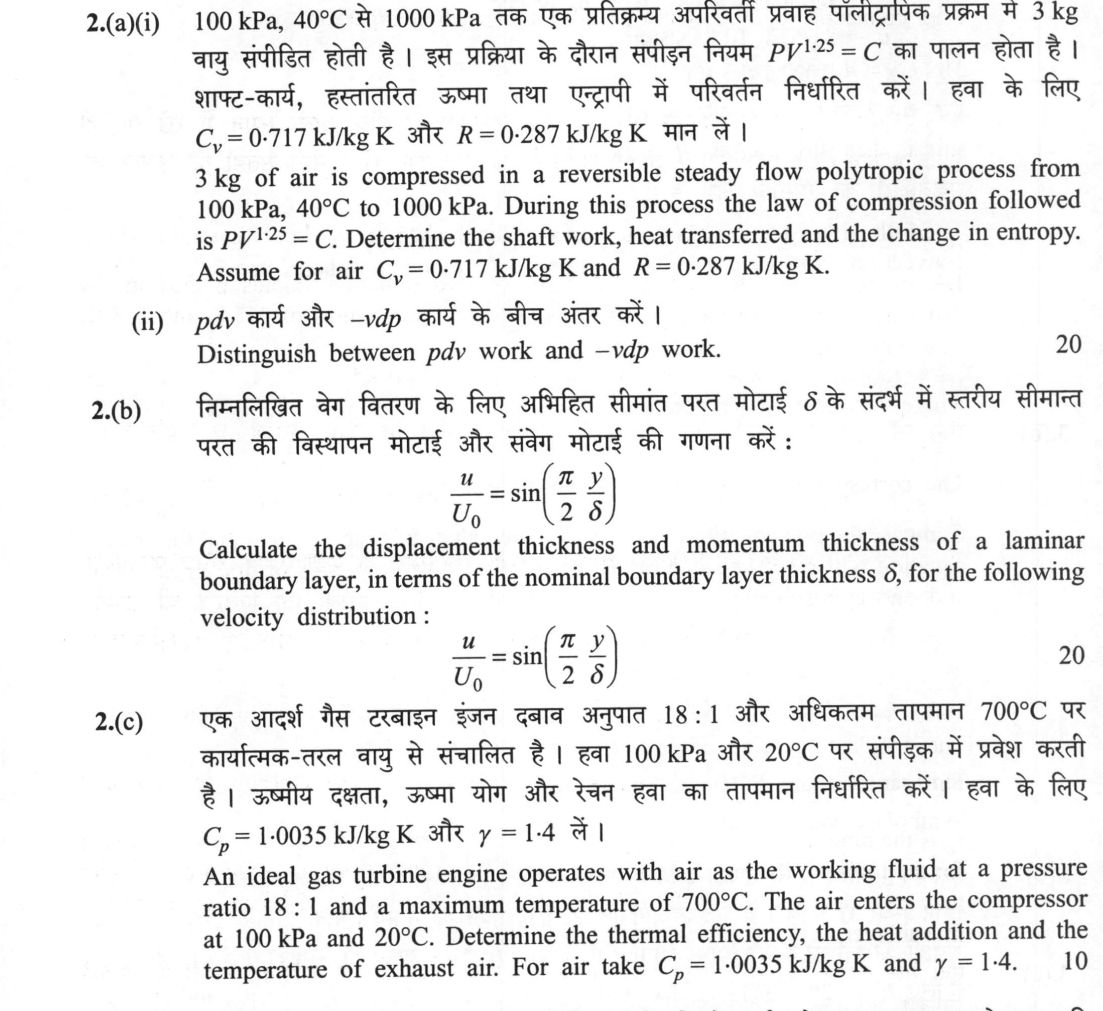
(a)(i) 3 kg of air is compressed in a reversible steady flow polytropic process from 100 kPa, 40°C to 1000 kPa. During this…
3 kg of air is compressed in a reversible steady flow polytropic process from 100 kPa, 40°C to 1000 kPa. During this process the law of compression followed is PV^1.25 = C. Determine the shaft work, heat transferred and the change in entropy. Assume for air C_v = 0.717 kJ/kg K and R = 0.287 kJ/kg K. (ii) Distinguish between pdv work and -vdp work. 20 marks
Calculate the displacement thickness and momentum thickness of a laminar boundary layer, in terms of the nominal boundary layer thickness δ, for the following velocity distribution: u/U_0 = sin(π/2 y/δ) 20 marks
An ideal gas turbine engine operates with air as the working fluid at a pressure ratio 18 : 1 and a maximum temperature of 700°C. The air enters the compressor at 100 kPa and 20°C. Determine the thermal efficiency, the heat addition and the temperature of exhaust air. For air take C_p = 1.0035 kJ/kg K and γ = 1.4. 10 marks
हिंदी में प्रश्न पढ़ें
100 kPa, 40°C से 1000 kPa तक एक प्रतिक्रम्य अपरिवर्ती प्रवाह पॉलिट्रॉपिक प्रक्रम में 3 kg वायु संपीड़ित होती है। इस प्रक्रिया के दौरान संपीड़न नियम PV^1.25 = C का पालन होता है। शाफ्ट-कार्य, हस्तांतरित ऊष्मा तथा एन्ट्रॉपी में परिवर्तन निर्धारित करें। हवा के लिए C_v = 0.717 kJ/kg K और R = 0.287 kJ/kg K मान लें। (ii) pdv कार्य और -vdp कार्य के बीच अंतर करें। (20 अंक)
निम्नलिखित वेग वितरण के लिए अभिहित सीमांत परत मोटाई δ के संदर्भ में स्तरीय सीमांत परत की विस्थापन मोटाई और संवेग मोटाई की गणना करें: u/U_0 = sin(π/2 y/δ) (20 अंक)
एक आदर्श गैस टरबाइन इंजन दबाव अनुपात 18 : 1 और अधिकतम तापमान 700°C पर कार्यात्मक-तरल वायु से संचालित है। हवा 100 kPa और 20°C पर संपीड़क में प्रवेश करती है। ऊष्मीय दक्षता, ऊष्मा योग और रेचन हवा का तापमान निर्धारित करें। हवा के लिए C_p = 1.0035 kJ/kg K और γ = 1.4 लें। (10 अंक)
Model answer
Written by UPSC Answer Check against this question's marking rubric, to the expected length. UPSC does not publish answers for Mains — this is one way to score well, not an official key.
(a)(i) For air, Cₚ = Cᵥ + R = 0.717 + 0.287 = 1.004 kJ/kg K.
Use the polytropic relation T₂/T₁ = (P₂/P₁)^((n−1)/n), with n = 1.25:
T₂ = 313.15 × (1000/100)^0.2 = 313.15 × 10^0.2 = 496.31 K.
So ΔT = 496.31 − 313.15 = 183.16 K.
For reversible steady flow, the shaft work done by the air is W_s = −∫V dP = −m[n/(n−1)]R(T₂−T₁).
W_s = −3 × [1.25/(1.25−1)] × 0.287 × 183.16 = −3 × 5 × 0.287 × 183.16 = −788.5 kJ.
Thus shaft work input = 788.5 kJ, or work done by air = −788.5 kJ.
First law for steady flow: Q − W_s = ΔH. ΔH = mCₚΔT = 3 × 1.004 × 183.16 = 551.7 kJ.
Q = ΔH + W_s = 551.7 − 788.5 = −236.8 kJ.
So heat transferred = 236.8 kJ rejected.
Entropy change: ΔS = m[Cₚ ln(T₂/T₁) − R ln(P₂/P₁)] = 3[1.004 ln(496.31/313.15) − 0.287 ln(1000/100)] = 3[1.004 × 0.4605 − 0.287 × 2.3026] = 3[0.4624 − 0.6608] = −0.595 kJ/K.
(a)(ii)
- pdv work is displacement or boundary work, W = ∫P dV. It is associated with a closed system and equals the area under the P–V curve.
- −vdp work is reversible steady-flow shaft work, W_s = −∫V dP. It is associated with open systems such as turbines, compressors and nozzles, and is the area to the left of the P–V curve with a reversed sign.
- For the same reversible path, ∫P dV + ∫V dP = Δ(PV). Hence pdv work and −vdp work differ by the flow-work term Δ(PV). In a compressor, pdv work appears in non-flow compression, while −vdp work gives the shaft work input.
(b) For the laminar boundary layer, use the definitions δ* = ∫₀^δ (1 − u/U₀) dy θ = ∫₀^δ (u/U₀)(1 − u/U₀) dy.
Given u/U₀ = sin(π/2 · y/δ). Put η = y/δ, so dy = δ dη.
δ* = δ∫₀¹ [1 − sin(πη/2)] dη = δ[η + (2/π)cos(πη/2)]₀¹ = δ[1 − 2/π].
So **δ* = (1 − 2/π)δ = (π − 2)δ/π ≈ 0.3634δ**.
For momentum thickness:
θ = δ∫₀¹ sin(πη/2)[1 − sin(πη/2)] dη = δ[∫₀¹ sin(πη/2)dη − ∫₀¹ sin²(πη/2)dη].
Now ∫₀¹ sin(πη/2)dη = 2/π, ∫₀¹ sin²(πη/2)dη = 1/2.
Therefore θ = δ(2/π − 1/2) = (4 − π)δ/(2π).
So θ = (2/π − 1/2)δ ≈ 0.1366δ.
(c) Use the ideal air-standard Brayton cycle. For isentropic compression:
T₂/T₁ = r_p^((γ−1)/γ) = 18^(0.4/1.4) = 18^(2/7) = 2.2838.
T₁ = 20 + 273.15 = 293.15 K, so T₂ = 293.15 × 2.2838 = 669.48 K.
Maximum temperature: T₃ = 700 + 273.15 = 973.15 K.
Heat addition per kg air: q_in = Cₚ(T₃ − T₂) = 1.0035 × (973.15 − 669.48) = 1.0035 × 303.67 = 304.73 kJ/kg.
For isentropic expansion, T₄ = T₃/18^(2/7): T₄ = 973.15/2.2838 = 426.12 K.
Exhaust temperature = 426.12 − 273.15 = 152.97°C.
Thermal efficiency: η = 1 − 1/18^(2/7) = 1 − 1/2.2838 = 0.5621 = 56.21%.
What "Calculate" is asking you to do
Apply the standard formula or schedule to data the question has already supplied — a table of readings, cost records, a balance sheet — and produce the number. The method is rarely in doubt; the marks sit in the named intermediate quantities, each of which has to appear as a labelled line.
Structure that answers it
Data as given → formula or standard treatment, named → substitution → each intermediate, labelled → result with units
Where marks are lost
Omitting an intermediate the marking scheme pays for separately, or rounding at an intermediate line so the final figure drifts. In commerce and accountancy, any figure in a statement that no numbered working note supports is treated as unearned.
How this answer will be evaluated
Approach
(a(i)) calculate: given > formula > substitution > result with units > interpretation | (a(ii)) compare: paired headings or table > key differences > significance > conclusion | (b) calculate: given > formula > substitution > result with units > interpretation | (c) calculate: given > formula > substitution > result with units > interpretation Full marks: Complete method with all steps, correct calculations, clear interpretation, and diagrams
Key points expected
- State initial and final states with units
- Apply polytropic work formula for steady flow
- Calculate heat transfer using first law
- Compute entropy change using given constants
- Define pdv work with context
- Define -vdp work with context
- Identify key differences clearly
- Provide physical interpretation
Evaluation rubric
Each sub-part is marked on its own, against the marks and word limit printed on the paper.
- (a(i)) Determine shaft work, heat transfer, and entropy change for the polytropic compression.
calculate— given → formula → substitution → result with units → interpretation
Must cover
- State initial and final states with units
- Apply polytropic work formula for steady flow
- Calculate heat transfer using first law
- Compute entropy change using given constants
Loses marks
- Missing governing equations
- Incorrect unit conversions
- No interpretation of results
Earns more
- Show intermediate temperature calculation
- Verify units consistency throughout
- Interpret physical meaning of results
- State assumptions clearly
Extra mark
- Include p-V or T-s diagram
- Compare with isentropic case
- (a(ii)) Distinguish between pdv work and -vdp work.
compare— paired headings or table → key differences → significance → conclusion
Must cover
- Define pdv work with context
- Define -vdp work with context
- Identify key differences clearly
- Provide physical interpretation
Loses marks
- Confusing the two concepts
- Missing physical interpretation
- No clear distinction
Earns more
- Use appropriate examples
- Show mathematical relationship
- Explain when each applies
- Include relevant diagrams
Extra mark
- Reference specific applications
- Mention historical context
- (b) Calculate displacement and momentum thickness for given velocity profile. 20 marks
calculate— given → formula → substitution → result with units → interpretation
Must cover
- State displacement thickness definition
- State momentum thickness definition
- Perform integration for both
- Express results in terms of δ
Loses marks
- Incorrect integration limits
- Missing definitions
- No physical interpretation
Earns more
- Show integration steps clearly
- Verify dimensional consistency
- Interpret physical significance
- Compare with standard results
Extra mark
- Include velocity profile sketch
- Mention practical applications
- (c) Determine thermal efficiency, heat addition, and exhaust temperature. 10 marks
calculate— given → formula → substitution → result with units → interpretation
Must cover
- State given parameters clearly
- Apply ideal gas turbine relations
- Calculate all three required values
- Show all intermediate steps
Loses marks
- Missing governing equations
- Incorrect temperature conversions
- No physical interpretation
Earns more
- Include T-s or p-V diagram
- Verify efficiency physically
- State assumptions explicitly
- Check unit consistency
Extra mark
- Compare with Carnot efficiency
- Mention real-world implications
Practice this exact question
Write your answer and it is marked point by point against the model answer above — what you covered, what you missed, what you got wrong.
Evaluate my answer →More from Mechanical Engineering 2021 Paper II
- Q1 (a) Discuss briefly the functional differences between a fan, a blower and a compressor.…
- Q2 (a)(i) 3 kg of air is compressed in a reversible steady flow polytropic process from 100…
- Q3 (a)(i) Show that the effective conductance, (A_1F̄₁₂) for two black, parallel plates of e…
- Q4 (a) Two walls A and B are maintained at temperatures T_A and T_B, respectively. One end o…
- Q5 (a) What do you understand by the term EGR? Explain how EGR reduces NOₓ emission in CI en…