Paper II — Q4
(a) Two walls A and B are maintained at temperatures T_A and T_B, respectively. One end of a metal rod of length l is embedded in…
Two walls A and B are maintained at temperatures T_A and T_B, respectively. One end of a metal rod of length l is embedded in the wall A, while the other end is fixed to wall B, the rod loses heat by convection to the environment at T_∞. Derive an expression to determine (i) the temperature distribution in the rod (ii) the total heat lost by the rod (iii) the heat transferred from the wall A 20 marks
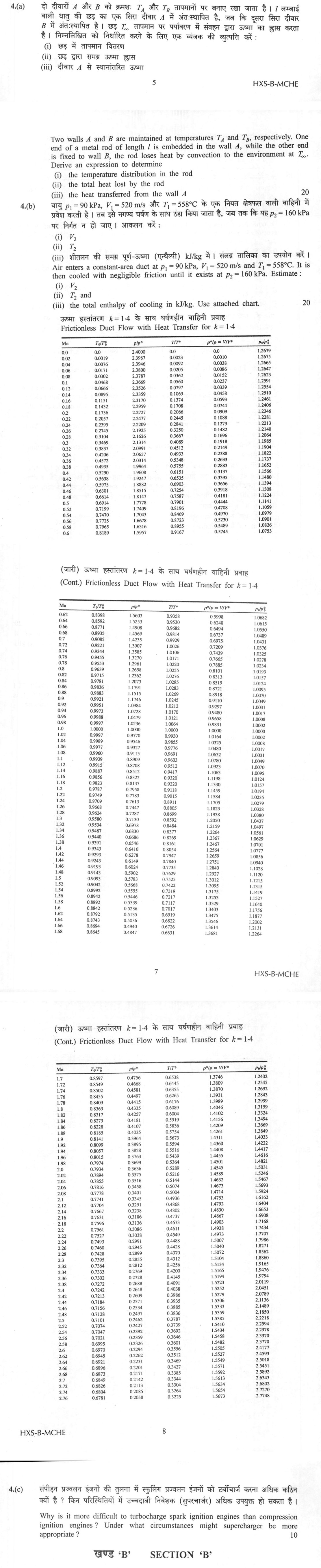
Air enters a constant-area duct at p_1 = 90 kPa, V_1 = 520 m/s and T_1 = 558°C. It is then cooled with negligible friction until it exists at p_2 = 160 kPa. Estimate : (i) V_2 (ii) T_2 and (iii) the total enthalpy of cooling in kJ/kg. Use attached chart. 20 marks
Why is it more difficult to turbocharge spark ignition engines than compression ignition engines ? Under what circumstances might supercharger be more appropriate ? 10 marks
हिंदी में प्रश्न पढ़ें
दो दीवारों A और B को क्रमशः T_A और T_B तापमानों पर बनाए रखा जाता है। l लंबाई वाली धातु की छड़ का एक सिरा दीवार A में अंतःस्थापित है, जब कि दूसरा सिरा दीवार B में अंतःस्थापित है। छड़ T_∞ तापमान पर पर्यावरण में संवहन द्वारा ऊष्मा का ह्रास करता है। निम्नलिखित को निर्धारित करने के लिए एक व्यंजक की व्युत्पत्ति करें : (i) छड़ में तापमान वितरण (ii) छड़ द्वारा समग्र ऊष्मा ह्रास (iii) दीवार A से स्थानांतरित ऊष्मा (20 अंक)
वायु p₁ = 90 kPa, V₁ = 520 m/s और T₁ = 558°C के एक नियत क्षेत्रफल वाली बाहिनी में प्रवेश करती है। तब इसे नगण्य घर्षण के साथ ठंडा किया जाता है, जब तक कि यह p₂ = 160 kPa पर निर्गत न हो जाए। आकलन करें : (i) V₂ (ii) T₂ (iii) शीतलन की समग्र पूर्ण-ऊष्मा (एन्थैल्पी) kJ/kg में। संलग्न तालिका का उपयोग करें। (20 अंक)
संपीड़न प्रज्वलन इंजनों की तुलना में स्पार्किंग प्रज्वलन इंजनों को टर्बोचार्ज करना अधिक कठिन क्यों है ? किन परिस्थितियों में उच्चदाबी निवेशक (सुपरचार्जर) अधिक उपयुक्त हो सकता है। (10 अंक)
The figure this question refers to, in words
The question paper is a scan and the diagram did not survive as text. This is the figure as read from the original page — every component, value and label — so the question can be worked from the text below.
(b) Table titled 'Frictionless Duct Flow with Heat Transfer for k = 1.4' with columns: Ma, T0/T0*, p/p*, T/T*, rho*/rho = V/V*, p0/p0*: Ma = 0.0: T0/T0* = 0.0, p/p* = 2.4000, T/T* = 0.0, rho*/rho = V/V* = 0.0, p0/p0* = 1.2679 Ma = 0.02: T0/T0* = 0.0019, p/p* = 2.3987, T/T* = 0.0023, rho*/rho = V/V* = 0.0010, p0/p0* = 1.2675 Ma = 0.04: T0/T0* = 0.0076, p/p* = 2.3946, T/T* = 0.0092, rho*/rho = V/V* = 0.0038, p0/p0* = 1.2665 Ma = 0.06: T0/T0* = 0.0171, p/p* = 2.3800, T/T* = 0.0205, rho*/rho = V/V* = 0.0086, p0/p0* = 1.2647 Ma = 0.08: T0/T0* = 0.0302, p/p* = 2.3787, T/T* = 0.0362, rho*/rho = V/V* = 0.0152, p0/p0* = 1.2623 Ma = 0.1: T0/T0* = 0.0468, p/p* = 2.3669, T/T* = 0.0560, rho*/rho = V/V* = 0.0237, p0/p0* = 1.2591 Ma = 0.12: T0/T0* = 0.0666, p/p* = 2.3526, T/T* = 0.0797, rho*/rho = V/V* = 0.0339, p0/p0* = 1.2554 Ma = 0.14: T0/T0* = 0.0895, p/p* = 2.3359, T/T* = 0.1069, rho*/rho = V/V* = 0.0458, p0/p0* = 1.2510 Ma = 0.16: T0/T0* = 0.1151, p/p* = 2.3170, T/T* = 0.1374, rho*/rho = V/V* = 0.0593, p0/p0* = 1.2461 Ma = 0.18: T0/T0* = 0.1432, p/p* = 2.2959, T/T* = 0.1708, rho*/rho = V/V* = 0.0744, p0/p0* = 1.2406 Ma = 0.2: T0/T0* = 0.1736, p/p* = 2.2727, T/T* = 0.2066, rho*/rho = V/V* = 0.0909, p0/p0* = 1.2346 Ma = 0.22: T0/T0* = 0.2057, p/p* = 2.2477, T/T* = 0.2445, rho*/rho = V/V* = 0.1088, p0/p0* = 1.2281 Ma = 0.24: T0/T0* = 0.2395, p/p* = 2.2209, T/T* = 0.2841, rho*/rho = V/V* = 0.1279, p0/p0* = 1.2213 Ma = 0.26: T0/T0* = 0.2745, p/p* = 2.1925, T/T* = 0.3250, rho*/rho = V/V* = 0.1482, p0/p0* = 1.2140 Ma = 0.28: T0/T0* = 0.3104, p/p* = 2.1626, T/T* = 0.3667, rho*/rho = V/V* = 0.1696, p0/p0* = 1.2064 Ma = 0.3: T0/T0* = 0.3469, p/p* = 2.1314, T/T* = 0.4089, rho*/rho = V/V* = 0.1918, p0/p0* = 1.1985 Ma = 0.32: T0/T0* = 0.3837, p/p* = 2.0991, T/T* = 0.4512, rho*/rho = V/V* = 0.2149, p0/p0* = 1.1904 Ma = 0.34: T0/T0* = 0.4206, p/p* = 2.0657, T/T* = 0.4933, rho*/rho = V/V* = 0.2388, p0/p0* = 1.1822 Ma = 0.36: T0/T0* = 0.4572, p/p* = 2.0314, T/T* = 0.5348, rho*/rho = V/V* = 0.2633, p0/p0* = 1.1737 Ma = 0.38: T0/T0* = 0.4935, p/p* = 1.9964, T/T* = 0.5755, rho*/rho = V/V* = 0.2883, p0/p0* = 1.1652 Ma = 0.4: T0/T0* = 0.5290, p/p* = 1.9608, T/T* = 0.6151, rho*/rho = V/V* = 0.3137, p0/p0* = 1.1566 Ma = 0.42: T0/T0* = 0.5638, p/p* = 1.9247, T/T* = 0.6535, rho*/rho = V/V* = 0.3395, p0/p0* = 1.1480 Ma = 0.44: T0/T0* = 0.5975, p/p* = 1.8882, T/T* = 0.6903, rho*/rho = V/V* = 0.3656, p0/p0* = 1.1394 Ma = 0.46: T0/T0* = 0.6301, p/p* = 1.8515, T/T* = 0.7254, rho*/rho = V/V* = 0.3918, p0/p0* = 1.1308 Ma = 0.48: T0/T0* = 0.6614, p/p* = 1.8147, T/T* = 0.7587, rho*/rho = V/V* = 0.4181, p0/p0* = 1.1224 Ma = 0.5: T0/T0* = 0.6914, p/p* = 1.7778, T/T* = 0.7901, rho*/rho = V/V* = 0.4444, p0/p0* = 1.1141 Ma = 0.52: T0/T0* = 0.7199, p/p* = 1.7409, T/T* = 0.8196, rho*/rho = V/V* = 0.4708, p0/p0* = 1.1059 Ma = 0.54: T0/T0* = 0.7470, p/p* = 1.7043, T/T* = 0.8469, rho*/rho = V/V* = 0.4970, p0/p0* = 1.0979 Ma = 0.56: T0/T0* = 0.7725, p/p* = 1.6678, T/T* = 0.8723, rho*/rho = V/V* = 0.5230, p0/p0* = 1.0901 Ma = 0.58: T0/T0* = 0.7965, p/p* = 1.6316, T/T* = 0.8955, rho*/rho = V/V* = 0.5489, p0/p0* = 1.0826 Ma = 0.6: T0/T0* = 0.8189, p/p* = 1.5957, T/T* = 0.9167, rho*/rho = V/V* = 0.5745, p0/p0* = 1.0753
Model answer
Written by UPSC Answer Check against this question's marking rubric, to the expected length. UPSC does not publish answers for Mains — this is one way to score well, not an official key.
(a)(i) Use the steady 1-D fin equation with constant k, h, A_c and perimeter P. Let θ(x) = T(x) − T∞, θ_A = T_A − T∞, θ_B = T_B − T∞. d²θ/dx² − m²θ = 0, where m = √(hP/(kA_c)). Boundary conditions: θ(0) = θ_A, θ(l) = θ_B. Hence θ(x) = [θ_A sinh(m(l−x)) + θ_B sinh(mx)] / sinh(ml). Therefore T(x) = T∞ + [(T_A − T∞) sinh(m(l−x)) + (T_B − T∞) sinh(mx)] / sinh(ml). Valid for steady, 1-D conduction, constant properties, no radiation or internal heat generation.
(a)(ii) Total heat lost by convection over length l is Q_loss = ∫₀ˡ hPθ(x) dx = hP(θ_A + θ_B)(cosh(ml) − 1)/(m sinh(ml)). Using hP = kA_c m², Q_loss = kA_c m tanh(ml/2)[(T_A − T∞) + (T_B − T∞)]. Positive Q_loss means net heat leaves the rod to the surroundings.
(a)(iii) Use Fourier law at wall A. Heat transferred from wall A into the rod in the +x direction is q_A = −kA_c (dT/dx)|_(x=0) = kA_c m [(T_A − T∞) cosh(ml) − (T_B − T∞)] / sinh(ml). Thus q_A = kA_c m [θ_A cosh(ml) − θ_B] / sinh(ml). Positive value means wall A supplies heat to the rod; negative means heat flows back into wall A. Energy balance gives Q_loss = q_A + q_B, where q_B = kA_c m [θ_B cosh(ml) − θ_A] / sinh(ml).
(b)(i) For constant-area, frictionless duct flow with heat transfer, use Rayleigh flow relations with k = 1.4, R = 287 J/kg K. T₁ = 558°C = 831.15 K. a₁ = √(kRT₁) = √(1.4 × 287 × 831.15) = 577.89 m/s. M₁ = V₁/a₁ = 520/577.89 = 0.8998 ≈ 0.900. Rayleigh relation: p/p* = (k + 1)/(1 + kM²). (p/p*)₁ = 2.4/(1 + 1.4 × 0.8998²) = 1.1249. p₂/p₁ = 160/90 = 1.7778. So (p/p*)₂ = 1.1249 × 1.7778 = 1.9998 ≈ 2.000. From the attached Rayleigh table/relation for subsonic branch, M₂ ≈ 0.3781. T/T* = (k + 1)²M²/(1 + kM²)². (T/T*)₁ = 1.02454, (T/T*)₂ = 0.57167. T₂/T₁ = 0.57167/1.02454 = 0.55798. T₂ = 831.15 × 0.55798 = 463.8 K. Continuity with ρ = p/(RT): V₂ = V₁(p₁/p₂)(T₂/T₁) = 520 × (90/160) × 0.55798 = 163.2 m/s. V₂ = 163.2 m/s.
(b)(ii) From above, T₂ = 463.8 K = 190.6°C.
(b)(iii) For a steady duct with no work, heat removed per kg equals decrease in stagnation enthalpy: q_cool = h₀₁ − h₀₂ = c_p(T₀₁ − T₀₂). T₀₁ = T₁[1 + (k − 1)M₁²/2] = 831.15[1 + 0.2 × 0.8998²] = 965.7 K. T₀₂ = T₂[1 + 0.2 × M₂²] = 463.8[1 + 0.2 × 0.3781²] = 477.0 K. c_p = kR/(k − 1) = 1.4 × 287/0.4 = 1004.5 J/kg K = 1.0045 kJ/kg K. q_cool = 1.0045 × (965.7 − 477.0) = 490.9 kJ/kg. Total enthalpy of cooling ≈ 491 kJ/kg.
(c) Turbocharging an SI engine is harder mainly because the fuel-air mixture is premixed and spark-ignited. Boosting raises charge temperature and pressure, sharply increasing knock tendency. This limits compression ratio, boost pressure and spark advance. SI engines also need stoichiometric mixture for three-way catalysts, while knock control often requires enrichment, retarding and intercooling. CI engines are unthrottled, inject fuel after air compression, and are not knock-limited in the same way, so they tolerate much higher boost and compression ratios.
A supercharger, being mechanically driven, is more appropriate when:
- immediate boost and throttle response are required without turbo lag;
- boost is needed at low engine speeds;
- exhaust energy is low, e.g. small engines or low-load operation;
- packaging or exhaust routing for a turbocharger is difficult;
- applications such as racing, aircraft, marine or two-stroke scavenging need rapid transient response. Its main penalty is parasitic power consumption, so it is chosen when response and simplicity outweigh fuel-economy loss.
What "Derive" is asking you to do
Reach the stated expression from a starting relation, justifying every step. The destination is printed in the question, so only the route earns marks, and the assumptions you work under are part of that route.
Structure that answers it
Assumptions and notation defined → starting relation or governing equation → each step with its justification → the required expression → limiting case or boundary check
Where marks are lost
Writing the standard result first and fitting three lines to it, which an examiner reads at a glance. Marks also go on assumptions left unstated — lossless medium, small amplitude, errors independent with zero mean — and on symbols used before they are defined, even when the question says usual notations.
How this answer will be evaluated
Approach
(a) derive: given > assumptions > stepwise derivation > result > check | (b) calculate: given > formula > substitution > result with units > interpretation | (c) explain: definition/context > points in order > small example > short close Full marks: Rigorous derivation with clear assumptions; correct application of Rayleigh flow tables; clear distinction between SI and CI engine limitations.
Key points expected
- State assumptions (steady state, 1D conduction, constant properties)
- Formulate differential energy balance equation for the rod
- Apply boundary conditions at x=0 and x=l
- Derive final expressions for T(x), Q_total, and Q_A
- Identify the flow as Rayleigh flow (constant area, frictionless, heat transfer)
- Calculate inlet Mach number using given p, V, and T
- Use the provided Rayleigh flow table to find exit properties
- Calculate V2, T2, and enthalpy change (q = h2 - h1)
Evaluation rubric
Each sub-part is marked on its own, against the marks and word limit printed on the paper.
- (a) Derive expressions for temperature distribution, total heat loss, and heat transfer from wall A for a fin with convection. 20 marks
derive— given → assumptions → stepwise derivation → result → check
Must cover
- State assumptions (steady state, 1D conduction, constant properties)
- Formulate differential energy balance equation for the rod
- Apply boundary conditions at x=0 and x=l
- Derive final expressions for T(x), Q_total, and Q_A
Loses marks
- Plugging numbers without deriving the governing equation
- Missing boundary conditions at the ends of the rod
Earns more
- Schematic diagram of the rod with boundary conditions
- Dimensional consistency check of the derived terms
Extra mark
- Discussion of the physical interpretation of the Biot number
- (b) Calculate exit velocity, temperature, and enthalpy change for air in a constant-area duct with heat transfer. 20 marks
calculate— given → formula → substitution → result with units → interpretation
Must cover
- Identify the flow as Rayleigh flow (constant area, frictionless, heat transfer)
- Calculate inlet Mach number using given p, V, and T
- Use the provided Rayleigh flow table to find exit properties
- Calculate V2, T2, and enthalpy change (q = h2 - h1)
Loses marks
- Using Fanno flow relations instead of Rayleigh flow
- Ignoring the constant area constraint
Earns more
- Correct conversion of temperature to Kelvin
- Explicit use of the provided table values
Extra mark
- T-s diagram showing the cooling process
- (c) Explain the difficulty of turbocharging SI engines compared to CI engines and the role of superchargers. 10 marks
explain— definition/context → points in order → small example → short close
Must cover
- Explain the knock limitation in SI engines
- Contrast with the high compression ratio tolerance of CI engines
- Identify the specific role of superchargers in SI engines
Loses marks
- Confusing turbocharger and supercharger definitions
- Failing to link knock to the difficulty of turbocharging
Earns more
- Mention of intercooling as a mitigation strategy
- Reference to the octane number requirement
Extra mark
- Mention of specific engine applications (e.g., racing vs. heavy duty)
Practice this exact question
Write your answer and it is marked point by point against the model answer above — what you covered, what you missed, what you got wrong.
Evaluate my answer →More from Mechanical Engineering 2021 Paper II
- Q1 (a) Discuss briefly the functional differences between a fan, a blower and a compressor.…
- Q2 (a)(i) 3 kg of air is compressed in a reversible steady flow polytropic process from 100…
- Q3 (a)(i) Show that the effective conductance, (A_1F̄₁₂) for two black, parallel plates of e…
- Q4 (a) Two walls A and B are maintained at temperatures T_A and T_B, respectively. One end o…
- Q5 (a) What do you understand by the term EGR? Explain how EGR reduces NOₓ emission in CI en…
- Q6 (a) (i) How does the mixture combustion in the combustion chamber of a C.I. engine differ…
- Q7 (a) (i) A single stage impulse steam turbine rotor has a diameter of 1·2 m and runs at 30…