Paper II — Q6
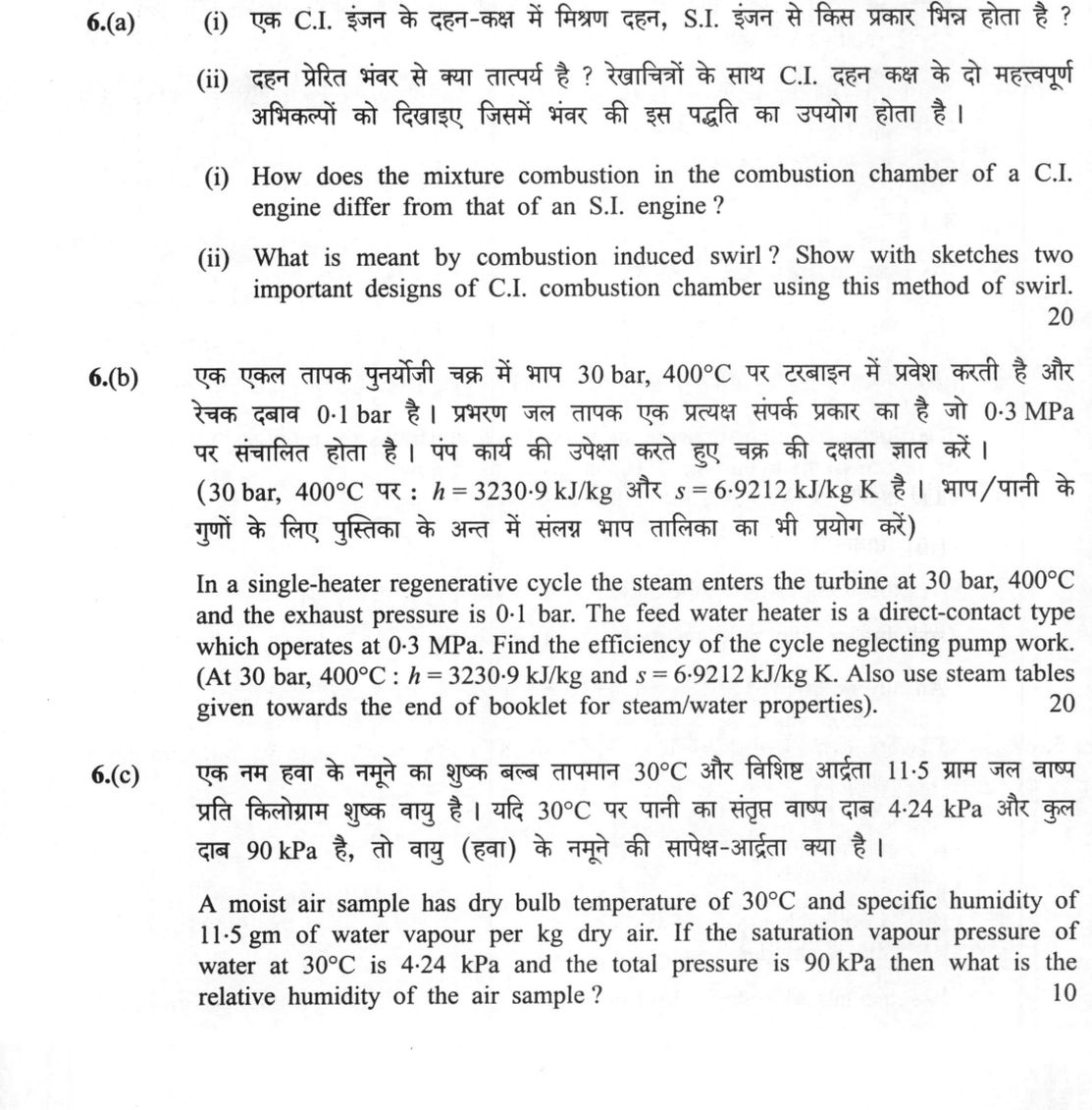
(a) (i) How does the mixture combustion in the combustion chamber of a C.I. engine differ from that of an S.I. engine? (ii) What…
How does the mixture combustion in the combustion chamber of a C.I. engine differ from that of an S.I. engine? (ii) What is meant by combustion induced swirl? Show with sketches two important designs of C.I. combustion chamber using this method of swirl. 20 marks
In a single-heater regenerative cycle the steam enters the turbine at 30 bar, 400°C and the exhaust pressure is 0·1 bar. The feed water heater is a direct-contact type which operates at 0·3 MPa. Find the efficiency of the cycle neglecting pump work. (At 30 bar, 400°C: h = 3230·9 kJ/kg and s = 6·9212 kJ/kg K. Also use steam tables given towards the end of booklet for steam/water properties). 20 marks
A moist air sample has dry bulb temperature of 30°C and specific humidity of 11·5 gm of water vapour per kg dry air. If the saturation vapour pressure of water at 30°C is 4·24 kPa and the total pressure is 90 kPa then what is the relative humidity of the air sample? 10 marks
हिंदी में प्रश्न पढ़ें
एक C.I. इंजन के दहन-कक्ष में मिश्रण दहन, S.I. इंजन से किस प्रकार भिन्न होता है? (ii) दहन प्रेरित भंवर से क्या तात्पर्य है? रेखाचित्रों के साथ C.I. दहन कक्ष के दो महत्वपूर्ण अभिकल्पों को दिखाइए जिसमें भंवर की इस पद्धति का उपयोग होता है। (20 अंक)
एक एकल तापक पुनर्जीवी चक्र में भाप 30 bar, 400°C पर टरबाइन में प्रवेश करती है और रेचक दबाव 0·1 bar है। प्रभरण जल तापक एक प्रत्यक्ष संपर्क प्रकार का है जो 0·3 MPa पर संचालित होता है। पंप कार्य की उपेक्षा करते हुए चक्र की दक्षता ज्ञात करें। (30 bar, 400°C पर: h = 3230·9 kJ/kg और s = 6·9212 kJ/kg K है। भाप/पानी के गुणों के लिए पुस्तिका के अंत में संलग्न भाप तालिका का भी प्रयोग करें)। (20 अंक)
एक नम हवा के नमूने का शुष्क बल्ब तापमान 30°C और विशिष्ट आर्द्रता 11·5 ग्राम जल वाष्प प्रति किलोग्राम शुष्क वायु है। यदि 30°C पर पानी का संतृप्त वाष्प दाब 4·24 kPa और कुल दाब 90 kPa है, तो वायु (हवा) के नमूने की सापेक्ष-आर्द्रता क्या है। (10 अंक)
Model answer
Written by UPSC Answer Check against this question's marking rubric, to the expected length. UPSC does not publish answers for Mains — this is one way to score well, not an official key.
Combustion differences. In an S.I. engine, a homogeneous air-fuel mixture is compressed and then ignited by a spark. The charge is homogeneous before compression; the flame starts at the plug and propagates as a premixed flame front. Its speed is governed by mixture composition, turbulence, and charge temperature, so the event is relatively fast and largely kinetically controlled. In a C.I. engine, only air is compressed; fuel is injected late in compression, near TDC. The hot compressed air autoignites the fuel after an ignition delay, and burning continues mainly by diffusion of air into fuel-rich zones. Thus C.I. combustion is heterogeneous and mixing-controlled: the effective flame speed is set by mixing rather than by a premixed chemical flame front, ignition delay is significant, and the combustion duration is longer because mixing and heat release must keep pace. This is why C.I. chambers are shaped to intensify air motion. The difference also explains why C.I. engines rely on injection timing and chamber geometry to manage the delay between injection and ignition.
Combustion-induced swirl and chamber sketches. Combustion-induced swirl is organised air motion generated by the piston’s compression stroke into a specially shaped chamber or pre-chamber, rather than by intake ducts. It increases air-fuel mixing, shortens ignition delay, and helps complete combustion. In both sketches, the swirl raises air velocity, improves atomisation and entrainment, and reduces the time needed for fuel to find air. Sketch 1, a swirl chamber or Ricardo Comet V type, shows a separate chamber connected to the main cylinder by a tangential throat. Arrows indicate compressed air entering the throat tangentially and forming a strong spiral in the chamber; the tangential throat converts piston-driven axial flow into rotational flow. Fuel is injected into this swirling air, and during expansion the arrows reverse through the throat. Sketch 2, a pre-combustion chamber, shows a small chamber with a restricted passage. Arrows show air being drawn through the passage by the pressure difference between the main chamber and the pre-chamber, producing swirl; the restricted passage creates a pressure drop that draws air through at high velocity. Fuel is injected into the pre-chamber, and hot products then pass into the main chamber.
Regenerative cycle. State 1 is turbine inlet: 30 bar, 400°C, h1=3230.9 kJ/kg, s1=6.9212 kJ/kg K. No turbine efficiency is given, so the expansion is taken isentropic. Expansion to the 0.3 MPa heater is isentropic to state 2. At 3 bar, sf≈1.672, sg≈6.992, hf≈561.4, hfg≈2163.8 kJ/kg. Hence x2=(6.9212−1.672)/(6.992−1.672)=0.9867 and h2=561.4+0.9867×2163.8≈2696.5 kJ/kg. For the low-pressure expansion to 0.1 bar, using hf≈191.8, hfg≈2392.8, sf≈0.649, sg≈8.150, x3=(6.9212−0.649)/(8.150−0.649)=0.836 and h3≈191.8+0.836×2392.8≈2192.6 kJ/kg. The extraction fraction y is the fraction of the original steam bled at 3 bar; the remaining (1-y) kg expands to the condenser. In the direct-contact heater, condensate at h4=hf(0.1 bar)=191.8 kJ/kg is mixed with extracted steam at h2 to give saturated liquid at h6=hf(3 bar)=561.4 kJ/kg. The balance y h2+(1−y)h4=h6 gives y=(561.4−191.8)/(2696.5−191.8)=0.1476. Turbine work, neglecting pump work, is W=(h1−h2)+(1−y)(h2−h3)=534.4+0.8524×503.9≈963.7 kJ/kg. Heat supplied is Q=h1−h6=3230.9−561.4=2669.5 kJ/kg. Therefore η=963.7/2669.5≈0.361, or 36.1%.
Relative humidity. The specific humidity is ω=11.5 g/kg=0.0115 kg/kg. From ω=0.622 pv/(p−pv), rearranging gives the vapour partial pressure pv=ωp/(0.622+ω)=0.0115×90/(0.622+0.0115)=1.634 kPa. Relative humidity is the ratio of actual vapour pressure to saturation vapour pressure at the dry-bulb temperature, so φ=pv/ps=1.634/4.24≈0.385, i.e. 38.5%. The dry-bulb temperature fixes ps; the total pressure fixes the dry-air partial pressure, so the result is the fraction of saturation vapour pressure actually present.
Thus the key distinction is premixed flame propagation versus diffusion-controlled burning, the cycle efficiency is 36.1%, and the air sample is about 38.5% saturated.
What "Explain" is asking you to do
Make the working of something clear — what sets it off, what follows from what, and what it produces. Explain is the Commission's mechanism word: it dominates the technical papers and the “explain why” stems, where the marks sit in the causal chain and not in the label.
Structure that answers it
State what it is → the initiating condition → the chain of cause, step by step → an instance where it plays out → what the chain produces
Where marks are lost
Describing what something looks like instead of why it works that way. Naming the stages without linking them reads as description too.
How this answer will be evaluated
Approach
(a) compare: paired headings or table > key differences > significance > conclusion | (b) calculate: given > formula > substitution > result with units > interpretation | (c) calculate: given > formula > substitution > result with units > interpretation Full marks: Complete derivations, labelled diagrams, and physical interpretation of results.
Key points expected
- Contrast premixed vs diffusion combustion
- Define combustion induced swirl
- Sketch two C.I. chamber designs
- Label swirl direction in sketches
- State given pressures and temperatures
- Apply energy balance for direct contact heater
- Calculate mass fraction of bled steam
- Compute net work and heat input
Evaluation rubric
Each sub-part is marked on its own, against the marks and word limit printed on the paper.
- (a) Contrast C.I. vs S.I. combustion and describe swirl chamber designs. 20 marks
compare— paired headings or table → key differences → significance → conclusion
Must cover
- Contrast premixed vs diffusion combustion
- Define combustion induced swirl
- Sketch two C.I. chamber designs
- Label swirl direction in sketches
Loses marks
- Confusing spark with compression ignition
- Sketches without labels or flow direction
Earns more
- Mention ignition delay in C.I.
- Mention flame propagation in S.I.
- Identify specific chamber types (e.g., toroidal)
Extra mark
- Mention specific swirl ratio values
- (b) Determine thermal efficiency of single-heater regenerative cycle. 20 marks
calculate— given → formula → substitution → result with units → interpretation
Must cover
- State given pressures and temperatures
- Apply energy balance for direct contact heater
- Calculate mass fraction of bled steam
- Compute net work and heat input
Loses marks
- Using wrong pressure for heater (0.3 MPa vs 0.3 bar)
- Missing units in intermediate steps
Earns more
- Draw T-s diagram with states marked
- Explicitly state pump work is neglected
- Show entropy check for turbine exit
Extra mark
- Compare efficiency with simple Rankine cycle
- (c) Determine relative humidity of moist air sample. 10 marks
calculate— given → formula → substitution → result with units → interpretation
Must cover
- Convert specific humidity to kg/kg
- Calculate partial pressure of vapour
- Apply relative humidity definition
- State final result as percentage
Loses marks
- Using grams instead of kg in formula
- Confusing total pressure with saturation pressure
Earns more
- Show formula for partial pressure
- Verify saturation pressure value
Extra mark
- Mention psychrometric chart usage
Practice this exact question
Write your answer and it is marked point by point against the model answer above — what you covered, what you missed, what you got wrong.
Evaluate my answer →More from Mechanical Engineering 2021 Paper II
- Q3 (a)(i) Show that the effective conductance, (A_1F̄₁₂) for two black, parallel plates of e…
- Q4 (a) Two walls A and B are maintained at temperatures T_A and T_B, respectively. One end o…
- Q5 (a) What do you understand by the term EGR? Explain how EGR reduces NOₓ emission in CI en…
- Q6 (a) (i) How does the mixture combustion in the combustion chamber of a C.I. engine differ…
- Q7 (a) (i) A single stage impulse steam turbine rotor has a diameter of 1·2 m and runs at 30…
- Q8 (a) An ammonia vapour compression refrigeration system works between temperature limits o…