Paper II — Q3
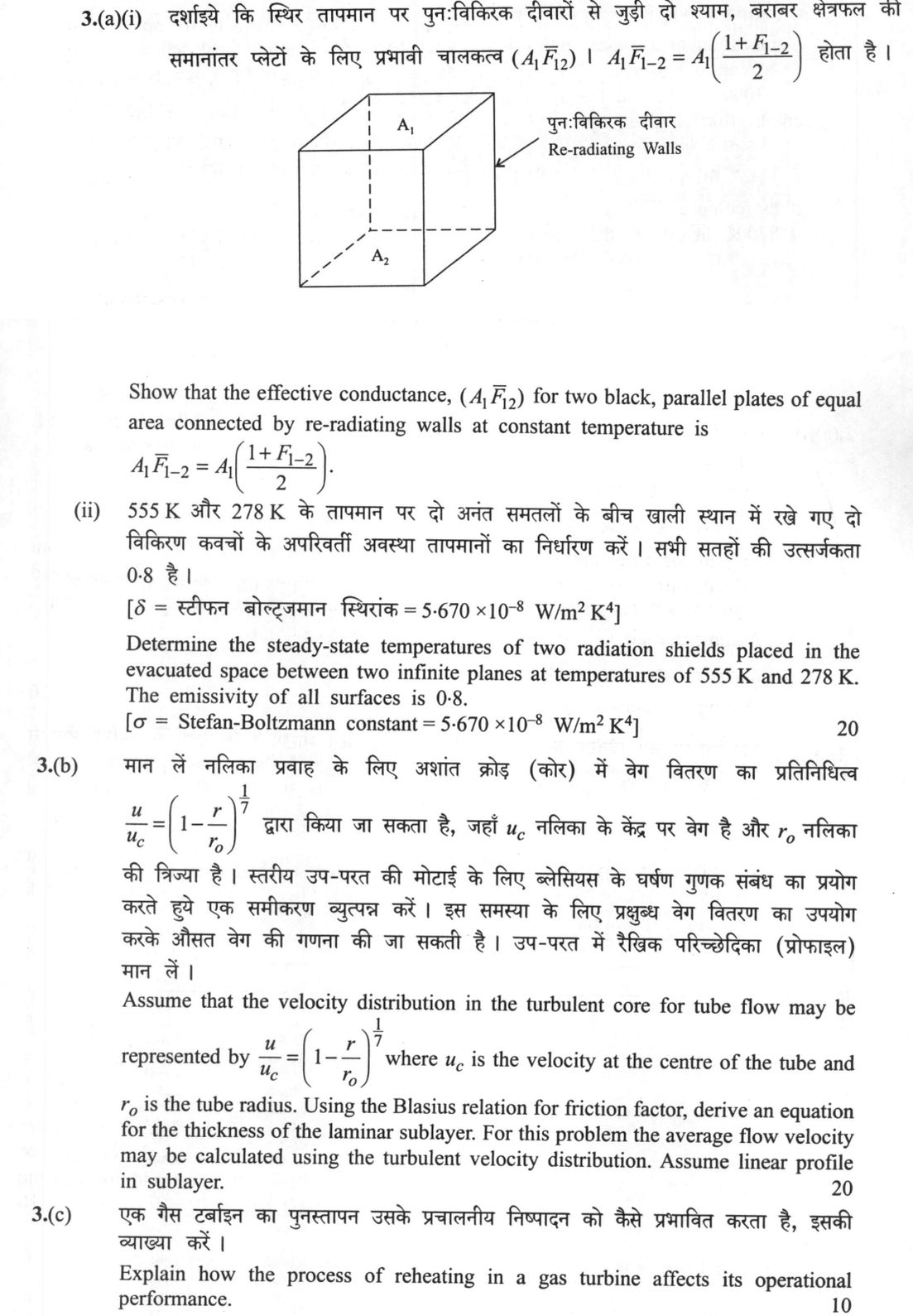
(a)(i) Show that the effective conductance, (A_1F̄₁₂) for two black, parallel plates of equal area connected by re-radiating…
Show that the effective conductance, (A_1F̄₁₂) for two black, parallel plates of equal area connected by re-radiating walls at constant temperature is A_1F̄₁₋₂ = A₁((1+F₁₋₂)/2). (ii) Determine the steady-state temperatures of two radiation shields placed in the evacuated space between two infinite planes at temperatures of 555 K and 278 K. The emissivity of all surfaces is 0.8. [σ = Stefan-Boltzmann constant = 5.670 × 10⁻⁸ W/m²K⁴] 20 marks
Assume that the velocity distribution in the turbulent core for tube flow may be represented by u/(u_c) = (1-r/(rₒ))¹/7 where u_c is the velocity at the centre of the tube and rₒ is the tube radius. Using the Blasius relation for friction factor, derive an equation for the thickness of the laminar sublayer. For this problem the average flow velocity may be calculated using the turbulent velocity distribution. Assume linear profile in sublayer. 20 marks
Explain how the process of reheating in a gas turbine affects its operational performance. 10 marks
हिंदी में प्रश्न पढ़ें
दर्शाइये कि स्थिर तापमान पर पुनःविकिरक दीवारों से जुड़ी दो श्याम, बराबर क्षेत्रफल की समानांतर प्लेटों के लिए प्रभावी चालकत्व (A_1F̄₁₂) | A_1F̄₁₋₂ = A₁((1+F₁₋₂)/2) होता है। (ii) 555 K और 278 K के तापमान पर दो अनंत समतलों के बीच खाली स्थान में रखे गए दो विकिरण कवचों के अपरिवर्ती अवस्था तापमानों का निर्धारण करें। सभी सतहों की उत्सर्जकता 0.8 है। [δ = स्टीफन बोल्ट्जमान स्थिरांक = 5.670 × 10⁻⁸ W/m²K⁴] (20 अंक)
मान लें नलिका प्रवाह के लिए अशांत कोर (कोर) में वेग वितरण का प्रतिनिधित्व u/(u_c) = (1-r/(rₒ))¹/7 द्वारा किया जा सकता है, जहाँ u_c नलिका के केंद्र पर वेग है और rₒ नलिका की त्रिज्या है। स्तरीय उप-परत की मोटाई के लिए ब्लेसियस के घर्षण गुणक संबंध का प्रयोग करते हुए एक समीकरण व्युत्पन्न करें। इस समस्या के लिए प्रक्षुब्ध वेग वितरण का उपयोग करके औसत वेग की गणना की जा सकती है। उप-परत में रैखिक परिछेदिका (प्रोफाइल) मान लें। (20 अंक)
एक गैस टर्बाइन का पुनःतापन उसके प्रचालनीय निष्पादन को कैसे प्रभावित करता है, इसकी व्याख्या करें। (10 अंक)
What "Derive" is asking you to do
Reach the stated expression from a starting relation, justifying every step. The destination is printed in the question, so only the route earns marks, and the assumptions you work under are part of that route.
Structure that answers it
Assumptions and notation defined → starting relation or governing equation → each step with its justification → the required expression → limiting case or boundary check
Where marks are lost
Writing the standard result first and fitting three lines to it, which an examiner reads at a glance. Marks also go on assumptions left unstated — lossless medium, small amplitude, errors independent with zero mean — and on symbols used before they are defined, even when the question says usual notations.
How this answer will be evaluated
Approach
(a(i)) derive: given > assumptions > stepwise derivation > result > check | (a(ii)) calculate: given > formula > substitution > result with units > interpretation | (b) derive: given > assumptions > stepwise derivation > result > check | (c) explain: definition/context > points in order > small example > short close Full marks: Complete derivations with clear schematics, all steps shown, physical interpretation included, units consistent throughout.
Key points expected
- Define view factor F1-2 for parallel plates
- Apply energy balance on re-radiating wall
- Solve for effective conductance A1F̄1-2
- Show final result A1(1+F1-2)/2
- State Stefan-Boltzmann law for radiation
- Set up energy balance for each shield
- Solve simultaneous equations for T1, T2
- Report temperatures in Kelvin
Evaluation rubric
Each sub-part is marked on its own, against the marks and word limit printed on the paper.
- (a(i)) Derive the effective conductance formula for two black parallel plates with re-radiating walls.
derive— given → assumptions → stepwise derivation → result → check
Must cover
- Define view factor F1-2 for parallel plates
- Apply energy balance on re-radiating wall
- Solve for effective conductance A1F̄1-2
- Show final result A1(1+F1-2)/2
Loses marks
- No energy balance on wall
- Skipping algebraic steps
- Incorrect view factor definition
Earns more
- Schematic of plates and walls
- Clear definition of re-radiating wall
- Step-by-step algebraic manipulation
Extra mark
- Physical interpretation of result
- Limiting case check (F1-2=1)
- (a(ii)) Calculate steady-state temperatures of two radiation shields between 555K and 278K planes.
calculate— given → formula → substitution → result with units → interpretation
Must cover
- State Stefan-Boltzmann law for radiation
- Set up energy balance for each shield
- Solve simultaneous equations for T1, T2
- Report temperatures in Kelvin
Loses marks
- No energy balance equations
- Incorrect use of emissivity
- Missing units in final answer
Earns more
- Schematic with labeled temperatures
- Emissivity values clearly stated
- Unit consistency check
Extra mark
- Comparison with no-shield case
- Physical interpretation of temperature distribution
- (b) Derive equation for laminar sublayer thickness using Blasius friction factor and 1/7 power law.
derive— given → assumptions → stepwise derivation → result → check
Must cover
- State 1/7 power law velocity profile
- Apply Blasius friction factor relation
- Assume linear profile in sublayer
- Derive final equation for sublayer thickness
Loses marks
- No Blasius relation used
- Incorrect velocity profile assumption
- Missing derivation steps
Earns more
- Schematic of velocity profile
- Clear definition of all variables
- Step-by-step derivation
Extra mark
- Physical interpretation of result
- Comparison with experimental data
- (c) Explain how reheating affects gas turbine operational performance.
explain— definition/context → points in order → small example → short close
Must cover
- Define reheating in gas turbine context
- Explain effect on thermal efficiency
- Discuss impact on specific work output
- Mention practical limitations
Loses marks
- No T-s diagram or cycle description
- Vague statements without mechanism
- Ignoring practical limitations
Earns more
- T-s diagram showing reheating
- Quantitative comparison with simple cycle
- Mention of component stresses
Extra mark
- Comparison with regenerative cycle
- Modern implementation examples
Model answer coming soon
Every evaluation on this site is marked against a verified model answer. This question's answer is still being written; evaluation opens the moment it lands.
More from Mechanical Engineering 2021 Paper II
- Q1 (a) Discuss briefly the functional differences between a fan, a blower and a compressor.…
- Q2 (a)(i) 3 kg of air is compressed in a reversible steady flow polytropic process from 100…
- Q3 (a)(i) Show that the effective conductance, (A_1F̄₁₂) for two black, parallel plates of e…
- Q4 (a) Two walls A and B are maintained at temperatures T_A and T_B, respectively. One end o…
- Q5 (a) What do you understand by the term EGR? Explain how EGR reduces NOₓ emission in CI en…
- Q6 (a) (i) How does the mixture combustion in the combustion chamber of a C.I. engine differ…