Paper II — Q7
(a) (i) A single stage impulse steam turbine rotor has a diameter of 1·2 m and runs at 3000 rpm. The nozzle angle is 18°. The…
A single stage impulse steam turbine rotor has a diameter of 1·2 m and runs at 3000 rpm. The nozzle angle is 18°. The blade speed ratio is 0·42. The relative velocity at the outlet to the relative velocity at inlet is 0·9. The outlet angle of the blade is 3° smaller than the inlet angle. For a steam flow rate of 10 kg/s find Blade angles at inlet and outlet, Axial thrust on the bearing and Power developed. 20 marks
Describe the phenomenon of super saturated flow observed in steam nozzle using T-s diagram. How does it influence the mass flow rate through the nozzle ? 20 marks
An air-conditioned space is maintained at 27°C DBT and 50% relative humidity. The ambient conditions are 40°C DBT and 27°C WBT. The space has a sensible heat gain of 14 kW. Air is supplied to the space at 7°C saturated. Determine the following : Mass of moist air supplied to the space
Latent heat gain of space
Cooling load of air washer if 30% of the air supplied to the space is fresh, the remainder being recirculated. Assume humid specific heat = 1·022 kJ/kg K. Psychrometric chart is given. 20 marks
A six-cylinder four-stroke diesel engine develops a power of 250 kW at 1500 rpm. The brake specific fuel consumption is 0·3 kg/kWh. The pressures of air in the cylinder at the beginning of injection and at the end of injection are 30 bar and 60 bar respectively. The fuel injection pressures at the beginning and end of injection are 220 bar and 550 bar respectively. Assume the coefficient of discharge for the injector to be 0·65, specific gravity of fuel to be 0·85 and the atmospheric pressure to be 1·013 bar. Also assume the effective pressure difference to be the average pressure difference over the injection period. Determine the nozzle area required per injection if the injection takes place over 15° crank angle. If the number of orifices used in the nozzle are 4, find the diameter of the orifice. (Conversion 1 bar = 10⁵ Pascal) 10 marks
हिंदी में प्रश्न पढ़ें
एक एकल पद आवेग भाप टर्बाइन के चुंबक का व्यास 1·2 m है और वह 3000 rpm पर चलता है। नोजल कोण 18° है। फलक वेग अनुपात 0·42 है। निर्गम पर सापेक्ष वेग का प्रवेश पर सापेक्ष वेग से अनुपात 0·9 है। फलक का बहिर्गम कोण अंतर्गम कोण से 3° छोटा है। 10 kg/s की भाप प्रवाह दर के लिए अंतर्गम और बहिर्गम पर फलक कोणों का मान, विचरिंग पर अक्षीय प्रणोद और विकसित शक्ति का मान ज्ञात कीजिए। (20 अंक)
T-s आरेख का उपयोग करते हुए भाप नोजल में अवलोकित अति-संतृप्त प्रवाह की घटना का वर्णन करें। यह नोजल में द्रव्यमान प्रवाह दर को कैसे प्रभावित करता है ? (20 अंक)
एक वातानुकूलित स्थान 27°C DBT और 50% (प्रतिशत) RH पर बनाए रखा जाता है। परिवेश की स्थिति 40°C DBT और 27°C WBT है। स्थान में 14 kW का संवेद उष्मा लाभ है। 7°C पर संतृप्त वायु की आपूर्ति इस स्थान में की जाती है। निम्नलिखित निर्धारित करें : स्थान में आपूर्ति की गई नम हवा का द्रव्यमान
स्थान में गुप्त उष्मा लाभ
धावक (वॉशर) का शीतलन भार, यदि स्थान में 30 प्रतिशत ताजी हवा की आपूर्ति की जाती है, शेष हवा का पुनःप्रचालन किया जाता है। आर्द्र विशिष्ट उष्मा = 1·022 kJ/kg K मान लें। आर्द्रतामितीय लेखाचित्र संलग्न है। (20 अंक)
एक छः सिलेंडर चार स्ट्रोक डीजल इंजन 1500 rpm पर 250 kW की शक्ति विकसित करता है। ब्रेक विशिष्ट ईंधन की खपत 0·3 kg/kWh है। अंतःक्षेपण की शुरुआत में और अंतःक्षेपण के अंत में सिलेंडर में हवा का दाब क्रमशः: 30 बार और 60 बार है। शुरुआत में और अंतःक्षेपण के अंत में ईंधन अंतःक्षेपण का दाब क्रमशः: 220 बार और 550 बार है। अंतःक्षेपक के लिए विसर्जन गुणांक 0·65, ईंधन विशिष्ट घनत्व 0·85 और वायुमंडलीय दाब 1·013 बार मान लें। प्रभावी दाब अंतर को अंतःक्षेपण अवधि पर औसत दाब अंतर के रूप में लें। प्रति अंतःक्षेपण के लिए, अपेक्षित तुंड का क्षेत्रफल निर्धारित करें, यदि अंतःक्षेपण 15° क्रैंक कोण से अधिक पर है। यदि तुंड में प्रयुक्त ऑरिफिसों की संख्या 4 है, तो ऑरिफिस का व्यास ज्ञात करें। (संपरिवर्तन 1 बार = 10⁵ पास्कल) (10 अंक)
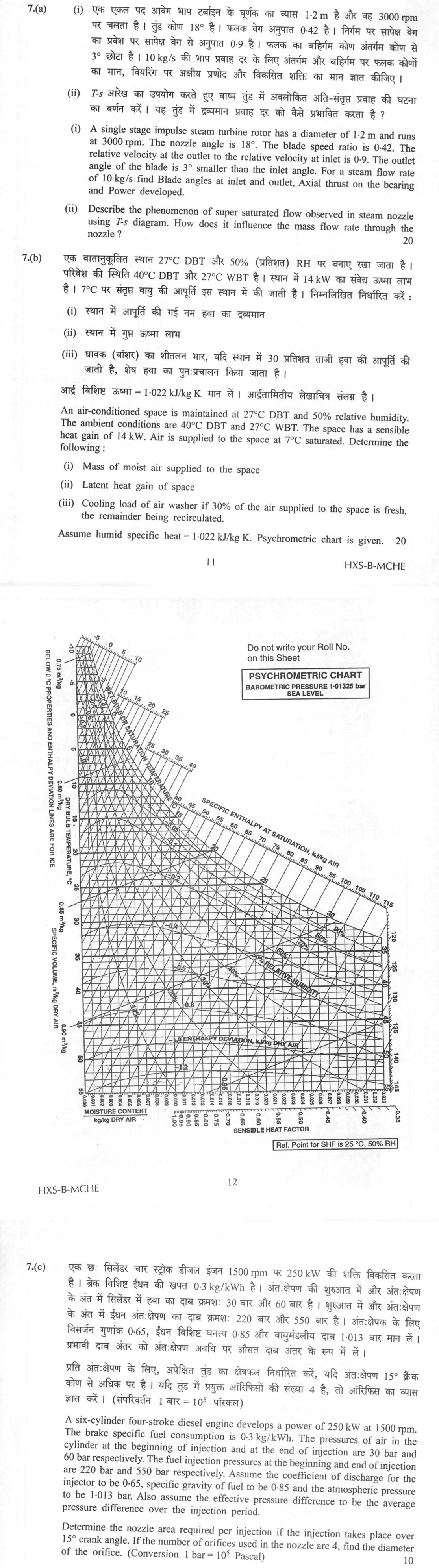
The figure this question refers to, in words
The question paper is a scan and the diagram did not survive as text. This is the figure as read from the original page — every component, value and label — so the question can be worked from the text below.
(b) Psychrometric Chart for barometric pressure 1.01325 bar (Sea Level). The chart plots Moisture Content (kg/kg dry air) on the x-axis (range 0.000 to 0.035) and Dry Bulb Temperature (°C) on the y-axis (range -10 to 55). Curves for Relative Humidity (10% to 90%) are shown. Diagonal lines represent Specific Enthalpy at Saturation (kJ/kg air) ranging from 0 to 145. Other lines indicate Wet Bulb or Saturation Temperature (°C), Specific Volume (m³/kg), and Enthalpy Deviation (kJ/kg dry air). A scale for Sensible Heat Factor (SHF) is provided at the bottom, with a reference point noted as 25°C, 50% RH.
Table: Saturated Water Pressure Entry. Columns: Press. (kPa), Temp. (°C), Specific Volume m3/kg (Sat. Liquid vf, Evap. vfg, Sat. Vapor vg), Internal Energy kJ/kg (Sat. Liquid uf, Evap. ufg, Sat. Vapor ug). Rows: 0.6113, 1, 1.5, 2, 2.5, 3, 4, 5, 7.5, 10, 15, 20, 25, 30, 40, 50, 75, 100, 125, 150, 175, 200, 225, 250, 275, 300, 325, 350, 375, 400, 450, 500, 550, 600, 650, 700, 750, 800.
What "Calculate" is asking you to do
Apply the standard formula or schedule to data the question has already supplied — a table of readings, cost records, a balance sheet — and produce the number. The method is rarely in doubt; the marks sit in the named intermediate quantities, each of which has to appear as a labelled line.
Structure that answers it
Data as given → formula or standard treatment, named → substitution → each intermediate, labelled → result with units
Where marks are lost
Omitting an intermediate the marking scheme pays for separately, or rounding at an intermediate line so the final figure drifts. In commerce and accountancy, any figure in a statement that no numbered working note supports is treated as unearned.
How this answer will be evaluated
Approach
(a(i)) calculate: given > formula > substitution > result with units > interpretation | (a(ii)) describe: define > structure or process in order > labelled diagram > significance | (b) calculate: given > formula > substitution > result with units > interpretation | (c) calculate: given > formula > substitution > result with units > interpretation Full marks: All parts show complete method with labeled diagrams, correct units, and physical interpretation.
Key points expected
- Velocity triangle construction with marked states
- Blade speed (u) calculation from diameter and rpm
- Inlet/outlet blade angle determination via trigonometry
- Power and thrust formulas with unit consistency
- T-s diagram showing metastable region
- Explanation of delayed condensation (super saturation)
- Comparison of actual vs equilibrium path
- Impact on mass flow rate (increase)
Evaluation rubric
Each sub-part is marked on its own, against the marks and word limit printed on the paper.
- (a(i)) Blade angles, axial thrust, and power developed for the impulse turbine.
calculate— given → formula → substitution → result with units → interpretation
Must cover
- Velocity triangle construction with marked states
- Blade speed (u) calculation from diameter and rpm
- Inlet/outlet blade angle determination via trigonometry
- Power and thrust formulas with unit consistency
Loses marks
- Plugging numbers without governing equations
- Unmarked states on velocity triangles
- Ignoring blade speed ratio in calculations
Earns more
- Explicit statement of blade speed ratio (rho)
- Relative velocity ratio (kr) application
- Physical interpretation of axial thrust direction
Extra mark
- Labeled T-s or velocity diagram
- (a(ii)) Phenomenon of super saturated flow and its effect on mass flow rate.
describe— define → structure or process in order → labelled diagram → significance
Must cover
- T-s diagram showing metastable region
- Explanation of delayed condensation (super saturation)
- Comparison of actual vs equilibrium path
- Impact on mass flow rate (increase)
Loses marks
- Confusing super saturation with superheating
- No mention of T-s diagram
- Incorrect claim that mass flow decreases
Earns more
- Mention of nucleation delay
- Reference to 'metastable' or 'superheated' state
- Quantitative effect on nozzle efficiency
Extra mark
- Sketch of T-s diagram with labeled points
- (b) Mass flow, latent heat gain, and air washer cooling load. 20 marks
calculate— given → formula → substitution → result with units → interpretation
Must cover
- Psychrometric chart usage for state points
- Sensible heat balance for mass flow calculation
- Latent heat gain from humidity difference
- Air washer load via mixing ratio (30% fresh)
Loses marks
- Ignoring psychrometric chart data
- Incorrect mixing ratio application
- Unit inconsistency in heat calculations
Earns more
- Explicit state point identification (1, 2, 3)
- Use of humid specific heat (1.022 kJ/kg K)
- Clear distinction between sensible and latent loads
Extra mark
- Labeled psychrometric chart with process lines
- (c) Nozzle area and orifice diameter for the diesel injector. 10 marks
calculate— given → formula → substitution → result with units → interpretation
Must cover
- Fuel mass flow rate from BSFC and power
- Average pressure difference calculation
- Nozzle area via discharge coefficient and Bernoulli
- Orifice diameter from total area and count
Loses marks
- Ignoring discharge coefficient (Cd)
- Incorrect pressure difference averaging
- Unit errors in area or diameter calculation
Earns more
- Explicit conversion of bar to Pascal
- Crank angle to time conversion
- Physical interpretation of discharge coefficient
Extra mark
- Schematic of injector with labeled pressures
Model answer coming soon
Every evaluation on this site is marked against a verified model answer. This question's answer is still being written; evaluation opens the moment it lands.
More from Mechanical Engineering 2021 Paper II
- Q4 (a) Two walls A and B are maintained at temperatures T_A and T_B, respectively. One end o…
- Q5 (a) What do you understand by the term EGR? Explain how EGR reduces NOₓ emission in CI en…
- Q6 (a) (i) How does the mixture combustion in the combustion chamber of a C.I. engine differ…
- Q7 (a) (i) A single stage impulse steam turbine rotor has a diameter of 1·2 m and runs at 30…
- Q8 (a) An ammonia vapour compression refrigeration system works between temperature limits o…