Paper II — Q8
(a) An ammonia vapour compression refrigeration system works between temperature limits of −6·7°C and 26·7°C. The vapour is dry…
An ammonia vapour compression refrigeration system works between temperature limits of −6·7°C and 26·7°C. The vapour is dry at the end of compression and there is no under cooling of the liquid which is further throttled to the lower temperature. Find the COP of the machine. Use the above properties of ammonia. 20 marks
In a cogeneration plant, steam enters the HP stage of a two-stage turbine at 1 MPa, 200°C and leaves it at 0·3 MPa. At this point some of the steam is bled off and passed through a heat exchanger which it leaves as saturated liquid at 0·3 MPa. The remaining steam expands in the LP stage of the turbine to 40 kPa. The turbine is required to produce a total power of 1 MW and the heat exchanger is required to provide a heating rate of 500 kW. Assuming all processes to be ideal, calculate the required mass flow rate of steam into the HP stage of the turbine. (At 1 MPa, 200°C : h = 2827·9 kJ/kg and s = 6·6939 kJ/kg K) Also use Steam Tables given at the end of the booklet. 20 marks
Compare the throttling processes happening at the following two locations in the steam power plant and using T-s diagrams contrast the observed phenomena : throttling of steam at inlet to turbine for governing.
throttling of condensate in closed feed heater trap exit. 10 marks
हिंदी में प्रश्न पढ़ें
एक अमोनिया वाष्प संपीडन प्रणाली −6·7°C और 26·7°C की ताप सीमाओं के बीच काम करती है। संपीडन के अंत में वाष्प शुष्क है और नीचे तापमान पर पुनः उपरोध किये जाने वाले तरल का कोई अवशीतन नहीं होता है। मशीन का सी.ओ.पी. ज्ञात करें। अमोनिया के निम्नलिखित गुणों का उपयोग करें। (20 अंक)
एक सहजनन संयंत्र में भाप द्विपद टरबाइन के HP पद में 1 MPa, 200°C पर प्रवेश करती है और इसे 0·3 MPa पर छोड़ देती है। इस बिंदु पर, कुछ भाप को निःश्वसित करते हुए एक उष्मा विनिमायक से पारित किया जाता है जो इसे 0·3 MPa पर संतृप्त तरल के रूप में छोड़ देता है। शेष भाप टरबाइन के LP पद में 40 kPa तक फैलती है। टरबाइन को 1 MW की समस्त शक्ति उत्पादन की और उष्मा विनिमायक को 500 kW की तापन दर के उत्पादन करने की आवश्यकता होती है। सभी प्रक्रियाओं को आदर्श मानते हुए टरबाइन के HP पद में भाप की अपेक्षित द्रव्यमान प्रवाह दर की गणना करें। (1 MPa, 200°C पर : h = 2827·9 kJ/kg और s = 6·6939 kJ/kg K) पुस्तिका के अंत में संलग्न भाप-तालिका का भी प्रयोग करें। (20 अंक)
भाप-शक्ति संयंत्र में निम्नलिखित स्थलों पर होने वाली उपरोधी प्रक्रियाओं की तुलना करें और T-s आरेखों का उपयोग करते हुए प्रेक्षित निम्नलिखित परिघटनाओं में व्यतिरेक करें : अधिनियंत्रण के लिए टरबाइन के अंतर्गम पर भाप उपरोधन।
संवृत प्रमरण तापक पाश निकास में द्रवितक उपरोधन। (10 अंक)
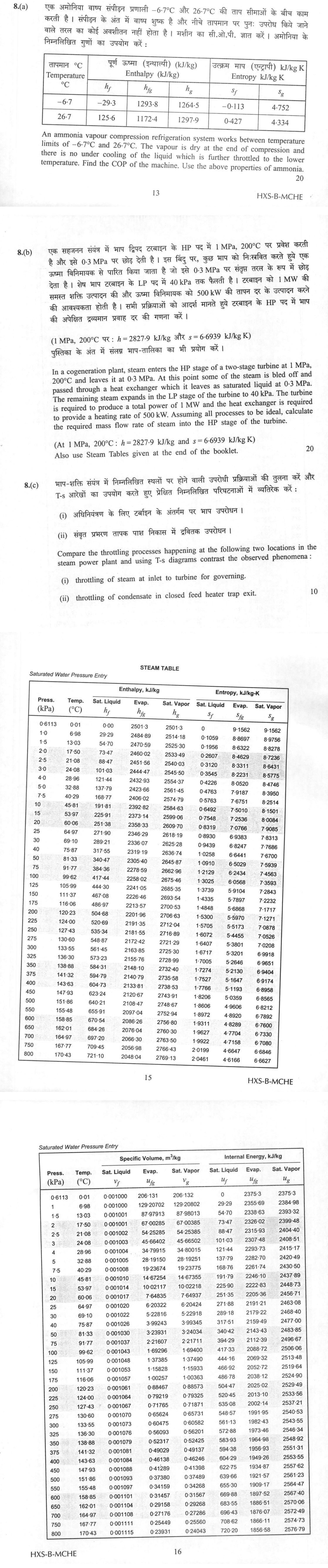
The figure this question refers to, in words
The question paper is a scan and the diagram did not survive as text. This is the figure as read from the original page — every component, value and label — so the question can be worked from the text below.
(a) Table of thermodynamic properties of ammonia: Columns: Temperature (°C) | Enthalpy hf (kJ/kg) | Enthalpy hfg (kJ/kg) | Enthalpy hg (kJ/kg) | Entropy sf (kJ/kg K) | Entropy sg (kJ/kg K) Row 1: -6.7 | -29.3 | 1293.8 | 1264.5 | -0.113 | 4.752 Row 2: 26.7 | 125.6 | 1172.4 | 1297.9 | 0.427 | 4.334
Model answer
Written by UPSC Answer Check against this question's marking rubric, to the expected length. UPSC does not publish answers for Mains — this is one way to score well, not an official key.
(a) Take states: 1 compressor suction, 2 compressor discharge, 3 condenser outlet, 4 after throttle. The cycle is ideal: compression 1-2 is isentropic, throttling 3-4 is isenthalpic, condensation and evaporation are isobaric.
Given: T_cond = 26.7°C, T_evap = −6.7°C. From table at 26.7°C: h_f3 = 125.6 kJ/kg, h_g2 = 1297.9 kJ/kg, s_g2 = 4.334 kJ/kg K. Since vapour is dry at end of compression, state 2 is dry saturated: h₂ = 1297.9 kJ/kg, s₂ = 4.334 kJ/kg K.
For ideal isentropic compression, s₁ = s₂ = 4.334 kJ/kg K. At −6.7°C, ammonia is wet. Dryness fraction: x₁ = (s₁ − s_f1)/(s_g1 − s_f1) = (4.334 − (−0.113))/(4.752 − (−0.113)) = 4.447/4.865 = 0.9141. Then h₁ = h_f1 + x₁ h_fg1 = −29.3 + 0.9141 × 1293.8 = 1153.34 kJ/kg.
No undercooling: state 3 is saturated liquid at 26.7°C, so h₃ = h_f3 = 125.6 kJ/kg. Throttling is isenthalpic: h₄ = h₃ = 125.6 kJ/kg.
Refrigeration effect: q_L = h₁ − h₄ = 1153.34 − 125.6 = 1027.74 kJ/kg.
Compressor work: w_c = h₂ − h₁ = 1297.9 − 1153.34 = 144.56 kJ/kg.
COP = q_L / w_c = 1027.74 / 144.56 = 7.109.
COP = 7.11. Valid for an ideal saturated vapour compression cycle with isentropic compression, isenthalpic expansion, and negligible pressure drops in the heat exchangers.
(b) Let m = mass flow rate into HP stage (kg/s), B = bled mass flow rate (kg/s). State 1: HP inlet at 1 MPa, 200°C: h₁ = 2827.9 kJ/kg, s₁ = 6.6939 kJ/kg K. HP expansion is ideal, so s₂ = s₁ = 6.6939 kJ/kg K at 0.3 MPa.
From steam tables at 0.3 MPa: h_f2 = 561.47 kJ/kg, h_fg2 = 2163.8 kJ/kg, s_f2 = 1.6718 kJ/kg K, s_g2 = 6.9919 kJ/kg K. Dryness fraction at state 2: x₂ = (s₂ − s_f2)/(s_g2 − s_f2) = (6.6939 − 1.6718)/(6.9919 − 1.6718) = 5.0221/5.3201 = 0.9440. h₂ = h_f2 + x₂ h_fg2 = 561.47 + 0.9440 × 2163.8 = 2604.07 kJ/kg.
Bled steam leaves heat exchanger as saturated liquid at 0.3 MPa: h₅ = h_f2 = 561.47 kJ/kg. Heat exchanger energy balance: B(h₂ − h₅) = 500 kW B = 500/(2604.07 − 561.47) = 500/2042.60 = 0.2448 kg/s.
LP stage receives (m − B) and expands isentropically to 40 kPa, so s₃ = s₂ = 6.6939 kJ/kg K. From steam tables at 40 kPa: h_f3 = 317.58 kJ/kg, h_fg3 = 2318.8 kJ/kg, s_f3 = 1.0261 kJ/kg K, s_g3 = 7.6700 kJ/kg K. x₃ = (6.6939 − 1.0261)/(7.6700 − 1.0261) = 5.6678/6.6439 = 0.8531. h₃ = h_f3 + x₃ h_fg3 = 317.58 + 0.8531 × 2318.8 = 2295.71 kJ/kg.
Turbine power balance: m(h₁ − h₂) + (m − B)(h₂ − h₃) = 1000 kW. m(2827.9 − 2604.07) + (m − 0.2448)(2604.07 − 2295.71) = 1000. m(223.83) + (m − 0.2448)(308.36) = 1000. m(223.83 + 308.36) − 0.2448 × 308.36 = 1000. m(532.19) = 1000 + 75.48 = 1075.48. m = 1075.48/532.19 = 2.021 kg/s.
Required HP-stage mass flow rate = 2.02 kg/s. Bled flow = 0.2448 kg/s.
(c) Both processes are steady-flow adiabatic throttling, so enthalpy remains constant, pressure falls, entropy increases, and available energy is destroyed. The difference arises from the initial phase of the fluid.
(i) Throttling of steam at inlet to turbine for governing: This is vapour-phase throttling. The steam is usually superheated or dry saturated. On a T-s diagram, the initial state lies in the superheated region (or on the saturated vapour line). At constant h, the pressure is reduced to the lower admission pressure. The state moves down and to the right because entropy increases. Temperature falls slightly. If the steam is superheated, it remains superheated; if it is wet, its dryness fraction increases. The main phenomenon is a loss of available work: the enthalpy drop across the turbine is reduced, so the turbine output is controlled. This is an irreversible process, but no phase change occurs if the steam is superheated.
(ii) Throttling of condensate in closed feed heater trap exit: This is liquid-phase throttling. The condensate is saturated liquid at the higher heater pressure. On a T-s diagram, the initial state lies on the saturated-liquid line. At constant h, it is throttled to a lower pressure. Since h at the higher pressure is greater than h_f at the lower pressure, the fluid cannot remain all liquid. The state moves down and to the right into the two-phase dome. Temperature drops to the lower saturation temperature. The observed phenomenon is flashing: part of the condensate evaporates. The quality after throttling is x = (h_before − h_f_low)/h_fg_low. This flash mixture is sent to the next lower-pressure heater or condenser, recovering some heat. Unlike turbine-inlet throttling, a phase change occurs.
What "Solve" is asking you to do
Choose the method, then carry it through to a final answer. Identifying what kind of problem this is and why that method applies is the first thing marked; a correct figure arrived at invisibly earns almost nothing.
Structure that answers it
Given data and what is required → method chosen, with the reason it applies → set-up (equation, circuit, free body, trial balance) → working, step by step → answer with units and any condition of validity
Where marks are lost
Doing the middle steps mentally and writing only the result. In mathematics papers, a further loss comes from giving a decimal where the exact value in surds or fractions was wanted, or from skipping the justification a part explicitly asks for.
How this answer will be evaluated
Approach
(a) calculate: given > formula > substitution > result with units > interpretation | (b) calculate: given > formula > substitution > result with units > interpretation | (c) compare: paired headings or table > key differences > significance > conclusion Full marks: All parts show complete method, correct calculations, and clear diagrams with labeled states.
Key points expected
- Identify state points on T-s diagram
- Calculate enthalpy at compressor exit
- Determine enthalpy at evaporator inlet
- Apply COP formula with units
- Apply energy balance to heat exchanger
- Calculate enthalpy drop in HP turbine
- Calculate enthalpy drop in LP turbine
- Solve for total mass flow rate
Evaluation rubric
Each sub-part is marked on its own, against the marks and word limit printed on the paper.
- (a) Determine the COP of the ammonia vapour compression refrigeration system. 20 marks
calculate— given → formula → substitution → result with units → interpretation
Must cover
- Identify state points on T-s diagram
- Calculate enthalpy at compressor exit
- Determine enthalpy at evaporator inlet
- Apply COP formula with units
Loses marks
- Missing governing equation for COP
- Incorrect state point identification
- No units on final answer
Earns more
- Correct use of provided property table
- Explicit statement of dry compression assumption
- Clear labeling of all state points
Extra mark
- Sketch of T-s diagram with cycle path
- (b) Calculate the required mass flow rate of steam into the HP stage. 20 marks
calculate— given → formula → substitution → result with units → interpretation
Must cover
- Apply energy balance to heat exchanger
- Calculate enthalpy drop in HP turbine
- Calculate enthalpy drop in LP turbine
- Solve for total mass flow rate
Loses marks
- Ignoring heat exchanger energy balance
- Incorrect turbine work calculation
- No final answer with units
Earns more
- Correct use of steam tables for enthalpies
- Clear separation of HP and LP power calculations
- Consistent units throughout calculation
Extra mark
- Schematic diagram of cogeneration plant
- (c) Compare throttling processes at turbine inlet and feed heater trap exit. 10 marks
compare— paired headings or table → key differences → significance → conclusion
Must cover
- Describe throttling at turbine inlet
- Describe throttling at feed heater trap
- Contrast pressure and temperature changes
- Explain purpose of each throttling
Loses marks
- No T-s diagram or sketch
- Confusing the two throttling locations
- No explanation of why throttling occurs
Earns more
- T-s diagram showing both processes
- Clear distinction between governing and trap throttling
- Mention of entropy change in both cases
Extra mark
- Labeled T-s diagram with both throttling lines
Practice this exact question
Write your answer and it is marked point by point against the model answer above — what you covered, what you missed, what you got wrong.
Evaluate my answer →More from Mechanical Engineering 2021 Paper II
- Q5 (a) What do you understand by the term EGR? Explain how EGR reduces NOₓ emission in CI en…
- Q6 (a) (i) How does the mixture combustion in the combustion chamber of a C.I. engine differ…
- Q7 (a) (i) A single stage impulse steam turbine rotor has a diameter of 1·2 m and runs at 30…
- Q8 (a) An ammonia vapour compression refrigeration system works between temperature limits o…