Paper I — Q1
(a) A slider-crank mechanism with crank radius 60 mm and connecting rod length 240 mm is shown in Figure 1(a). The crank is…
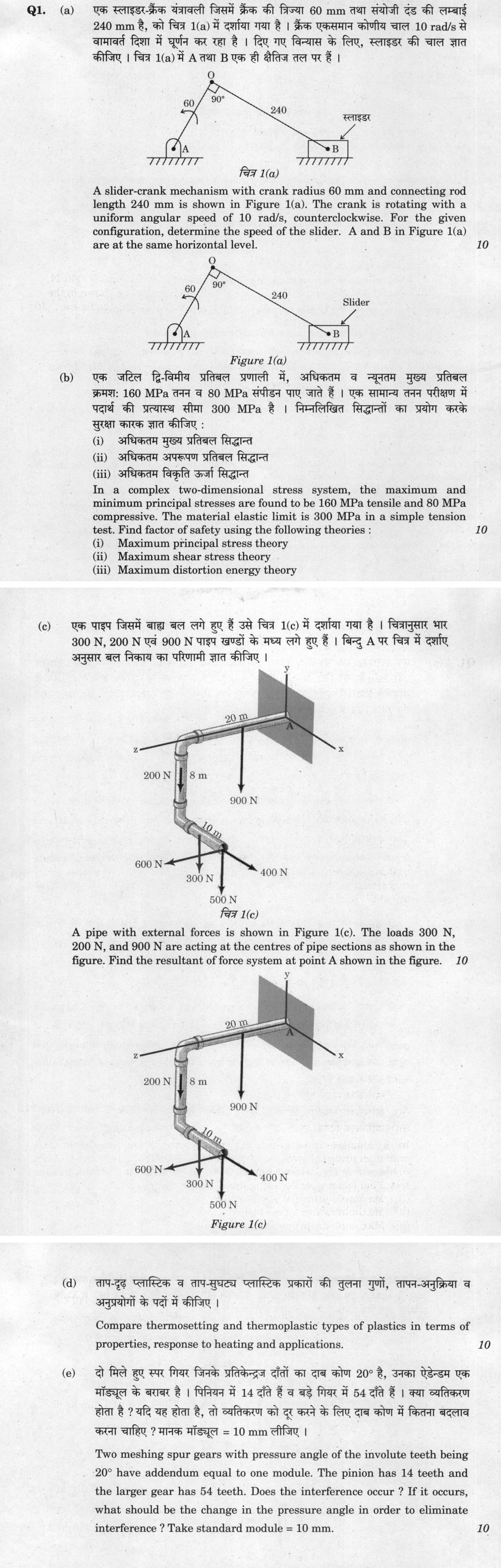
A slider-crank mechanism with crank radius 60 mm and connecting rod length 240 mm is shown in Figure 1(a). The crank is rotating with a uniform angular speed of 10 rad/s, counterclockwise. For the given configuration, determine the speed of the slider. A and B in Figure 1(a) are at the same horizontal level. 10 marks
In a complex two-dimensional stress system, the maximum and minimum principal stresses are found to be 160 MPa tensile and 80 MPa compressive. The material elastic limit is 300 MPa in a simple tension test. Find factor of safety using the following theories: Maximum principal stress theory
Maximum shear stress theory
Maximum distortion energy theory 10 marks
A pipe with external forces is shown in Figure 1(c). The loads 300 N, 200 N, and 900 N are acting at the centres of pipe sections as shown in the figure. Find the resultant of force system at point A shown in the figure. 10 marks
Compare thermosetting and thermoplastic types of plastics in terms of properties, response to heating and applications. 10 marks
Two meshing spur gears with pressure angle of the involute teeth being 20° have addendum equal to one module. The pinion has 14 teeth and the larger gear has 54 teeth. Does the interference occur? If it occurs, what should be the change in the pressure angle in order to eliminate interference? Take standard module = 10 mm. 10 marks
हिंदी में प्रश्न पढ़ें
एक स्लाइडर-क्रैंक यंत्रावली जिसमें क्रैंक की त्रिज्या 60 mm तथा संयोजी दंड की लम्बाई 240 mm है, को चित्र 1(a) में दर्शाया गया है। क्रैंक एकसमान कोणीय चाल 10 rad/s से वामावर्त दिशा में घूर्णन कर रहा है। दिए गए विन्यास के लिए, स्लाइडर की चाल ज्ञात कीजिए। चित्र 1(a) में A तथा B एक ही क्षैतिज तल पर हैं। (10 अंक)
एक जटिल द्वि-विमीय प्रतिबल प्रणाली में, अधिकतम व न्यूनतम मुख्य प्रतिबल क्रमशः 160 MPa तनन व 80 MPa संपीडन पाए जाते हैं। एक सामान्य तनन परीक्षण में पदार्थ की प्रत्यास्थ सीमा 300 MPa है। निम्नलिखित सिद्धांतों का प्रयोग करके सुरक्षा कारक ज्ञात कीजिए: अधिकतम मुख्य प्रतिबल सिद्धांत
अधिकतम अपरूपण प्रतिबल सिद्धांत
अधिकतम विकृति ऊर्जा सिद्धांत (10 अंक)
एक पाइप जिसमें बाह्य बल लगे हुए हैं उसे चित्र 1(c) में दर्शाया गया है। चित्रानुसार भार 300 N, 200 N एवं 900 N पाइप खंडों के मध्य लगे हुए हैं। बिन्दु A पर चित्र में दर्शाए अनुसार बल निकाय का परिणामी ज्ञात कीजिए। (10 अंक)
ताप-दृढ़ प्लास्टिक व ताप-सुग्राह्य प्लास्टिक प्रकारों की तुलना गुणों, तापन-अनुक्रिया व अनुप्रयोगों के पदों में कीजिए। (10 अंक)
दो मिले हुए स्पर गियर जिनके प्रतिकेन्द्रज दाँतों का दाब कोण 20° है, उनका ऐडेंडम एक मॉड्यूल के बराबर है। पिनियन में 14 दाँते हैं व बड़े गियर में 54 दाँते हैं। क्या व्यतिकरण होता है? यदि यह होता है, तो व्यतिकरण को दूर करने के लिए दाब कोण में कितना बदलाव करना चाहिए? मानक मॉड्यूल = 10 mm लीजिए। (10 अंक)
The figure this question refers to, in words
The question paper is a scan and the diagram did not survive as text. This is the figure as read from the original page — every component, value and label — so the question can be worked from the text below.
(a) A slider-crank mechanism diagram. A fixed pivot point labeled 'A' is located on a horizontal ground line. A crank arm of length 60 mm extends from A to a point labeled 'O'. At point O, the crank connects to a connecting rod of length 240 mm at a 90-degree angle, indicated by a right-angle symbol. The connecting rod extends from O to a slider block labeled 'B'. The slider block rests on a horizontal ground line, aligned with the level of point A. An arrow near the crank indicates a counterclockwise direction of rotation. The text '60' is written along the crank arm, and '240' is written along the connecting rod. The slider is labeled 'Slider' with an arrow pointing to the block.
(c) A 3D pipe assembly is shown with a Cartesian coordinate system (x, y, z) originating at point A. The y-axis is vertical, the x-axis points to the right, and the z-axis points out of the page towards the viewer. The pipe consists of three segments connected by 90-degree elbows. The first segment is horizontal, aligned with the z-axis, extending 20 m from point A. A vertical downward force of 900 N acts at the midpoint of this segment (10 m from A). The second segment is vertical, aligned with the y-axis, extending 8 m downwards from the end of the first segment. A vertical downward force of 200 N acts at the midpoint of this segment (4 m from the elbow). The third segment is horizontal, aligned with the x-axis, extending 10 m from the end of the second segment. At the free end of this third segment, three forces act: 600 N in the negative x-direction, 400 N in the positive x-direction, and 500 N in the negative y-direction (downwards). Additionally, a vertical downward force of 300 N acts at the midpoint of this third segment (5 m from the elbow). The question asks for the resultant of the force system at point A.
Model answer
Written by UPSC Answer Check against this question's marking rubric, to the expected length. UPSC does not publish answers for Mains — this is one way to score well, not an official key.
(a) Let r = 60 mm, l = 240 mm, ω = 10 rad/s. From Figure 1(a), A and B are on the same horizontal line and AO is perpendicular to OB. Let θ be the crank angle measured from AB. The validity condition is that the slider is to the right of A and the connecting rod is not folded, so l > r and the square root below is real.
In right triangle AOB, AB = √(r² + l²) = √(60² + 240²) = 60√17 mm. Hence cosθ = r/AB = 1/√17 and sinθ = l/AB = 4/√17.
For a slider-crank, the slider position from A is x = r cosθ + √(l² − r² sin²θ). Differentiating with respect to time, with dθ/dt = ω, dx/dt = −rω sinθ − r²ω sinθ cosθ / √(l² − r² sin²θ) = −rω sinθ [1 + r cosθ / √(l² − r² sin²θ)].
Now √(l² − r² sin²θ) = √(240² − 60²·16/17) = 960/√17 mm. Therefore the speed magnitude is v_B = rω sinθ [1 + r cosθ / √(l² − r² sin²θ)] = 60·10·(4/√17) [1 + 60(1/√17)/(960/√17)] = 2400/√17 · (17/16) = 150√17 mm/s ≈ 618.5 mm/s.
As a check, the component of the crank-pin velocity along the connecting rod is −600 mm/s; since the slider velocity component along the rod must equal this, v_B(4/√17) = −600, giving the same result.
Speed of slider = 150√17 mm/s ≈ 618.5 mm/s. For the drawn configuration with O above AB and CCW rotation, dx/dt is negative, so the slider moves toward A.
(b) The given two-dimensional principal stresses are +160 MPa and −80 MPa. For a plane stress state, the third principal stress is zero, so the ordered principal stresses are σ₁ = 160 MPa, σ₂ = 0 MPa, σ₃ = −80 MPa. The elastic limit in simple tension is σ_e = 300 MPa. Factor of safety is dimensionless. The maximum principal stress theory is most appropriate for brittle materials, while the maximum shear stress and distortion energy theories are commonly used for ductile materials.
- (i) Maximum principal stress theory: failure is predicted when the largest tensile principal stress reaches σ_e. FOS = σ_e/σ₁ = 300/160 = 15/8. FOS = 1.875.
- (ii) Maximum shear stress theory: the maximum shear stress is half the difference between the largest and smallest principal stresses. τ_max = (σ₁ − σ₃)/2 = (160 − (−80))/2 = 120 MPa. In a simple tension test, the allowable maximum shear stress is σ_e/2 = 150 MPa. FOS = 150/120 = 5/4. FOS = 1.25.
- (iii) Maximum distortion energy theory: the equivalent von Mises stress is σ_vm = √(1/2[(σ₁−σ₂)² + (σ₂−σ₃)² + (σ₃−σ₁)²]) = √(1/2[160² + 80² + 240²]) = √44800 = 80√7 MPa ≈ 211.66 MPa. FOS = σ_e/σ_vm = 300/(80√7) = 15/(4√7) = 15√7/28 ≈ 1.417. FOS = 1.417.
(c) From Figure 1(c), take A as the origin, +x to the right, +y upward, and +z out of the page. The right-handed system is consistent with the described axes. The force positions are in metres and force vectors in newtons.
- 900 N downward at (0, 0, 10): F₁ = (0, −900, 0)
- 200 N downward at (0, −4, 20): F₂ = (0, −200, 0)
- 300 N downward at (5, −8, 20): F₃ = (0, −300, 0)
- At the free end (10, −8, 20): F₄ = (−600, 0, 0), F₅ = (400, 0, 0), F₆ = (0, −500, 0)
The resultant force is R = ΣF = (−200, −1900, 0) N. Its magnitude is |R| = √(200² + 1900²) = 100√365 N ≈ 1910.5 N. The direction is 84.0° below the negative x-axis, since arctan(1900/200) = 84.0°.
The moment about A is M_A = Σ r × F, where r × F = (yF_z − zF_y, zF_x − xF_z, xF_y − yF_x). Evaluating each force:
- 900 N: (9000, 0, 0) N·m
- 200 N: (4000, 0, 0) N·m
- 300 N: (6000, 0, 0) N·m
- 600 N: (0, −12000, −4800) N·m
- 400 N: (0, 8000, 3200) N·m
- 500 N: (10000, 0, 0) N·m
Summing, M_A = (29000, −4000, −1600) N·m. Its magnitude is |M_A| = √(29000² + 4000² + 1600²) = 200√21489 N·m ≈ 29318 N·m.
Equivalent system at A: R = (−200 i − 1900 j) N and M_A = (29000 i − 4000 j − 1600 k) N·m. If the question requires only the resultant force, R = 100√365 N ≈ 1910.5 N in the stated direction.
(d)
- Thermoplastics have linear or branched molecular chains held together by secondary forces. They may be amorphous or semi-crystalline. Typical properties are moderate stiffness, good toughness, higher elongation, easier moulding, lower cost, and the ability to be remelted and reprocessed. Common examples are polyethylene, polypropylene, PVC, polystyrene, ABS, nylon, and polycarbonate.
- Response to heating is reversible. A thermoplastic softens above its glass transition temperature and, if semi-crystalline, melts above its melting temperature. On cooling it hardens again, so the same material can be injection moulded, extruded, thermoformed, or recycled by melting.
- Applications include packaging, films, bottles, pipes, containers, automotive interior and exterior parts, electrical housings, and 3D printing filaments.
- Thermosetting plastics form a crosslinked three-dimensional network during curing. Typical properties are high rigidity, high compressive strength, good dimensional stability, high heat resistance, good chemical resistance, and low elongation. They are usually more brittle than thermoplastics and are difficult to join or reprocess. Common examples are phenolic, epoxy, melamine, urea-formaldehyde, and unsaturated polyester.
- Response to heating after cure is irreversible. A cured thermoset does not soften or melt on further heating; at sufficiently high temperature it chars or decomposes. Curing is usually done by heat, catalyst, UV, or chemical reaction.
- Applications include electrical insulators, adhesives, laminates, composites, cookware handles, switchboards, automotive panels, and structural mouldings where heat and chemical resistance are important.
- Key contrast: thermoplastic behaviour on heating is reversible and processable repeatedly; thermoset behaviour is a permanent cure that gives higher heat and chemical resistance at the cost of brittleness and recyclability.
(e) Given standard module m = 10 mm, pinion teeth z₁ = 14, gear teeth z₂ = 54, and addendum a = m = 10 mm. Pitch radii: r₁ = mz₁/2 = 70 mm, r₂ = mz₂/2 = 270 mm. Addendum radii: r_a1 = r₁ + a = 80 mm, r_a2 = r₂ + a = 280 mm. Centre distance: C = r₁ + r₂ = 340 mm.
For involute gears, the line of action is tangent to the base circles. The distance from the pitch point to the pinion base-circle tangent point is r₁ sinφ. The gear addendum circle intersects the line of action at a distance √(r_a2² − r_b2²) − r₂ sinφ from the pitch point on the pinion side, where r_b2 = r₂ cosφ. No interference of the gear addendum on the pinion requires this distance not to exceed r₁ sinφ: √(r_a2² − r_b2²) − r₂ sinφ ≤ r₁ sinφ. This simplifies to r_a2² ≤ r_b2² + C² sin²φ.
At φ = 20°: r_a2² = 280² = 78400 mm². RHS = 270² cos²20° + 340² sin²20° ≈ 64372.3 + 13522.6 = 77894.9 mm². Since 78400 > 77894.9, interference occurs.
The opposite possible interference, pinion addendum on the gear, is checked by r_a1² ≤ r_b1² + C² sin²φ. At 20°, 6400 mm² ≤ 70² cos²20° + 340² sin²20° ≈ 17849.4 mm², so it is not governing.
To eliminate interference, set the governing condition to equality: (r₂ + m)² = r₂² cos²φ + C² sin²φ. Using cos²φ = 1 − sin²φ, r₂² + 2r₂m + m² = r₂² + (C² − r₂²) sin²φ. Therefore sin²φ_min = (2r₂m + m²)/(C² − r₂²) = (2·270·10 + 10²)/(340² − 270²) = 5500/42700 = 55/427. φ_min = arcsin(√(55/427)) ≈ 21.03°.
Interference occurs at 20°; the pressure angle must be increased by at least 1.03° to 21.03° to eliminate interference. A smaller pressure angle would increase interference.
What "Solve" is asking you to do
Choose the method, then carry it through to a final answer. Identifying what kind of problem this is and why that method applies is the first thing marked; a correct figure arrived at invisibly earns almost nothing.
Structure that answers it
Given data and what is required → method chosen, with the reason it applies → set-up (equation, circuit, free body, trial balance) → working, step by step → answer with units and any condition of validity
Where marks are lost
Doing the middle steps mentally and writing only the result. In mathematics papers, a further loss comes from giving a decimal where the exact value in surds or fractions was wanted, or from skipping the justification a part explicitly asks for.
How this answer will be evaluated
Approach
(a) calculate: given > formula > substitution > result with units > interpretation | (b) calculate: given > formula > substitution > result with units > interpretation | (c) calculate: given > formula > substitution > result with units > interpretation | (d) compare: paired headings or table > key differences > significance > conclusion | (e) calculate: given > formula > substitution > result with units > interpretation Full marks: All parts show complete method with governing equations, correct calculations, and proper units; diagrams where applicable.
Key points expected
- State given data: r=60mm, l=240mm, ω=10 rad/s
- Identify crank angle θ from geometry (A and B same level)
- Apply velocity equation or graphical method (velocity polygon)
- Calculate final speed with units (m/s)
- State σ1=160 MPa, σ2=-80 MPa, σe=300 MPa
- Apply Maximum Principal Stress Theory formula
- Apply Maximum Shear Stress Theory formula
- Apply Maximum Distortion Energy Theory formula
Evaluation rubric
Each sub-part is marked on its own, against the marks and word limit printed on the paper.
- (a) Determine the speed of the slider for the given configuration. 10 marks
calculate— given → formula → substitution → result with units → interpretation
Must cover
- State given data: r=60mm, l=240mm, ω=10 rad/s
- Identify crank angle θ from geometry (A and B same level)
- Apply velocity equation or graphical method (velocity polygon)
- Calculate final speed with units (m/s)
Loses marks
- No governing equation or method stated
- Incorrect angle identification from figure
Earns more
- Draws velocity diagram with labelled vectors
- Uses analytical formula v = ωr(sinθ + sin²θ/2n)
Extra mark
- Calculates acceleration of slider as well
- (b) Find factor of safety using three failure theories. 10 marks
calculate— given → formula → substitution → result with units → interpretation
Must cover
- State σ1=160 MPa, σ2=-80 MPa, σe=300 MPa
- Apply Maximum Principal Stress Theory formula
- Apply Maximum Shear Stress Theory formula
- Apply Maximum Distortion Energy Theory formula
Loses marks
- Confuses tensile and compressive signs
- Missing one of the three theories
Earns more
- Shows calculation steps for each theory
- States final FOS for all three theories clearly
Extra mark
- Compares the three FOS values
- (c) Find the resultant of the force system at point A. 10 marks
calculate— given → formula → substitution → result with units → interpretation
Must cover
- Resolve all forces into x, y, z components
- Sum forces in each direction (ΣFx, ΣFy, ΣFz)
- Calculate magnitude of resultant vector
- State direction or components of resultant
Loses marks
- Incorrect force direction assumption
- Missing one component in summation
Earns more
- Draws free body diagram with coordinate system
- Shows component resolution for each force
Extra mark
- Calculates moment about point A
- (d) Compare thermosetting and thermoplastic plastics. 10 marks
compare— paired headings or table → key differences → significance → conclusion
Must cover
- Define both types of plastics
- Compare properties (strength, rigidity, etc.)
- Compare response to heating (melt vs char)
- Give applications for each type
Loses marks
- Only lists properties without comparison
- Missing response to heating discussion
Earns more
- Uses table format for comparison
- Mentions molecular structure difference
Extra mark
- Gives specific examples (Bakelite, PVC)
- (e) Check for interference and find required pressure angle change. 10 marks
calculate— given → formula → substitution → result with units → interpretation
Must cover
- State given: Zp=14, Zg=54, m=10mm, α=20°
- Calculate minimum teeth to avoid interference
- Determine if interference occurs for given gears
- Calculate new pressure angle to eliminate interference
Loses marks
- Incorrect interference criterion used
- No calculation for new pressure angle
Earns more
- Uses standard interference formula
- Shows calculation of minimum teeth number
Extra mark
- Draws gear profile showing interference
Practice this exact question
Write your answer and it is marked point by point against the model answer above — what you covered, what you missed, what you got wrong.
Evaluate my answer →More from Mechanical Engineering 2022 Paper I
- Q1 (a) A slider-crank mechanism with crank radius 60 mm and connecting rod length 240 mm is…
- Q2 (a) A 20 mm diameter shaft is subjected to a torque of 80 Nm and a downward bending momen…
- Q3 (a) A thin cylinder of diameter 200 mm and length 1000 mm is subjected to an internal pre…
- Q4 (a) An automobile weighing 15 kN is moving at a speed of 100 km per hour. The dynamic coe…