Paper I — Q8
Q8. (a) (i) Discuss the mechanism of material removal in ultrasonic machining. (10 marks) (ii) What are the different parameters…
Q8. (a) (i) Discuss the mechanism of material removal in ultrasonic machining. 10 marks
What are the different parameters affecting the material removal rate in ultrasonic machining ? Show the variation of material removal rate with respect to these parameters using suitable schematic.
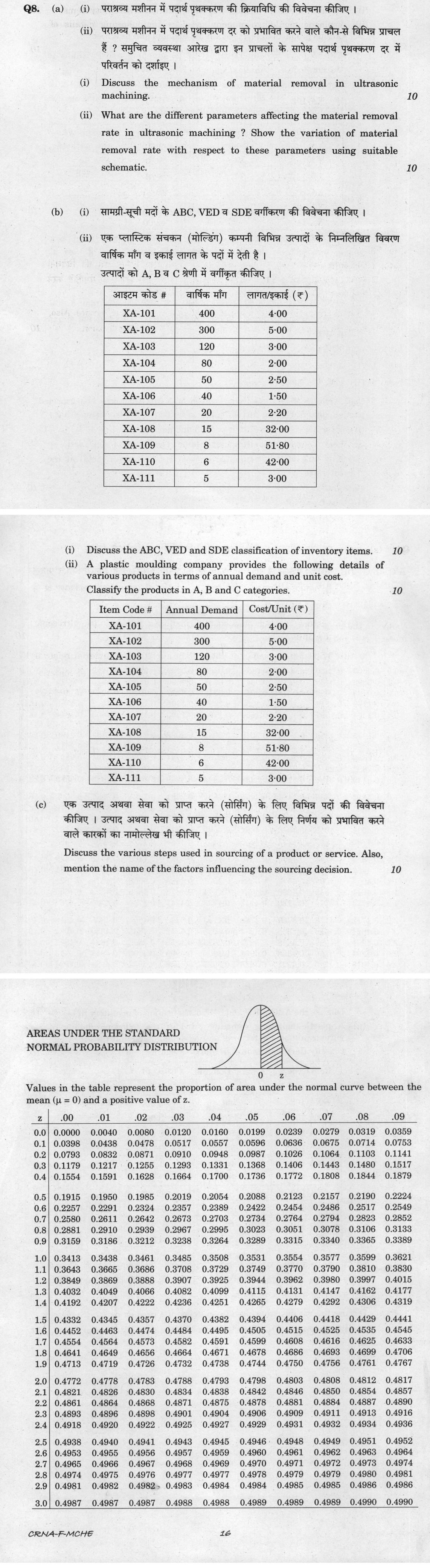
Discuss the ABC, VED and SDE classification of inventory items. 10 marks
A plastic moulding company provides the following details of various products in terms of annual demand and unit cost. Classify the products in A, B and C categories. 10 marks
| Item Code # | Annual Demand | Cost/Unit (₹) |
|---|---|---|
| XA-101 | 400 | 4.00 |
| XA-102 | 300 | 5.00 |
| XA-103 | 120 | 3.00 |
| XA-104 | 80 | 2.00 |
| XA-105 | 50 | 2.50 |
| XA-106 | 40 | 1.50 |
| XA-107 | 20 | 2.20 |
| XA-108 | 15 | 32.00 |
| XA-109 | 8 | 51.80 |
| XA-110 | 6 | 42.00 |
| XA-111 | 5 | 3.00 |
Discuss the various steps used in sourcing of a product or service. Also, mention the name of the factors influencing the sourcing decision. 10 marks
हिंदी में प्रश्न पढ़ें
Q8. (a) (i) पराश्रव्य मशीन में पदार्थ पृथक्करण की क्रियाविधि की विवेचना कीजिए ।
पराश्रव्य मशीन में पदार्थ पृथक्करण दर को प्रभावित करने वाले कौन-से विभिन्न प्राचल हैं ? समुचित व्यवस्था आरेख द्वारा इन प्राचलों के सापेक्ष पदार्थ पृथक्करण दर में परिवर्तन को दर्शाइए ।
सामग्री-सूची मदों के ABC, VED व SDE वर्गीकरण की विवेचना कीजिए ।
एक प्लास्टिक संचकन (मोल्डिंग) कम्पनी विभिन्न उत्पादों के निम्नलिखित विवरण वार्षिक माँग व इकाई लागत के पदों में देती है । उत्पादों को A, B व C श्रेणी में वर्गीकृत कीजिए ।
| आइटम कोड # | वार्षिक माँग | लागत/इकाई (₹) |
|---|---|---|
| XA-101 | 400 | 4·00 |
| XA-102 | 300 | 5·00 |
| XA-103 | 120 | 3·00 |
| XA-104 | 80 | 2·00 |
| XA-105 | 50 | 2·50 |
| XA-106 | 40 | 1·50 |
| XA-107 | 20 | 2·20 |
| XA-108 | 15 | 32·00 |
| XA-109 | 8 | 51·80 |
| XA-110 | 6 | 42·00 |
| XA-111 | 5 | 3·00 |
एक उत्पाद अथवा सेवा को प्राप्त करने (सोर्सिंग) के लिए विभिन्न पदों की विवेचना कीजिए । उत्पाद अथवा सेवा को प्राप्त करने (सोर्सिंग) के लिए निर्णय को प्रभावित करने वाले कारकों का नामोल्लेख भी कीजिए ।
The figure this question refers to, in words
The question paper is a scan and the diagram did not survive as text. This is the figure as read from the original page — every component, value and label — so the question can be worked from the text below.
(b) Table with columns: Item Code #, Annual Demand, Cost/Unit (₹). Rows: XA-101, 400, 4.00; XA-102, 300, 5.00; XA-103, 120, 3.00; XA-104, 80, 2.00; XA-105, 50, 2.50; XA-106, 40, 1.50; XA-107, 20, 2.20; XA-108, 15, 32.00; XA-109, 8, 51.80; XA-110, 6, 42.00; XA-111, 5, 3.00.
Model answer
Written by UPSC Answer Check against this question's marking rubric, to the expected length. UPSC does not publish answers for Mains — this is one way to score well, not an official key.
Ultrasonic machining. In USM, a tool vibrates at 15–30 kHz with 10–50 μm amplitude in an abrasive slurry. Material removal occurs through three mechanisms: direct hammering by abrasive particles on the work surface, cavitation-induced erosion where collapsing bubbles produce micro-jets and shock waves, and chemical action at the tool-work interface that weakens hard/brittle surfaces. The combined mechanical and chemical action creates micro-cracks and brittle fracture, so USM is useful for hard, brittle and difficult-to-machine materials.
Parameters and schematic. The material removal rate depends on amplitude, frequency, static feed force, abrasive grit size, concentration and slurry viscosity. A suitable schematic shows MRR rising with amplitude approximately as amplitude^0.5, increasing nearly linearly with frequency, and rising with grit size and feed force only up to an optimum, then falling. Excessive grit size or feed force reduces slurry penetration, causes tool-work contact and increases tool wear. Concentration and viscosity also affect MRR: too low concentration reduces hammering, while too high concentration or high viscosity restricts slurry flow.
ABC, VED and SDE. ABC classifies inventory by annual consumption value: A items are high value, B moderate, C low, often following the 70-20-10 rule. VED classifies by criticality to production: Vital, Essential and Desirable. Vital items stop production if unavailable; Essential reduce efficiency; Desirable can be substituted. SDE classifies by availability: Scarce, Difficult and Easy. Scarce items have long lead time, difficult items have multiple sources but long lead, easy items have ready availability. In Indian manufacturing, ABC guides procurement control, VED supports production continuity, and SDE helps fix safety stock for scarce or imported inputs.
ABC classification. For the company, annual value = demand × unit cost. Total = ₹5,010.40. Ranked values: XA-101 ₹1,600 (31.9%); XA-102 ₹1,500 (61.9%); XA-108 ₹480 (71.5%); XA-109 ₹414.40 (79.7%); XA-103 ₹360 (86.9%); XA-110 ₹252 (91.9%); XA-104 ₹160 (95.1%); XA-105 ₹125 (97.6%); XA-106 ₹60 (98.8%); XA-107 ₹44 (99.7%); XA-111 ₹15 (100%). The first four items account for 79.7% of value, so they are A; the next three add 15.4%, forming B; the remaining 4.9% are C. Hence A: 101, 102, 108, 109; B: 103, 110, 104; C: 105, 106, 107, 111.
Sourcing. Sourcing of a product or service begins with identifying the need and preparing specifications, market survey, prequalification, supplier identification, RFQ/bidding, bid opening, technical-commercial evaluation, negotiation, contract award, onboarding, and performance monitoring/relationship management. The factors influencing the sourcing decision are cost, quality, delivery, reliability, geopolitical risk, and Make-in-India policy alignment. Thus, effective manufacturing management requires controlled USM parameters, value-based inventory focus, and risk-aware sourcing.
What "Discuss" is asking you to do
Lay the issue out from more than one side — how it arose, what is claimed for it, what is held against it, and where it now stands. UPSC attaches discuss to broad topics with several live dimensions, so coverage of the dimensions earns more than the strength of your opinion.
Structure that answers it
Set the issue up → the case as it is made → the case against → the dimension both sides leave out → where the balance now lies
Where marks are lost
Listing facts with no thread between them, or arguing one side throughout and calling it a discussion.
How this answer will be evaluated
Approach
(a(i)) discuss: intro > 3-4 dimensions > example > balanced close | (a(ii)) explain: definition/context > points in order > small example > short close | (b(i)) discuss: intro > 3-4 dimensions > example > balanced close | (b(ii)) calculate: given > formula > substitution > result with units > interpretation | (c) discuss: intro > 3-4 dimensions > example > balanced close Full marks: All parts answered with correct method, schematics, and calculations.
Key points expected
- Mention cavitation and micro-jetting in the slurry
- Describe the role of abrasive particles
- Explain the impact of the tool tip
- Mention the role of the liquid medium
- List at least 3 parameters (e.g., power, frequency, feed)
- Draw a schematic for MRR vs Power
- Draw a schematic for MRR vs Frequency
- Draw a schematic for MRR vs Feed rate
Evaluation rubric
Each sub-part is marked on its own, against the marks and word limit printed on the paper.
- (a(i)) Explain the physical mechanism of material removal in ultrasonic machining. 10 marks
discuss— intro → 3-4 dimensions → example → balanced close
Must cover
- Mention cavitation and micro-jetting in the slurry
- Describe the role of abrasive particles
- Explain the impact of the tool tip
- Mention the role of the liquid medium
Loses marks
- Confusing ultrasonic with electrochemical machining
- Omitting the role of the abrasive
Earns more
- Mention fatigue failure of the workpiece
- Mention the role of the frequency of vibration
Extra mark
- Labelled schematic of the machining process
- (a(ii)) List parameters affecting MRR and show their variation schematically. 10 marks
explain— definition/context → points in order → small example → short close
Must cover
- List at least 3 parameters (e.g., power, frequency, feed)
- Draw a schematic for MRR vs Power
- Draw a schematic for MRR vs Frequency
- Draw a schematic for MRR vs Feed rate
Loses marks
- Listing parameters without drawing the required schematics
- Incorrect trends in the schematics
Earns more
- Mention the effect of abrasive size
- Mention the effect of slurry concentration
Extra mark
- Mention the effect of tool material
- (b(i)) Explain the ABC, VED, and SDE classification of inventory items. 10 marks
discuss— intro → 3-4 dimensions → example → balanced close
Must cover
- Define ABC classification (Value)
- Define VED classification (Criticality)
- Define SDE classification (Availability)
Loses marks
- Confusing VED with FSN
- Omitting the definition of SDE
Earns more
- Mention the percentage split for ABC (e.g., 80/15/5)
- Give an example for each category
Extra mark
- Mention the use of FSN classification
- (b(ii)) Classify the given products into A, B, and C categories. 10 marks
calculate— given → formula → substitution → result with units → interpretation
Must cover
- Calculate Annual Value for each item
- Sort items in descending order of Annual Value
- Calculate Cumulative Percentage of Value
- Assign A, B, C categories based on cumulative percentage
Loses marks
- Incorrect calculation of Annual Value
- Incorrect sorting of items
Earns more
- Correct calculation of Annual Value
- Correct assignment of categories
Extra mark
- Mention the specific percentage cutoffs used
- (c) Discuss the steps in sourcing and factors influencing the decision. 10 marks
discuss— intro → 3-4 dimensions → example → balanced close
Must cover
- List the steps in sourcing (e.g., identification, evaluation, selection)
- Mention at least 3 factors influencing the decision (e.g., cost, quality, delivery)
- Explain the importance of each step
Loses marks
- Omitting the factors influencing the decision
- Listing steps without explaining their importance
Earns more
- Mention the role of the supplier
- Mention the role of the buyer
Extra mark
- Mention the use of a sourcing strategy
Practice this exact question
Write your answer and it is marked point by point against the model answer above — what you covered, what you missed, what you got wrong.
Evaluate my answer →More from Mechanical Engineering 2022 Paper I
- Q5 (a) An HSS drill during its life can drill 150 through holes in a 10 mm thick brass plate…
- Q6 (a) During turning of a steel rod of 100 mm diameter, at a speed of 600 rpm, feed of 0·32…
- Q7 Q7. (a) A firm has identified four operations, which are to be conducted in succession fo…
- Q8 Q8. (a) (i) Discuss the mechanism of material removal in ultrasonic machining. (10 marks)…