Paper I — Q7
Q7. (a) A firm has identified four operations, which are to be conducted in succession for an order to be processed. The…
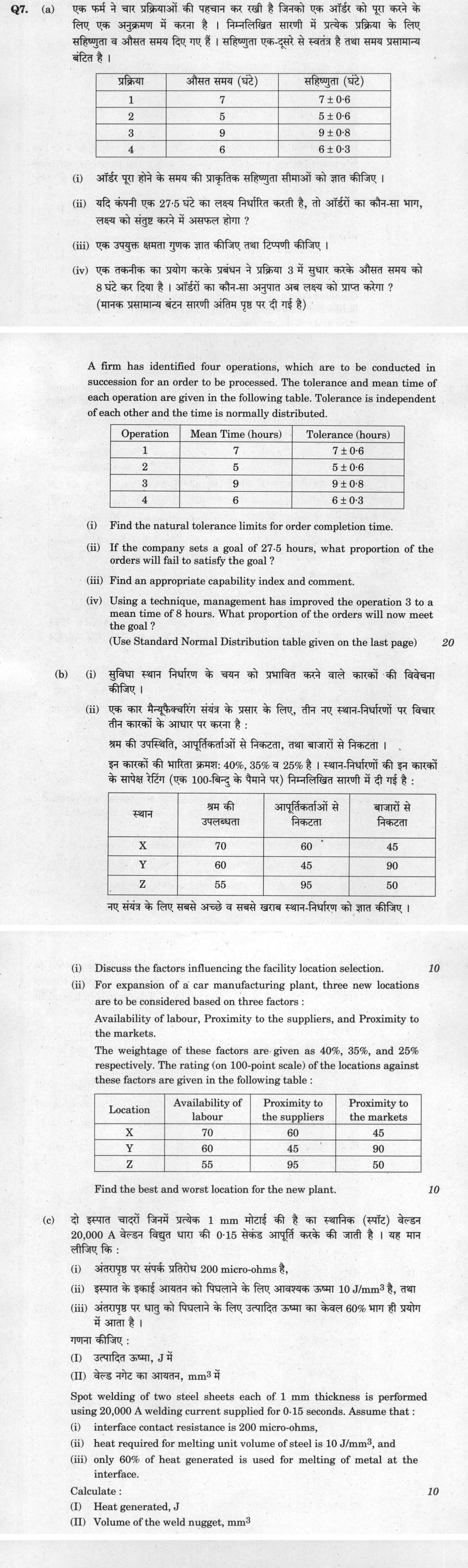
Q7. (a) A firm has identified four operations, which are to be conducted in succession for an order to be processed. The tolerance and mean time of each operation are given in the following table. Tolerance is independent of each other and the time is normally distributed.
| Operation | Mean Time (hours) | Tolerance (hours) |
|---|---|---|
| 1 | 7 | 7 ± 0·6 |
| 2 | 5 | 5 ± 0·6 |
| 3 | 9 | 9 ± 0·8 |
| 4 | 6 | 6 ± 0·3 |
Find the natural tolerance limits for order completion time. 20 marks
If the company sets a goal of 27·5 hours, what proportion of the orders will fail to satisfy the goal ?
Find an appropriate capability index and comment.
Using a technique, management has improved the operation 3 to a mean time of 8 hours. What proportion of the orders will now meet the goal ?
(Use Standard Normal Distribution table given on the last page)
Discuss the factors influencing the facility location selection. 10 marks
For expansion of a car manufacturing plant, three new locations are to be considered based on three factors : Availability of labour, Proximity to the suppliers, and Proximity to the markets. The weightage of these factors are given as 40%, 35%, and 25% respectively. The rating (on 100-point scale) of the locations against these factors are given in the following table :
| Location | Availability of labour | Proximity to the suppliers | Proximity to the markets |
|---|---|---|---|
| X | 70 | 60 | 45 |
| Y | 60 | 45 | 90 |
| Z | 55 | 95 | 50 |
Find the best and worst location for the new plant. 10 marks
Spot welding of two steel sheets each of 1 mm thickness is performed using 20,000 A welding current supplied for 0·15 seconds. Assume that :
interface contact resistance is 200 micro-ohms,
heat required for melting unit volume of steel is 10 J/mm³, and
only 60% of heat generated is used for melting of metal at the interface.
Calculate : 10 marks
(I) Heat generated, J
(II) Volume of the weld nugget, mm³
हिंदी में प्रश्न पढ़ें
Q7. (a) एक फर्म ने चार प्रक्रियाओं की पहचान कर रखी है जिनको एक ऑर्डर को पूरा करने के लिए एक अनुक्रम में करना है । निम्नलिखित सारणी में प्रत्येक प्रक्रिया के लिए सहिष्णुता व औसत समय दिए गए हैं । सहिष्णुता एक-दूसरे से स्वतंत्र है तथा समय प्रसामान्य बंटित है ।
| प्रक्रिया | औसत समय (घंटे) | सहिष्णुता (घंटे) |
|---|---|---|
| 1 | 7 | 7 ± 0·6 |
| 2 | 5 | 5 ± 0·6 |
| 3 | 9 | 9 ± 0·8 |
| 4 | 6 | 6 ± 0·3 |
ऑर्डर पूरा होने के समय की प्राकृतिक सहिष्णुता सीमाओं को ज्ञात कीजिए ।
यदि कंपनी एक 27·5 घंटे का लक्ष्य निर्धारित करती है, तो ऑर्डरों का कौन-सा भाग, लक्ष्य को संतुष्ट करने में असफल होगा ?
एक उपयुक्त क्षमता गुणक ज्ञात कीजिए तथा टिप्पणी कीजिए ।
एक तकनीक का प्रयोग करके प्रबंधन ने प्रक्रिया 3 में सुधार करके औसत समय को 8 घंटे कर दिया है । ऑर्डरों का कौन-सा अनुपात अब लक्ष्य को प्राप्त करेगा ?
(मानक प्रसामान्य बंटन सारणी अंतिम पृष्ठ पर दी गई है)
सुविधा स्थान निर्धारण के चयन को प्रभावित करने वाले कारकों की विवेचना कीजिए ।
एक कार मैन्युफैक्चरिंग संयंत्र के प्रसार के लिए, तीन नए स्थान-निर्धारणों पर विचार तीन कारकों के आधार पर करना है : श्रम की उपस्थिति, आपूर्तिकर्ताओं से निकटता, तथा बाजारों से निकटता । इन कारकों की भारिता क्रमशः: 40%, 35% व 25% है । स्थान-निर्धारणों की इन कारकों के सापेक्ष रेटिंग (एक 100-बिंदु के पैमाने पर) निम्नलिखित सारणी में दी गई है :
| स्थान | श्रम की उपलब्धता | आपूर्तिकर्ताओं से निकटता | बाजारों से निकटता |
|---|---|---|---|
| X | 70 | 60 | 45 |
| Y | 60 | 45 | 90 |
| Z | 55 | 95 | 50 |
नए संयंत्र के लिए सबसे अच्छे व सबसे खराब स्थान-निर्धारण को ज्ञात कीजिए ।
दो इस्पात चादरों जिनमें प्रत्येक 1 mm मोटाई की है का स्थानिक (स्पॉट) वेल्डन 20,000 A वेल्डन विद्युत धारा की 0·15 सेकंड आपूर्ति करके की जाती है । यह मान लीजिए कि :
अंतरापृष्ठ पर संपर्क प्रतिरोध 200 micro-ohms है,
इस्पात के इकाई आयतन को पिघलाने के लिए आवश्यक ऊष्मा 10 J/mm³ है, तथा
अंतरापृष्ठ पर धातु को पिघलाने के लिए उत्पादित ऊष्मा का केवल 60% भाग ही प्रयोग में आता है ।
गणना कीजिए :
(I) उत्पादित ऊष्मा, J में
(II) वेल्ड नगेट का आयतन, mm³ में
Model answer
Written by UPSC Answer Check against this question's marking rubric, to the expected length. UPSC does not publish answers for Mains — this is one way to score well, not an official key.
(a)(i) Method: for independent normal times, the sum is also normal; means add and variances add. Taking each given tolerance as the natural tolerance half-width, half-width = 3σ.
σ₁ = 0.6/3 = 0.2 h, σ₂ = 0.6/3 = 0.2 h, σ₃ = 0.8/3 = 0.2667 h, σ₄ = 0.3/3 = 0.1 h.
Total mean time, μ_T = 7 + 5 + 9 + 6 = 27 h.
Total variance, σ_T² = (0.2)² + (0.2)² + (0.8/3)² + (0.1)² = 0.04 + 0.04 + 0.07111 + 0.01 = 0.16111 h².
σ_T = √0.16111 = 0.4014 h.
Natural tolerance half-width = 3σ_T = 3 × 0.4014 = 1.204 h.
Thus natural tolerance limits = 27 ± 1.204 h = 25.796 h to 28.204 h.
(a)(ii) Let T be completion time. Fail the goal if T > 27.5 h.
z = (27.5 − 27)/0.4014 = 0.5/0.4014 = 1.246.
From standard normal table, Φ(1.246) ≈ 0.8936.
P(T > 27.5) = 1 − 0.8936 = 0.1064.
Proportion failing = 10.64% ≈ 10.6%.
(a)(iii) Since only an upper goal is specified, the appropriate index is the upper capability index:
C_pu = (USL − μ)/(3σ) = (27.5 − 27)/1.204 = 0.415.
C_pu ≈ 0.415. Since C_pu < 1, the process is not capable of meeting the 27.5 h goal; about 10.6% orders fail.
(a)(iv) Operation 3 mean changes from 9 h to 8 h, so new total mean:
μ_T′ = 7 + 5 + 8 + 6 = 26 h.
σ_T remains 0.4014 h. Meet goal if T ≤ 27.5 h.
z = (27.5 − 26)/0.4014 = 1.5/0.4014 = 3.737.
P(T ≤ 27.5) = Φ(3.737) ≈ 0.999907.
Proportion meeting goal ≈ 99.99%.
(b)(i) Facility location selection depends on both tangible and intangible factors. Raw-material and supplier proximity reduce inbound transport cost and improve reliability. Market proximity lowers outbound distribution cost and improves customer service. Labour availability, skill level, wage rates, productivity and union conditions are critical. Infrastructure such as power, water, transport, roads, rail, ports and communication must be adequate. Land cost, size, topography, drainage and scope for expansion matter. Government policies, taxes, subsidies, environmental regulations and political stability influence long-term viability. Community attitude, housing, schools, hospitals and quality of life affect employee retention. Climate, seismic risk and environmental conditions also matter. Finally, competitors, supporting industries and agglomeration economies may attract or repel a plant.
(b)(ii) Use the weighted scoring method.
X = 70×0.40 + 60×0.35 + 45×0.25 = 28 + 21 + 11.25 = 60.25.
Y = 60×0.40 + 45×0.35 + 90×0.25 = 24 + 15.75 + 22.5 = 62.25.
Z = 55×0.40 + 95×0.35 + 50×0.25 = 22 + 33.25 + 12.5 = 67.75.
Best location: Z (67.75). Worst location: X (60.25).
(c)(I) Joule heating law: H = I² R t.
I = 20,000 A, R = 200 μΩ = 200×10⁻⁶ Ω, t = 0.15 s.
H = (20,000)² × (200×10⁻⁶) × 0.15 = 4×10⁸ × 2×10⁻⁴ × 0.15 = 12,000 J.
Heat generated = 12,000 J = 12 kJ.
(c)(II) Heat used for melting = 60% of generated heat:
Q_m = 0.60 × 12,000 = 7,200 J.
Heat required per unit volume = 10 J/mm³.
Volume of weld nugget, V = Q_m / 10 = 7,200/10 = 720 mm³.
Volume of weld nugget = 720 mm³.
What "Calculate" is asking you to do
Apply the standard formula or schedule to data the question has already supplied — a table of readings, cost records, a balance sheet — and produce the number. The method is rarely in doubt; the marks sit in the named intermediate quantities, each of which has to appear as a labelled line.
Structure that answers it
Data as given → formula or standard treatment, named → substitution → each intermediate, labelled → result with units
Where marks are lost
Omitting an intermediate the marking scheme pays for separately, or rounding at an intermediate line so the final figure drifts. In commerce and accountancy, any figure in a statement that no numbered working note supports is treated as unearned.
How this answer will be evaluated
Approach
Framework: Statistical Process Control (SPC) & Facility Location Analysis. (a) calculate: given > formula > substitution > result with units > interpretation | (b) discuss: intro > 3-4 dimensions > example > balanced close | (c) calculate: given > formula > substitution > result with units > interpretation Full marks: Accurate calculations with clear steps, correct units, and logical interpretation of results.
Key points expected
- Sum of means = 27h, Sum of variances = 0.36+0.36+0.64+0.09 = 1.45
- σ_total = √1.45 ≈ 1.204h
- Natural limits: 27 ± 3(1.204) = 23.39 to 30.61h
- Z for 27.5h: (27.5-27)/1.204 ≈ 0.415
- Cpk calculation based on 27.5h goal
- Weighted scores: X=61.25, Y=56.25, Z=68.75
- Heat Q = (20000)² * 200e-6 * 0.15 = 120,000 J
- Useful heat = 0.6 * 120,000 = 72,000 J
- Volume = 72,000 / 10 = 7,200 mm³
Evaluation rubric
Each sub-part is marked on its own, against the marks and word limit printed on the paper.
- (a) Compute natural tolerance limits, failure proportion, capability index, and improved proportion. 20 marks
calculate— given → formula → substitution → result with units → interpretation
Must cover
- Sum means and variances for total time
- Calculate natural tolerance limits (mean ± 3σ)
- Compute Z-score for 27.5h goal
- Calculate Cpk and interpret process capability
Loses marks
- Adding tolerances directly instead of variances
- Confusing Cpu/Cpl with Cpk
- Ignoring the 'independent' assumption
Earns more
- Correctly summing variances (not tolerances)
- Using standard normal table for probability
- Recalculating mean/variance for part (iv)
Extra mark
- Drawing a normal distribution curve with limits marked
- (b) List location factors and calculate weighted scores to rank locations. 10 marks
discuss— intro → 3-4 dimensions → example → balanced close
Must cover
- List 3-4 key location factors (e.g., labour, transport)
- Apply weighted factor rating method
- Calculate weighted score for each location
- Identify best and worst location based on scores
Loses marks
- Listing factors without explanation
- Ignoring the given weightages in calculation
Earns more
- Mentioning qualitative vs quantitative factors
- Correct arithmetic in weighted sum calculation
Extra mark
- Briefly mentioning PESTLE or SWOT analysis context
- (c) Calculate heat generated and weld nugget volume using Joule's law. 10 marks
calculate— given → formula → substitution → result with units → interpretation
Must cover
- Use Joule's law Q = I²Rt for heat generated
- Convert micro-ohms to ohms correctly
- Apply efficiency factor (60%) to heat generated
- Calculate volume using heat per unit volume
Loses marks
- Forgetting to convert micro-ohms to ohms
- Ignoring the 60% efficiency factor
Earns more
- Correct unit conversion (A, s, Ω)
- Clear step-by-step substitution
Extra mark
- Mentioning assumptions about heat dissipation
Practice this exact question
Write your answer and it is marked point by point against the model answer above — what you covered, what you missed, what you got wrong.
Evaluate my answer →More from Mechanical Engineering 2022 Paper I
- Q4 (a) An automobile weighing 15 kN is moving at a speed of 100 km per hour. The dynamic coe…
- Q5 (a) An HSS drill during its life can drill 150 through holes in a 10 mm thick brass plate…
- Q6 (a) During turning of a steel rod of 100 mm diameter, at a speed of 600 rpm, feed of 0·32…
- Q7 Q7. (a) A firm has identified four operations, which are to be conducted in succession fo…
- Q8 Q8. (a) (i) Discuss the mechanism of material removal in ultrasonic machining. (10 marks)…