Paper I — Q2
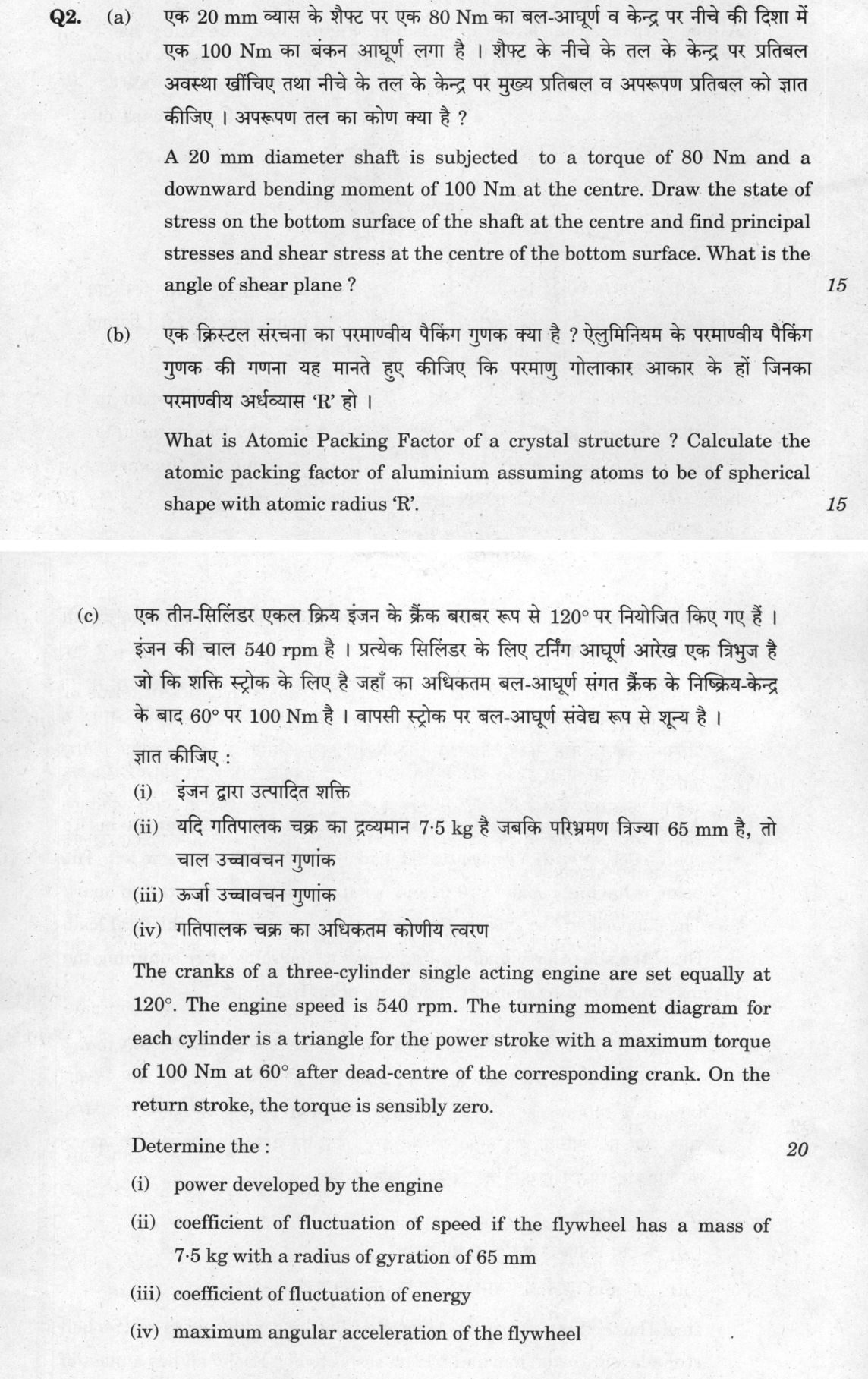
(a) A 20 mm diameter shaft is subjected to a torque of 80 Nm and a downward bending moment of 100 Nm at the centre. Draw the…
A 20 mm diameter shaft is subjected to a torque of 80 Nm and a downward bending moment of 100 Nm at the centre. Draw the state of stress on the bottom surface of the shaft at the centre and find principal stresses and shear stress at the centre of the bottom surface. What is the angle of shear plane? 15 marks
What is Atomic Packing Factor of a crystal structure? Calculate the atomic packing factor of aluminium assuming atoms to be of spherical shape with atomic radius 'R'. 15 marks
The cranks of a three-cylinder single acting engine are set equally at 120°. The engine speed is 540 rpm. The turning moment diagram for each cylinder is a triangle for the power stroke with a maximum torque of 100 Nm at 60° after dead-centre of the corresponding crank. On the return stroke, the torque is sensibly zero.
Determine the: power developed by the engine
coefficient of fluctuation of speed if the flywheel has a mass of 7·5 kg with a radius of gyration of 65 mm
coefficient of fluctuation of energy
maximum angular acceleration of the flywheel 20 marks
हिंदी में प्रश्न पढ़ें
एक 20 mm व्यास के शैफ्ट पर एक 80 Nm का बल-आघूर्ण व केन्द्र पर नीचे की दिशा में एक 100 Nm का बंकन आघूर्ण लगा है। शैफ्ट के नीचे के तल के केन्द्र पर प्रतिबल अवस्था खींचिए तथा नीचे के तल के केन्द्र पर मुख्य प्रतिबल व अपरूपण प्रतिबल को ज्ञात कीजिए। अपरूपण तल का कोण क्या है? (15 अंक)
एक क्रिस्टल संरचना का परमाण्वीय पैकिंग गुणक क्या है? ऐल्युमिनियम के परमाण्वीय पैकिंग गुणक की गणना यह मानते हुए कीजिए कि परमाणु गोलाकार आकार के हों जिनका परमाण्वीय अर्धव्यास 'R' हो। (15 अंक)
एक तीन-सिलिंडर एकल क्रिय इंजन के क्रैंक बराबर रूप से 120° पर नियोजित किए गए हैं। इंजन की चाल 540 rpm है। प्रत्येक सिलिंडर के लिए टर्निंग आघूर्ण आरेख एक त्रिभुज है जो कि शक्ति स्ट्रोक के लिए है जहाँ का अधिकतम बल-आघूर्ण संगत क्रैंक के निष्क्रिय-केंद्र के बाद 60° पर 100 Nm है। वापसी स्ट्रोक पर बल-आघूर्ण संवेद्य रूप से शून्य है।
ज्ञात कीजिए: इंजन द्वारा उत्पादित शक्ति
यदि गतिपालक चक्र का द्रव्यमान 7·5 kg है जबकि परिभ्रमण त्रिज्या 65 mm है, तो चाल उच्चावचन गुणांक
ऊर्जा उच्चावचन गुणांक
गतिपालक चक्र का अधिकतम कोणीय त्वरण (20 अंक)
Model answer
Written by UPSC Answer Check against this question's marking rubric, to the expected length. UPSC does not publish answers for Mains — this is one way to score well, not an official key.
(a) For the shaft, d = 20 mm = 0.02 m, bending moment M = 100 Nm, torque T = 80 Nm. At the bottom surface, taking the downward bending moment as sagging, the bending stress is tensile along the shaft axis. Bending stress: σx = 32M/(πd³) = 32×100/(π×0.02³) = 1.27324×10⁸ Pa = 127.324 MPa. Torsional shear stress: τ = 16T/(πd³) = 16×80/(π×0.02³) = 5.09296×10⁷ Pa = 50.930 MPa. On the free surface, σy = 0. Draw the element with σx acting outward on the axial faces and τ acting on the same faces in the circumferential direction.
Principal stresses by the plane-stress principal stress formula: σ1,2 = σx/2 ± √((σx/2)² + τ²) = 63.662 ± √(63.662² + 50.930²) MPa = 63.662 ± 81.527 MPa. Hence, σ1 = 145.189 MPa and σ2 = −17.865 MPa. Maximum shear stress τmax = (σ1 − σ2)/2 = 81.527 MPa.
Angle of principal plane: tan 2θp = 2τ/σx = 2×50.930/127.324 = 0.800. Thus θp = 19.33° from the shaft axis. The shear planes are at θp ± 45°, i.e. 64.33° and −25.67° from the shaft axis, equivalently 45° from the principal planes.
(b) Atomic Packing Factor is the fraction of unit-cell volume occupied by atoms: APF = volume of atoms in one unit cell / volume of the unit cell. Aluminium has an FCC crystal structure. For FCC, number of atoms per unit cell n = 4. Atoms touch along the face diagonal: 4R = a√2, so a = 2√2 R. Volume of atoms = 4 × (4/3)πR³ = 16πR³/3. Unit-cell volume = a³ = (2√2 R)³ = 16√2 R³. Therefore, APF = (16πR³/3)/(16√2 R³) = π/(3√2) = π√2/6 ≈ 0.74048 = 74.05%. This assumes hard spherical atoms touching along the FCC face diagonal.
(c) Each cylinder gives a triangular turning-moment pulse. Base = 180° = π rad, maximum torque = 100 Nm. Work per cylinder per revolution = area of triangle = (1/2)×π×100 = 50π J. Three cylinders give total work per revolution = 150π J. Speed N = 540 rpm = 9 rev/s.
(i) Power developed = total work per second = 150π × 9 = 1350π W = 4241.15 W ≈ 4.241 kW. Mean torque = total work per revolution/(2π) = 150π/(2π) = 75 Nm.
(ii) With cranks at 120° and a 180° power stroke, the total torque diagram repeats every 120°. It varies linearly from 50 Nm to 100 Nm and back to 50 Nm. Maximum fluctuation of energy ΔE is the area above the mean torque 75 Nm. This is a triangle from 30° to 90°: base = 60° = π/3 rad, height = 100 − 75 = 25 Nm. ΔE = (1/2)×(π/3)×25 = 25π/6 J = 13.09 J. Flywheel moment of inertia: I = mk² = 7.5×(0.065)² = 0.0316875 kg m². Angular speed: ω = 2πN/60 = 18π rad/s. Coefficient of fluctuation of speed: Cs = ΔE/(Iω²) = (25π/6)/(0.0316875×(18π)²) = 0.1292.
(iii) Coefficient of fluctuation of energy: Ce = ΔE/(work done per cycle). Work done per cycle = work per revolution = 150π J. Ce = (25π/6)/(150π) = 25/900 = 1/36 = 0.02778.
(iv) Maximum angular acceleration occurs at maximum excess torque over mean torque: αmax = (Tmax − Tmean)/I = (100 − 75)/0.0316875 = 788.95 rad/s² ≈ 789 rad/s². The maximum retardation has the same magnitude.
What "Calculate" is asking you to do
Apply the standard formula or schedule to data the question has already supplied — a table of readings, cost records, a balance sheet — and produce the number. The method is rarely in doubt; the marks sit in the named intermediate quantities, each of which has to appear as a labelled line.
Structure that answers it
Data as given → formula or standard treatment, named → substitution → each intermediate, labelled → result with units
Where marks are lost
Omitting an intermediate the marking scheme pays for separately, or rounding at an intermediate line so the final figure drifts. In commerce and accountancy, any figure in a statement that no numbered working note supports is treated as unearned.
How this answer will be evaluated
Approach
(a) calculate: given > formula > substitution > result with units > interpretation | (b) calculate: given > formula > substitution > result with units > interpretation | (c) calculate: given > formula > substitution > result with units > interpretation Full marks: All parts show complete method, correct equations, and physical interpretation.
Key points expected
- Calculate bending stress using M = 100 Nm
- Calculate shear stress using T = 80 Nm
- Draw stress element on bottom surface
- Compute principal stresses and shear plane angle
- Define APF as volume of atoms over cell volume
- Identify aluminium as FCC crystal structure
- Derive lattice constant a in terms of R
- Calculate APF value for FCC (0.74)
Evaluation rubric
Each sub-part is marked on its own, against the marks and word limit printed on the paper.
- (a) Stress state, principal stresses, shear stress, and shear plane angle at the bottom surface. 15 marks
calculate— given → formula → substitution → result with units → interpretation
Must cover
- Calculate bending stress using M = 100 Nm
- Calculate shear stress using T = 80 Nm
- Draw stress element on bottom surface
- Compute principal stresses and shear plane angle
Loses marks
- Missing governing equations for stress calculation
- Confusing top and bottom surface stress signs
- No units on final stress values
Earns more
- Correct identification of bottom surface stress state
- Clear schematic of the shaft and loading
- Explicit calculation of section modulus Z
- Correct sign convention for bending stress
Extra mark
- Mohr's circle construction for verification
- Explicit statement of assumptions (e.g., linear elastic)
- (b) Definition of APF and its calculation for aluminium (FCC). 15 marks
calculate— given → formula → substitution → result with units → interpretation
Must cover
- Define APF as volume of atoms over cell volume
- Identify aluminium as FCC crystal structure
- Derive lattice constant a in terms of R
- Calculate APF value for FCC (0.74)
Loses marks
- Assuming BCC or simple cubic for aluminium
- Missing derivation of a-R relationship
- No definition of APF before calculation
Earns more
- Clear diagram of FCC unit cell with atoms
- Explicit count of atoms per unit cell (4)
- Step-by-step algebraic derivation of a = 2√2 R
- Mention of close-packed nature of FCC
Extra mark
- Comparison with BCC or HCP APF values
- Explicit calculation of unit cell volume
- (c) Power, speed fluctuation, energy fluctuation, and max angular acceleration. 20 marks
calculate— given → formula → substitution → result with units → interpretation
Must cover
- Calculate mean torque from turning moment diagram
- Compute power using P = T_mean × ω
- Determine energy fluctuation ΔE from TMD area
- Calculate coefficient of speed fluctuation
Loses marks
- Ignoring the 120° crank angle in TMD
- Incorrect calculation of mean torque
- Missing units on power and energy values
Earns more
- Correct construction of turning moment diagram
- Accurate calculation of flywheel moment of inertia
- Clear identification of max/min energy points
- Correct use of 120° crank angle spacing
Extra mark
- Graphical representation of energy variation
- Explicit statement of assumptions (e.g., constant speed)
Practice this exact question
Write your answer and it is marked point by point against the model answer above — what you covered, what you missed, what you got wrong.
Evaluate my answer →More from Mechanical Engineering 2022 Paper I
- Q1 (a) A slider-crank mechanism with crank radius 60 mm and connecting rod length 240 mm is…
- Q2 (a) A 20 mm diameter shaft is subjected to a torque of 80 Nm and a downward bending momen…
- Q3 (a) A thin cylinder of diameter 200 mm and length 1000 mm is subjected to an internal pre…
- Q4 (a) An automobile weighing 15 kN is moving at a speed of 100 km per hour. The dynamic coe…
- Q5 (a) An HSS drill during its life can drill 150 through holes in a 10 mm thick brass plate…