Paper I — Q5
(a) An HSS drill during its life can drill 150 through holes in a 10 mm thick brass plate at a drill speed of 400 rpm. Another…
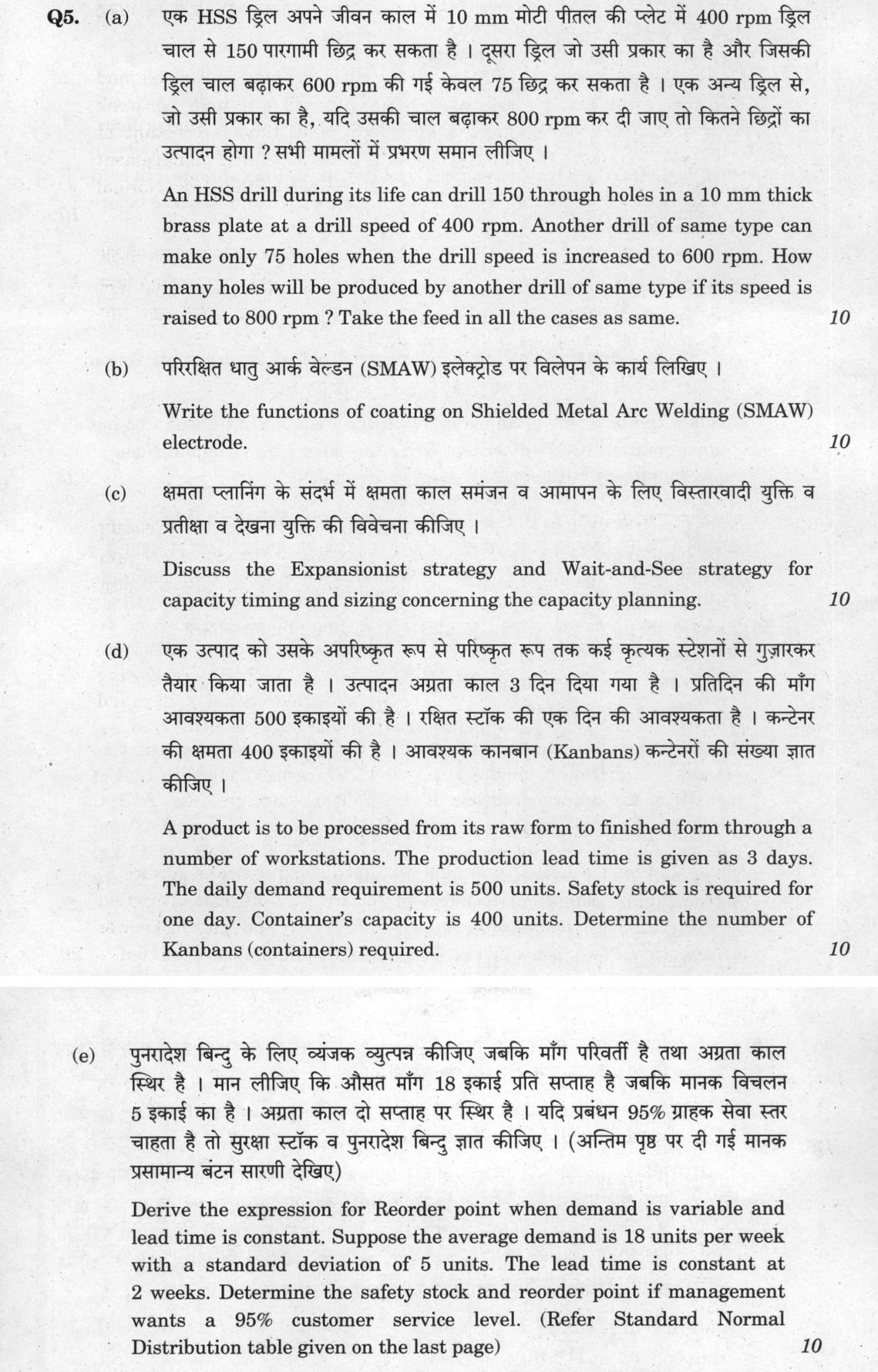
An HSS drill during its life can drill 150 through holes in a 10 mm thick brass plate at a drill speed of 400 rpm. Another drill of same type can make only 75 holes when the drill speed is increased to 600 rpm. How many holes will be produced by another drill of same type if its speed is raised to 800 rpm ? Take the feed in all the cases as same. 10 marks
Write the functions of coating on Shielded Metal Arc Welding (SMAW) electrode. 10 marks
Discuss the Expansionist strategy and Wait-and-See strategy for capacity timing and sizing concerning the capacity planning. 10 marks
A product is to be processed from its raw form to finished form through a number of workstations. The production lead time is given as 3 days. The daily demand requirement is 500 units. Safety stock is required for one day. Container's capacity is 400 units. Determine the number of Kanbans (containers) required. 10 marks
Derive the expression for Reorder point when demand is variable and lead time is constant. Suppose the average demand is 18 units per week with a standard deviation of 5 units. The lead time is constant at 2 weeks. Determine the safety stock and reorder point if management wants a 95% customer service level. (Refer Standard Normal Distribution table given on the last page) 10 marks
हिंदी में प्रश्न पढ़ें
एक HSS ड्रिल अपने जीवन काल में 10 mm मोटी पीतल की प्लेट में 400 rpm ड्रिल चाल से 150 पारगामी छिद्र कर सकता है । दूसरा ड्रिल जो उसी प्रकार का है और जिसकी ड्रिल चाल बढ़ाकर 600 rpm की गई केवल 75 छिद्र कर सकता है । एक अन्य ड्रिल से, जो उसी प्रकार का है, यदि उसकी चाल बढ़ाकर 800 rpm कर दी जाए तो कितने छिद्रों का उत्पादन होगा ? सभी मामलों में प्रवरण समान लीजिए । (10 अंक)
परिरक्षित धातु आर्क वेल्डन (SMAW) इलेक्ट्रोड पर विलेपन के कार्य लिखिए । (10 अंक)
क्षमता प्लानिंग के संदर्भ में क्षमता काल समंजन व आमापन के लिए विस्तारवादी युक्ति व प्रतीक्षा व देखना युक्ति की विवेचना कीजिए । (10 अंक)
एक उत्पाद को उसके अपरिष्कृत रूप से परिष्कृत रूप तक कई क्रियक स्टेशनों से गुजारकर तैयार किया जाता है । उत्पादन अग्रता काल 3 दिन दिया गया है । प्रतिदिन की मांग आवश्यकता 500 इकाइयों की है । रक्षित स्टॉक की एक दिन की आवश्यकता है । कंटेनर की क्षमता 400 इकाइयों की है । आवश्यक कानबन (Kanbans) कंटेनरों की संख्या ज्ञात कीजिए । (10 अंक)
पुनरादेश बिन्दु के लिए व्यंजक व्युत्पन्न कीजिए जबकि मांग परिवर्ती है तथा अग्रता काल स्थिर है । मान लीजिए कि औसत मांग 18 इकाई प्रति सप्ताह है जबकि मानक विचलन 5 इकाई का है । अग्रता काल दो सप्ताह पर स्थिर है । यदि प्रबंधन 95% ग्राहक सेवा स्तर चाहता है तो सुरक्षा स्टॉक व पुनरादेश बिन्दु ज्ञात कीजिए । (अंतिम पृष्ठ पर दी गई मानक प्रसामान्य बंटन सारणी देखिए) (10 अंक)
Model answer
Written by UPSC Answer Check against this question's marking rubric, to the expected length. UPSC does not publish answers for Mains — this is one way to score well, not an official key.
(a) Let the drill speed be N rpm, feed be f mm/rev, plate thickness be L = 10 mm, and tool life be T minutes. The cutting speed V = πDN/1000, so for the same drill diameter D, V ∝ N. Taylor’s tool-life equation is V Tⁿ = C, hence N Tⁿ = C₁.
Time required for one through hole = L/(f N). Therefore, number of holes in tool life T is H = T/(L/(f N)) = T f N/L. So T = H L/(f N).
Substitute T in Taylor’s equation: N (H L/(f N))ⁿ = C₂. Since L and f are constant, N^(1−n) Hⁿ = C₃.
Using the two given data sets: 400^(1−n) × 150ⁿ = 600^(1−n) × 75ⁿ. Taking logarithms: (1−n) ln(400/600) + n ln(150/75) = 0 (1−n) ln(2/3) + n ln 2 = 0 (1−n)(−0.405465) + n(0.693147) = 0 −0.405465 + 0.405465n + 0.693147n = 0 1.098612n = 0.405465 n = 0.3691.
Now for N₃ = 800 rpm: 400^(1−n) × 150ⁿ = 800^(1−n) × H₃ⁿ H₃ = 150 × (400/800)^((1−n)/n) H₃ = 150 × (1/2)^((1−0.3691)/0.3691) H₃ = 150 × (1/2)^1.7095 H₃ = 150 × 0.3058 = 45.87.
Therefore, the drill will produce about 46 holes theoretically. Strictly, the limiting life is reached after about 45.9 holes, so 45 complete through holes are certain before the drill needs attention.
(b) Functions of coating on a Shielded Metal Arc Welding electrode:
- Arc stabilisation: Coating contains potassium, sodium, calcium and titanium compounds which ionise the arc gap. This makes arc striking easier and keeps the arc stable, reducing arc blow and spatter.
- Atmospheric shielding: The coating decomposes under arc heat and generates shielding gases such as CO₂, CO and water vapour. These gases form an envelope around the molten weld pool and prevent contact with atmospheric oxygen and nitrogen.
- Slag formation: The flux forms a molten slag that floats on the weld pool. It protects the solidifying weld from oxidation, slows cooling, refines grain structure and supports the weld bead in vertical and overhead positions.
- Deoxidation and purification: Elements such as manganese, silicon, titanium and aluminium in the coating deoxidise the molten metal and combine with sulphur, phosphorus and oxides, which then enter the slag and are removed.
- Alloying additions: Ferroalloys in the coating can add chromium, nickel, molybdenum, manganese, vanadium etc. to the weld deposit. This improves strength, hardness, toughness, creep resistance or corrosion resistance.
- Control of bead shape and penetration: The coating controls slag viscosity and surface tension, influencing weld bead profile, penetration, ripples and appearance. It also helps control spatter and metal transfer.
- Electrical insulation and arc direction: The coating insulates the core wire from accidental contact and confines the arc to the electrode tip, giving directional control to the welder.
- Mechanical protection and binding: Silicate binders give mechanical strength to the coating, prevent it from chipping during handling, protect the core wire from corrosion and help maintain the electrode shape.
- Deposition improvement: Coatings containing iron powder increase deposition rate, improve arc efficiency and reduce welding time in suitable positions.
(c) Capacity timing and sizing decisions determine when and how much production capacity is to be added. Two common strategies are Expansionist and Wait-and-See.
Expansionist strategy: This is an aggressive, lead-capacity strategy. Capacity is added before demand actually appears, often in large increments. The firm anticipates growth and creates capacity ahead of the market. Its advantages are: it captures market share, reduces the risk of shortage, discourages competitors, exploits economies of scale, lowers unit cost and improves service level. It is suitable when demand is expected to grow steadily, capital is available, and delay would mean permanent loss of market to competitors. The main risks are overcapacity, idle facilities, high fixed cost and financial loss if demand does not materialise.
Wait-and-See strategy: This is a conservative, lag-capacity strategy. Capacity is added only after demand has actually increased and is confirmed. Additions are usually smaller and more frequent. Its advantages are lower risk of overbuilding, better utilisation of existing capacity, reduced capital exposure and greater flexibility under uncertain demand. It is suitable when demand is volatile, forecasts are unreliable, technology changes rapidly or capital is scarce. Its disadvantages are lost sales, poor customer service, inability to meet sudden demand and loss of market share to an expansionist competitor. Later expansion may also become costlier due to rising prices or scarce resources.
In short, Expansionist policy favours leading demand with large capacity chunks, while Wait-and-See policy favours following demand with small, cautious increments. Modern practice often uses a mixed or average-capacity strategy, supported by overtime, subcontracting, inventories and flexible facilities.
(d) The Kanban formula is: N = (D × L + S)/C where N = number of Kanbans or containers, D = daily demand, L = production lead time in days, S = safety stock in units, and C = container capacity.
Given: D = 500 units/day L = 3 days Safety stock = one day demand = 500 units C = 400 units/container
Substitute: N = (500 × 3 + 500)/400 N = (1500 + 500)/400 N = 2000/400 N = 5.
Therefore, the number of Kanbans required is 5 containers. If the result had not been exact, it would have been rounded up to the next whole container.
(e) Let demand per period be a random variable with mean μ and standard deviation σ. Let lead time L be constant. Demand during lead time is the sum of L independent demand periods: X = d₁ + d₂ + ... + d_L.
By linearity of expectation: E(X) = μ + μ + ... + μ = L μ.
Since the demand periods are independent, variances add: Var(X) = σ² + σ² + ... + σ² = L σ². Hence the standard deviation of demand during lead time is: σ_X = σ√L.
For a desired service level, say probability p of not stocking out during lead time, let z be the standard normal variate such that P(Z ≤ z) = p. Then: P(X ≤ ROP) = p P(Z ≤ (ROP − L μ)/(σ√L)) = p.
Therefore: z = (ROP − L μ)/(σ√L) ROP = L μ + z σ√L.
The term z σ√L is the safety stock: SS = z σ√L.
Given: μ = 18 units/week σ = 5 units/week L = 2 weeks Service level = 95%, so from the standard normal table, z = 1.645.
Mean demand during lead time: L μ = 2 × 18 = 36 units.
Standard deviation during lead time: σ_X = σ√L = 5√2 = 7.071 units.
Safety stock: SS = z σ_X = 1.645 × 7.071 = 11.632 units.
Reorder point: ROP = L μ + SS = 36 + 11.632 = 47.632 units.
Therefore, the safety stock is about 11.63 units and the reorder point is about 47.63 units, i.e. practically 48 units. This holds when lead time is constant, successive demands are independent, and demand during lead time is approximated by a normal distribution.
What "Solve" is asking you to do
Choose the method, then carry it through to a final answer. Identifying what kind of problem this is and why that method applies is the first thing marked; a correct figure arrived at invisibly earns almost nothing.
Structure that answers it
Given data and what is required → method chosen, with the reason it applies → set-up (equation, circuit, free body, trial balance) → working, step by step → answer with units and any condition of validity
Where marks are lost
Doing the middle steps mentally and writing only the result. In mathematics papers, a further loss comes from giving a decimal where the exact value in surds or fractions was wanted, or from skipping the justification a part explicitly asks for.
How this answer will be evaluated
Approach
(a) calculate: given > formula > substitution > result with units > interpretation | (b) explain: definition/context > points in order > small example > short close | (c) discuss: intro > 3-4 dimensions > example > balanced close | (d) calculate: given > formula > substitution > result with units > interpretation | (e) derive: given > assumptions > stepwise derivation > result > check Full marks: Rigorous application of formulas with clear derivation and physical interpretation.
Key points expected
- State Taylor's tool life equation (VT^n = C)
- Calculate the exponent 'n' using the 400/600 rpm data
- Substitute n and 800 rpm to find the life in holes
- Final answer must be 37.5 holes
- Mention fluxing action to remove impurities
- Mention shielding gas generation (CO2/CO)
- Mention stabilizing the electric arc
- Mention forming a protective slag layer
Evaluation rubric
Each sub-part is marked on its own, against the marks and word limit printed on the paper.
- (a) Determine the number of holes produced at 800 rpm using the given data. 10 marks
calculate— given → formula → substitution → result with units → interpretation
Must cover
- State Taylor's tool life equation (VT^n = C)
- Calculate the exponent 'n' using the 400/600 rpm data
- Substitute n and 800 rpm to find the life in holes
- Final answer must be 37.5 holes
Loses marks
- Plugging numbers without stating Taylor's equation
- Incorrect calculation of exponent 'n'
Earns more
- Explicitly states assumption of constant feed
- Shows dimensional consistency in time/speed units
Extra mark
- Mentions physical interpretation of tool wear
- (b) List the functions of the coating on an SMAW electrode. 10 marks
explain— definition/context → points in order → small example → short close
Must cover
- Mention fluxing action to remove impurities
- Mention shielding gas generation (CO2/CO)
- Mention stabilizing the electric arc
- Mention forming a protective slag layer
Loses marks
- Confusing electrode core functions with coating functions
- Vague descriptions without specific mechanisms
Earns more
- Mentioning alloying of the weld pool
- Mentioning improving mechanical properties
Extra mark
- Mentioning specific fluxing agents like MnO or SiO2
- (c) Compare Expansionist and Wait-and-See strategies for capacity planning. 10 marks
discuss— intro → 3-4 dimensions → example → balanced close
Must cover
- Define Expansionist strategy (lead demand)
- Define Wait-and-See strategy (lag demand)
- Discuss risks of Expansionist (overcapacity)
- Discuss risks of Wait-and-See (lost market share)
Loses marks
- Defining only one strategy
- Failing to link strategy to timing/sizing
Earns more
- Mentioning cost implications of each strategy
- Providing a real-world example for either strategy
Extra mark
- Mentioning the 'Match' or 'Track' strategy as a middle ground
- (d) Determine the number of Kanbans required for the production system. 10 marks
calculate— given → formula → substitution → result with units → interpretation
Must cover
- State the Kanban formula (N = dL + SS) / C
- Calculate demand during lead time (500 * 3)
- Calculate safety stock (500 * 1)
- Final answer must be 5 Kanbans
Loses marks
- Forgetting to include safety stock in the numerator
- Incorrect calculation of demand during lead time
Earns more
- Clearly defining variables d, L, SS, and C
- Checking if the result is an integer
Extra mark
- Mentioning the impact of container size on efficiency
- (e) Derive the Reorder Point expression and calculate it for the given data. 10 marks
derive— given → assumptions → stepwise derivation → result → check
Must cover
- Derive ROP = dL + zσ_L
- Calculate standard deviation of demand during lead time (σ_L)
- Find z-value for 95% service level (1.645)
- Final ROP calculation (36 + 1.645*7.07)
Loses marks
- Using the wrong z-value for 95% confidence
- Failing to scale standard deviation by lead time
Earns more
- Showing the derivation of σ_L = σ_d * √L
- Explicitly stating the assumption of normal distribution
Extra mark
- Mentioning the cost of stockouts vs holding costs
Practice this exact question
Write your answer and it is marked point by point against the model answer above — what you covered, what you missed, what you got wrong.
Evaluate my answer →More from Mechanical Engineering 2022 Paper I
- Q2 (a) A 20 mm diameter shaft is subjected to a torque of 80 Nm and a downward bending momen…
- Q3 (a) A thin cylinder of diameter 200 mm and length 1000 mm is subjected to an internal pre…
- Q4 (a) An automobile weighing 15 kN is moving at a speed of 100 km per hour. The dynamic coe…
- Q5 (a) An HSS drill during its life can drill 150 through holes in a 10 mm thick brass plate…
- Q6 (a) During turning of a steel rod of 100 mm diameter, at a speed of 600 rpm, feed of 0·32…
- Q7 Q7. (a) A firm has identified four operations, which are to be conducted in succession fo…
- Q8 Q8. (a) (i) Discuss the mechanism of material removal in ultrasonic machining. (10 marks)…