Paper I — Q6
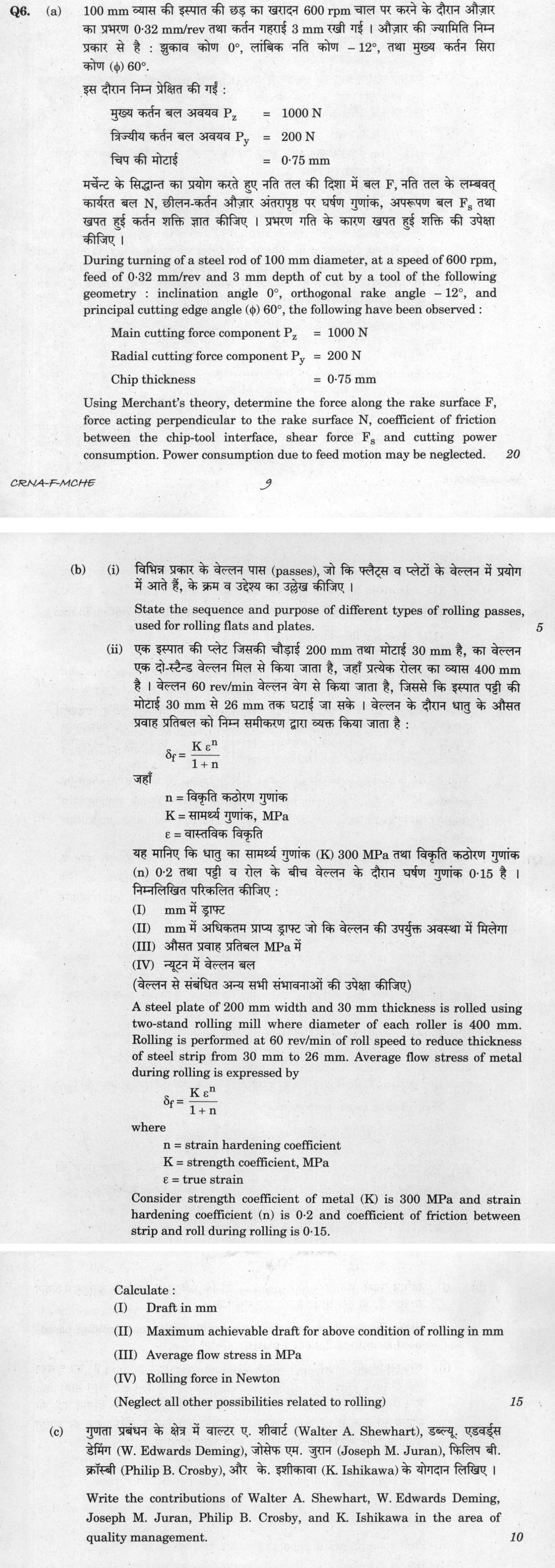
(a) During turning of a steel rod of 100 mm diameter, at a speed of 600 rpm, feed of 0·32 mm/rev and 3 mm depth of cut by a tool…
During turning of a steel rod of 100 mm diameter, at a speed of 600 rpm, feed of 0·32 mm/rev and 3 mm depth of cut by a tool of the following geometry : inclination angle 0°, orthogonal rake angle – 12°, and principal cutting edge angle (φ) 60°, the following have been observed :
Main cutting force component Pz = 1000 N Radial cutting force component Py = 200 N Chip thickness = 0·75 mm
Using Merchant's theory, determine the force along the rake surface F, force acting perpendicular to the rake surface N, coefficient of friction between the chip-tool interface, shear force Fs and cutting power consumption. Power consumption due to feed motion may be neglected. 20 marks
State the sequence and purpose of different types of rolling passes, used for rolling flats and plates. 5 marks
A steel plate of 200 mm width and 30 mm thickness is rolled using two-stand rolling mill where diameter of each roller is 400 mm. Rolling is performed at 60 rev/min of roll speed to reduce thickness of steel strip from 30 mm to 26 mm. Average flow stress of metal during rolling is expressed by
δ_f = (K εⁿ)/(1+n)
where
n = strain hardening coefficient
K = strength coefficient, MPa
ε = true strain
Consider strength coefficient of metal (K) is 300 MPa and strain hardening coefficient (n) is 0·2 and coefficient of friction between strip and roll during rolling is 0·15.
Calculate : (I) Draft in mm (II) Maximum achievable draft for above condition of rolling in mm (III) Average flow stress in MPa (IV) Rolling force in Newton (Neglect all other possibilities related to rolling) 15 marks
Write the contributions of Walter A. Shewhart, W. Edwards Deming, Joseph M. Juran, Philip B. Crosby, and K. Ishikawa in the area of quality management. 10 marks
हिंदी में प्रश्न पढ़ें
100 mm व्यास की इस्पात की छड़ का खरादन 600 rpm चाल पर करने के दौरान औजार का प्रभरण 0·32 mm/rev तथा कतन गहराई 3 mm रखी गई । औजार की ज्यामिति निम्न प्रकार से है : झुकाव कोण 0°, लांबिक नति कोण – 12°, तथा मुख्य कतन सिरा कोण (φ) 60°.
इस दौरान निम्न प्रेक्षित की गई :
मुख्य कतन बल अवयव Pz = 1000 N त्रिज्यीय कतन बल अवयव Py = 200 N चिप की मोटाई = 0·75 mm
मर्चेंट के सिद्धांत का प्रयोग करते हुए नति तल की दिशा में बल F, नति तल के लंबवत् कार्यरत बल N, छीलन-कतन औजार अंतरापृष्ठ पर घर्षण गुणांक, अपरूपण बल Fs तथा खपत हुई कतन शक्ति ज्ञात कीजिए । प्रभरण गति के कारण खपत हुई शक्ति की उपेक्षा कीजिए । (20 अंक)
विभिन्न प्रकार के वेल्लन पास (passes), जो कि फ्लैट्स व प्लेटों के वेल्लन में प्रयोग में आते हैं, के क्रम व उद्देश्य का उल्लेख कीजिए । (5 अंक)
एक इस्पात की प्लेट जिसकी चौड़ाई 200 mm तथा मोटाई 30 mm है, का वेल्लन एक दो-स्टैंड वेल्लन मिल से किया जाता है, जहाँ प्रत्येक रोलर का व्यास 400 mm है । वेल्लन 60 rev/min वेल्लन वेग से किया जाता है, जिससे कि इस्पात पट्टी की मोटाई 30 mm से 26 mm तक घटाई जा सके । वेल्लन के दौरान धातु के औसत प्रवाह प्रतिबल को निम्न समीकरण द्वारा व्यक्त किया जाता है :
δ_f = (K εⁿ)/(1+n)
जहाँ
n = विकृति कठोरण गुणांक
K = सामर्थ्य गुणांक, MPa
ε = वास्तविक विकृति
यह मानिए कि धातु का सामर्थ्य गुणांक (K) 300 MPa तथा विकृति कठोरण गुणांक (n) 0·2 तथा पट्टी व रोल के बीच वेल्लन के दौरान घर्षण गुणांक 0·15 है । निम्नलिखित परिकलित कीजिए :
(I) mm में ड्राफ्ट (II) mm में अधिकतम प्राप्य ड्राफ्ट जो कि वेल्लन की उपर्युक्त अवस्था में मिलेगा (III) औसत प्रवाह प्रतिबल MPa में (IV) न्यूटन में वेल्लन बल
(वेल्लन से संबंधित अन्य सभी संभावनाओं की उपेक्षा कीजिए) (15 अंक)
गुणता प्रबंधन के क्षेत्र में वाल्टर ए. शीवार्ट (Walter A. Shewhart), डब्ल्यू. एडवर्ड्स डेमिंग (W. Edwards Deming), जोसेफ एम. जुरान (Joseph M. Juran), फिलिप बी. क्रॉस्बी (Philip B. Crosby), और के. इशीकावा (K. Ishikawa) के योगदान लिखिए । (10 अंक)
Model answer
Written by UPSC Answer Check against this question's marking rubric, to the expected length. UPSC does not publish answers for Mains — this is one way to score well, not an official key.
(a) Given: D = 100 mm, N = 600 rpm, f = 0.32 mm/rev, d = 3 mm, φ = 60°, α = –12°, P_z = 1000 N, P_y = 200 N, t₂ = 0.75 mm.
Uncut chip thickness t₁ = f sin φ = 0.32 × sin 60° = 0.32 × 0.8660 = 0.2771 mm. Chip thickness ratio r = t₁/t₂ = 0.2771/0.75 = 0.3695. Using Merchant's shear-angle relation: tan φₛ = r cos α / (1 – r sin α). sin(–12°) = –0.2079, cos(–12°) = 0.9781. tan φₛ = (0.3695 × 0.9781) / (1 – 0.3695 × (–0.2079)) = 0.3615 / 1.0768 = 0.3357. φₛ = arctan(0.3357) = 18.56°.
Orthogonal cutting force components: F_c = P_z = 1000 N. For principal cutting edge angle φ, the radial force P_y is the component of the thrust force F_t along the radial direction, so F_t = P_y / cos φ = 200 / cos 60° = 400 N.
Using Merchant's force relations: F = F_c sin α + F_t cos α = 1000 sin(–12°) + 400 cos(–12°) = –207.9 + 391.2 = 183.3 N. N = F_c cos α – F_t sin α = 1000 cos(–12°) – 400 sin(–12°) = 978.1 – (–83.2) = 1061.3 N. Coefficient of friction μ = F/N = 183.3/1061.3 = 0.173.
Shear force F_s = F_c cos φₛ – F_t sin φₛ = 1000 cos 18.56° – 400 sin 18.56° = 948.0 – 127.3 = 820.7 N.
Cutting speed V = π D N / 60 = π × 0.1 × 600 / 60 = π m/s = 3.1416 m/s. Cutting power P = P_z × V = 1000 × 3.1416 = 3141.6 W = 3.142 kW.
Final answers: F ≈ 183.3 N; N ≈ 1061.3 N; μ ≈ 0.173; F_s ≈ 820.7 N; cutting power ≈ 3.142 kW.
(b)(i) Sequence of rolling passes for flats and plates:
- Breakdown/roughing passes: hot slab is rolled in a reversing mill to reduce thickness, break cast structure, and remove scale.
- Broadside/edge passes: slab is rotated 90° and rolled across width to obtain required plate width and sound edges.
- Longitudinal/intermediate passes: repeated passes elongate the plate and bring thickness close to final size.
- Finishing passes: final passes in finishing train/plate mill give accurate thickness, flatness, surface finish, and desired mechanical properties. Purpose: gradual reduction avoids excessive roll force and defects, controls width and length, refines grain structure, and meets final dimensional and metallurgical specifications.
(b)(ii) Given: b = 200 mm, h₀ = 30 mm, h₁ = 26 mm, R = D/2 = 200 mm, μ = 0.15, K = 300 MPa, n = 0.2.
(I) Draft Δh = h₀ – h₁ = 30 – 26 = 4 mm.
(II) Maximum achievable draft Δh_max = μ² R = (0.15)² × 200 = 0.0225 × 200 = 4.5 mm. Since 4 mm < 4.5 mm, rolling is feasible.
(III) True strain ε = ln(h₀/h₁) = ln(30/26) = ln(1.153846) = 0.1431. Average flow stress δ_f = K εⁿ / (1 + n) = 300 × (0.1431)^0.2 / 1.2. (0.1431)^0.2 = exp(0.2 ln 0.1431) = exp(0.2 × (–1.9443)) = exp(–0.3889) = 0.6779. δ_f = 300 × 0.6779 / 1.2 = 169.5 MPa.
(IV) Contact length L = √(R Δh) = √(200 × 4) = √800 = 28.28 mm. Rolling force F = δ_f × b × L = 169.5 × 200 × 28.28 = 958,600 N = 9.586 × 10⁵ N ≈ 958.6 kN. (Roll speed is not required for the asked quantities.)
(c)
- Walter A. Shewhart: introduced statistical quality control, control charts, distinction between chance and assignable causes, and the Plan-Do-Check-Act (PDCA) cycle.
- W. Edwards Deming: promoted statistical quality control and system thinking; gave 14 points for management; emphasized reduction of variation, continuous improvement, and top-management commitment.
- Joseph M. Juran: developed quality trilogy (planning, control, improvement); introduced Pareto principle; advocated top-management involvement and cost of quality; defined quality as fitness for use.
- Philip B. Crosby: concept of “Quality is Free” and “Zero Defects”; emphasized prevention and doing it right the first time; gave 14 steps to quality improvement; quality management maturity grid.
- K. Ishikawa: developed cause-and-effect (fishbone) diagram; advocated company-wide quality control (CWQC), quality circles, and use of seven basic quality tools; introduced internal customer concept.
What "Calculate" is asking you to do
Apply the standard formula or schedule to data the question has already supplied — a table of readings, cost records, a balance sheet — and produce the number. The method is rarely in doubt; the marks sit in the named intermediate quantities, each of which has to appear as a labelled line.
Structure that answers it
Data as given → formula or standard treatment, named → substitution → each intermediate, labelled → result with units
Where marks are lost
Omitting an intermediate the marking scheme pays for separately, or rounding at an intermediate line so the final figure drifts. In commerce and accountancy, any figure in a statement that no numbered working note supports is treated as unearned.
How this answer will be evaluated
Approach
Framework: Mechanical Engineering, Paper 1. (a) calculate: given > formula > substitution > result with units > interpretation | (b(i)) describe: define > structure or process in order > labelled diagram > significance | (b(ii)) calculate: given > formula > substitution > result with units > interpretation | (c) write short notes: define > 3-4 key features > one example > one-line significance Full marks: All parts fully solved with correct formulas, clear steps, and physical interpretation; diagrams where appropriate.
Key points expected
- Calculate shear angle φs from chip thickness ratio
- Resolve Pz and Py into cutting and feed forces
- Apply Merchant's circle to find F and N
- Calculate shear force Fs and cutting power
- List passes in correct sequence (e.g., roughing, finishing)
- State purpose of each pass type
- Distinguish between flat and plate rolling if applicable
- Calculate draft from initial and final thickness
Evaluation rubric
Each sub-part is marked on its own, against the marks and word limit printed on the paper.
- (a) Determine F, N, μ, Fs, and cutting power using Merchant's theory. 20 marks
calculate— given → formula → substitution → result with units → interpretation
Must cover
- Calculate shear angle φs from chip thickness ratio
- Resolve Pz and Py into cutting and feed forces
- Apply Merchant's circle to find F and N
- Calculate shear force Fs and cutting power
Loses marks
- Plugging numbers without stating Merchant's equations
- Ignoring rake angle in force resolution
- Confusing shear plane angle with rake angle
Earns more
- Correctly identify rake angle sign convention
- Show force triangle or vector resolution
- State assumption of negligible feed power
- Verify dimensional consistency of forces
Extra mark
- Draw labelled Merchant's circle diagram
- Calculate coefficient of friction explicitly
- (b(i)) State sequence and purpose of rolling passes for flats and plates. 5 marks
describe— define → structure or process in order → labelled diagram → significance
Must cover
- List passes in correct sequence (e.g., roughing, finishing)
- State purpose of each pass type
- Distinguish between flat and plate rolling if applicable
Loses marks
- Listing passes without stating their purpose
- Confusing flat and plate rolling sequences
- Omitting the sequence order
Earns more
- Mention specific pass names (e.g., box pass, round pass)
- Explain why sequence matters for shape control
- Reference typical industrial practice
Extra mark
- Include schematic of pass sequence
- Mention effect of pass shape on final product
- (b(ii)) Calculate draft, max draft, flow stress, and rolling force. 15 marks
calculate— given → formula → substitution → result with units → interpretation
Must cover
- Calculate draft from initial and final thickness
- Compute max draft using friction and roll radius
- Calculate true strain and average flow stress
- Determine rolling force using flow stress and contact area
Loses marks
- Using engineering strain instead of true strain
- Ignoring friction in max draft calculation
- Confusing roll diameter with radius in formulas
Earns more
- Show formula for max draft (μ²R)
- Use correct true strain formula ln(h0/h1)
- State assumption of constant width (plane strain)
- Verify units in final force calculation
Extra mark
- Draw schematic of roll contact and deformation zone
- Mention effect of friction on neutral point
- (c) Write contributions of five quality management pioneers. 10 marks
write short notes— define → 3-4 key features → one example → one-line significance
Must cover
- Name each of the five individuals
- State one key contribution per person
- Link contribution to quality management context
- Keep each note concise (1-2 lines)
Loses marks
- Omitting any of the five names
- Vague or generic statements without specific contributions
- Confusing contributions between individuals
Earns more
- Mention specific tools or concepts (e.g., control charts, PDCA)
- Reference historical context or impact
- Distinguish between statistical and managerial contributions
Extra mark
- Include a brief comparison or synthesis
- Mention modern relevance of their work
Practice this exact question
Write your answer and it is marked point by point against the model answer above — what you covered, what you missed, what you got wrong.
Evaluate my answer →More from Mechanical Engineering 2022 Paper I
- Q3 (a) A thin cylinder of diameter 200 mm and length 1000 mm is subjected to an internal pre…
- Q4 (a) An automobile weighing 15 kN is moving at a speed of 100 km per hour. The dynamic coe…
- Q5 (a) An HSS drill during its life can drill 150 through holes in a 10 mm thick brass plate…
- Q6 (a) During turning of a steel rod of 100 mm diameter, at a speed of 600 rpm, feed of 0·32…
- Q7 Q7. (a) A firm has identified four operations, which are to be conducted in succession fo…
- Q8 Q8. (a) (i) Discuss the mechanism of material removal in ultrasonic machining. (10 marks)…