Paper I — Q4
(a) An automobile weighing 15 kN is moving at a speed of 100 km per hour. The dynamic coefficient of friction between the rubber…
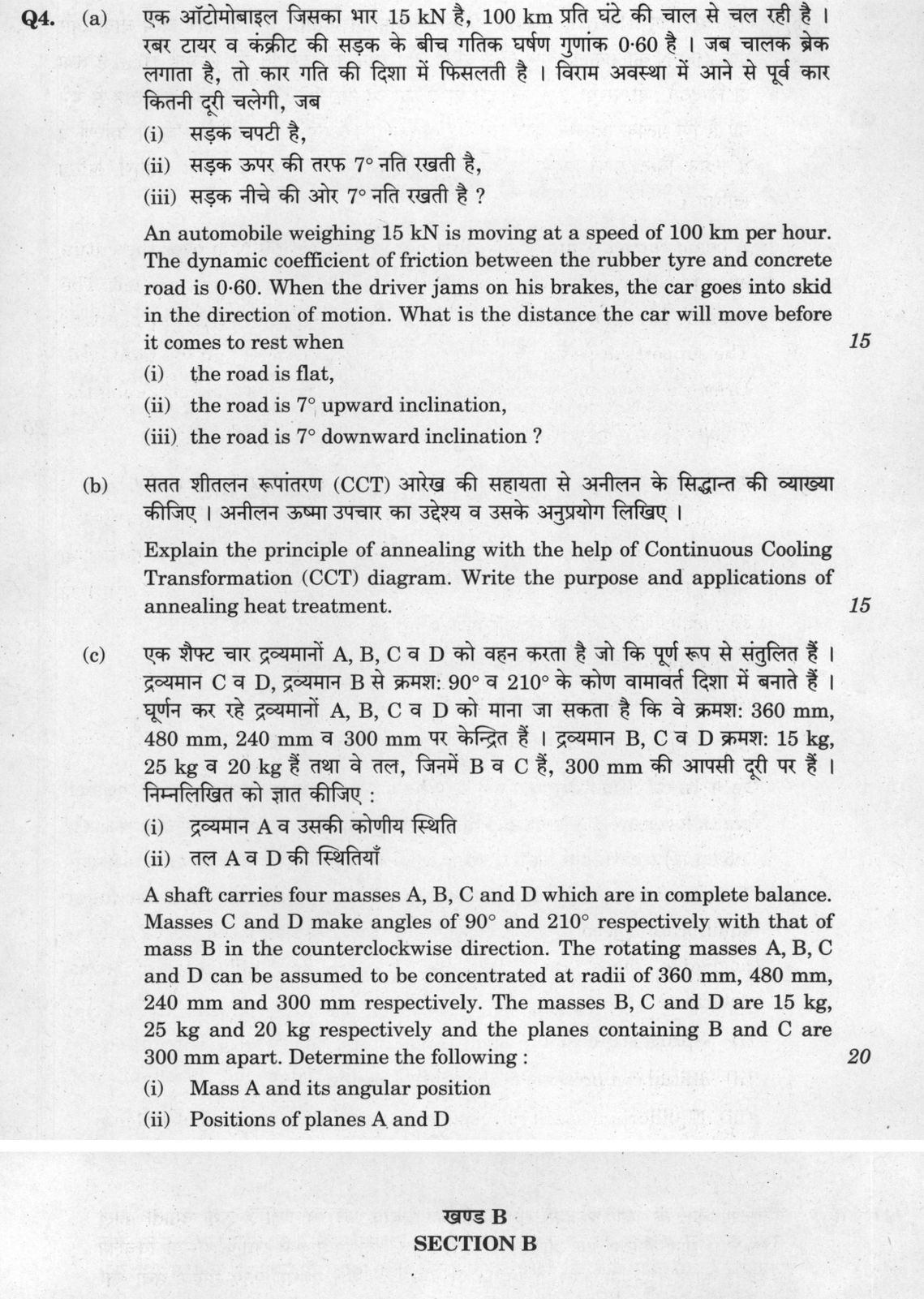
An automobile weighing 15 kN is moving at a speed of 100 km per hour. The dynamic coefficient of friction between the rubber tyre and concrete road is 0·60. When the driver jams on his brakes, the car goes into skid in the direction of motion. What is the distance the car will move before it comes to rest when the road is flat,
the road is 7° upward inclination,
the road is 7° downward inclination? 15 marks
Explain the principle of annealing with the help of Continuous Cooling Transformation (CCT) diagram. Write the purpose and applications of annealing heat treatment. 15 marks
A shaft carries four masses A, B, C and D which are in complete balance. Masses C and D make angles of 90° and 210° respectively with that of mass B in the counterclockwise direction. The rotating masses A, B, C and D can be assumed to be concentrated at radii of 360 mm, 480 mm, 240 mm and 300 mm respectively. The masses B, C and D are 15 kg, 25 kg and 20 kg respectively and the planes containing B and C are 300 mm apart. Determine the following: Mass A and its angular position
Positions of planes A and D 20 marks
हिंदी में प्रश्न पढ़ें
एक ऑटोमोबाइल जिसका भार 15 kN है, 100 km प्रति घंटे की चाल से चल रही है । रबर टायर व कंक्रीट की सड़क के बीच गतिक घर्षण गुणांक 0·60 है । जब चालक ब्रेक लगाता है, तो कार गति की दिशा में फिसलती है । विराम अवस्था में आने से पूर्व कार कितनी दूरी चलेगी, जब सड़क चपटी है,
सड़क ऊपर की तरफ 7° नति रखती है,
सड़क नीचे की ओर 7° नति रखती है ? (15 अंक)
सतत शीतलन रूपांतरण (CCT) आरेख की सहायता से अनीलन के सिद्धांत की व्याख्या कीजिए । अनीलन उष्मा उपचार का उद्देश्य व उसके अनुप्रयोग लिखिए । (15 अंक)
एक शाफ्ट चार द्रव्यमानों A, B, C व D को वहन करता है जो कि पूर्ण रूप से संतुलित हैं । द्रव्यमान C व D, द्रव्यमान B से क्रमशः 90° व 210° के कोण वामावर्त दिशा में बनाते हैं । घूर्णन कर रहे द्रव्यमानों A, B, C व D को माना जा सकता है कि वे क्रमशः 360 mm, 480 mm, 240 mm व 300 mm पर केंद्रित हैं । द्रव्यमान B, C व D क्रमशः 15 kg, 25 kg व 20 kg हैं तथा वे तल, जिनमें B व C हैं, 300 mm की आपसी दूरी पर हैं । निम्नलिखित को ज्ञात कीजिए : द्रव्यमान A व उसकी कोणीय स्थिति
तल A व D की स्थितियाँ (20 अंक)
Model answer
Written by UPSC Answer Check against this question's marking rubric, to the expected length. UPSC does not publish answers for Mains — this is one way to score well, not an official key.
(a) Given W = 15 kN, v = 100 km/h = 250/9 m/s = 27.778 m/s, μ = 0.60. Use work-energy: loss of kinetic energy equals work done against resistance. Since W = mg, weight cancels and distance is independent of the vehicle weight.
(a)(i) Flat road: Normal reaction N = W, friction = μW, so deceleration a = μg. s = v²/(2μg) = (250/9)²/(2 × 0.60 × 9.81) = 65.55 m. Distance = 65.55 m.
(a)(ii) Road inclined 7° upward: N = W cos θ. Retarding force = μW cos θ + W sin θ. a = g(μ cos θ + sin θ) = 9.81(0.60 cos 7° + sin 7°) = 7.038 m/s². s = v²/(2a) = (250/9)²/(2 × 7.038) = 54.82 m. Distance = 54.82 m.
(a)(iii) Road inclined 7° downward: Gravity assists motion, friction opposes it. a = g(μ cos θ − sin θ) = 9.81(0.60 cos 7° − sin 7°) = 4.647 m/s². s = v²/(2a) = (250/9)²/(2 × 4.647) = 83.03 m. Distance = 83.03 m. Validity: μ cos θ > sin θ; here 0.5955 > 0.1219, so the car stops.
(b) Annealing is a heat-treatment process in which steel is heated to or near the austenitizing temperature, held long enough for homogenisation, and then cooled very slowly, usually in the furnace. Its principle is best seen on a CCT diagram.
A CCT diagram plots temperature against time on a logarithmic scale and shows the start and finish curves for diffusion-controlled transformations such as ferrite, pearlite and bainite, and the martensite start and finish temperatures. For annealing, the cooling curve is made to lie far to the right of the pearlite start and finish curves. Therefore austenite transforms at a relatively high temperature by diffusion into ferrite and pearlite, and the cooling curve avoids the martensite region altogether. The resulting structure is near-equilibrium, coarse, soft and ductile. If subcritical spheroidizing annealing is used, cementite is eventually obtained as spheroids in a ferrite matrix.
The purpose of annealing is:
- to soften the metal and improve machinability;
- to relieve internal stresses produced by casting, forging, welding or cold working;
- to improve ductility and toughness;
- to homogenise the microstructure and remove segregation;
- to refine grain size in some full-annealing operations;
- to prepare the material for subsequent cold working or machining.
Applications include annealing of low- and medium-carbon steel castings and forgings, welded joints, cold-worked sheets and wires, and spheroidizing high-carbon or alloy steels before machining. Stress-relief annealing is widely used after welding, and recrystallization annealing is used after cold deformation to restore ductility.
(c) Let plane B be the datum, θ_B = 0°, θ_C = 90°, θ_D = 210° in the counterclockwise direction. Let F = mr in kg·mm.
F_B = 15 × 480 = 7200 kg·mm at 0°. F_C = 25 × 240 = 6000 kg·mm at 90°. F_D = 20 × 300 = 6000 kg·mm at 210°.
For complete balance, primary force balance gives ΣF = 0. F_B + F_C + F_D = (7200 − 3000√3) + i(6000 − 3000) = (7200 − 3000√3) + i3000. Therefore F_A = −[(7200 − 3000√3) + i3000] = (3000√3 − 7200) − i3000.
(c)(i) Magnitude: F_A = √[(7200 − 3000√3)² + 3000²] = 3607.69 kg·mm. m_A = F_A/r_A = 3607.69/360 = 10.02 kg.
Angular position: the vector F_A has both components negative, so it lies in the third quadrant. θ_A = 180° + tan⁻¹[3000/(7200 − 3000√3)] = 236.26° from B in the counterclockwise direction. Mass A = 10.02 kg, angular position = 236.26° CCW from B.
(c)(ii) Take moments about plane B. Let z be positive from B toward C, so z_B = 0, z_C = 300 mm. Couple balance: F_A z_A + F_C(300) + F_D z_D = 0.
Using components: F_A = (−2003.85, −3000), F_C = (0, 6000), F_D = (−5196.15, −3000).
From x-components: 2003.85 z_A + 5196.15 z_D = 0. From y-components: −3000 z_A − 3000 z_D + 6000 × 300 = 0, so z_A + z_D = 600 mm.
Solving: z_D = −376.63 mm, z_A = 976.63 mm.
Taking B as datum with C at +300 mm, plane A is at z_A = +976.63 mm and plane D is at z_D = −376.63 mm. Thus A is 976.63 mm from B on the C-side, i.e. 676.63 mm beyond C; D is 376.63 mm from B on the side opposite to C, i.e. 676.63 mm from C on the other side from A.
What "Calculate" is asking you to do
Apply the standard formula or schedule to data the question has already supplied — a table of readings, cost records, a balance sheet — and produce the number. The method is rarely in doubt; the marks sit in the named intermediate quantities, each of which has to appear as a labelled line.
Structure that answers it
Data as given → formula or standard treatment, named → substitution → each intermediate, labelled → result with units
Where marks are lost
Omitting an intermediate the marking scheme pays for separately, or rounding at an intermediate line so the final figure drifts. In commerce and accountancy, any figure in a statement that no numbered working note supports is treated as unearned.
How this answer will be evaluated
Approach
(a) calculate: given > formula > substitution > result with units > interpretation | (b) explain: definition/context > points in order > small example > short close | (c) calculate: given > formula > substitution > result with units > interpretation Full marks: Rigorous method, clear diagrams, correct units, physical interpretation of results.
Key points expected
- Convert 100 km/h to m/s
- State friction force equation F = μN
- Resolve weight components for inclinations
- Apply kinematic equation v² = u² + 2as
- Draw labelled CCT diagram (Austenite, Pearlite, Bainite, Martensite)
- Define annealing as slow cooling process
- State purpose: soften, relieve stress, refine grain
- List at least 3 applications
Evaluation rubric
Each sub-part is marked on its own, against the marks and word limit printed on the paper.
- (a) Determine skid distance for flat, 7° upward, and 7° downward inclinations. 15 marks
calculate— given → formula → substitution → result with units → interpretation
Must cover
- Convert 100 km/h to m/s
- State friction force equation F = μN
- Resolve weight components for inclinations
- Apply kinematic equation v² = u² + 2as
Loses marks
- Using km/h directly in SI equations
- Ignoring gravity component on slopes
- No governing equation stated
Earns more
- Free body diagram for each case
- Explicit calculation of deceleration 'a'
- Units carried through all steps
Extra mark
- Comparison of distances in a table
- (b) Explain annealing principle via CCT diagram and list applications. 15 marks
explain— definition/context → points in order → small example → short close
Must cover
- Draw labelled CCT diagram (Austenite, Pearlite, Bainite, Martensite)
- Define annealing as slow cooling process
- State purpose: soften, relieve stress, refine grain
- List at least 3 applications
Loses marks
- Confusing annealing with quenching
- CCT diagram missing phase labels
- No mention of cooling rate effect
Earns more
- Mentioning specific steel grades
- Distinguishing full vs. process annealing
Extra mark
- Reference to specific industrial standard
- (c) Determine mass A, its angle, and positions of planes A and D. 20 marks
calculate— given → formula → substitution → result with units → interpretation
Must cover
- Calculate mr values for B, C, D
- Construct vector polygon for static balance
- Calculate moments about a reference plane
- Solve for mass A and angular position
Loses marks
- Incorrect angle measurement direction
- Omitting moment calculation for dynamic balance
- No vector diagram provided
Earns more
- Clear vector diagram with scale
- Moment table for planes
- Check for dynamic balance condition
Extra mark
- Verification of resultant force and moment
Practice this exact question
Write your answer and it is marked point by point against the model answer above — what you covered, what you missed, what you got wrong.
Evaluate my answer →More from Mechanical Engineering 2022 Paper I
- Q1 (a) A slider-crank mechanism with crank radius 60 mm and connecting rod length 240 mm is…
- Q2 (a) A 20 mm diameter shaft is subjected to a torque of 80 Nm and a downward bending momen…
- Q3 (a) A thin cylinder of diameter 200 mm and length 1000 mm is subjected to an internal pre…
- Q4 (a) An automobile weighing 15 kN is moving at a speed of 100 km per hour. The dynamic coe…
- Q5 (a) An HSS drill during its life can drill 150 through holes in a 10 mm thick brass plate…
- Q6 (a) During turning of a steel rod of 100 mm diameter, at a speed of 600 rpm, feed of 0·32…
- Q7 Q7. (a) A firm has identified four operations, which are to be conducted in succession fo…