Paper II — Q1
(a) Consider the system shown in Fig. 1(a). The two chambers initially have equal volumes of 28 litres and contain air (C_p =…
Consider the system shown in Fig. 1(a). The two chambers initially have equal volumes of 28 litres and contain air (C_p = 1·005 kJ/kg-K and C_v = 0·717 kJ/kg-K) and hydrogen (C_p = 14·32 kJ/kg-K and C_v = 10·17 kJ/kg-K), respectively. The chambers are separated by a frictionless piston which is non-heat-conducting. Both the gases are initially at 140 kPa and 40 °C. Heat is added to the air side until the pressure of both the gases reaches 280 kPa. All outside walls of the chambers are insulated except for the surface where heat is added to air. Calculate the final temperature of the air. 10 marks
What is 'choked flow' in a convergent-divergent nozzle? Explain, with diagram, the effect of pressure ratio on exit velocity of compressible gas in a convergent-divergent nozzle. 10 marks
An axial flow compressor with inlet and outlet angles of 40° and 15°, respectively has been designed for 50% reaction. The compressor has a pressure ratio of 6 : 1 and overall isentropic efficiency of 0·80, when inlet static temperature is 41 °C. The blade speed and axial velocity are constant throughout. Assuming a value of 210 m/s for blade speed, find the number of stages required if the work done factor is 0·88 for all the stages. Take Cp = 1·005 kJ/kg-K and γ = 1·4 for air. 10 marks
Hot water is flowing through a pipe made of cast iron having thermal conductivity of 52 W/m-°C, with an average velocity of 1·5 m/s. The inner and outer diameters of the pipe are 3 cm and 3·5 cm, respectively. The pipe passes through a 15 m long section of a basement whose temperature is 15 °C. The temperature of the water drops from 70 °C to 67 °C as it passes through the basement. The heat transfer coefficient on the inner surface of the pipe is 400 W/m²-°C. Determine the combined convection and radiation heat transfer coefficient at the outer surface of the pipe. 10 marks
Define the total and spectral black body emissive powers. How are they related to each other? 5 marks
Consider two identical bodies, one at 1000 K and the other at 1500 K. Which body emits more radiation in the shorter wavelength region? Which body emits more radiation at a wavelength of 20 μm? 5 marks
हिंदी में प्रश्न पढ़ें
चित्र 1(a) में दर्शाये गये निकाय पर गौर कीजिये। दोनों कक्ष प्रारम्भ में 28 लीटर के समान आयतन के हैं, जिनमें क्रमशः वायु (C_p = 1·005 kJ/kg-K तथा C_v = 0·717 kJ/kg-K) एवं हाइड्रोजन (C_p = 14·32 kJ/kg-K तथा C_v = 10·17 kJ/kg-K) हैं। ये कक्ष एक घर्षणहीन पिस्टन, जो कि ऊष्मा अचालक है, के द्वारा अलग किये गये हैं। दोनों गैसें आरम्भ में 140 kPa तथा 40 °C पर हैं। वायु की ओर से इस प्रकार ऊष्मा दी जाती है कि दोनों गैसों का दाब 280 kPa तक पहुँच जाये। जहाँ से वायु को ऊष्मा दी जाती है उस सतह को छोड़कर कक्ष की सभी बाहरी दीवारों को रोधित किया गया है। वायु का अन्तिम तापमान ज्ञात कीजिये। (10 अंक)
एक अभिसारी-अपसारी नोजल में 'प्रोध प्रवाह' क्या होता है? एक अभिसारी-अपसारी नोजल में संपीड्य गैस के निर्गम वेग पर दाब अनुपात के प्रभाव को आरेख की सहायता से समझाइये। (10 अंक)
एक अक्षीय प्रवाह संपीडक, जिसके अंतर्गाम तथा निर्गम कोण क्रमशः: 40° तथा 15° हैं, को 50% प्रतिक्रिया के लिये अभिकल्पित किया गया है। संपीडक का दाब अनुपात 6 : 1 है तथा समग्र समझौती दक्षता 0·80 है, जबकि अंतर्गाम स्थैतिक तापमान 41 °C है। फलक (ब्लेड) चाल तथा अक्षीय वेग आद्योपांत समान हैं। यदि सभी पदों के लिये कृत कार्य गुणक 0·88 हो, तो फलक चाल का मान 210 m/s मानते हुए वांछित पदों की संख्या ज्ञात कीजिये। वायु के लिये Cp = 1·005 kJ/kg-K तथा γ = 1·4 लीजिये। (10 अंक)
52 W/m-°C की ऊष्मीय चालकता वाले ढलवां लोहे से बने एक पाइप में गर्म जल 1·5 m/s के औसत वेग से प्रवाहित हो रहा है। पाइप के आंतरिक तथा बाह्य व्यास क्रमशः: 3 cm तथा 3·5 cm हैं। 15 °C तापमान वाले तलघर के 15 m लम्बे हिस्से से पाइप गुजरता है। पाइप के तलघर से गुजरने से जल का तापमान 70 °C से घटकर 67 °C रह जाता है। पाइप की आंतरिक सतह पर ऊष्मा अंतरण गुणांक 400 W/m²-°C है। पाइप की बाह्य सतह पर संयुक्त संवहन तथा विकिरण ऊष्मा अंतरण गुणांक को निर्धारित कीजिये। (10 अंक)
सम्पूर्ण तथा स्पेक्ट्रमी कृष्णिका उत्सर्जक शक्तियों को परिभाषित कीजिये। ये एक-दूसरे से किस प्रकार सम्बन्धित हैं? (5 अंक)
दो समरूप पिंडों पर विचार कीजिये, जिनमें एक 1000 K तथा दूसरा 1500 K पर है। लघु तरंगदैर्घ्य क्षेत्र में कौन-सा पिंड ज्यादा विकिरण उत्सर्जित करता है? 20 μm के तरंगदैर्घ्य पर कौन-सा पिंड ज्यादा विकिरण उत्सर्जित करता है? (5 अंक)
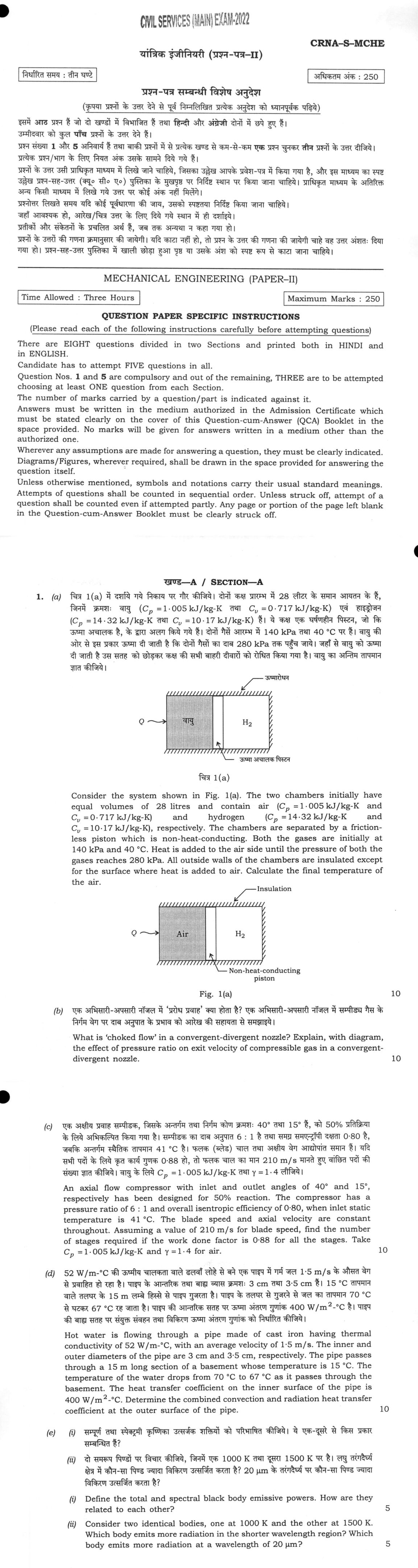
The figure this question refers to, in words
The question paper is a scan and the diagram did not survive as text. This is the figure as read from the original page — every component, value and label — so the question can be worked from the text below.
(a) A horizontal rectangular chamber is divided into two sections by a vertical separator labeled 'Non-heat-conducting piston'. The left section is labeled 'Air', and the right section is labeled 'H2'. The top, bottom, and right external walls are hatched to indicate thermal insulation, labeled with an arrow as 'Insulation'. The left vertical wall is uninsulated, and an arrow labeled 'Q' points into the Air chamber through this wall, representing heat input.
Model answer
Written by UPSC Answer Check against this question's marking rubric, to the expected length. UPSC does not publish answers for Mains — this is one way to score well, not an official key.
(a) For the hydrogen side, the walls are insulated and the piston is frictionless and non-heat-conducting, so hydrogen undergoes a reversible adiabatic compression. Let hydrogen be denoted by H.
Initial state: P₁ = 140 kPa, T₁ = 40 °C = 313.15 K, V₁ = 28 L = 0.028 m³ for each gas. Final pressure: P₂ = 280 kPa.
For hydrogen, γ_H = C_p/C_v = 14.32/10.17 = 1.40806.
Using the reversible adiabatic relation P V^γ = constant: V_H2 = V₁ (P₁/P₂)^(1/γ_H) = 28 × (140/280)^(1/1.40806) = 28 × 0.5^0.71020 = 17.11 L.
Total volume = 28 + 28 = 56 L. Final air volume: V_air2 = 56 − 17.11 = 38.89 L.
For air, using the ideal gas relation between initial and final states: T_air2 = T₁ (P₂/P₁)(V_air2/V₁) = 313.15 × 2 × (38.89/28) = 869.8 K approximately.
Final temperature of air ≈ 869.8 K ≈ 596.7 °C.
---
(b) Choked flow: In a convergent-divergent nozzle, choked flow occurs when the throat reaches sonic velocity, M = 1. At this condition, the mass flow rate reaches its maximum value for the given upstream stagnation pressure and temperature. Once choked, further reduction of downstream pressure cannot increase the mass flow rate; it only changes the pressure distribution in the diverging section.
For air, the critical pressure ratio is p*/p₀ = (2/(γ+1))^(γ/(γ−1)) ≈ 0.528 for γ = 1.4.
Schematic diagram:
p₀, T₀ → converging section → throat A_t, M = 1 when choked → diverging section → exit A_e
Effect of pressure ratio p_b/p₀ on exit velocity:
- For p_b/p₀ = 1, there is no flow.
- As p_b/p₀ decreases but remains above the critical value, the flow is subsonic throughout. The exit velocity increases as p_b/p₀ decreases.
- At the critical pressure ratio, the throat becomes sonic. Choking starts, and mass flow rate becomes maximum.
- For p_b/p₀ below critical, the diverging section can accelerate the flow supersonically. A normal shock may appear in the diverging section depending on back pressure.
- At the design pressure ratio, the nozzle is correctly expanded and the exit velocity reaches its maximum supersonic value for the given area ratio.
- If p_b/p₀ is reduced below the design value, the nozzle becomes underexpanded. The exit velocity at the nozzle exit remains approximately constant, and further expansion occurs outside the nozzle.
Thus, the exit velocity generally increases as p_b/p₀ decreases, but after choking the mass flow becomes constant and the diverging section controls supersonic expansion.
---
(c) For a 50% reaction axial compressor stage with constant axial velocity C_a and blade speed U, the velocity triangles are symmetrical: α₁ = β₂ and α₂ = β₁.
Given β₁ = 40°, β₂ = 15°, U = 210 m/s.
Using the velocity triangle relation: C_a = U/(tan β₁ + tan β₂).
tan 40° = 0.83910, tan 15° = 0.26795.
C_a = 210/(0.83910 + 0.26795) = 210/1.10705 = 189.69 m/s.
Ideal work per stage from Euler work equation: w_stage = U C_a (tan β₁ − tan β₂) = 210 × 189.69 × (0.83910 − 0.26795) = 210 × 189.69 × 0.57115 = 22 752 J/kg = 22.75 kJ/kg.
With work-done factor 0.88: w_actual = 0.88 × 22.75 = 20.02 kJ/kg per stage.
At inlet, for 50% reaction, α₁ = β₂ = 15°. C₁ = C_a/cos 15° = 189.69/0.96593 = 196.39 m/s.
T₁ = 41 °C = 314.15 K.
Inlet stagnation temperature: T₀₁ = T₁ + C₁²/(2C_p) = 314.15 + 196.39²/(2 × 1005) = 314.15 + 19.19 = 333.34 K.
For pressure ratio 6, isentropic outlet stagnation temperature: T₀₂s = T₀₁ × 6^((γ−1)/γ) = 333.34 × 6^0.2857 = 333.34 × 1.66846 = 556.16 K.
Overall isentropic efficiency η_c = 0.80: T₀₂ − T₀₁ = (T₀₂s − T₀₁)/η_c = (556.16 − 333.34)/0.80 = 278.53 K.
Total work required: w_total = C_p (T₀₂ − T₀₁) = 1.005 × 278.53 = 279.92 kJ/kg.
Number of stages: N = w_total/w_actual = 279.92/20.02 = 13.98.
Therefore, number of stages required = 14.
---
(d) Assume water properties at average temperature 68.5 °C: ρ = 1000 kg/m³, C_p = 4.18 kJ/kg·°C.
Pipe inner diameter D_i = 0.03 m, outer diameter D_o = 0.035 m, length L = 15 m. Water velocity V = 1.5 m/s.
Flow area: A_c = πD_i²/4 = π(0.03)²/4 = 7.0686 × 10⁻⁴ m².
Mass flow rate: ṁ = ρ A_c V = 1000 × 7.0686 × 10⁻⁴ × 1.5 = 1.0603 kg/s.
Heat lost by water: Q = ṁ C_p ΔT = 1.0603 × 4.18 × (70 − 67) = 13.296 kW = 13 296 W.
Using LMTD for water 70 °C to 67 °C and surroundings at 15 °C: ΔT₁ = 70 − 15 = 55 °C, ΔT₂ = 67 − 15 = 52 °C.
ΔT_lm = (55 − 52)/ln(55/52) = 3/ln(1.05769) = 53.49 °C.
Total thermal resistance: R_total = ΔT_lm/Q = 53.49/13 296 = 4.023 × 10⁻³ K/W.
Inner convection resistance: A_i = πD_iL = π × 0.03 × 15 = 1.4137 m². R_i = 1/(h_i A_i) = 1/(400 × 1.4137) = 1.768 × 10⁻³ K/W.
Pipe wall resistance: R_wall = ln(D_o/D_i)/(2πkL) = ln(0.035/0.03)/(2π × 52 × 15) = 3.145 × 10⁻⁵ K/W.
Outer resistance: R_o = R_total − R_i − R_wall = 4.023 × 10⁻³ − 1.768 × 10⁻³ − 0.03145 × 10⁻³ = 2.223 × 10⁻³ K/W.
Outer surface area: A_o = πD_oL = π × 0.035 × 15 = 1.6493 m².
Combined outer heat transfer coefficient: h_o = 1/(R_o A_o) = 1/(2.223 × 10⁻³ × 1.6493) = 272.8 W/m²·°C.
Combined convection and radiation heat transfer coefficient at outer surface ≈ 273 W/m²·°C.
---
(e)(i) Total black body emissive power, E_b, is the total radiant energy emitted per unit time per unit surface area of a black body over all wavelengths. Its unit is W/m².
Spectral black body emissive power, E_bλ, is the radiant energy emitted per unit time per unit surface area per unit wavelength interval at wavelength λ. Its unit is W/m²·μm.
They are related by: E_b = ∫ from 0 to ∞ E_bλ dλ.
Using Planck’s distribution: E_bλ = C₁/[λ⁵(exp(C₂/(λT)) − 1)] where C₁ = 2πhc₀² and C₂ = hc₀/k.
Integration over all wavelengths gives the Stefan-Boltzmann law: E_b = σT⁴.
---
(e)(ii) By Wien’s displacement law: λ_max T = 2898 μm·K.
For T = 1000 K: λ_max = 2898/1000 = 2.90 μm.
For T = 1500 K: λ_max = 2898/1500 = 1.93 μm.
Thus, the 1500 K body has its peak radiation at a shorter wavelength, so it emits more radiation in the shorter wavelength region.
At 20 μm, using Planck’s law: E_λ ∝ 1/[λ⁵(exp(C₂/(λT)) − 1)].
Ratio at 20 μm: E_λ(1500)/E_λ(1000) = [exp(C₂/(20 × 1000)) − 1]/[exp(C₂/(20 × 1500)) − 1] = [exp(0.7194) − 1]/[exp(0.4796) − 1] = (2.053 − 1)/(1.615 − 1) = 1.053/0.615 ≈ 1.71.
So at a wavelength of 20 μm, the 1500 K body emits more radiation than the 1000 K body, by a factor of about 1.71.
What "Calculate" is asking you to do
Apply the standard formula or schedule to data the question has already supplied — a table of readings, cost records, a balance sheet — and produce the number. The method is rarely in doubt; the marks sit in the named intermediate quantities, each of which has to appear as a labelled line.
Structure that answers it
Data as given → formula or standard treatment, named → substitution → each intermediate, labelled → result with units
Where marks are lost
Omitting an intermediate the marking scheme pays for separately, or rounding at an intermediate line so the final figure drifts. In commerce and accountancy, any figure in a statement that no numbered working note supports is treated as unearned.
How this answer will be evaluated
Approach
(a) calculate: given > formula > substitution > result with units > interpretation | (b) explain: definition/context > points in order > small example > short close | (c) calculate: given > formula > substitution > result with units > interpretation | (d) calculate: given > formula > substitution > result with units > interpretation | (e(i)) define: precise definition > the distinguishing feature > one example | (e(ii)) compare: paired headings or table > key differences > significance > conclusion Full marks: All parts answered with correct method, clear diagrams, and physical interpretation.
Key points expected
- State ideal gas law and first law of thermodynamics
- Identify hydrogen process as adiabatic (insulated)
- Apply ideal gas law to find final hydrogen temperature
- Equate final pressures of both gases (280 kPa)
- Define choked flow as Mach 1 at the throat
- Explain that exit velocity is constant when choked
- Describe subsonic flow in the divergent section
- Relate pressure ratio to the onset of choking
Evaluation rubric
Each sub-part is marked on its own, against the marks and word limit printed on the paper.
- (a) Final temperature of air in a two-chamber system with a moving piston. 10 marks
calculate— given → formula → substitution → result with units → interpretation
Must cover
- State ideal gas law and first law of thermodynamics
- Identify hydrogen process as adiabatic (insulated)
- Apply ideal gas law to find final hydrogen temperature
- Equate final pressures of both gases (280 kPa)
Loses marks
- Assuming hydrogen temperature remains constant
- Ignoring the work done by the moving piston
- Using wrong specific heat values for the gases
Earns more
- Calculate mass of air and hydrogen from initial state
- Use specific heat ratio (gamma) for hydrogen
- Show step-by-step substitution of values
- Verify final temperature is physically reasonable
Extra mark
- Draw schematic of the two-chamber system
- Label initial and final states on a p-V diagram
- (b) Definition of choked flow and effect of pressure ratio on exit velocity. 10 marks
explain— definition/context → points in order → small example → short close
Must cover
- Define choked flow as Mach 1 at the throat
- Explain that exit velocity is constant when choked
- Describe subsonic flow in the divergent section
- Relate pressure ratio to the onset of choking
Loses marks
- Confusing choked flow with sonic flow
- Failing to explain the role of the throat
- Incorrectly stating that exit velocity increases with pressure ratio
Earns more
- Draw a p-V or T-s diagram for the nozzle
- Mention the critical pressure ratio for choking
- Explain the effect of back pressure on flow
- Distinguish between subsonic and supersonic exit conditions
Extra mark
- Provide a labelled diagram of a convergent-divergent nozzle
- Show the location of the shock wave if applicable
- (c) Number of stages required for an axial flow compressor. 10 marks
calculate— given → formula → substitution → result with units → interpretation
Must cover
- Use the work done factor in the stage work equation
- Calculate the total work required for the compression
- Determine the work done per stage
- Divide total work by work per stage to find number of stages
Loses marks
- Ignoring the work done factor
- Using the wrong formula for stage work
- Failing to account for the overall isentropic efficiency
Earns more
- State the formula for work done per stage
- Use the given pressure ratio and efficiency
- Show the calculation of the stage work
- Round the number of stages to the nearest integer
Extra mark
- Draw a velocity triangle for the compressor
- Label the inlet and outlet angles on the diagram
- (d) Combined convection and radiation heat transfer coefficient at the outer surface. 10 marks
calculate— given → formula → substitution → result with units → interpretation
Must cover
- Calculate the heat loss from the water
- Set up the thermal resistance network for the pipe
- Solve for the unknown outer surface heat transfer coefficient
- Use the given temperatures and dimensions
Loses marks
- Ignoring the thermal resistance of the pipe wall
- Using the wrong formula for heat transfer
- Failing to account for the change in water temperature
Earns more
- Show the calculation of the heat loss
- Draw a thermal resistance diagram
- State the formula for the total heat transfer rate
- Verify the units of the final answer
Extra mark
- Label the thermal resistances on the diagram
- Show the calculation of the individual resistances
- (e(i)) Definitions of total and spectral black body emissive powers and their relationship. 5 marks
define— precise definition → the distinguishing feature → one example
Must cover
- Define total black body emissive power
- Define spectral black body emissive power
- State the relationship between the two
- Mention the Stefan-Boltzmann law
Loses marks
- Confusing emissive power with emissivity
- Failing to state the relationship between the two
- Incorrectly defining the spectral emissive power
Earns more
- Write the mathematical expressions for both
- Explain the physical meaning of each
- Mention the units of each quantity
- Provide a simple example to illustrate the relationship
Extra mark
- Draw a graph of spectral emissive power vs wavelength
- Label the peak wavelength on the graph
- (e(ii)) Comparison of radiation emission from two bodies at different temperatures. 5 marks
compare— paired headings or table → key differences → significance → conclusion
Must cover
- State that the hotter body emits more radiation
- Explain using Wien's displacement law
- Compare the emission at 20 μm
- Justify the comparison using Planck's law
Loses marks
- Stating that the colder body emits more radiation
- Failing to use Wien's displacement law
- Incorrectly comparing the emission at 20 μm
Earns more
- Calculate the peak wavelength for each body
- Show that the 1500 K body has a shorter peak wavelength
- Explain that the 1500 K body emits more at 20 μm
- Use the Stefan-Boltzmann law to support the argument
Extra mark
- Draw a graph of spectral emissive power vs wavelength for both bodies
- Label the peak wavelengths on the graph
Practice this exact question
Write your answer and it is marked point by point against the model answer above — what you covered, what you missed, what you got wrong.
Evaluate my answer →More from Mechanical Engineering 2022 Paper II
- Q1 (a) Consider the system shown in Fig. 1(a). The two chambers initially have equal volumes…
- Q2 (a) 10 g of water at 20 °C is converted into ice at –10 °C at constant atmospheric pressu…
- Q3 (a) (i) How do the specific work output and efficiency vary with pressure ratio in a gas…
- Q4 (a) A single-stage impulse turbine rotor has a mean blade ring diameter of 500 mm and rot…