Paper II — Q6
(a) A four-cylinder diesel engine with swept volume of 0·98 litre is tested on a performance bed. The engine running at a speed…
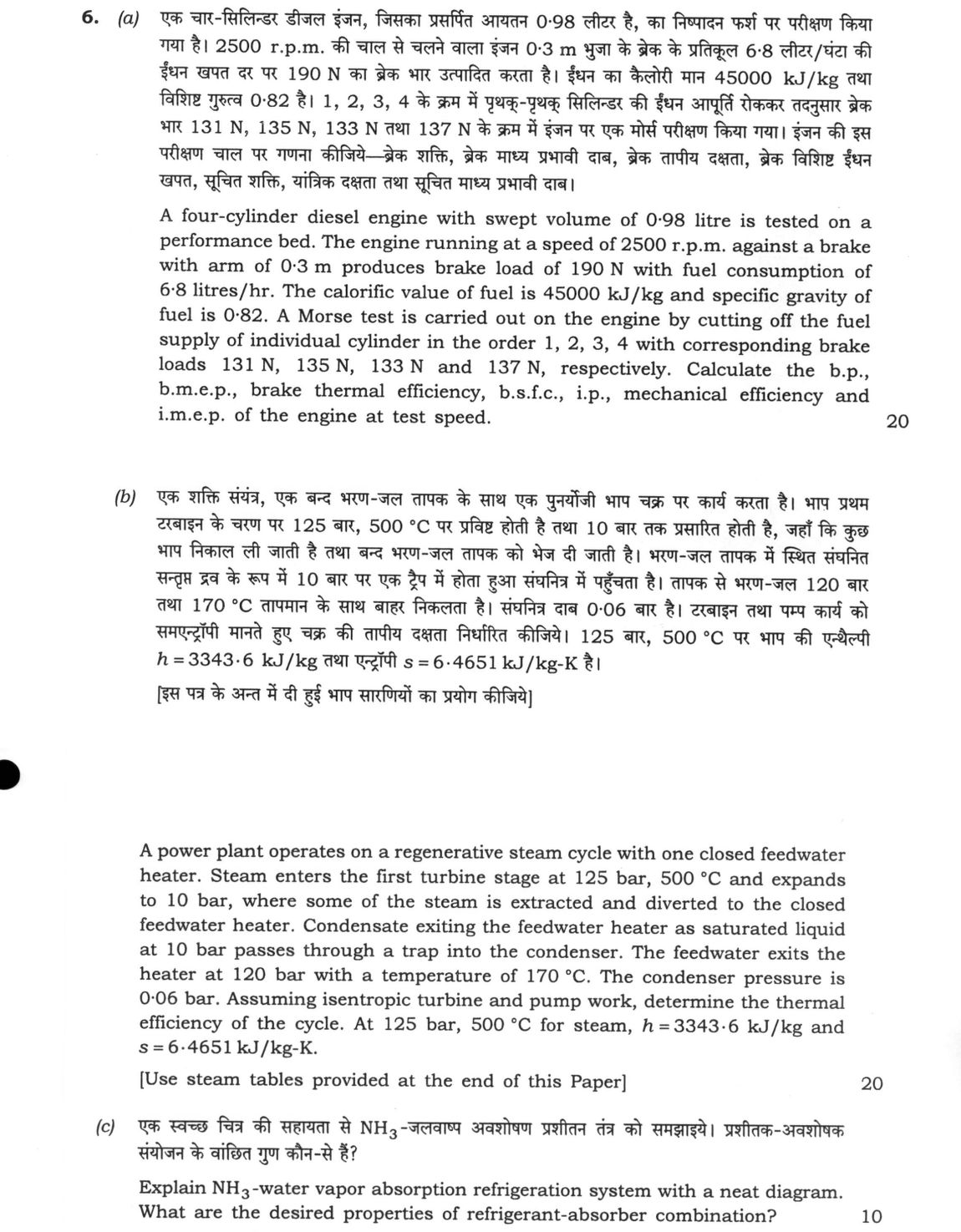
A four-cylinder diesel engine with swept volume of 0·98 litre is tested on a performance bed. The engine running at a speed of 2500 r.p.m. against a brake with arm of 0·3 m produces brake load of 190 N with fuel consumption of 6·8 litres/hr. The calorific value of fuel is 45000 kJ/kg and specific gravity of fuel is 0·82. A Morse test is carried out on the engine by cutting off the fuel supply of individual cylinder in the order 1, 2, 3, 4 with corresponding brake loads 131 N, 135 N, 133 N and 137 N, respectively. Calculate the b.p., b.m.e.p., brake thermal efficiency, b.s.f.c., i.p., mechanical efficiency and i.m.e.p. of the engine at test speed. 20 marks
A power plant operates on a regenerative steam cycle with one closed feedwater heater. Steam enters the first turbine stage at 125 bar, 500 °C and expands to 10 bar, where some of the steam is extracted and diverted to the closed feedwater heater. Condensate exiting the feedwater heater as saturated liquid at 10 bar passes through a trap into the condenser. The feedwater exits the heater at 120 bar with a temperature of 170 °C. The condenser pressure is 0·06 bar. Assuming isentropic turbine and pump work, determine the thermal efficiency of the cycle. At 125 bar, 500 °C for steam, h = 3343·6 kJ/kg and s = 6·4651 kJ/kg-K. [Use steam tables provided at the end of this Paper] 20 marks
Explain NH₃-water vapor absorption refrigeration system with a neat diagram. What are the desired properties of refrigerant-absorber combination? 10 marks
हिंदी में प्रश्न पढ़ें
एक चार-सिलिन्डर डीजल इंजन, जिसका प्रस्पीत आयतन 0·98 लीटर है, का निष्पादन फर्श पर परीक्षण किया गया। 2500 r.p.m. की चाल से चलने वाला इंजन 0·3 m भुजा के ब्रेक के प्रतिकूल 6·8 लीटर/घंटा की ईंधन खपत दर पर 190 N का ब्रेक भार उत्पादित करता है। ईंधन का कैलोरी मान 45000 kJ/kg तथा विशिष्ट गुरुत्व 0·82 है। 1, 2, 3, 4 के क्रम में पृथक-पृथक सिलिन्डर की ईंधन आपूर्ति रोककर तदनुसार ब्रेक भार 131 N, 135 N, 133 N तथा 137 N के क्रम में इंजन पर एक मोर्स परीक्षण किया गया। इंजन की इस परीक्षण चाल पर गणना कीजिये—ब्रेक शक्ति, ब्रेक माध्य प्रभावी दाब, ब्रेक तापीय दक्षता, ब्रेक विशिष्ट ईंधन खपत, सूचित शक्ति, यांत्रिक दक्षता तथा सूचित माध्य प्रभावी दाब। (20 अंक)
एक शक्ति संयंत्र, एक बंद भरण-जल तापक के साथ एक पुनर्जीवी भाप चक्र पर कार्य करता है। भाप प्रथम टरबाइन के चरण पर 125 बार, 500 °C पर प्रविष्ट होती है तथा 10 बार तक प्रसारित होती है, जहाँ कि कुछ भाप निकाल ली जाती है तथा बंद भरण-जल तापक को भेज दी जाती है। भरण-जल तापक में स्थित संयुक्त संतृप्त द्रव के रूप में 10 बार पर एक ट्रेप में होता हुआ संयंत्र में पहुँचता है। तापक से भरण-जल 120 बार तथा 170 °C तापमान के साथ बाहर निकलता है। संयंत्र दाब 0·06 बार है। टरबाइन तथा पम्प कार्य को समपद्रूपी मानते हुए चक्र की तापीय दक्षता निर्धारित कीजिये। 125 बार, 500 °C पर भाप की एन्थैल्पी h = 3343·6 kJ/kg तथा एन्ट्रॉपी s = 6·4651 kJ/kg-K है। [इस पत्र के अंत में दी हुई भाप सारणियों का प्रयोग कीजिये] (20 अंक)
एक स्वच्छ चित्र की सहायता से NH₃-जलवाष्प अवशोषण प्रशीतन तंत्र को समझाइये। प्रशीतक-अवशोषक संयोजन के वांछित गुण कौन-से हैं? (10 अंक)
Model answer
Written by UPSC Answer Check against this question's marking rubric, to the expected length. UPSC does not publish answers for Mains — this is one way to score well, not an official key.
(a) Torque, T = brake load × arm = 190 × 0.3 = 57 N m.
Brake power, B.P. = 2πNT/60 = 2π × 2500 × 57/60 = 14922.6 W = 14.9226 kW.
Swept volume, V_s = 0.98 litre = 0.98 × 10⁻³ m³. For a four-stroke engine: b.m.e.p. = B.P. × 2 × 60/(V_s × N) = 14.9226 × 120/(0.98 × 10⁻³ × 2500) = 730.90 kPa = 7.309 bar.
Fuel mass flow, m_f = 6.8 × 0.82 = 5.576 kg/h = 0.0015489 kg/s. Heat supplied, Q_in = m_f × CV = 0.0015489 × 45000 = 69.70 kW.
Brake thermal efficiency, η_bt = B.P./Q_in = 14.9226/69.70 = 0.2141 = 21.41%.
b.s.f.c. = m_f/B.P. = 5.576/14.9226 = 0.3737 kg/kWh = 373.7 g/kWh.
Morse test: if one cylinder is cut, its indicated power = B.P. − B.P. with that cylinder cut. Since speed and arm are unchanged, B.P. ∝ brake load.
Total I.P. = B.P. × [(190−131)+(190−135)+(190−133)+(190−137)]/190 = 14.9226 × (59+55+57+53)/190 = 14.9226 × 224/190 = 17.5929 kW.
Mechanical efficiency, η_m = B.P./I.P. = 190/224 = 0.8482 = 84.82%.
i.m.e.p. = b.m.e.p. × I.P./B.P. = 7.309 × 224/190 = 8.617 bar = 861.7 kPa.
(b) State 1: 125 bar, 500 °C, h₁ = 3343.6 kJ/kg, s₁ = 6.4651 kJ/kg-K.
At 10 bar, from steam tables: h_f10 = 762.81 kJ/kg, h_fg10 = 2015.3 kJ/kg, s_f10 = 2.1387, s_fg10 = 4.4478 kJ/kg-K.
Isentropic expansion 1→2: x₂ = (s₁ − s_f10)/s_fg10 = (6.4651 − 2.1387)/4.4478 = 0.9727. h₂ = h_f10 + x₂ h_fg10 = 762.81 + 0.9727 × 2015.3 = 2723.10 kJ/kg.
At 0.06 bar: h_f0 = 151.53 kJ/kg, h_fg0 = 2415.9 kJ/kg, s_f0 = 0.5209, s_fg0 = 7.8095 kJ/kg-K.
Isentropic expansion 2→3 at s = 6.4651: x₃ = (6.4651 − 0.5209)/7.8095 = 0.7611. h₃ = 151.53 + 0.7611 × 2415.9 = 1990.39 kJ/kg.
Pump work, 0.06 bar → 120 bar: w_p = v_f0(P_120 − P_0.06) = 0.0010064 × (12000 − 6) kPa = 12.07 kJ/kg. h_fw,in = h_f0 + w_p = 151.53 + 12.07 = 163.60 kJ/kg.
Feedwater exits heater at 120 bar, 170 °C. Using compressed-liquid tables, h_fw,out ≈ 731.7 kJ/kg.
Closed feedwater heater heat balance: y(h₂ − h_f10) = h_fw,out − h_fw,in y = (731.7 − 163.60)/(2723.10 − 762.81) = 0.2898.
Turbine work: w_t = (h₁ − h₂) + (1 − y)(h₂ − h₃) = (3343.6 − 2723.10) + 0.7102(2723.10 − 1990.39) = 620.50 + 520.37 = 1140.87 kJ/kg.
Net work, w_net = w_t − w_p = 1140.87 − 12.07 = 1128.80 kJ/kg. Heat input, q_in = h₁ − h_fw,out = 3343.6 − 731.7 = 2611.9 kJ/kg.
Thermal efficiency, η_th = w_net/q_in = 1128.80/2611.9 = 0.4322 = 43.2%.
(c) In an NH₃-water vapour absorption refrigeration system, ammonia is the refrigerant and water is the absorbent.
Schematic flow:
- Generator: heat supplied separates NH₃ vapour from strong aqua.
- Rectifier: removes water vapour carried with NH₃ vapour.
- Condenser: NH₃ vapour condenses, rejecting heat.
- Expansion valve: pressure of liquid NH₃ is reduced.
- Evaporator: NH₃ absorbs heat from the refrigerated space and vaporises.
- Absorber: NH₃ vapour from evaporator is absorbed in weak aqua coming from generator, forming strong aqua; heat of absorption is rejected.
- Pump: strong aqua is pumped to generator pressure.
- Solution heat exchanger: hot weak aqua preheats strong aqua, improving COP.
- Pressure-reducing valve: weak aqua returns from generator pressure to absorber pressure.
Flow path: Generator NH₃ vapour → Rectifier → Condenser → Expansion valve → Evaporator → Absorber. Strong aqua: Absorber → Pump → Solution heat exchanger → Generator. Weak aqua: Generator → Solution heat exchanger → Pressure-reducing valve → Absorber.
Desired properties of refrigerant-absorber combination:
- Refrigerant should have high latent heat, low boiling point, high critical temperature, and low specific volume.
- Absorbent should have high affinity for refrigerant, low volatility, low viscosity, low specific heat, and low vapour pressure at absorber temperature.
- The pair must be chemically stable, non-corrosive, non-toxic, non-flammable and inexpensive.
- Refrigerant should be more volatile than absorbent so it can be separated easily in the generator.
- The mixture should not form solids or polymers in the operating range and should give high COP with low circulation ratio.
What "Calculate" is asking you to do
Apply the standard formula or schedule to data the question has already supplied — a table of readings, cost records, a balance sheet — and produce the number. The method is rarely in doubt; the marks sit in the named intermediate quantities, each of which has to appear as a labelled line.
Structure that answers it
Data as given → formula or standard treatment, named → substitution → each intermediate, labelled → result with units
Where marks are lost
Omitting an intermediate the marking scheme pays for separately, or rounding at an intermediate line so the final figure drifts. In commerce and accountancy, any figure in a statement that no numbered working note supports is treated as unearned.
How this answer will be evaluated
Approach
(a) calculate: given > formula > substitution > result with units > interpretation | (b) calculate: given > formula > substitution > result with units > interpretation | (c) explain: definition/context > points in order > small example > short close Full marks: Rigorous application of thermodynamic laws with clear, labelled diagrams and precise unit handling.
Key points expected
- Calculate Brake Power from torque and speed
- Determine Indicated Power via Morse test method
- Compute Brake Specific Fuel Consumption (b.s.f.c.)
- Calculate Brake and Indicated Mean Effective Pressure
- Identify state points on T-s or p-v diagram
- Calculate enthalpy changes for turbine and pump
- Determine extraction fraction for feedwater heater
- Apply energy balance for the closed heater
Evaluation rubric
Each sub-part is marked on its own, against the marks and word limit printed on the paper.
- (a) Compute b.p., b.m.e.p., b.s.f.c., b.m.e., i.p., i.m.e.p., and mechanical efficiency. 20 marks
calculate— given → formula → substitution → result with units → interpretation
Must cover
- Calculate Brake Power from torque and speed
- Determine Indicated Power via Morse test method
- Compute Brake Specific Fuel Consumption (b.s.f.c.)
- Calculate Brake and Indicated Mean Effective Pressure
Loses marks
- Omitting the Morse test calculation for i.p.
- Incorrect unit conversion for fuel consumption
- Missing governing equations for efficiency
Earns more
- Correct conversion of fuel volume to mass
- Explicit calculation of Mechanical Efficiency
- Consistent use of units (kW, bar, kJ/kg)
Extra mark
- Tabulated summary of all calculated parameters
- (b) Determine the thermal efficiency of the regenerative steam cycle. 20 marks
calculate— given → formula → substitution → result with units → interpretation
Must cover
- Identify state points on T-s or p-v diagram
- Calculate enthalpy changes for turbine and pump
- Determine extraction fraction for feedwater heater
- Apply energy balance for the closed heater
Loses marks
- Ignoring the closed feedwater heater energy balance
- Incorrect application of isentropic expansion
- Failure to account for pump work
Earns more
- Correct use of isentropic efficiency assumptions
- Accurate reading of steam table values
- Clear labeling of all state points
Extra mark
- Sketch of the regenerative cycle layout
- (c) Describe the NH3-water absorption system and its properties. 10 marks
explain— definition/context → points in order → small example → short close
Must cover
- Provide a neat, labelled system diagram
- Identify the four main components of the cycle
- List desired properties of refrigerant-absorber pair
- Explain the role of the generator and absorber
Loses marks
- Diagram missing key components like rectifier
- Vague description of the absorption process
- Omitting the properties of the combination
Earns more
- Mentioning the specific pressure/temperature levels
- Clarifying the difference from vapor compression
Extra mark
- Comparison with LiBr-water systems
Practice this exact question
Write your answer and it is marked point by point against the model answer above — what you covered, what you missed, what you got wrong.
Evaluate my answer →More from Mechanical Engineering 2022 Paper II
- Q3 (a) (i) How do the specific work output and efficiency vary with pressure ratio in a gas…
- Q4 (a) A single-stage impulse turbine rotor has a mean blade ring diameter of 500 mm and rot…
- Q5 (a) Can alcohols be used as fuel in IC engine? Explain with advantages and disadvantages.…
- Q6 (a) A four-cylinder diesel engine with swept volume of 0·98 litre is tested on a performa…
- Q7 (a) (i) Briefly discuss HC, CO and NOₓ emission formation in SI engine. Explain the depen…
- Q8 (a) A VCR cycle refrigerator driven by a 60 kW compressor has a COP of 6·0. The enthalpie…