Paper II — Q4
(a) A single-stage impulse turbine rotor has a mean blade ring diameter of 500 mm and rotates at a speed of 10000 r.p.m. The…
A single-stage impulse turbine rotor has a mean blade ring diameter of 500 mm and rotates at a speed of 10000 r.p.m. The nozzle angle is 20° and the steam leaves the nozzles with a velocity of 900 m/s. The blades are equiangular and the blade friction factor is 0·85. Construct velocity diagrams for the blades and determine the inlet angle of the blades for shockless entry of steam. Also, determine (i) the diagram power for a steam flow of 750 kg/hr, (ii) the diagram efficiency, (iii) the axial thrust and (iv) the loss of kinetic energy due to friction.
20 marks
Explain the effect of impeller blade shape on the performance of a centrifugal compressor with the help of an exit velocity diagram and pressure ratio-mass flow rate curve.
Discuss the phenomena of surging and choking in centrifugal compressors.
20 marks
A shell and tube heat exchanger operates with two shell passes and four tube passes. The shell side fluid is ethylene glycol, which enters at 140 °C and leaves at 80 °C with a flow rate of 4500 kg/hr. Water flows in the tubes, entering at 35 °C and leaving at 85 °C. The overall heat transfer coefficient for this arrangement is 850 W/m²-°C. Calculate the flow rate of water required and the area of the heat exchanger. The specific heat of ethylene glycol may be taken as 2·742 J/g-°C and the specific heat of water may be taken as 4·175 J/g-°C. For NTU relations, the following figure may be used.
10 marks
हिंदी में प्रश्न पढ़ें
औसत फलक (ब्लेड) वलय व्यास 500 mm वाली एक एकल-चरण आवेगी टर्बाइन का रोटर 10000 r.p.m. की गति से घूमता है। नोजल कोण 20° है तथा नोजल से भाप 900 m/s के वेग से बाहर निकलती है। फलक समानकोणिक है तथा फलक घर्षण गुणांक 0·85 है। फलकों के लिये वेग आरेख बनाइये तथा भाप की प्रयात्-रहित प्रविष्टि के लिये फलकों पर प्रवेश का कोण मालूम कीजिये। यह भी मालूम कीजिये (i) भाप प्रवाह 750 kg/hr के लिये आरेख शक्ति, (ii) आरेख दक्षता, (iii) अक्षीय प्रयोद और (iv) गतिज ऊर्जा की घर्षण के कारण हानि।
(20 अंक)
एक अपकेन्द्री समीपदक के निष्पादन पर प्ररोदक के फलक (ब्लेड) की आकृति के प्रभाव को, एक निर्गम वेग आरेख तथा दाब अनुपात-मात्रा प्रवाह दर वक्र की सहायता से समझाइये।
अपकेन्द्री समीपदकों में प्रोल्क्षण व प्रोधन घटनाओं को समझाइये।
(20 अंक)
एक कोष तथा नलिका उष्मा विनिमयित्र दो कोष पथ तथा चार नलिका पथ के साथ कार्यरत है। कोष की ओर का द्रव एथिलीन ग्लाइकॉल है, जो 140 °C पर प्रविष्ट होता है तथा 80 °C पर 4500 kg/hr की प्रवाह दर से बाहर निकलता है। नलिकाओं में प्रवाहित जल, 35 °C पर प्रविष्ट हो रहा है तथा 85 °C पर बाहर निकल रहा है। इस व्यवस्था के लिये समग्र उष्मा अन्तरण गुणांक 850 W/m²-°C है। वांछित जल-प्रवाह दर की तथा उष्मा विनिमयित्र के क्षेत्रफल की गणना कीजिये। एथिलीन ग्लाइकॉल की विशिष्ट उष्मा 2·742 J/g-°C तथा जल की विशिष्ट उष्मा 4·175 J/g-°C ली जा सकती है। एन० टी० यू० सम्बन्धों के लिये निम्न आरेख उपयोग में लिया जा सकता है।
(10 अंक)
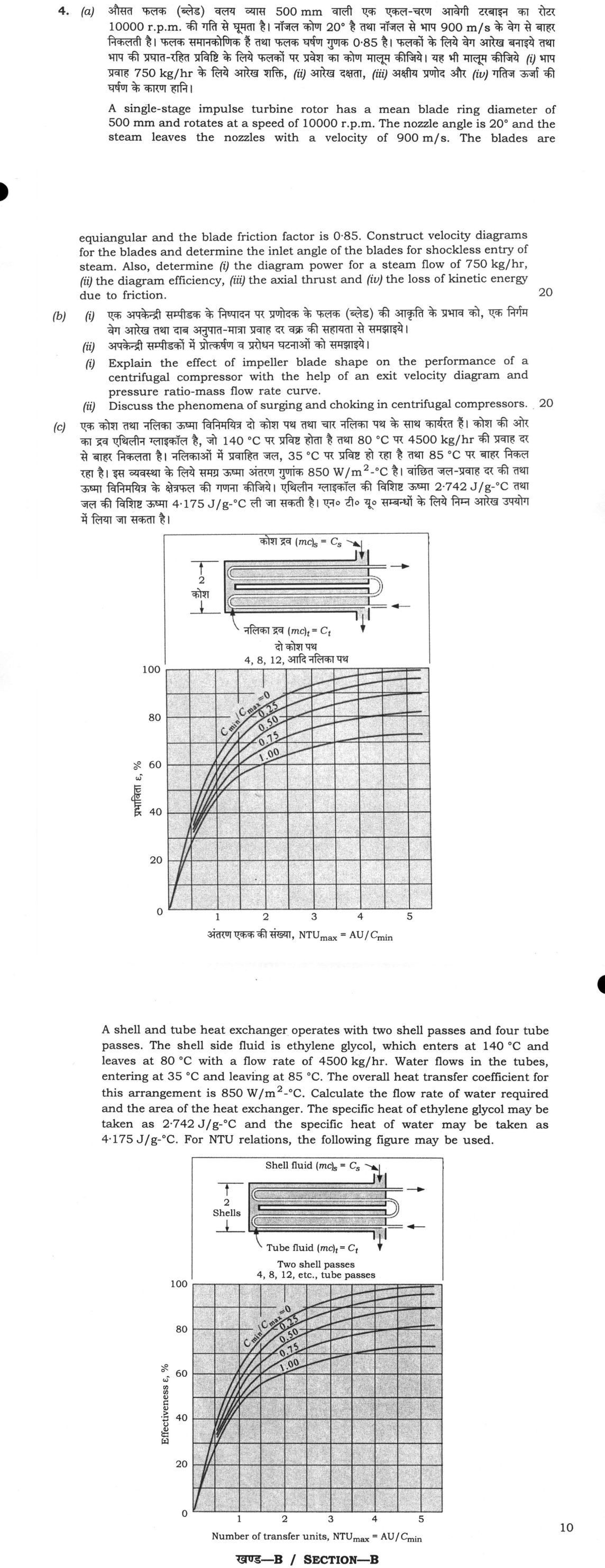
The figure this question refers to, in words
The question paper is a scan and the diagram did not survive as text. This is the figure as read from the original page — every component, value and label — so the question can be worked from the text below.
(c) The figure consists of two parts: a schematic diagram of a heat exchanger and a performance chart. The schematic shows a shell-and-tube heat exchanger with two shell passes and four tube passes. The shell fluid enters at the top right and exits at the bottom right, labeled with (mc)_s = C_s. The tube fluid enters at the bottom left and exits at the top left, labeled with (mc)_t = C_t. The chart below has a vertical axis labeled 'Effectiveness, epsilon, %' ranging from 0 to 100 with grid lines every 20 units. The horizontal axis is labeled 'Number of transfer units, NTU_max = AU/C_min' ranging from 0 to 5 with grid lines every 1 unit. The chart contains a family of curves representing different values of the ratio C_min/C_max. The curves are labeled with values 0, 0.25, 0.50, 0.75, and 1.00. The curve for C_min/C_max = 0 is the highest, starting at 0 and rising steeply to approach 100%. The curve for C_min/C_max = 1.00 is the lowest, rising more gradually. All curves start at the origin (0,0).
What "Construct" is asking you to do
Build the required object — a velocity diagram, a sequential test, a control chart, a geometrical figure — step by step, so the sequence is visible on the page. The steps are marked, not only the finished thing.
Structure that answers it
Data and requirement → scale or basis chosen, stated → construction steps in order → the finished construction, labelled → quantities read off, or the result it yields
Where marks are lost
A diagram drawn without a stated scale, so nothing can be scaled off it and the quantities that follow lose their support. In statistics, writing down the procedure without fixing its defining constants — stopping bounds in terms of the two error probabilities, or the control limits — leaves it unmarkable.
How this answer will be evaluated
Approach
Framework: UPSC Mechanical Engineering Paper 2. (a) calculate: given > formula > substitution > result with units > interpretation | (b(i)) explain: definition/context > points in order > small example > short close | (b(ii)) discuss: intro > 3-4 dimensions > example > balanced close | (c) calculate: given > formula > substitution > result with units > interpretation Full marks: All parts fully addressed with correct calculations, diagrams, and clear explanations.
Key points expected
- Blade velocity (u) calculated from D and N
- Velocity triangles drawn with correct angles
- Blade inlet angle determined for shockless entry
- Diagram power and efficiency calculated with units
- Exit velocity diagram included
- Pressure ratio-mass flow rate curve shown
- Blade shape (radial, backward, forward) linked to performance
- Work done and efficiency implications discussed
Evaluation rubric
Each sub-part is marked on its own, against the marks and word limit printed on the paper.
- (a) Velocity diagrams, blade angle, power, efficiency, thrust, and friction loss for impulse turbine. 20 marks
calculate— given → formula → substitution → result with units → interpretation
Must cover
- Blade velocity (u) calculated from D and N
- Velocity triangles drawn with correct angles
- Blade inlet angle determined for shockless entry
- Diagram power and efficiency calculated with units
Loses marks
- Missing velocity diagrams
- Blade angle not derived from geometry
- Units missing in final results
Earns more
- Axial thrust calculated from momentum change
- Kinetic energy loss due to friction quantified
- Relative velocities (Vr1, Vr2) explicitly stated
- Absolute exit velocity (V2) determined
Extra mark
- Clear, labelled velocity diagrams
- Physical interpretation of efficiency
- (b(i)) Effect of impeller blade shape on centrifugal compressor performance.
explain— definition/context → points in order → small example → short close
Must cover
- Exit velocity diagram included
- Pressure ratio-mass flow rate curve shown
- Blade shape (radial, backward, forward) linked to performance
- Work done and efficiency implications discussed
Loses marks
- No velocity diagram
- Blade shape not linked to performance
- Missing pressure ratio-mass flow curve
Earns more
- Slip factor mentioned
- Effect of blade angle on head coefficient
- Comparison of different blade shapes
Extra mark
- Reference to specific compressor types
- Graphical representation of performance curves
- (b(ii)) Phenomena of surging and choking in centrifugal compressors.
discuss— intro → 3-4 dimensions → example → balanced close
Must cover
- Surging defined and explained
- Choking defined and explained
- Causes and effects of both phenomena
- Prevention or mitigation strategies mentioned
Loses marks
- Surging and choking not clearly distinguished
- Causes or effects missing
- No mention of prevention strategies
Earns more
- Stability limits discussed
- Effect on compressor operation
- Reference to performance curves
Extra mark
- Graphical representation of surging/choking
- Practical examples or applications
- (c) Water flow rate and heat exchanger area for shell-and-tube exchanger. 10 marks
calculate— given → formula → substitution → result with units → interpretation
Must cover
- NTU method applied correctly
- Water flow rate calculated from energy balance
- Heat exchanger area determined using NTU relations
- Given data (temperatures, flow rates, specific heats) used
Loses marks
- NTU method not applied
- Water flow rate or area not calculated
- Units inconsistent or missing
Earns more
- Effectiveness (ε) calculated
- NTU value determined from graph or formula
- Unit consistency maintained throughout
Extra mark
- Clear step-by-step calculation
- Reference to NTU graph or formula
Model answer coming soon
Every evaluation on this site is marked against a verified model answer. This question's answer is still being written; evaluation opens the moment it lands.
More from Mechanical Engineering 2022 Paper II
- Q1 (a) Consider the system shown in Fig. 1(a). The two chambers initially have equal volumes…
- Q2 (a) 10 g of water at 20 °C is converted into ice at –10 °C at constant atmospheric pressu…
- Q3 (a) (i) How do the specific work output and efficiency vary with pressure ratio in a gas…
- Q4 (a) A single-stage impulse turbine rotor has a mean blade ring diameter of 500 mm and rot…
- Q5 (a) Can alcohols be used as fuel in IC engine? Explain with advantages and disadvantages.…
- Q6 (a) A four-cylinder diesel engine with swept volume of 0·98 litre is tested on a performa…
- Q7 (a) (i) Briefly discuss HC, CO and NOₓ emission formation in SI engine. Explain the depen…