Paper II — Q2
(a) 10 g of water at 20 °C is converted into ice at –10 °C at constant atmospheric pressure. Assuming the specific heat of liquid…
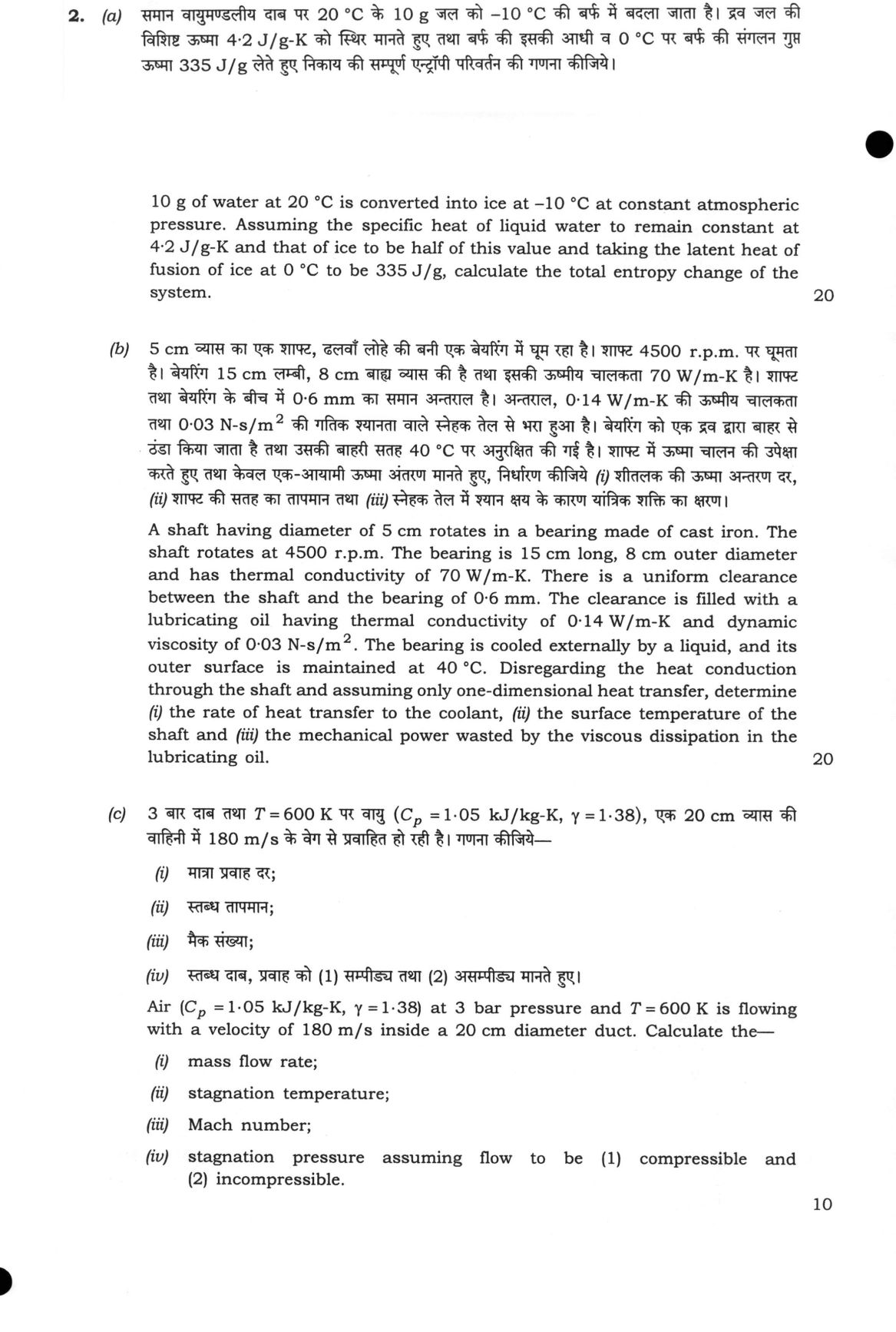
10 g of water at 20 °C is converted into ice at –10 °C at constant atmospheric pressure. Assuming the specific heat of liquid water to remain constant at 4·2 J/g-K and that of ice to be half of this value and taking the latent heat of fusion of ice at 0 °C to be 335 J/g, calculate the total entropy change of the system. 20 marks
A shaft having diameter of 5 cm rotates in a bearing made of cast iron. The shaft rotates at 4500 r.p.m. The bearing is 15 cm long, 8 cm outer diameter and has thermal conductivity of 70 W/m-K. There is a uniform clearance between the shaft and the bearing of 0·6 mm. The clearance is filled with a lubricating oil having thermal conductivity of 0·14 W/m-K and dynamic viscosity of 0·03 N-s/m². The bearing is cooled externally by a liquid, and its outer surface is maintained at 40 °C. Disregarding the heat conduction through the shaft and assuming only one-dimensional heat transfer, determine (i) the rate of heat transfer to the coolant, (ii) the surface temperature of the shaft and (iii) the mechanical power wasted by the viscous dissipation in the lubricating oil. 20 marks
Air (C_p = 1·05 kJ/kg-K, γ = 1·38) at 3 bar pressure and T = 600 K is flowing with a velocity of 180 m/s inside a 20 cm diameter duct. Calculate the—
mass flow rate;
stagnation temperature;
Mach number;
stagnation pressure assuming flow to be (1) compressible and (2) incompressible. 10 marks
हिंदी में प्रश्न पढ़ें
समान वायुमण्डलीय दाब पर 20 °C के 10 g जल को –10 °C की बर्फ में बदला जाता है। द्रव जल की विशिष्ट ऊष्मा 4·2 J/g-K को स्थिर मानते हुए तथा बर्फ की इसकी आधी व 0 °C पर बर्फ की संगलन गुप्त ऊष्मा 335 J/g लेते हुए निकाय की सम्पूर्ण एन्ट्रॉपी परिवर्तन की गणना कीजिये। (20 अंक)
5 cm व्यास का एक शाफ्ट, ढलवाँ लोहे की बनी एक बेयरिंग में घूम रहा है। शाफ्ट 4500 r.p.m. पर घूमता है। बेयरिंग 15 cm लम्बी, 8 cm बाह्य व्यास की है तथा इसकी ऊष्मीय चालकता 70 W/m-K है। शाफ्ट तथा बेयरिंग के बीच में 0·6 mm का समान अन्तराल है। अन्तराल, 0·14 W/m-K की ऊष्मीय चालकता तथा 0·03 N-s/m² की गतिक श्यानता वाले स्नेहक तेल से भरा हुआ है। बेयरिंग को एक द्रव द्वारा बाहर से ठंडा किया जाता है तथा उसकी बाहरी सतह 40 °C पर अनुशीत की गई है। शाफ्ट में ऊष्मा चालन की उपेक्षा करते हुए तथा केवल एक-आयामी ऊष्मा अन्तरण मानते हुए, निर्धारण कीजिये (i) शीतलक की ऊष्मा अन्तरण दर, (ii) शाफ्ट की सतह का तापमान तथा (iii) स्नेहक तेल में श्यान क्षय के कारण यांत्रिक शक्ति का क्षरण। (20 अंक)
3 बार दाब तथा T = 600 K पर वायु (C_p = 1·05 kJ/kg-K, γ = 1·38), एक 20 cm व्यास की वाहिनी में 180 m/s के वेग से प्रवाहित हो रही है। गणना कीजिये—
मात्रा प्रवाह दर;
स्थब्ध तापमान;
मैक संख्या;
स्थब्ध दाब, प्रवाह को (1) संपीड्य तथा (2) असंपीड्य मानते हुए। (10 अंक)
Model answer
Written by UPSC Answer Check against this question's marking rubric, to the expected length. UPSC does not publish answers for Mains — this is one way to score well, not an official key.
(a) Entropy is a state property, so replace the irreversible process by a reversible path. For the water–ice system:
- Cooling liquid water from 20 °C to 0 °C: ΔS₁ = m c_w ln(T₂/T₁) = 10 × 4.2 × ln(273/293) = 42 × ln(0.931741) = −2.969 J/K.
- Freezing at 0 °C: ΔS₂ = −m L/T₂ = −10 × 335/273 = −12.271 J/K.
- Cooling ice from 0 °C to −10 °C: ΔS₃ = m c_ice ln(T₃/T₂) = 10 × 2.1 × ln(263/273) = 21 × ln(0.963370) = −0.784 J/K.
Total entropy change of the system: ΔS_total = −2.969 − 12.271 − 0.784 = −16.024 J/K.
The negative sign is expected because the system cools and freezes, rejecting heat.
(b) Using the thin-film (Couette) approximation, valid because clearance c = 0.6 mm is small compared with shaft radius r₁ = 25 mm.
Given: r₁ = 0.025 m, c = 0.0006 m, r₂ = bearing inner radius = r₁ + c = 0.0256 m, r₃ = bearing outer radius = 0.04 m, L = 0.15 m, N = 4500/60 = 75 rev/s.
Shaft surface velocity: V = ω r₁ = 2πN r₁ = 2π × 75 × 0.025 = 3.75π = 11.781 m/s.
Shear stress in oil: τ = μV/c = 0.03 × 11.781/0.0006 = 589.05 N/m².
Shaft area: A = 2π r₁ L = 2π × 0.025 × 0.15 = 0.023562 m².
Viscous force: F = τA = 589.05 × 0.023562 = 13.879 N.
Mechanical power wasted: P = FV = 13.879 × 11.781 = 163.51 W.
(b)(i) In steady state, all viscous heat goes to the coolant: Rate of heat transfer to coolant = 163.51 W.
(b)(ii) Since shaft conduction is neglected, the oil–shaft interface is adiabatic. For the oil film with internal generation q‴:
q‴ = Q/[π(r₂² − r₁²)L] = 163.51/[π(0.0256² − 0.025²) × 0.15] = 1.143 × 10⁷ W/m³.
For radial conduction with internal generation and dT/dr = 0 at r₁: T(r₁) − T(r₂) = q‴/(4k_oil)[r₂² − r₁² + 2r₁² ln(r₁/r₂)] = 14.58 K.
Bearing conduction resistance: R_b = ln(r₃/r₂)/(2π k_b L) = ln(0.04/0.0256)/(2π × 70 × 0.15) = 0.006765 K/W.
Temperature drop through bearing: ΔT_b = Q R_b = 163.51 × 0.006765 = 1.106 K.
Thus bearing inner surface temperature = 40 + 1.106 = 41.106 °C.
Shaft surface temperature: T_shaft = 41.106 + 14.58 = 55.69 °C.
(b)(iii) Mechanical power wasted by viscous dissipation is the same as the heat generated: P_wasted = 163.51 W.
(c) For ideal gas: R = C_p(γ − 1)/γ = 1050 × (1.38 − 1)/1.38 = 289.13 J/kg-K.
Density: ρ = P/(RT) = 300000/(289.13 × 600) = 1.729 kg/m³.
Duct area: A = πD²/4 = π × 0.2²/4 = 0.031416 m².
(c)(i) Mass flow rate: m_dot = ρAV = 1.729 × 0.031416 × 180 = 9.779 kg/s.
(c)(ii) Stagnation temperature: T₀ = T + V²/(2C_p) = 600 + 180²/(2 × 1050) = 600 + 15.429 = 615.43 K.
(c)(iii) Speed of sound: a = sqrt(γRT) = sqrt(1.38 × 289.13 × 600) = sqrt(239400) = 489.29 m/s.
Mach number: M = V/a = 180/489.29 = 0.368.
(c)(iv)(1) Compressible stagnation pressure: P₀ = P[1 + (γ − 1)M²/2]^γ/(γ−1) = 3[1 + 0.19 × 0.368²]^3.6316 = 3 × 1.09659 = 3.290 bar.
(c)(iv)(2) Incompressible stagnation pressure: P₀ = P + ρV²/2 = 3 bar + (1.729 × 180²)/(2 × 10⁵) = 3 + 0.28015 = 3.280 bar.
What "Calculate" is asking you to do
Apply the standard formula or schedule to data the question has already supplied — a table of readings, cost records, a balance sheet — and produce the number. The method is rarely in doubt; the marks sit in the named intermediate quantities, each of which has to appear as a labelled line.
Structure that answers it
Data as given → formula or standard treatment, named → substitution → each intermediate, labelled → result with units
Where marks are lost
Omitting an intermediate the marking scheme pays for separately, or rounding at an intermediate line so the final figure drifts. In commerce and accountancy, any figure in a statement that no numbered working note supports is treated as unearned.
How this answer will be evaluated
Approach
(a) calculate: given > formula > substitution > result with units > interpretation | (b) calculate: given > formula > substitution > result with units > interpretation | (c) calculate: given > formula > substitution > result with units > interpretation Full marks: All parts solved with correct formulas, units, and physical interpretation.
Key points expected
- Identify three distinct thermodynamic states (20°C, 0°C, -10°C)
- Apply entropy formula for sensible heat (mCp ln(T2/T1))
- Apply entropy formula for phase change (mL/T)
- Sum contributions with correct signs for heat rejection
- Calculate viscous dissipation power (Torque x Angular Velocity)
- Set up thermal resistance network (conduction + convection)
- Determine shaft surface temperature via heat balance
- Calculate heat transfer rate to coolant
Evaluation rubric
Each sub-part is marked on its own, against the marks and word limit printed on the paper.
- (a) Total entropy change of the system for water to ice conversion. 20 marks
calculate— given → formula → substitution → result with units → interpretation
Must cover
- Identify three distinct thermodynamic states (20°C, 0°C, -10°C)
- Apply entropy formula for sensible heat (mCp ln(T2/T1))
- Apply entropy formula for phase change (mL/T)
- Sum contributions with correct signs for heat rejection
Loses marks
- Using Celsius in logarithmic temperature terms
- Omitting the phase change entropy term
- Sign error in entropy change calculation
Earns more
- Convert temperatures to Kelvin explicitly
- State specific heat of ice as 2.1 J/g-K
- Show units in each intermediate step
Extra mark
- T-s diagram showing the cooling and freezing path
- (b) Heat transfer rate, shaft surface temperature, and mechanical power wasted. 20 marks
calculate— given → formula → substitution → result with units → interpretation
Must cover
- Calculate viscous dissipation power (Torque x Angular Velocity)
- Set up thermal resistance network (conduction + convection)
- Determine shaft surface temperature via heat balance
- Calculate heat transfer rate to coolant
Loses marks
- Confusing diameter with radius in area calculations
- Ignoring the thermal resistance of the cast iron
- Incorrect unit conversion for viscosity or conductivity
Earns more
- Convert rpm to rad/s correctly
- Identify inner and outer radii for conduction
- Use Newton's law of cooling for the oil film
Extra mark
- Schematic of the shaft-bearing cross-section with dimensions
- (c) Mass flow rate, stagnation temperature, Mach number, and stagnation pressure. 10 marks
calculate— given → formula → substitution → result with units → interpretation
Must cover
- Calculate mass flow rate using density and area
- Determine stagnation temperature using energy equation
- Calculate Mach number using speed of sound
- Compute stagnation pressure for both compressible and incompressible cases
Loses marks
- Using static pressure instead of stagnation in Bernoulli
- Incorrect speed of sound calculation
- Mixing up compressible and incompressible formulas
Earns more
- Use ideal gas law for density calculation
- Apply isentropic relations for compressible flow
- Show Bernoulli's equation for incompressible case
Extra mark
- Comparison table for compressible vs incompressible results
Practice this exact question
Write your answer and it is marked point by point against the model answer above — what you covered, what you missed, what you got wrong.
Evaluate my answer →More from Mechanical Engineering 2022 Paper II
- Q1 (a) Consider the system shown in Fig. 1(a). The two chambers initially have equal volumes…
- Q2 (a) 10 g of water at 20 °C is converted into ice at –10 °C at constant atmospheric pressu…
- Q3 (a) (i) How do the specific work output and efficiency vary with pressure ratio in a gas…
- Q4 (a) A single-stage impulse turbine rotor has a mean blade ring diameter of 500 mm and rot…
- Q5 (a) Can alcohols be used as fuel in IC engine? Explain with advantages and disadvantages.…