Paper II — Q7
(a) (i) Briefly discuss HC, CO and NOₓ emission formation in SI engine. Explain the dependence of these emissions on equivalence…
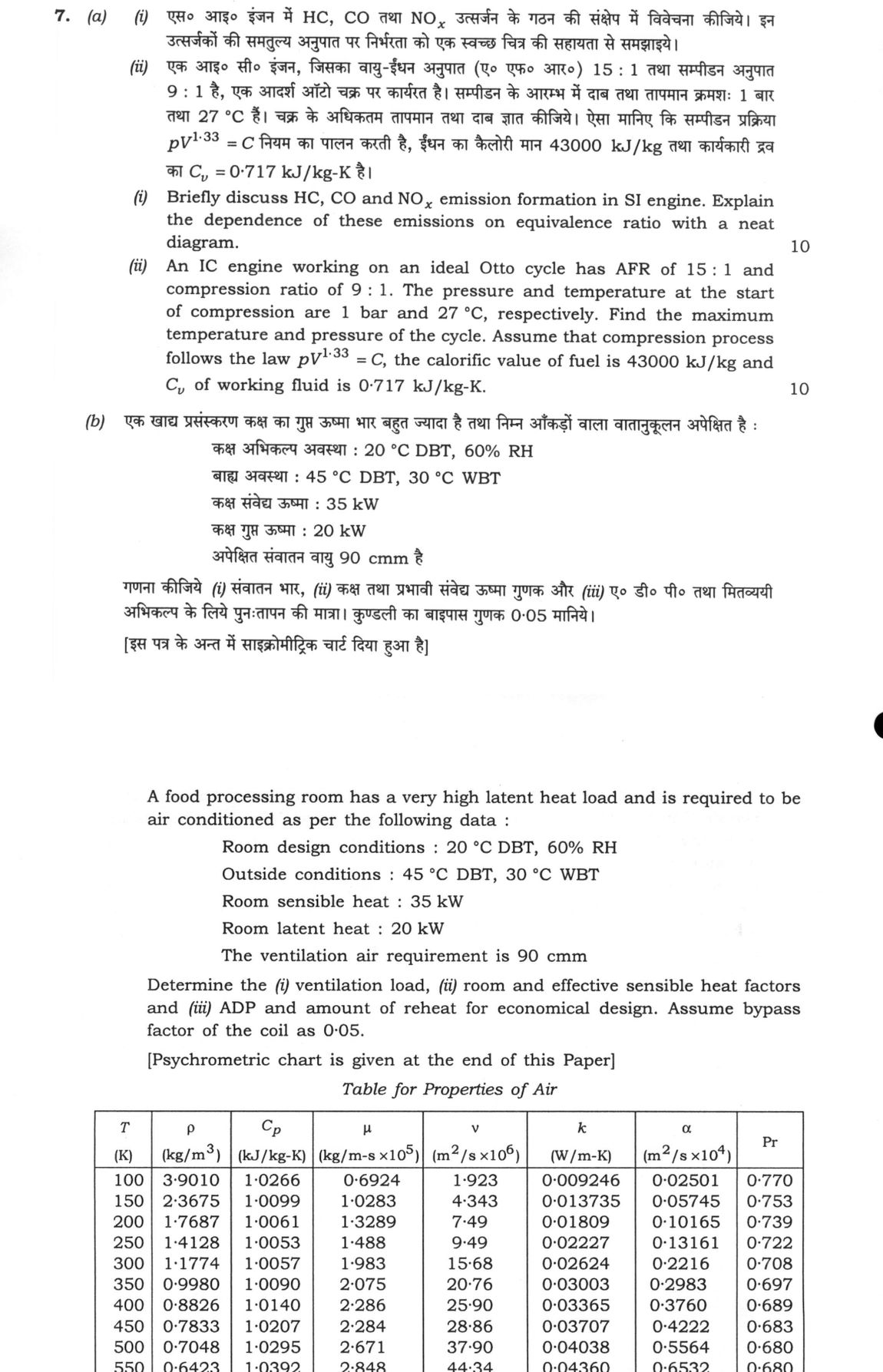
Briefly discuss HC, CO and NOₓ emission formation in SI engine. Explain the dependence of these emissions on equivalence ratio with a neat diagram. 10 marks
An IC engine working on an ideal Otto cycle has AFR of 15 : 1 and compression ratio of 9 : 1. The pressure and temperature at the start of compression are 1 bar and 27 °C, respectively. Find the maximum temperature and pressure of the cycle. Assume that compression process follows the law pV¹·³³ = C, the calorific value of fuel is 43000 kJ/kg and Cᵥ of working fluid is 0·717 kJ/kg-K. 10 marks
A food processing room has a very high latent heat load and is required to be air conditioned as per the following data: Room design conditions : 20 °C DBT, 60% RH Outside conditions : 45 °C DBT, 30 °C WBT Room sensible heat : 35 kW Room latent heat : 20 kW The ventilation air requirement is 90 cmm Determine the (i) ventilation load, (ii) room and effective sensible heat factors and (iii) ADP and amount of reheat for economical design. Assume bypass factor of the coil as 0·05. [Psychrometric chart is given at the end of this Paper] 20 marks
Prove mathematically that for maximum discharge through a chimney of a certain height and cross-section, the absolute temperature of gases bears a certain ratio to the absolute temperature of the outside atmosphere, in case of natural draught of a boiler. 10 marks
हिंदी में प्रश्न पढ़ें
एस० आइ० इंजन में HC, CO तथा NOₓ उत्सर्जन के गठन की संक्षेप में विवेचना कीजिये। इन उत्सर्जकों की समतुल्य अनुपात पर निर्भरता को एक स्वच्छ चित्र की सहायता से समझाइये। (10 अंक)
एक आइ० सी० इंजन, जिसका वायु-ईंधन अनुपात (ए० एफ० आर०) 15 : 1 तथा संपीडन अनुपात 9 : 1 है, एक आदर्श ऑटो चक्र पर कार्यरत है। संपीडन के आरम्भ में दाब तथा तापमान क्रमशः 1 बार तथा 27 °C है। चक्र के अधिकतम तापमान तथा दाब ज्ञात कीजिये। ऐसा मानिये कि संपीडन प्रक्रिया pV¹·³³ = C नियम का पालन करती है, ईंधन का कैलोरी मान 43000 kJ/kg तथा कार्यकारी द्रव का Cᵥ = 0·717 kJ/kg-K है। (10 अंक)
एक खाद्य प्रसंस्करण कक्ष का गुप्त उष्मा भार बहुत ज्यादा है तथा निम्न आँकड़ों वाला वातानुकूलन अपेक्षित है : कक्ष अभिकल्प अवस्था : 20 °C DBT, 60% RH बाह्य अवस्था : 45 °C DBT, 30 °C WBT कक्ष संवेग उष्मा : 35 kW कक्ष गुप्त उष्मा : 20 kW अपेक्षित संवातन वायु 90 cmm है गणना कीजिये (i) संवातन भार, (ii) कक्ष तथा प्रभावी संवेग उष्मा गुणांक और (iii) ए० डी० पी० तथा मितव्ययी अभिकल्प के लिये पुनःतापन की मात्रा। कुडली का बाइपास गुणांक 0·05 मानिये। [इस पत्र के अंत में साइक्रोमैट्रिक चार्ट दिया हुआ है] (20 अंक)
एक वाष्पीय (बॉयलर) में, प्राकृतिक प्रवाह की अवस्था के लिये, गणितीय रूप से सिद्ध कीजिये कि एक निश्चित ऊँचाई तथा अनुप्रस्थ काट की चिमनी में, अधिकतम निस्सरण के लिये, गैसों के निरपेक्ष तापमान का बाह्य वातावरण के निरपेक्ष तापमान से एक निश्चित अनुपात वाला सम्बन्ध होता है। (10 अंक)
The figure this question refers to, in words
The question paper is a scan and the diagram did not survive as text. This is the figure as read from the original page — every component, value and label — so the question can be worked from the text below.
(b) PSYCHROMETRIC CHART BAROMETRIC PRESSURE 1.01325 bar SEA LEVEL
Top Axis: SPECIFIC ENTHALPY AT SATURATION, kJ/kg AIR. Scale from 0 to 115 in increments of 5.
Left Vertical Axis: DRY BULB TEMPERATURE, °C. Scale from -10 to 55 in increments of 5.
Bottom Left Axis: MOISTURE CONTENT kg/kg DRY AIR. Scale from 0.000 to 0.033 in increments of 0.001.
Bottom Right Axis: SENSIBLE HEAT FACTOR. Scale from 0.35 to 1.00.
Left Side Annotations (Specific Volume, m³/kg): 0.75 m³/kg 0.80 m³/kg 0.85 m³/kg 0.90 m³/kg
Diagonal Lines (Wet Bulb or Saturation Temperature, °C): Labels visible: -5, 0, 5, 10, 15, 20, 25, 30, 35, 40, 45, 50, 55.
Curved Lines (Relative Humidity %): Labels visible: 10%, 20%, 30%, 40%, 50%, 60%, 70%, 80%, 90%.
Dashed Lines (Enthalpy Deviation, kJ/kg DRY AIR): Labels visible: -0.05, -0.1, -0.2, -0.4, -0.6, -0.8, -1.0, -1.2.
Note at bottom: Ref. Point for SHF is 25 °C, 50% RH
Footer: CRNA-S-MCHE/19 20 SS23-582
What "Solve" is asking you to do
Choose the method, then carry it through to a final answer. Identifying what kind of problem this is and why that method applies is the first thing marked; a correct figure arrived at invisibly earns almost nothing.
Structure that answers it
Given data and what is required → method chosen, with the reason it applies → set-up (equation, circuit, free body, trial balance) → working, step by step → answer with units and any condition of validity
Where marks are lost
Doing the middle steps mentally and writing only the result. In mathematics papers, a further loss comes from giving a decimal where the exact value in surds or fractions was wanted, or from skipping the justification a part explicitly asks for.
How this answer will be evaluated
Approach
(a(i)) discuss: intro > 3-4 dimensions > example > balanced close | (a(ii)) calculate: given > formula > substitution > result with units > interpretation | (b) calculate: given > formula > substitution > result with units > interpretation Full marks: All parts fully solved with correct methods, units, and diagrams; no conceptual errors.
Key points expected
- HC formation via quenching and crevice flow
- CO formation via incomplete combustion
- NOx formation via Zeldovich mechanism
- Neat diagram of emissions vs equivalence ratio
- State 1 properties (P1, T1) and compression ratio
- Calculate state 2 using pV^1.33 = C
- Calculate state 3 using heat addition and Cv
- Final values for T3 and P3 with units
Evaluation rubric
Each sub-part is marked on its own, against the marks and word limit printed on the paper.
- (a(i)) Formation mechanisms of HC, CO, NOx and their dependence on equivalence ratio. 10 marks
discuss— intro → 3-4 dimensions → example → balanced close
Must cover
- HC formation via quenching and crevice flow
- CO formation via incomplete combustion
- NOx formation via Zeldovich mechanism
- Neat diagram of emissions vs equivalence ratio
Loses marks
- No diagram provided
- Confusing CO and HC formation mechanisms
- Missing dependence on equivalence ratio
Earns more
- Explanation of peak NOx at stoichiometric ratio
- Mention of rich vs lean burn effects
- Reference to residence time and temperature
Extra mark
- Mention of catalytic converter relevance
- Specific temperature threshold for NOx
- (a(ii)) Maximum temperature and pressure of the ideal Otto cycle. 10 marks
calculate— given → formula → substitution → result with units → interpretation
Must cover
- State 1 properties (P1, T1) and compression ratio
- Calculate state 2 using pV^1.33 = C
- Calculate state 3 using heat addition and Cv
- Final values for T3 and P3 with units
Loses marks
- Using gamma=1.4 instead of 1.33 for compression
- Missing units in final answer
- No governing equation stated
Earns more
- Correct calculation of air-fuel mass ratio
- Explicit statement of assumptions (ideal gas)
- Step-by-step substitution of values
Extra mark
- Sketch of p-V or T-s diagram with states
- Verification of dimensional consistency
- (b) Ventilation load, SHF, ESHF, ADP, and reheat amount. 20 marks
calculate— given → formula → substitution → result with units → interpretation
Must cover
- Ventilation load calculation (sensible + latent)
- Room SHF and ESHF determination
- ADP location on psychrometric chart
- Reheat amount calculation using bypass factor
Loses marks
- Ignoring ventilation load in ESHF
- Incorrect ADP location
- No use of bypass factor in reheat calc
Earns more
- Correct use of psychrometric chart data
- Clear distinction between room and effective loads
- Proper application of bypass factor formula
Extra mark
- Labelled psychrometric chart with all states
- Mention of coil efficiency or effectiveness
Model answer coming soon
Every evaluation on this site is marked against a verified model answer. This question's answer is still being written; evaluation opens the moment it lands.
More from Mechanical Engineering 2022 Paper II
- Q4 (a) A single-stage impulse turbine rotor has a mean blade ring diameter of 500 mm and rot…
- Q5 (a) Can alcohols be used as fuel in IC engine? Explain with advantages and disadvantages.…
- Q6 (a) A four-cylinder diesel engine with swept volume of 0·98 litre is tested on a performa…
- Q7 (a) (i) Briefly discuss HC, CO and NOₓ emission formation in SI engine. Explain the depen…
- Q8 (a) A VCR cycle refrigerator driven by a 60 kW compressor has a COP of 6·0. The enthalpie…