Paper II — Q1
(a) A 50 kg block of iron at 500 K is placed into open atmosphere which is at a temperature of 285 K. The iron block eventually…
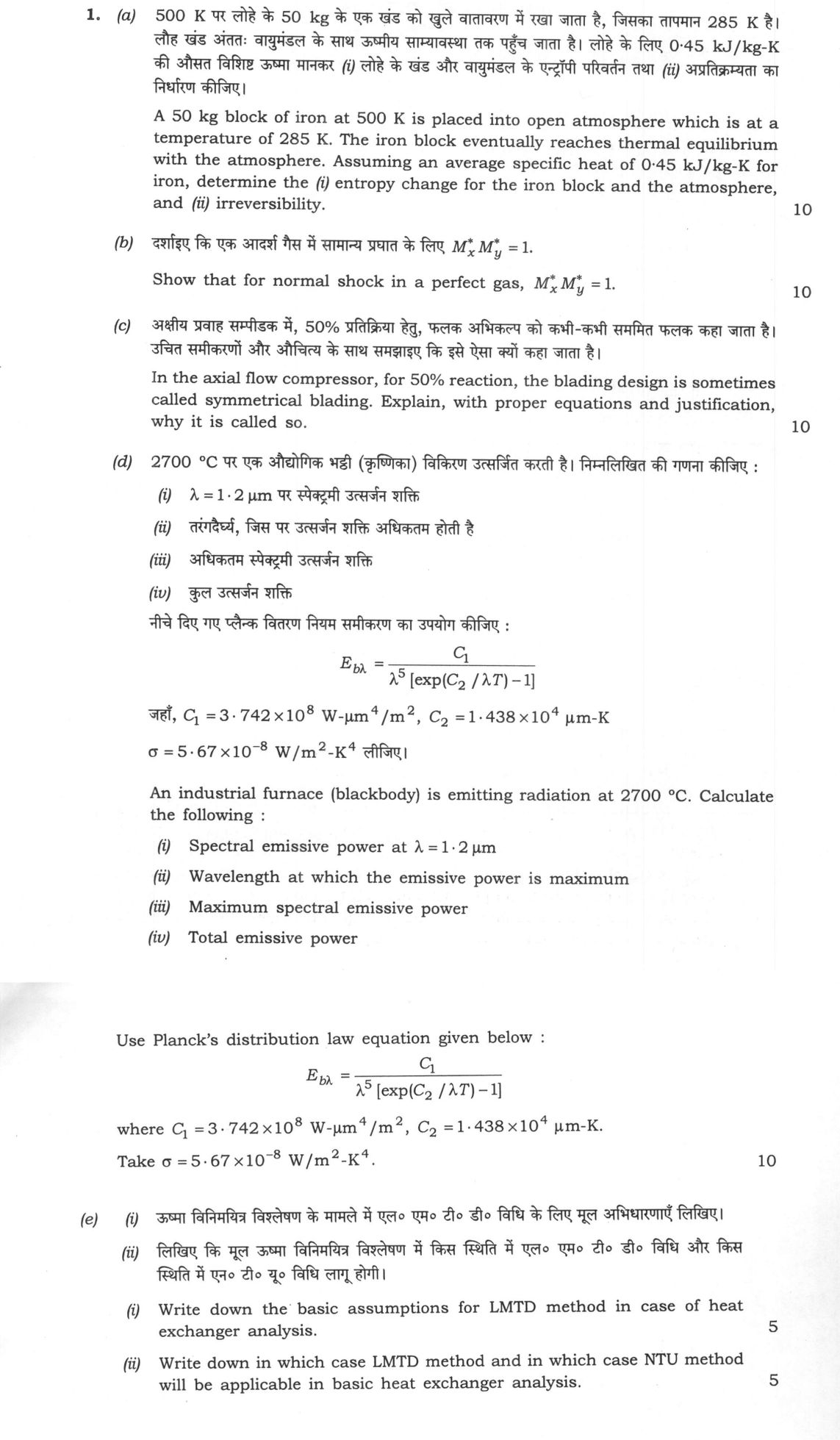
A 50 kg block of iron at 500 K is placed into open atmosphere which is at a temperature of 285 K. The iron block eventually reaches thermal equilibrium with the atmosphere. Assuming an average specific heat of 0·45 kJ/kg-K for iron, determine the (i) entropy change for the iron block and the atmosphere, and (ii) irreversibility. 10 marks
Show that for normal shock in a perfect gas, M*ₓ M*ᵧ = 1. 10 marks
In the axial flow compressor, for 50% reaction, the blading design is sometimes called symmetrical blading. Explain, with proper equations and justification, why it is called so. 10 marks
An industrial furnace (blackbody) is emitting radiation at 2700 °C. Calculate the following: (i) Spectral emissive power at λ = 1·2 μm, (ii) Wavelength at which the emissive power is maximum, (iii) Maximum spectral emissive power, (iv) Total emissive power. Use Planck's distribution law equation given below: E_bλ = (C₁)/(λ⁵ [exp(C₂/λ T)-1]) where C₁ = 3.742 × 10⁸ W-μm⁴/m², C₂ = 1.438 × 10⁴ μm-K. Take σ = 5.67 × 10⁻⁸ W/m²-K⁴. 10 marks
Write down the basic assumptions for LMTD method in case of heat exchanger analysis. 5 marks
Write down in which case LMTD method and in which case NTU method will be applicable in basic heat exchanger analysis. 5 marks
हिंदी में प्रश्न पढ़ें
500 K पर लोहे के 50 kg के एक खंड को खुले वातावरण में रखा जाता है, जिसका तापमान 285 K है। लोह खंड अंततः वायुमंडल के साथ ऊष्मीय साम्यावस्था तक पहुँच जाता है। लोहे के लिए 0·45 kJ/kg-K की औसत विशिष्ट ऊष्मा मानकर (i) लोहे के खंड और वायुमंडल के एन्ट्रॉपी परिवर्तन तथा (ii) अप्रतिक्रम्यता का निर्धारण कीजिए। (10 अंक)
दर्शाइए कि एक आदर्श गैस में सामान्य प्रघात के लिए M*ₓ M*ᵧ = 1. (10 अंक)
अक्षीय प्रवाह संपीडक में, 50% प्रतिक्रिया हेतु, फलक अभिकल्प को कभी-कभी सममित फलक कहा जाता है। उचित समीकरणों और औचित्य के साथ समझाइए कि इसे ऐसा क्यों कहा जाता है। (10 अंक)
2700 °C पर एक औद्योगिक भट्टी (कृष्णिका) विकिरण उत्सर्जित करती है। निम्नलिखित की गणना कीजिए: (i) λ = 1·2 μm पर स्पेक्ट्रमी उत्सर्जन शक्ति, (ii) तरंगदैर्ध्य, जिस पर उत्सर्जन शक्ति अधिकतम होती है, (iii) अधिकतम स्पेक्ट्रमी उत्सर्जन शक्ति, (iv) कुल उत्सर्जन शक्ति। नीचे दिए गए प्लैंक वितरण नियम समीकरण का उपयोग कीजिए: E_bλ = (C₁)/(λ⁵ [exp(C₂/λT)-1]) जहाँ, C₁ = 3·742×10⁸ W-μm⁴/m², C₂ = 1·438×10⁴ μm-K. σ = 5·67×10⁻⁸ W/m²-K⁴ लीजिए। (10 अंक)
उष्मा विनिमयक विश्लेषण के मामले में एल० एम० टी० डी० विधि के लिए मूल अभिधारणाएँ लिखिए। (5 अंक)
लिखिए कि मूल उष्मा विनिमयक विश्लेषण में किस स्थिति में एल० एम० टी० डी० विधि और किस स्थिति में एन० टी० यू० विधि लागू होगी। (5 अंक)
Model answer
Written by UPSC Answer Check against this question's marking rubric, to the expected length. UPSC does not publish answers for Mains — this is one way to score well, not an official key.
(a)(i) For a solid with average specific heat c, entropy change is obtained from dS = m c dT/T.
ΔS_iron = ∫ from T_i to T_f of m c dT/T = m c ln(T_f/T_i)
m c = 50 × 0·45 = 22·5 kJ/K, T_i = 500 K, T_f = 285 K.
ΔS_iron = 22·5 ln(285/500) = 22·5 ln(0·57) = 22·5 × (−0·5621189) = −12·65 kJ/K
Heat given by iron to atmosphere:
Q = m c (T_i − T_f) = 50 × 0·45 × (500 − 285) = 22·5 × 215 = 4837·5 kJ
Atmosphere behaves as a thermal reservoir at T_atm = 285 K.
ΔS_atm = Q/T_atm = 4837·5/285 = +16·974 kJ/K
Thus total entropy generation:
S_gen = ΔS_iron + ΔS_atm = −12·6477 + 16·9737 = 4·326 kJ/K
(a)(ii) Irreversibility is the exergy destroyed:
I = T₀ S_gen = T_atm S_gen
I = 285 × 4·326 = 1232·9 kJ
Condition: average specific heat is constant and no phase change occurs.
(b) For a perfect gas across a normal shock, define the critical Mach number as M* = V/a*, where
a* = √(2γRT₀/(γ+1))
Using T₀/T = 1 + ((γ−1)/2)M²,
M*² = V²/a*² = γRTM² / [2γRT₀/(γ+1)]
M*² = (γ+1)M² / [2 + (γ−1)M²]
For upstream x:
M*ₓ² = (γ+1)Mₓ² / [2 + (γ−1)Mₓ²]
The normal-shock relation for downstream y is
Mᵧ² = [(γ−1)Mₓ² + 2] / [2γMₓ² − (γ−1)]
Let u = Mₓ². Then
Mᵧ² = [(γ−1)u + 2] / [2γu − (γ−1)]
Now
M*ᵧ² = (γ+1)Mᵧ² / [2 + (γ−1)Mᵧ²]
Substitute Mᵧ² and simplify. Let D = 2γu − (γ−1).
M*ᵧ² = [(γ+1)((γ−1)u + 2)/D] / [2 + (γ−1)((γ−1)u + 2)/D]
Denominator simplifies to
[2D + (γ−1)((γ−1)u + 2)]/D = [(γ+1)²u]/D
Hence
M*ᵧ² = [(γ−1)u + 2] / [(γ+1)u]
But
M*ₓ² = (γ+1)u / [(γ−1)u + 2]
Therefore
M*ₓ² M*ᵧ² = 1
Taking positive square roots,
**M*ₓ M*ᵧ = 1**
This result holds for a steady, adiabatic normal shock in a perfect gas with constant γ.
(c) For an axial compressor stage, reaction R is
R = static enthalpy rise in rotor / stage static enthalpy rise
R = (h₂ − h₁)/(h₃ − h₁)
For 50% reaction, R = 1/2, so the rotor and stator have equal static enthalpy rise.
For the rotor, using the relative-flow energy equation with constant blade speed at the mean radius,
h₂ − h₁ = (W₁² − W₂²)/2
For the stator,
h₃ − h₂ = (V₂² − V₃²)/2
For a repeating stage, V₃ = V₁. Hence for R = 1/2,
W₁² − W₂² = V₂² − V₁²
Assume constant axial velocity C_a. Let U be blade speed and V_u be whirl component. Then
V² = C_a² + V_u²
W² = C_a² + (V_u − U)²
Substituting:
(V_u1 − U)² − (V_u2 − U)² = V_u2² − V_u1²
Expanding and simplifying gives
U = V_u1 + V_u2
Therefore,
W_u1 = V_u1 − U = −V_u2
W_u2 = V_u2 − U = −V_u1
So the magnitude of the rotor-inlet relative whirl equals the rotor-exit absolute whirl, and the magnitude of the rotor-exit relative whirl equals the rotor-inlet absolute whirl. Thus
|β₁| = |α₂| and |β₂| = |α₁|
or, with the usual opposite-angle convention,
β₁ = α₂ and β₂ = α₁
The inlet and outlet velocity triangles are therefore mirror images. The rotor and stator blade angles are identical in magnitude, so the rotor and stator blade passages have the same shape and same angles. This is why 50% reaction blading is called symmetrical blading. It also gives equal diffusion and equal static pressure rise in rotor and stator.
(d) Furnace temperature:
T = 2700 + 273 = 2973 K
(d)(i) Planck’s law:
E_bλ = C₁ / [λ⁵(exp(C₂/(λT)) − 1)]
λ = 1·2 μm, λT = 1·2 × 2973 = 3567·6 μm-K
C₂/(λT) = 14380/3567·6 = 4·0307
exp(4·0307) − 1 = 55·3015
λ⁵ = 1·2⁵ = 2·48832
E_bλ = 3·742 × 10⁸ / [2·48832 × 55·3015]
E_bλ = 3·742 × 10⁸ / 137·608 = 2·72 × 10⁶ W/(m²·μm)
(d)(ii) Wien’s displacement law:
λ_max T = 2898 μm-K
λ_max = 2898/2973 = 0·9748 μm ≈ 0·975 μm
(d)(iii) At λ_max, using Planck’s law:
C₂/(λ_max T) = C₂/2898 = 14380/2898 = 4·9620
exp(4·9620) − 1 = 141·884
λ_max⁵ ≈ (0·9748)⁵ = 0·8802
E_bλ,max = 3·742 × 10⁸ / [0·8802 × 141·884]
E_bλ,max = 2·997 × 10⁶ W/(m²·μm) ≈ 3·00 × 10⁶ W/(m²·μm)
(d)(iv) Stefan-Boltzmann law:
E_b = σT⁴
E_b = 5·67 × 10⁻⁸ × (2973)⁴
(2973)⁴ = 7·8123 × 10¹³ K⁴
E_b = 5·67 × 10⁻⁸ × 7·8123 × 10¹³
E_b = 4·43 × 10⁶ W/m²
(e)(i) Basic assumptions for LMTD method:
- Steady-state operation of the heat exchanger.
- Constant mass flow rates of both fluids.
- Constant specific heats and fluid properties.
- Constant overall heat transfer coefficient U over the entire heat transfer surface.
- No heat loss to the surroundings; heat exchanger is adiabatic.
- Negligible kinetic and potential energy changes.
- No internal heat generation.
- For the basic LMTD formula, flow arrangement is usually parallel-flow or counter-flow.
- For cross-flow or multipass exchangers, LMTD is multiplied by a correction factor F.
- If phase change occurs, it is assumed to occur at constant temperature, or the fluid is treated as having very large heat capacity.
(e)(ii) LMTD method is applicable when the inlet and outlet temperatures of both fluids are known or can be determined directly. It is mainly used for design or sizing problems, e.g. to find the required heat transfer area from Q = U A ΔT_lm. If outlet temperatures are unknown, LMTD requires trial-and-error iteration.
NTU method is applicable when inlet temperatures and mass flow rates or fluid properties are known, but outlet temperatures are unknown. It is mainly used for performance or rating problems, e.g. to find heat duty and outlet temperatures from known exchanger size. The ε-NTU method avoids iteration and is especially convenient when one fluid undergoes phase change or when C_min/C_max is known.
What "Solve" is asking you to do
Choose the method, then carry it through to a final answer. Identifying what kind of problem this is and why that method applies is the first thing marked; a correct figure arrived at invisibly earns almost nothing.
Structure that answers it
Given data and what is required → method chosen, with the reason it applies → set-up (equation, circuit, free body, trial balance) → working, step by step → answer with units and any condition of validity
Where marks are lost
Doing the middle steps mentally and writing only the result. In mathematics papers, a further loss comes from giving a decimal where the exact value in surds or fractions was wanted, or from skipping the justification a part explicitly asks for.
How this answer will be evaluated
Approach
(a) calculate: given > formula > substitution > result with units > interpretation | (b) derive: given > assumptions > stepwise derivation > result > check | (c) explain: definition/context > points in order > small example > short close | (d) calculate: given > formula > substitution > result with units > interpretation | (e(i)) enumerate: list the items in order > one line each > no commentary | (e(ii)) compare: paired headings or table > key differences > significance > conclusion Full marks: Rigorous derivations, correct units, clear diagrams, physical interpretation.
Key points expected
- Given data: m=50kg, T1=500K, T2=285K, c=0.45kJ/kg-K
- Iron entropy change: ΔS = mc ln(T2/T1)
- Atmosphere entropy change: ΔS = Q/T_atm
- Irreversibility: I = T0 ΔS_universe
- Definition of M* (critical Mach number)
- Normal shock relations (mass, momentum, energy)
- Algebraic manipulation to isolate Mx* My*
- Final result Mx* My* = 1
Evaluation rubric
Each sub-part is marked on its own, against the marks and word limit printed on the paper.
- (a) Entropy changes for iron and atmosphere, and irreversibility. 10 marks
calculate— given → formula → substitution → result with units → interpretation
Must cover
- Given data: m=50kg, T1=500K, T2=285K, c=0.45kJ/kg-K
- Iron entropy change: ΔS = mc ln(T2/T1)
- Atmosphere entropy change: ΔS = Q/T_atm
- Irreversibility: I = T0 ΔS_universe
Loses marks
- Using Celsius instead of Kelvin
- Ignoring entropy change of atmosphere
Earns more
- Correct sign convention for entropy
- Units consistent (kJ/K)
- Physical interpretation of irreversibility
Extra mark
- T-s diagram showing heat transfer
- (b) Proof that Mx* My* = 1 for normal shock in perfect gas. 10 marks
derive— given → assumptions → stepwise derivation → result → check
Must cover
- Definition of M* (critical Mach number)
- Normal shock relations (mass, momentum, energy)
- Algebraic manipulation to isolate Mx* My*
- Final result Mx* My* = 1
Loses marks
- Skipping intermediate algebra steps
- Confusing M* with M
Earns more
- Clear step-by-step derivation
- Correct use of gamma (γ)
Extra mark
- Mention of Fanno line or Rayleigh line context
- (c) Why 50% reaction blading is called symmetrical blading. 10 marks
explain— definition/context → points in order → small example → short close
Must cover
- Definition of reaction (R = Δh_rotor / Δh_stage)
- Velocity triangle geometry for R=0.5
- Symmetry of inlet/outlet velocity triangles
- Blade angle relationships (β1 = α2, β2 = α1)
Loses marks
- No velocity triangles
- Confusing absolute and relative velocities
Earns more
- Drawn velocity triangles
- Equation for reaction R
Extra mark
- Comparison with 0% or 100% reaction
- (d) Spectral emissive power, peak wavelength, max power, total power. 10 marks
calculate— given → formula → substitution → result with units → interpretation
Must cover
- Planck's law substitution for E_bλ at 1.2μm
- Wien's displacement law for λ_max
- Calculation of E_bλ at λ_max
- Stefan-Boltzmann law for total emissive power
Loses marks
- Using Celsius in Planck's law
- Arithmetic errors in exponentials
Earns more
- Correct unit conversions (K, μm)
- Use of provided constants C1, C2, σ
Extra mark
- Graph of Planck distribution
- (e(i)) Basic assumptions for LMTD method. 5 marks
enumerate— list the items in order → one line each → no commentary
Must cover
- Constant specific heats
- Constant overall heat transfer coefficient (U)
- Negligible heat loss to surroundings
- Steady-state operation
Loses marks
- Listing assumptions for NTU method instead
Earns more
- Mention of constant fluid properties
Extra mark
- Mention of no phase change
- (e(ii)) Applicability of LMTD vs NTU methods. 5 marks
compare— paired headings or table → key differences → significance → conclusion
Must cover
- LMTD: when outlet temperatures are known
- NTU: when outlet temperatures are unknown
- LMTD: for design problems
- NTU: for rating problems
Loses marks
- Confusing design and rating contexts
Earns more
- Mention of effectiveness (ε) for NTU
Extra mark
- Example of a rating problem
Practice this exact question
Write your answer and it is marked point by point against the model answer above — what you covered, what you missed, what you got wrong.
Evaluate my answer →More from Mechanical Engineering 2023 Paper II
- Q1 (a) A 50 kg block of iron at 500 K is placed into open atmosphere which is at a temperatu…
- Q2 (a) A 15 m high cylinder with a cross-sectional area of 0.6 m² contains 3 m³ of liquid wa…
- Q3 (a) Heat is generated in a stainless steel plate (thermal conductivity = 22 W/m-K) of thi…
- Q4 (a) Considering an ideal, isentropic gas flow through a nozzle, show that choking will oc…