Paper II — Q4
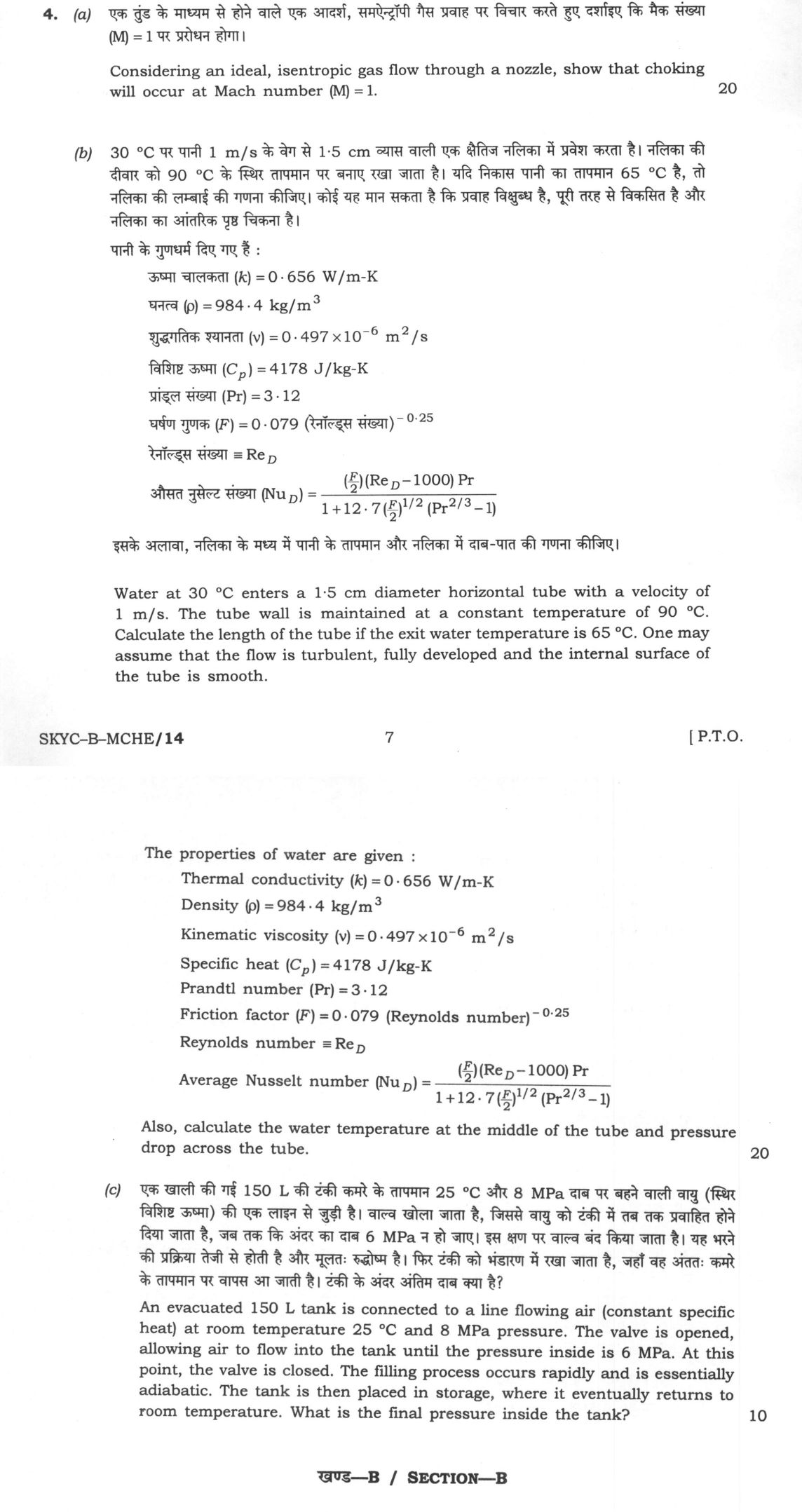
(a) Considering an ideal, isentropic gas flow through a nozzle, show that choking will occur at Mach number (M) = 1. (20…
Considering an ideal, isentropic gas flow through a nozzle, show that choking will occur at Mach number (M) = 1. 20 marks
Water at 30 °C enters a 1·5 cm diameter horizontal tube with a velocity of 1 m/s. The tube wall is maintained at a constant temperature of 90 °C. Calculate the length of the tube if the exit water temperature is 65 °C. One may assume that the flow is turbulent, fully developed and the internal surface of the tube is smooth.
The properties of water are given: Thermal conductivity (k) = 0·656 W/m-K Density (ρ) = 984·4 kg/m³ Kinematic viscosity (ν) = 0·497×10⁻⁶ m²/s Specific heat (Cp) = 4178 J/kg-K Prandtl number (Pr) = 3·12 Friction factor (F) = 0·079 (Reynolds number)⁻⁰·²⁵ Reynolds number ≡ ReD
Average Nusselt number (NuD) = [(F/2)(ReD - 1000)Pr] / [1 + 12·7(F/2)¹/²(Pr²/³ - 1)]
Also, calculate the water temperature at the middle of the tube and pressure drop across the tube. 20 marks
An evacuated 150 L tank is connected to a line flowing air (constant specific heat) at room temperature 25 °C and 8 MPa pressure. The valve is opened, allowing air to flow into the tank until the pressure inside is 6 MPa. At this point, the valve is closed. The filling process occurs rapidly and is essentially adiabatic. The tank is then placed in storage, where it eventually returns to room temperature. What is the final pressure inside the tank? 10 marks
हिंदी में प्रश्न पढ़ें
एक नोजल के माध्यम से होने वाले एक आदर्श, समएन्ट्रॉपी गैस प्रवाह पर विचार करते हुए दर्शाइए कि मैक संख्या (M) = 1 पर प्रोधन होगा। (20 अंक)
30 °C पर पानी 1 m/s के वेग से 1·5 cm व्यास वाली एक क्षैतिज नलिका में प्रवेश करता है। नलिका की दीवार को 90 °C के स्थिर तापमान पर बनाए रखा जाता है। यदि निकास पानी का तापमान 65 °C है, तो नलिका की लम्बाई की गणना कीजिए। कोई यह मान सकता है कि प्रवाह विषमुख है, पूरी तरह से विकसित है और नलिका का आंतरिक पृष्ठ चिकना है।
पानी के गुणधर्म दिए गए हैं: ऊष्मा चालकता (k) = 0·656 W/m-K घनत्व (ρ) = 984·4 kg/m³ श्यानता (ν) = 0·497×10⁻⁶ m²/s विशिष्ट ऊष्मा (Cₚ) = 4178 J/kg-K प्रांडल संख्या (Pr) = 3·12 घर्षण गुणक (F) = 0·079 (रेनॉल्ड्स संख्या)⁻⁰·²⁵ रेनॉल्ड्स संख्या ≡ Reᴅ
औसत नुसेल्ट संख्या (Nuᴅ) = [(F/2)(Reᴅ - 1000)Pr] / [1 + 12·7(F/2)¹/²(Pr²/³ - 1)]
इसके अलावा, नलिका के मध्य में पानी के तापमान और नलिका में दाब-पात की गणना कीजिए। (20 अंक)
एक खाली की गई 150 L की टंकी कमरे के तापमान 25 °C और 8 MPa दाब पर बहने वाली वायु (स्थिर विशिष्ट ऊष्मा) की एक लाइन से जुड़ी है। वाल्व खोला जाता है, जिससे वायु को टंकी में तब तक प्रवाहित होने दिया जाता है, जब तक कि अंदर का दाब 6 MPa न हो जाए। इस क्षण पर वाल्व बंद किया जाता है। यह भरने की प्रक्रिया तेजी से होती है और मूलतः रूद्धोष्म है। फिर टंकी को भंडारण में रखा जाता है, जहाँ वह अंततः कमरे के तापमान पर वापस आ जाती है। टंकी के अंदर अंतिम दाब क्या है? (10 अंक)
Model answer
Written by UPSC Answer Check against this question's marking rubric, to the expected length. UPSC does not publish answers for Mains — this is one way to score well, not an official key.
(a) For isentropic flow of an ideal gas, the stagnation relations are T0/T = 1 + ((γ − 1)/2)M² p0/p = [1 + ((γ − 1)/2)M²]^(γ/(γ − 1)) V = M√(γRT)
The mass flow through area A is ṁ = ρAV = A p M √(γ/(RT))
Substituting p and T from the stagnation relations, ṁ = A p0 √(γ/(R T0)) M [1 + ((γ − 1)/2)M²]^[−(γ + 1)/(2(γ − 1))]
For fixed A, p0 and T0, the mass flux G = ṁ/A is maximum when d(ln G)/dM = 0
Thus, 1/M − [(γ + 1)/2]M/[1 + ((γ − 1)/2)M²] = 0
This gives 1 + ((γ − 1)/2)M² = ((γ + 1)/2)M² so M² = 1, hence M = 1 for positive flow.
Therefore the mass flow reaches a maximum at M = 1. Once the throat reaches M = 1, further reduction of downstream pressure cannot increase the flow, because pressure signals cannot travel upstream through a sonic throat. Hence choking occurs at Mach number M = 1.
(b) (i) Tube length D = 1·5 cm = 0·015 m, u = 1 m/s, Ti = 30 °C, To = 65 °C, Ts = 90 °C. ReD = uD/ν = (1 × 0·015)/(0·497 × 10⁻⁶) = 3·018 × 10⁴
Using F = 0·079 ReD⁻⁰·²⁵, F = 0·079(3·018 × 10⁴)⁻⁰·²⁵ = 5·99 × 10⁻³
Using the given Gnielinski correlation, NuD = [(F/2)(ReD − 1000)Pr]/[1 + 12·7(F/2)^(1/2)(Pr^(2/3) − 1)] NuD = 152·5
h = NuD k/D = (152·5 × 0·656)/0·015 = 6·67 × 10³ W/m²K
Ac = πD²/4 = π(0·015)²/4 = 1·767 × 10⁻⁴ m² ṁ = ρuAc = 984·4 × 1 × 1·767 × 10⁻⁴ = 0·1739 kg/s
Q = ṁCp(To − Ti) = 0·1739 × 4178 × (65 − 30) = 2·544 × 10⁴ W
ΔTlm = [(Ts − Ti) − (Ts − To)]/ln[(Ts − Ti)/(Ts − To)] = [60 − 25]/ln(60/25) = 35/ln(2·4) = 39·98 °C
Q = hπDLΔTlm L = 2·544 × 10⁴/(6·67 × 10³ × π × 0·015 × 39·98) L = 2·03 m
(ii) Temperature at middle and pressure drop For constant wall temperature, (Ts − Tx)/(Ts − Ti) = exp[−hπDx/(ṁCp)]
At x = L, (90 − 65)/(90 − 30) = 25/60 = 5/12. At x = L/2, ratio = √(5/12) = 0·6455. Tmid = 90 − 60 × 0·6455 Tmid = 51·27 °C
Using F as the Fanning friction factor, Δp = 4F(L/D)(ρu²/2) = 2F(L/D)ρu² Δp = 2 × 5·99 × 10⁻³ × (2·03/0·015) × 984·4 × 1² Δp = 1·59 × 10³ Pa = 1·59 kPa
(c) For rapid adiabatic filling of an initially evacuated rigid tank, the first law gives m2u2 = m_in h_line
Since m2 = m_in, u2 = h_line
For an ideal gas with constant specific heat, cvT2 = cpT_line T2 = (cp/cv)T_line = γT_line
Taking γ = 1·4 and T_line = 25 °C = 298·15 K, T2 = 1·4 × 298·15 = 417·41 K = 144·26 °C
At closing, p2 = 6 MPa, T2 = 417·41 K. After storage, the tank returns to room temperature T3 = 298·15 K at constant volume and constant mass. Hence p3/p2 = T3/T2 p3 = 6 × (298·15/417·41) = 6/1·4 MPa
p3 = 30/7 MPa = 4·286 MPa
What "Derive" is asking you to do
Reach the stated expression from a starting relation, justifying every step. The destination is printed in the question, so only the route earns marks, and the assumptions you work under are part of that route.
Structure that answers it
Assumptions and notation defined → starting relation or governing equation → each step with its justification → the required expression → limiting case or boundary check
Where marks are lost
Writing the standard result first and fitting three lines to it, which an examiner reads at a glance. Marks also go on assumptions left unstated — lossless medium, small amplitude, errors independent with zero mean — and on symbols used before they are defined, even when the question says usual notations.
How this answer will be evaluated
Approach
(a) derive: given > assumptions > stepwise derivation > result > check | (b) calculate: given > formula > substitution > result with units > interpretation | (c) calculate: given > formula > substitution > result with units > interpretation Full marks: Complete derivations/calculations with all steps, correct units, physical interpretation, and labelled diagrams.
Key points expected
- State continuity and isentropic relations
- Express mass flow rate as function of Mach number
- Differentiate mass flow rate with respect to M
- Show that d(m_dot)/dM = 0 at M = 1
- Calculate Reynolds number using given properties
- Apply the given Nusselt number correlation
- Use heat transfer equation to find tube length
- Calculate pressure drop using friction factor
Evaluation rubric
Each sub-part is marked on its own, against the marks and word limit printed on the paper.
- (a) Derive the condition for maximum mass flow rate in an isentropic nozzle. 20 marks
derive— given → assumptions → stepwise derivation → result → check
Must cover
- State continuity and isentropic relations
- Express mass flow rate as function of Mach number
- Differentiate mass flow rate with respect to M
- Show that d(m_dot)/dM = 0 at M = 1
Loses marks
- Plugging numbers without governing equations
- Skipping the differentiation step
- Not stating assumptions before applying laws
Earns more
- Include area-velocity relation
- Show the choking condition explicitly
- Mention physical significance of M=1
Extra mark
- Draw a T-s or p-V diagram showing the nozzle flow
- Reference the area-Mach number relation
- (b) Calculate tube length, mid-point temperature, and pressure drop for water heating. 20 marks
calculate— given → formula → substitution → result with units → interpretation
Must cover
- Calculate Reynolds number using given properties
- Apply the given Nusselt number correlation
- Use heat transfer equation to find tube length
- Calculate pressure drop using friction factor
Loses marks
- Using wrong correlation or missing the given formula
- Not calculating Reynolds number first
- Forgetting to convert units or check consistency
Earns more
- Show dimensional consistency in calculations
- Calculate mid-point temperature using exponential relation
- State all assumptions clearly
- Interpret results physically
Extra mark
- Draw a labelled schematic of the tube with states marked
- Include a T-x diagram showing temperature profile
- (c) Calculate final pressure in tank after adiabatic filling and cooling. 10 marks
calculate— given → formula → substitution → result with units → interpretation
Must cover
- Apply first law for unsteady adiabatic filling
- Use ideal gas relation for state changes
- Account for temperature change during filling
- Calculate final pressure after cooling to 25°C
Loses marks
- Ignoring the temperature rise during adiabatic filling
- Not applying the first law correctly for open system
- Forgetting the final cooling step to room temperature
Earns more
- State assumptions (adiabatic, ideal gas, constant cp)
- Show the energy balance equation clearly
- Mark initial and final states on a p-V diagram
Extra mark
- Draw a p-V diagram showing the filling and cooling process
- Reference the specific heat ratio for air
Practice this exact question
Write your answer and it is marked point by point against the model answer above — what you covered, what you missed, what you got wrong.
Evaluate my answer →More from Mechanical Engineering 2023 Paper II
- Q1 (a) A 50 kg block of iron at 500 K is placed into open atmosphere which is at a temperatu…
- Q2 (a) A 15 m high cylinder with a cross-sectional area of 0.6 m² contains 3 m³ of liquid wa…
- Q3 (a) Heat is generated in a stainless steel plate (thermal conductivity = 22 W/m-K) of thi…
- Q4 (a) Considering an ideal, isentropic gas flow through a nozzle, show that choking will oc…
- Q5 (a) Show in the form of a table, how the increase in the following variables affects (inc…
- Q6 (a) The power output of a six-cylinder, four-stroke CI engine is absorbed by a hydraulic…
- Q7 (a) A convergent-divergent nozzle receives steam at 5 bar, 250 °C and expands it isentrop…